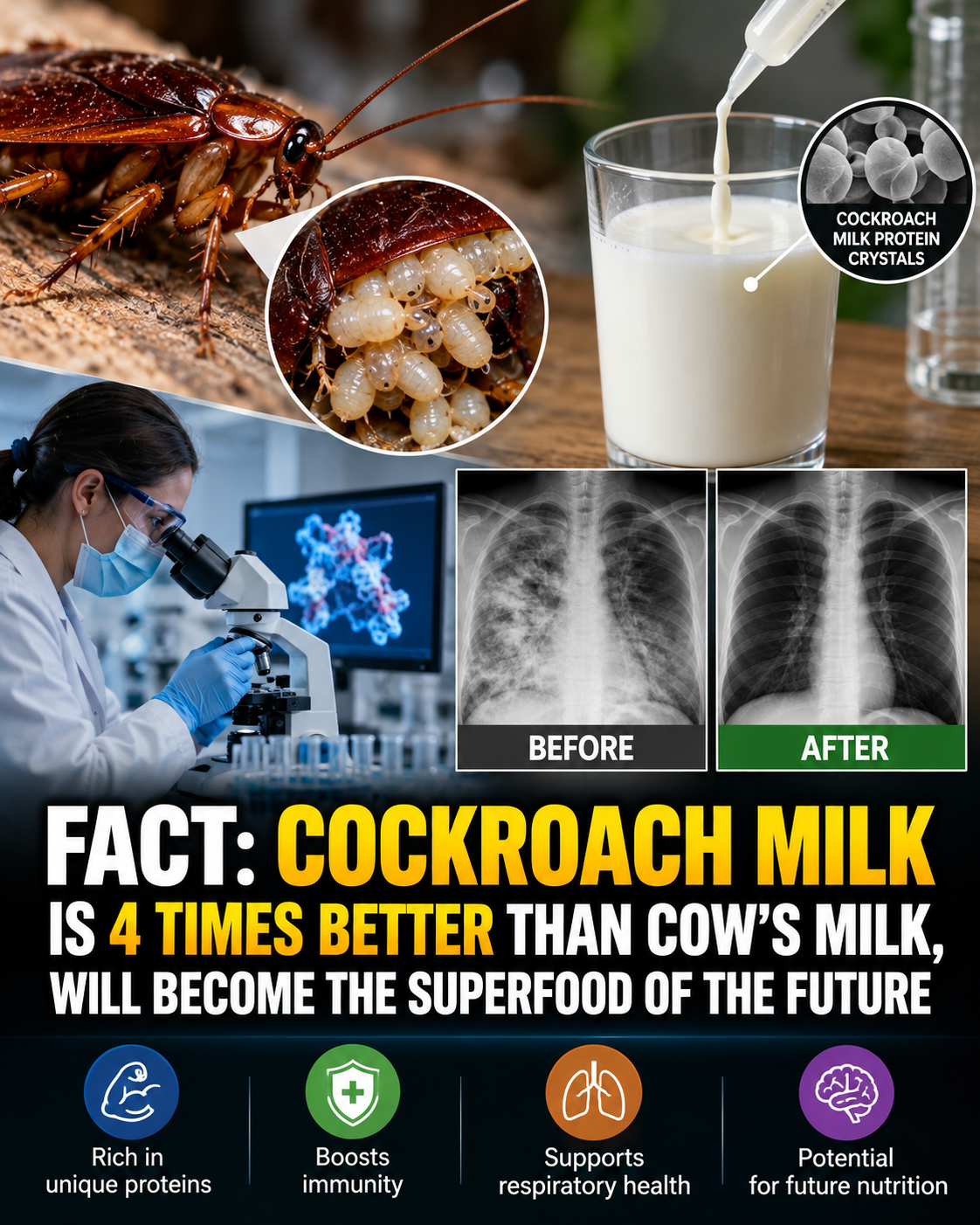
Cockroach Milk sounds like the kind of phrase designed to stop people mid-scroll, yet it refers to a real and unusual biological phenomenon. One particular species, the Pacific beetle cockroach, Diploptera punctata, gives birth to live young and produces a nutrient-rich secretion that feeds its developing embryos. Inside those embryos, components of the secretion can form protein crystals packed with amino acids, carbohydrates, and fats.
That discovery inspired headlines calling Cockroach Milk a possible “superfood of the future.” However, the reality is more complicated. Researchers have shown that the material is highly nutrient-dense, but nobody has established it as a safe, practical, or commercially available food for people. Production also presents obvious difficulties because harvesting useful quantities directly from insects would be inefficient.
I first heard about Cockroach Milk through one of those stories that sounded too strange to be real. My immediate reaction was disbelief, followed quickly by curiosity. Once I looked beyond the headline, the science became much more interesting than the shock value. Researchers were not talking about pouring ordinary cockroach secretions into a breakfast glass. They were studying a remarkable reproductive system in a live-bearing insect and the protein crystals that nourish its embryos. That distinction changed the whole story for me. Instead of imagining a bizarre dairy replacement, I started seeing it as an example of how unusual biological systems can inspire future food technology.
What Cockroach Milk Actually Is
The Pacific Beetle Cockroach Produces a Unique Nutrient Secretion
Cockroach Milk does not come from the common household cockroach most people picture.
Researchers study Diploptera punctata, commonly called the Pacific beetle cockroach. This species is unusual because it gives birth to live young rather than simply laying eggs and leaving embryos to develop independently.
During development, the mother supplies nutrients to embryos through a milk-like secretion.
Scientists have described this secretion as a mixture containing proteins, free amino acids, carbohydrates, and lipids in a water-based medium. Research has also identified a family of lipocalin-like milk proteins that play an important role in nourishing the embryos.
Once the embryos consume the secretion, some of its proteins become highly concentrated and form crystals inside the embryonic gut.
These crystals attracted scientific attention because they contain more than protein alone.
They also bind lipids and carry carbohydrates through attached sugar structures.
As a result, the crystals function as an unusually compact source of nutrition.
A 2016 structural study reported that the milk proteins form heterogeneous crystals containing glycosylated proteins and bound fatty acids. The researchers described the crystals as a complete nutrient source for the developing embryos.
Therefore, the term “milk” works as a biological comparison.
It describes a maternal secretion that nourishes developing offspring.
It does not mean the substance resembles cow’s milk in production, appearance, or everyday use.
That distinction helps remove some of the sensationalism surrounding Cockroach Milk.
The underlying biology remains strange, but it also becomes much easier to understand.
Why Scientists Became Interested in the Protein Crystals
The nutrient density of the crystals explains much of the excitement.
Researchers studying the structure of these proteins estimated that a single crystal contains more than three times the energy of an equivalent mass of dairy milk.
That comparison often turns into dramatic headlines.
However, it needs careful interpretation.
The researchers compared energy on an equivalent-mass basis.
They did not demonstrate that someone could drink a glass of Cockroach Milk and receive a standardized nutritional profile comparable with commercial dairy milk.
Older biochemical research also shows why scientists found the secretion interesting.
A 1977 analysis reported that dried milk secretion from Diploptera punctata contained approximately 45% protein, 25% carbohydrate, 16% to 22% lipid, and about 5% free amino acids.
Later structural work found that the milk proteins provide all essential amino acids while carrying fatty acids and carbohydrates.
That combination makes Cockroach Milk biologically efficient.
Developing embryos need a compact and steady supply of nutrients.
The crystalline form allows nutrients to remain available as the embryos grow.
More recent research continues to examine these milk proteins rather than treating the topic as a forgotten scientific curiosity.
A 2023 study investigated how several milk-protein forms bind fatty acids and found that the different protein versions could accommodate multiple fatty acids.
Therefore, scientific interest extends beyond unusual nutrition claims.
Researchers can use the system to study protein structure, nutrient storage, fatty-acid binding, reproduction, and insect biology.
Cockroach Milk may eventually inspire applications that look nothing like drinking an insect-derived beverage.
That possibility makes the science far more interesting than the headline alone.
Why People Call Cockroach Milk a Potential Superfood
Its Nutrient Density Is Genuinely Unusual
Cockroach Milk earns attention because its natural purpose requires extraordinary nutrient density.
A developing embryo has limited space, yet it needs protein, energy, fatty acids, carbohydrates, and essential amino acids.
The milk crystals solve that problem by packaging those nutrients efficiently.
The 2016 structural analysis described the milk proteins as a complete nutrient source for Diploptera punctata embryos. The proteins carry attached carbohydrates and bind fatty acids such as linoleic and oleic acids.
That sounds like an ideal nutritional package.
However, “superfood” is not a formal scientific category.
Food marketers often use the term to describe foods with high nutrient concentrations or appealing health associations.
Therefore, calling Cockroach Milk a superfood tells you more about its unusual nutrient profile than about proven benefits for humans.
Still, the nutritional composition deserves attention.
Protein quality matters because humans need essential amino acids from food.
The fact that these milk proteins contain essential amino acids makes them scientifically interesting as a possible future protein source.
Likewise, the combination of protein, carbohydrate, and lipid creates a dense source of energy.
Yet high energy density can be an advantage or a disadvantage depending on how a food is used.
A concentrated food might help in situations where compact nutrition matters.
However, someone seeking a low-calorie everyday beverage would not necessarily benefit from extreme energy density.
Therefore, Cockroach Milk does not automatically become nutritionally superior simply because it contains more energy per gram.
Nutrition depends on context.
Still, the unusual composition offers food scientists an intriguing model.
Researchers may eventually reproduce useful components without requiring anyone to consume material directly harvested from cockroaches.
The “Four Times Better Than Cow’s Milk” Claim Needs Context
Online articles sometimes claim that Cockroach Milk contains roughly four times the nutrition or energy of cow’s milk.
That statement simplifies a more specific scientific finding.
The 2016 structural paper estimated that a milk-protein crystal contained more than three times the energy of an equivalent mass of dairy milk.
That does not mean Cockroach Milk has proven itself three or four times “healthier.”
Energy density and health value are not the same thing.
For example, foods rich in fat often contain more calories per gram than foods rich in water.
That makes them energy-dense, but it does not automatically make them nutritionally superior for every person.
Likewise, the cockroach secretion exists naturally to support growing embryos of another species.
Human digestion, nutrient requirements, safety, allergy risk, and long-term health effects represent separate questions.
Researchers have not yet answered those questions adequately.
A 2024 review continued to describe Diploptera punctata milk as a potential future food source because of its nutritional properties, but the concept remains developmental rather than established as an everyday human food.
Therefore, Cockroach Milk deserves interest without exaggerated promises.
Its protein crystals are impressive biological structures.
They contain useful nutrients.
They may inspire food technology.
However, none of those statements proves that humans should start consuming them.
That distinction protects the fascinating science from becoming another misleading health trend.
The Major Problems With Turning Cockroach Milk Into Food
Harvesting Enough Directly From Cockroaches Is Impractical
Even if researchers proved Cockroach Milk safe and nutritionally useful for people, large-scale production would create an immediate problem.
You cannot manage cockroaches like dairy cattle.
The secretion exists inside a specialized reproductive process and nourishes embryos.
Obtaining significant quantities directly would be labor-intensive and inefficient.
Current consumer-oriented reviews of the research emphasize that direct production would be impractical and could require enormous numbers of insects.
That limitation explains why a supermarket carton of Cockroach Milk remains highly unlikely.
The more realistic future could involve biotechnology.
Instead of harvesting the material directly, scientists may eventually reproduce specific milk proteins using microbial fermentation, recombinant protein technology, or another controlled manufacturing method.
Researchers already work with recombinant versions of these milk proteins in laboratory studies.
For example, the 2023 fatty-acid binding research examined recombinantly expressed versions of several Lili-Mip proteins.
That approach offers an important clue.
If a useful protein can be manufactured without farming and processing huge numbers of cockroaches, the source organism becomes biological inspiration rather than the final production system.
Food technology already uses similar concepts in other areas.
Microorganisms can produce enzymes, proteins, flavors, and other compounds through fermentation.
Therefore, future research may focus less on “milking cockroaches” and more on recreating useful molecular structures in controlled systems.
That prospect sounds less dramatic.
However, it also sounds far more realistic.
Human Safety Has Not Been Established
The biggest question involves safety.
A nutrient-dense substance does not automatically qualify as safe human food.
Researchers need to evaluate digestibility, allergies, contamination risks, toxicity, processing stability, dosage, and long-term effects.
At present, Cockroach Milk does not have the kind of human safety evidence required to recommend it as a normal food.
Recent consumer health reviews still note that researchers have not established its safety for human consumption.
That uncertainty matters particularly for people with food allergies.
Insect proteins can potentially trigger allergic reactions, especially because some insect proteins share structural similarities with allergens from crustaceans and other arthropods.
Therefore, a future insect-derived protein product would require careful allergen assessment and clear labeling.
Regulators would also need to evaluate how manufacturers produce and purify the ingredient.
A laboratory-produced protein could differ substantially from crude material extracted directly from insects.
Those differences would affect safety testing.
Consequently, the phrase “natural” offers no shortcut.
Many natural substances require extensive evaluation before entering the food supply.
Cockroach Milk should face the same standard.
Until researchers establish safety and regulators approve specific products, curiosity should not turn into DIY consumption.
The scientific discovery deserves study.
It does not justify trying to obtain or eat cockroach secretions at home.
Could Cockroach Milk Actually Become a Future Food?
Biotechnology May Matter More Than the Cockroach Itself
The future of Cockroach Milk probably depends on whether researchers can separate the useful biology from the impractical production method.
The protein system itself offers several attractive qualities.
It contains essential amino acids.
It binds useful fatty acids.
It carries carbohydrates.
It forms stable nutrient-rich crystals.
Researchers also continue to characterize how these proteins behave at the molecular level.
If scientists can manufacture similar proteins efficiently, they could potentially explore their use in specialized foods or nutrition products.
However, several steps would still remain.
The proteins would need to be produced consistently.
Researchers would need to confirm digestibility.
Manufacturers would need to establish food-grade purification methods.
Safety studies would need to examine allergic reactions and other risks.
Regulatory agencies would then need to evaluate any proposed food ingredient according to local requirements.
Finally, consumers would need to want the product.
That last step may prove surprisingly difficult.
The word “cockroach” carries an immediate negative association for many people.
Therefore, manufacturers might focus on describing a future ingredient by its protein source or production method rather than presenting it as literal Cockroach Milk.
If biotechnology produces the protein in yeast or another microorganism, the final food would also differ fundamentally from something extracted directly from insects.
In that scenario, the Pacific beetle cockroach would provide the molecular blueprint.
A fermentation system would provide the ingredient.
That future remains hypothetical, but it represents a much more plausible path than bottles filled by harvesting insects.
The Bigger Story Is About Future Food Technology
Cockroach Milk may never become a breakfast beverage.
That possibility does not make the research pointless.
Biology often provides ideas that scientists adapt into completely different technologies.
Spider silk inspired strong engineered fibers.
Microbial enzymes help manufacture foods and medicines.
Fermentation now produces proteins that previously required animals.
Likewise, the nutrient-storage strategy of Diploptera punctata could inspire new approaches to compact nutrition.
The milk crystals combine protein, carbohydrate, and fatty acids within a highly organized structure.
That unusual design could help researchers understand how proteins store and release nutrients efficiently.
The 2016 study highlighted the crystal as an uncommon example of a naturally grown protein crystal functioning inside a living organism.
Meanwhile, newer research continues examining how the milk proteins bind different fatty acids.
Therefore, the scientific value extends beyond the question of whether people will ever eat the material.
Researchers can learn from the system even if Cockroach Milk never reaches grocery shelves.
That perspective also creates a more realistic conclusion.
The substance has an extraordinary nutritional profile for its natural purpose.
It may inspire future food or biotechnology applications.
Yet major questions about manufacturing, safety, regulation, cost, and consumer acceptance remain unresolved.
So, could it become a food of the future?
Possibly in a transformed, laboratory-produced form.
However, a carton of literal Cockroach Milk next to regular dairy milk still looks much more like a headline than an approaching reality.
Frequently Asked Questions
What is Cockroach Milk?
Cockroach Milk is the informal name for a nutrient-rich secretion produced by the Pacific beetle cockroach, Diploptera punctata, to nourish developing embryos. Components of that secretion form nutrient-rich protein crystals inside the embryonic gut.
Is Cockroach Milk really more nutritious than cow’s milk?
Research suggests the protein crystals are extremely energy-dense. A 2016 study estimated that a crystal contains more than three times the energy of an equivalent mass of dairy milk. However, that does not prove Cockroach Milk is three times healthier or better for humans.
Does Cockroach Milk contain all essential amino acids?
Research on the milk proteins indicates that they provide all essential amino acids while also carrying carbohydrates and lipids for developing embryos.
Can people currently buy Cockroach Milk?
No mainstream commercial supply exists, and direct production remains impractical. Researchers would likely need biotechnology-based production methods before an ingredient inspired by these proteins could become commercially realistic.
Is Cockroach Milk safe to drink?
Human safety has not been established well enough to recommend direct consumption. Researchers would need to evaluate allergies, digestibility, toxicity, manufacturing quality, and other safety questions before any specific product could be considered a routine human food.
Conclusion
Cockroach Milk: Could It Become the Superfood of the Future? has a fascinating answer, but not the one sensational headlines often suggest.
The science behind Cockroach Milk is real.
The Pacific beetle cockroach produces a nutrient-rich secretion to support its live developing offspring.
Inside the embryos, milk proteins can form crystals that contain essential amino acids, carbohydrates, and bound fatty acids.
Older biochemical work also found substantial amounts of protein, carbohydrate, and fat in the secretion.
Therefore, researchers have good reason to study this unusual system.
However, high nutrient density does not automatically make something a proven human superfood.
Researchers have not established Cockroach Milk as safe for routine human consumption.
Likewise, producing large quantities directly from insects would be inefficient and impractical.
The most promising future may involve reproducing specific milk proteins with biotechnology rather than harvesting them directly.
Scientists have already created recombinant forms of these proteins for laboratory research, which demonstrates that the concept is technically worth exploring.
Even then, any future food ingredient would still need safety testing, scalable manufacturing, regulatory review, and consumer acceptance.
So, will people someday pour literal Cockroach Milk over cereal?
Probably not anytime soon.
Could scientists learn from cockroach milk proteins and use that knowledge to develop new foods or nutrient systems?
That possibility deserves serious attention.
The real value of Cockroach Milk may ultimately come not from drinking something extracted from an insect, but from understanding how nature created such an efficient nutrient-storage system in the first place.
More Health
- Foamy Urine: Here’s Why You Have Bubbles in Your Urine and When to Pay Attention
- More Than a Moment: Understanding the Layers of Intimacy and What Creates Lasting Connection
- Sleeping With the Wrong Person: The Emotional, Social, and Personal Consequences People Often Overlook
- Found a Weird Bug in Your Child’s Hair? What Parents Should Know