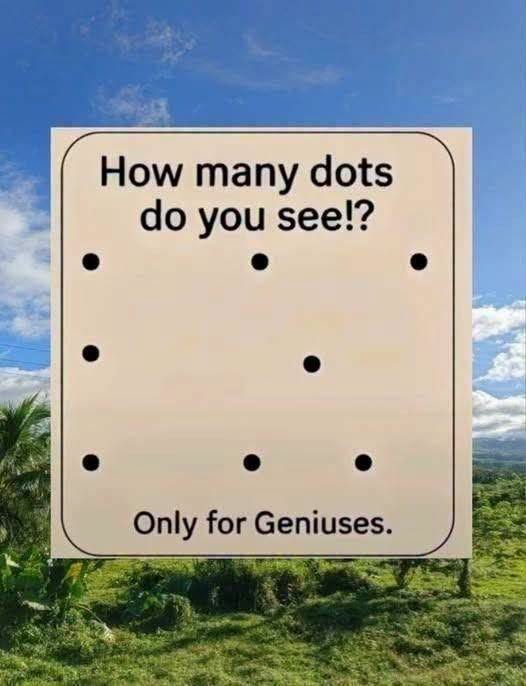
At first glance, How Many Dots Can You See? looks almost too easy to count as a puzzle. A group of large black dots appears inside a box, and the challenge asks you to determine how many you can spot.
Most people glance at the image, count quickly, and answer within a few seconds.
However, the wording makes many people second-guess themselves.
Are you supposed to count only the large circles? Should punctuation count too? What about dots above letters? Could there be hidden marks somewhere in the image?
That uncertainty turns a basic visual counting exercise into a surprisingly entertaining attention challenge.
For the main puzzle itself, the arrangement contains three dots near the top, two in the middle, and three near the bottom.
That gives:
3 + 2 + 3 = 8
So the straightforward answer is 8 dots.
Still, the real appeal of the puzzle comes from understanding why such a simple question can make people hesitate.
Why How Many Dots Can You See? Feels Trickier Than It Looks
The Obvious Answer Comes Quickly
The easiest way to solve How Many Dots Can You See? involves focusing only on the large black circles inside the main puzzle area.
Start at the top.
You can see three dots.
Then move to the middle.
You can see two more.
Finally, move to the bottom.
You can see another three.
Therefore:
3 + 2 + 3 = 8
That makes eight the most natural answer.
The arrangement looks slightly scattered rather than perfectly aligned in a traditional grid. Consequently, some people may lose track if they move their eyes around randomly.
However, a simple top-to-bottom scan removes most of the confusion.
The phrase often placed beneath puzzles like this, such as “Only for Geniuses,” can also make people suspicious.
Instead of trusting what they see, they start searching for a hidden trick.
That reaction makes sense.
Many online puzzles intentionally hide extra objects, use misleading wording, or rely on tiny visual details.
Therefore, people often assume that an obvious answer cannot possibly be the final one.
In this case, however, the eight main circles provide the intended straightforward solution.
The challenge is less about advanced mathematics and more about whether you can look carefully without overcomplicating the task.
Why People Start Searching for Hidden Dots
Once someone counts eight circles, a second thought often appears:
“Is that really all?”
At that point, people may start examining punctuation, lettering, borders, or tiny circular shapes.
For example, a question mark contains a small dot-like portion at the bottom.
Likewise, lowercase letters such as “i” contain dots.
Therefore, if someone interprets How Many Dots Can You See? as literally asking for every dot-shaped mark anywhere in the entire image, the total could change.
That creates the puzzle’s main ambiguity.
There is a difference between asking how many large dots appear in the puzzle and asking how many dot-like marks exist across the entire graphic.
The visual design usually emphasizes the large black circles. Consequently, those circles represent the intended objects to count.
Still, people who notice punctuation or dotted letters are not necessarily observing incorrectly.
They may simply be answering a broader version of the question.
That difference shows how much wording and context can influence even a very simple puzzle.
The Best Way to Count the Dots Correctly
Use a Consistent Scanning Pattern
One of the easiest ways to make a counting mistake involves moving your eyes randomly around an image.
You might count one dot twice.
Alternatively, you might accidentally skip a dot.
A consistent scanning pattern solves that problem.
For How Many Dots Can You See?, begin at the upper-left side of the image.
Move across the top section from left to right.
Count:
1, 2, 3
Then move down to the middle section.
Count:
4, 5
Finally, move to the bottom section.
Count:
6, 7, 8
That process gives the correct main answer without requiring guesswork.
You can also scan from top to bottom instead of left to right.
The exact direction matters less than using a consistent method.
This strategy works especially well for larger visual puzzles because it reduces the chance of skipping or repeating items.
It also demonstrates an important principle: organization often matters more than speed.
Many people make simple mistakes because they rush.
However, slowing down for only a few seconds can make the answer obvious.
Why Symmetry Can Mislead Your Eyes
The arrangement in How Many Dots Can You See? looks somewhat balanced.
That visual balance can cause your brain to predict where objects should appear rather than carefully checking what actually appears.
For example, if the top section contains three dots, you may automatically expect the middle section to contain the same number.
Instead, it contains only two.
Likewise, you may glance at the pattern and mentally complete a shape that does not truly exist.
Our brains constantly look for symmetry and familiar patterns.
That ability helps us process complex scenes quickly.
However, it can also produce small counting errors.
The best solution involves separating observation from expectation.
Instead of assuming what should appear, identify each object individually.
Then count it once.
This method prevents your brain from filling in missing pieces.
It also explains why some people can look at an extremely simple visual puzzle and still arrive at different totals.
They may not actually be seeing different images.
Instead, their brains may be organizing the same information differently.
Why Simple Visual Puzzles Fool the Brain
Attention Filters Out Unimportant Details
Human vision does not process every part of an image with equal attention.
Instead, the brain quickly decides which details seem most important.
In How Many Dots Can You See?, the large black circles immediately stand out because they share several visual characteristics.
They have strong contrast.
They use similar shapes.
They appear within the central puzzle area.
They also occupy more visual space than punctuation or small lettering.
Therefore, your brain naturally identifies the large circles as the objects you should count.
Meanwhile, smaller details fade into the background.
That selective process helps us navigate everyday life.
If you had to consciously analyze every tiny detail in every scene, even simple tasks would become exhausting.
However, visual puzzles take advantage of that efficiency.
They encourage you to focus on the obvious objects while wondering whether less noticeable details should also count.
That tension creates much of the entertainment.
The puzzle does not need complicated mathematics.
Instead, it relies on perception and interpretation.
Overthinking Can Create New Mistakes
Many people assume that a puzzle labeled as difficult must have a complicated solution.
Consequently, they distrust an easy answer.
If they count eight dots immediately, they may start looking for a ninth.
Then they notice punctuation.
After that, they examine every letter.
Soon, a simple counting exercise becomes a debate about what technically qualifies as a dot.
This reaction highlights an interesting problem.
Underthinking can produce mistakes, but overthinking can also make a straightforward problem harder than necessary.
The best approach involves checking the obvious answer carefully before searching for hidden possibilities.
For How Many Dots Can You See?, count the large circles systematically first.
If you get eight, you have solved the main visual challenge.
Only after that should you consider whether the wording invites a more literal interpretation.
This order prevents unnecessary confusion.
It also shows why confidence and careful observation can work together.
You do not need to distrust every simple answer.
Sometimes the simplest answer really is correct.
What This Puzzle Reveals About Attention and Perception
Simple Challenges Can Test Useful Skills
Although How Many Dots Can You See? does not function as a scientific intelligence test, it can still exercise several useful mental skills.
First, it encourages visual scanning.
Second, it rewards concentration.
Third, it highlights pattern recognition.
Finally, it demonstrates how wording can affect interpretation.
These same skills appear in everyday activities.
For example, careful scanning helps when reviewing a document for errors.
Likewise, attention to detail matters when reading instructions, checking numbers, following a recipe, proofreading a message, or comparing two pieces of information.
The puzzle also reminds us that speed does not always improve accuracy.
Someone may answer instantly and get the correct number.
However, another person may move too quickly and overlook a dot.
A third person may spend too long searching for hidden tricks.
Therefore, the best strategy usually falls somewhere between rushing and overanalyzing.
Look carefully.
Use a system.
Then trust the evidence in front of you.
Why “Only for Geniuses” Gets Attention
Phrases such as “Only for Geniuses” appear frequently in viral puzzles because they create a challenge.
The wording suggests that solving the puzzle says something about your intelligence.
Naturally, many people want to test themselves.
As a result, they stop scrolling and participate.
The phrase also creates social comparison.
If someone answers eight, another person may insist that the correct answer is ten.
Then someone else may claim that punctuation raises the total even further.
Soon, a basic image generates a long discussion.
That interaction helps explain why simple visual puzzles spread so widely.
They require almost no instructions.
Anyone can participate immediately.
People can also compare answers without needing specialized knowledge.
Most importantly, disagreement keeps the conversation going.
Is How Many Dots Can You See? Really an IQ Test?
The Puzzle Does Not Measure Intelligence Scientifically
Despite labels such as “genius test” or “IQ challenge,” How Many Dots Can You See? does not provide a scientifically validated measure of intelligence.
Counting a small collection of dots primarily tests observation and attention in that moment.
A person who gives the wrong answer may simply have looked too quickly.
Likewise, someone who counts punctuation may have interpreted the wording differently.
Neither outcome tells you much about overall intelligence.
Formal cognitive testing uses carefully designed tasks, standardized procedures, and established scoring methods.
A viral social-media puzzle does not meet those standards.
Therefore, the “genius” label should be treated as entertainment rather than a genuine assessment.
That does not make the puzzle pointless.
It can still provide a quick mental exercise and a fun conversation starter.
It simply should not be used to judge anyone’s intelligence.
Different Answers Can Come From Different Interpretations
Suppose one person answers eight.
Another person answers a larger number because they include punctuation.
Who is right?
That depends on the question being answered.
If the challenge asks for the prominent black circles inside the main puzzle area, eight provides the correct answer.
If someone intentionally counts every dot-shaped mark across the entire graphic, they may produce another total.
The important point involves defining the counting rules.
Many disagreements about visual puzzles happen because different people apply different rules without realizing it.
One person counts objects.
Another counts punctuation.
A third counts letters.
Therefore, comparing answers becomes confusing.
For How Many Dots Can You See?, the clearest interpretation focuses on the large black circles.
That interpretation leads to eight.
Frequently Asked Questions
What is the answer to How Many Dots Can You See?
The main puzzle contains 8 prominent black dots. The arrangement shows three at the top, two in the middle, and three at the bottom.
Why do some people count more than eight?
Some people include punctuation marks, dots above letters, or other dot-like elements elsewhere in the image. However, those details go beyond the main set of large circles.
Is there a hidden ninth dot?
The supplied puzzle description identifies eight main dots. No additional large hidden dot forms part of the straightforward count.
Why is this puzzle called a genius test?
The phrase mainly creates curiosity and encourages participation. The puzzle does not provide a scientific measure of intelligence.
What is the easiest way to avoid counting a dot twice?
Use a systematic pattern. Scan from left to right, row by row, or move from top to bottom without jumping around the image.
Conclusion
How Many Dots Can You See? demonstrates how a remarkably simple question can become surprisingly engaging.
The main puzzle contains three large dots in the upper section, two in the middle, and three in the lower section.
Therefore:
3 + 2 + 3 = 8
The intended main answer is 8 dots.
However, the puzzle becomes more interesting when people start questioning exactly what the word “dots” includes.
Some may notice punctuation.
Others may count dots above letters.
Still others may assume that a challenge labeled “Only for Geniuses” must contain a hidden trick.
That uncertainty explains why visual puzzles like this attract so much discussion.
They test more than counting.
They reveal how attention, expectation, wording, and interpretation influence what we notice.
The most reliable approach remains simple: scan the main image systematically, count each obvious circle once, and avoid assuming that a straightforward answer must be wrong.
Sometimes careful observation leads to a complicated solution.
In this case, however, careful observation leads right back to the simplest one:
8 dots.
Focus Keyword: How Many Dots Can You See?
SEO Title: How Many Dots Can You See? The Puzzle Answer Explained
Meta Description: How Many Dots Can You See? Count carefully and discover why the simple answer is 8 and why this visual puzzle makes people second-guess it.
Expert SEO Title: How Many Dots Can You See? 8 Surprising Clues Explained
More Blog
- Drinking Water on an Empty Stomach — What Science Actually Supports (No Hype, Just Facts)
- Waking Up Between 3 and 5 AM? It Might Be Your Soul Trying to Talk to You
- What a “Bleach” Patch on Your Underwear Really Means — And Why It’s Actually a Good Sign
- This Drink May Weaken Your Bones From The Inside — But Everyone Drinks It Anyway