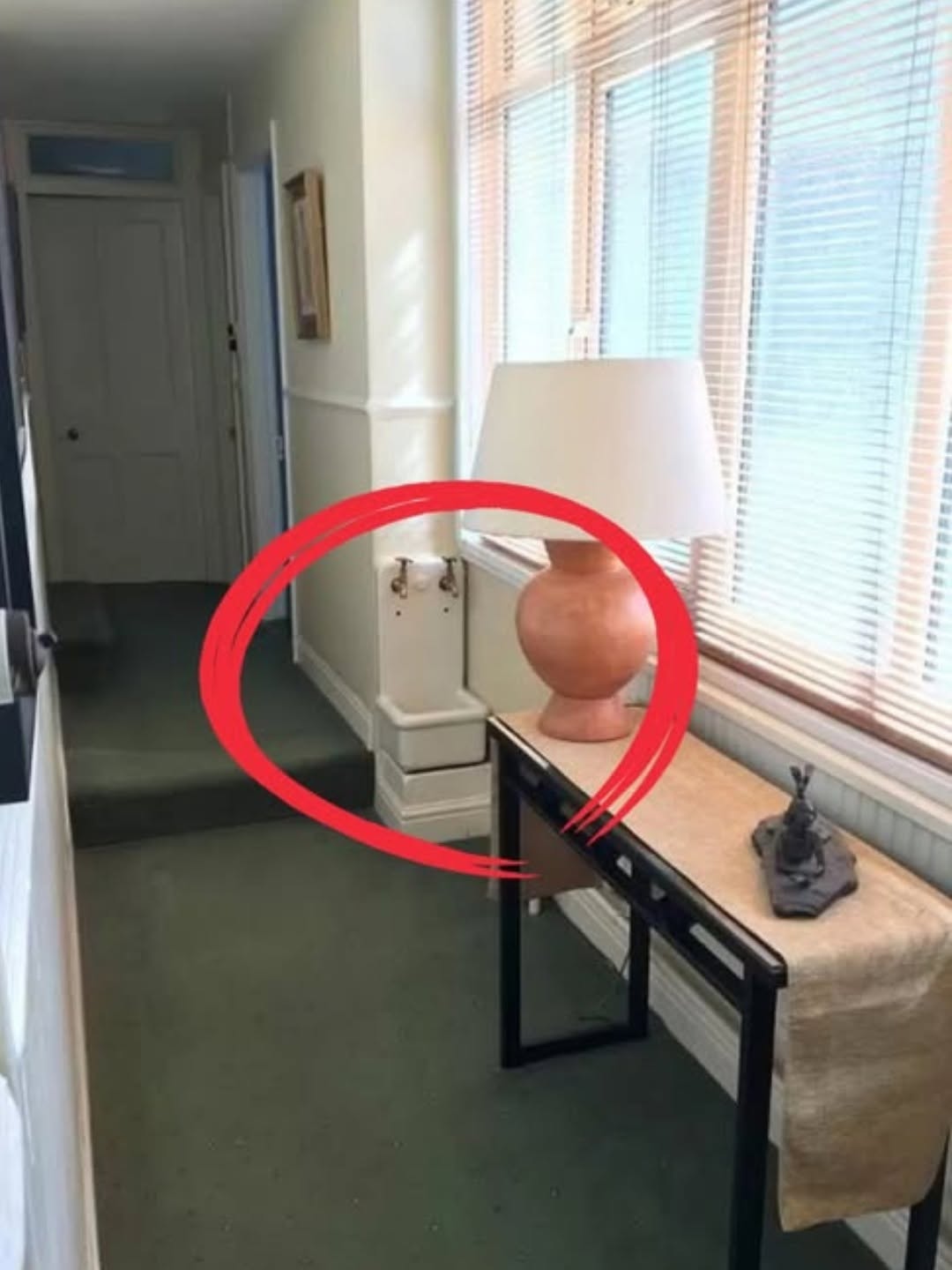
Walk through enough historic houses and eventually you’ll encounter something that seems completely out of place: a small sink mounted in a hallway, bedroom, landing, or other space nowhere near the bathroom.
To modern eyes, it can look like a renovation mistake. Why would anyone install plumbing there?
In many cases, however, these unusual sinks are remnants of an earlier period when indoor plumbing developed gradually—and the way people washed, dressed, and used their homes was very different from today.
🕰️ Indoor Plumbing Didn’t Arrive All at Once
During the 19th and early 20th centuries, indoor plumbing spread unevenly. Older houses were often constructed before complete modern bathrooms became standard.
When running water eventually became available, homeowners didn’t necessarily rebuild the entire house.
Instead, plumbing was sometimes added wherever it was practical and economical.
That could produce arrangements that seem strange today: sinks in bedrooms, basins near staircases, toilets in converted closets, and plumbing fixtures squeezed into previously unused corners.
🛏️ Some Were Actually Bedroom Washbasins
One important distinction is that a mysterious sink wasn’t necessarily originally located in a hallway.
In wealthier homes, hotels, boarding houses, and similar buildings, individual bedrooms sometimes had their own washbasins.
Before private en-suite bathrooms became commonplace, having running water directly in a bedroom was a significant convenience.
A person could wash their face and hands, shave, brush their teeth, or prepare for bed without carrying a pitcher and basin—or walking to a shared bathroom.
After a building was remodeled and interior walls were moved, an old bedroom sink could suddenly find itself incorporated into what became a hallway.
🧼 Hygiene Was Another Practical Reason
Strategically placed sinks could also provide convenient handwashing facilities.
Depending on the building, a basin might have served residents, household staff, guests, workers, or patients.
That’s why the history of a particular building matters. A sink in a private Victorian residence may have had a different purpose from one in an old school, hospital, hotel, boarding house, or institutional building.
🏠 Why Not Just Install Another Bathroom?
Because a sink is much simpler.
Creating a full bathroom requires space for multiple fixtures, drainage, ventilation, waterproofing, and considerably more construction.
Installing a small basin near existing water and waste lines could provide much of the everyday convenience of running water without requiring another complete bathroom.
For an older home being gradually modernized, that could be an attractive compromise.
🔧 Plumbing Location Often Provides the Biggest Clue
Sometimes the explanation is less romantic and much more practical: the pipes were already nearby.
If a hallway shared a wall with a kitchen, bathroom, utility area, or existing plumbing stack, installing a small sink there could be relatively straightforward.
Old houses frequently evolved through decades of additions and renovations. What looks nonsensical today may have been the cheapest and most logical solution 80 or 100 years ago.
🪞 What About Those Tiny Wall-Mounted Sinks?
Very small antique sinks were designed primarily for basic washing rather than bathing or household cleaning.
Their compact dimensions allowed them to fit into bedrooms and narrow spaces without consuming much floor area.
Some surviving examples have beautiful porcelain basins, decorative brackets, separate hot and cold taps, or exposed plumbing—features that can now make them desirable historic details.
🏨 You May Find Them Outside Houses, Too
Unusual sinks are particularly understandable in buildings that once accommodated many people.
Old hotels and boarding houses could offer guests a private basin even when toilets and baths were shared. Schools, medical facilities, dormitories, servants’ quarters, and converted institutional buildings could have sinks distributed according to their particular needs.
Later renovations can obscure those original room arrangements completely.
A hallway today might once have been part of a bedroom or another functional space.
🔎 How to Determine What Your Sink Was Originally Used For
The sink itself provides clues, but the building’s history is even more valuable.
Consider its approximate age, whether surrounding walls appear original, what’s located on the opposite side of the wall, and whether the property was always a private residence.
Old floor plans, renovation records, photographs, plumbing evidence, and property records can sometimes reveal that an apparently bizarre fixture once occupied a perfectly logical location.
⚠️ Think Before Removing One
If you own an older property, don’t automatically rip out an unusual sink simply because it seems pointless.
Original plumbing fixtures can contribute to a historic home’s character, and some antique porcelain sinks and fittings are increasingly difficult to replace.
If the fixture is no longer needed, a plumber can determine whether it’s functional, safely disconnected, or connected to plumbing that still serves other parts of the house.
🏡 The Bottom Line
There isn’t one universal explanation for every mysterious hallway sink.
Some were convenient handwashing stations. Others began as bedroom washbasins before walls and rooms were rearranged. Some were installed during early plumbing upgrades because that location was simply closest to existing pipes.
What looks like a strange design decision today can therefore be a small piece of architectural history.
So if you discover an old porcelain sink sitting unexpectedly in a hallway, don’t assume someone made a plumbing mistake—it may be revealing how people actually lived in that building generations ago.
More Blog
- Drinking Water on an Empty Stomach — What Science Actually Supports (No Hype, Just Facts)
- Waking Up Between 3 and 5 AM? It Might Be Your Soul Trying to Talk to You
- What a “Bleach” Patch on Your Underwear Really Means — And Why It’s Actually a Good Sign
- This Drink May Weaken Your Bones From The Inside — But Everyone Drinks It Anyway