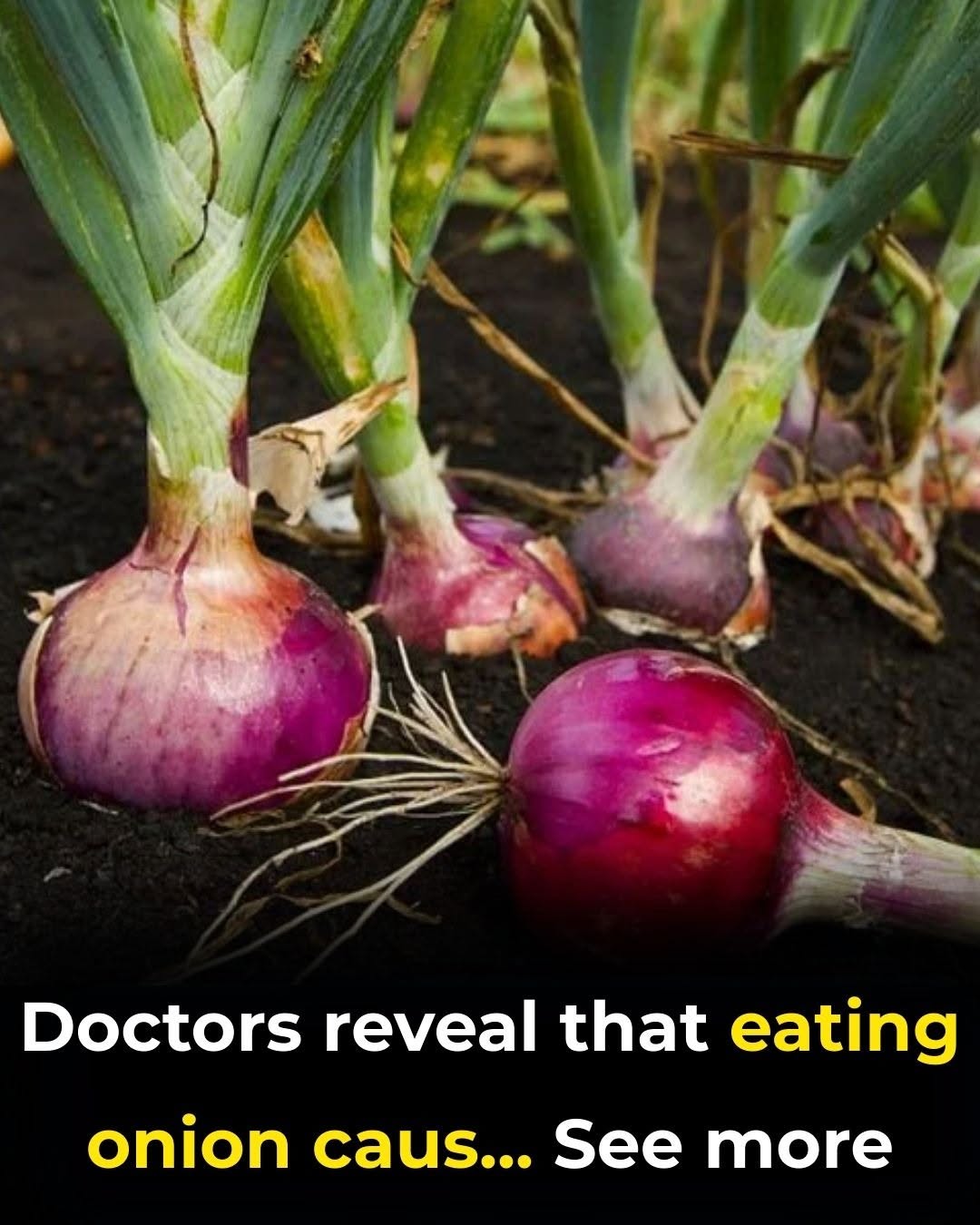
Doctors Reveal That Eating Onion Causes many different reactions depending on the person, the amount eaten, and whether the onion is raw or cooked. For most people, onions fit comfortably into a healthy diet. They provide fiber, vitamin C, sulfur-containing compounds, and plant chemicals such as quercetin. However, onions can also trigger bloating, gas, heartburn, or allergic reactions in susceptible people.
The important point is balance. Eating onions does not automatically lower cholesterol, prevent cancer, thin your blood, or cure inflammation. Likewise, onions are not harmful simply because they sometimes cause digestive symptoms.
Much of the confusion comes from taking promising laboratory findings or studies of concentrated quercetin supplements and applying them directly to ordinary servings of onions. Research does suggest that some compounds found in onions may support cardiovascular and metabolic health, but the evidence remains much more nuanced than many viral headlines suggest. For example, reviews of quercetin supplements have found small reductions in blood pressure, yet those studies tested concentrated supplemental doses rather than normal portions of onion.
For most healthy adults, onions remain a flavorful, nutrient-rich vegetable. Still, people with irritable bowel syndrome, frequent heartburn, or a true onion allergy may need a more individualized approach.
I remember a family dinner where one person confidently announced that onions were a “natural medicine” and another immediately replied that onions always made their stomach hurt. Both experiences sounded completely different, yet both made sense. One person tolerated onions easily and enjoyed them in almost every meal, while the other dealt with bloating after only a small amount of raw onion. That conversation made one point very clear: a food can offer useful nutrients without agreeing with everyone. Since then, I have looked at onions less as a miracle food or a problem food and more as an ordinary ingredient whose effects depend greatly on the individual.
Doctors Reveal That Eating Onion Causes Several Potential Benefits
Onions Provide Useful Plant Compounds and Nutrients
Onions belong to the Allium family, which also includes garlic, leeks, scallions, and chives. Their sharp smell and flavor come partly from sulfur-containing compounds that form when you cut or crush the vegetable.
Onions also contain flavonoids, particularly quercetin.
Quercetin has attracted substantial research interest because it acts as a plant antioxidant and interacts with several biological pathways. However, it is important to distinguish studies of whole onions from studies that give participants concentrated quercetin supplements.
Several meta-analyses of randomized trials have found that quercetin supplementation can produce modest reductions in blood pressure. One 2022 analysis covering 10 trials and 841 participants reported small reductions in systolic blood pressure, while a broader 2023 umbrella review concluded that quercetin may reduce systolic blood pressure but found little convincing evidence for improvements in many other cardiometabolic measures. The certainty of evidence ranged from very low to moderate.
Those findings sound promising, but they do not prove that adding a few slices of onion to dinner will produce the same effect.
Supplement studies may use hundreds of milligrams of isolated quercetin per day. A normal serving of onion delivers a much smaller and more variable amount.
Therefore, onions make sense as part of an overall balanced eating pattern rather than as a treatment for hypertension.
Onions also contribute dietary fiber, which supports normal digestion and feeds intestinal bacteria. Furthermore, they contain vitamin C and small amounts of several other micronutrients.
Because they add considerable flavor without requiring large quantities of salt or sugar, onions can also help make vegetable-rich meals more enjoyable.
What Research Says About Heart and Metabolic Health
Doctors Reveal That Eating Onion Causes cardiovascular benefits in some popular headlines, but the actual science requires more careful wording.
Researchers have studied onions, onion extracts, and quercetin for possible effects on blood pressure, blood lipids, inflammation, and glucose control.
Results have varied.
For quercetin specifically, a 2020 meta-analysis of 17 randomized trials found modest reductions in blood pressure but no significant overall changes in blood glucose or lipid profiles.
A later umbrella review reached a similar conclusion. Researchers found evidence for a small reduction in systolic blood pressure and insulin levels, but they found no consistent improvement in diastolic blood pressure, cholesterol profiles, fasting glucose, or several other metabolic outcomes.
Therefore, statements that onions “lower cholesterol and blood sugar” overstate the evidence.
That does not make onions nutritionally unimportant.
Instead, it means they should remain in the category of healthy vegetables rather than medical treatments.
The strongest dietary approach to heart health involves the overall eating pattern. Vegetables, fruits, legumes, whole grains, nuts, seeds, appropriate protein sources, and unsaturated fats matter together.
An onion added to a vegetable soup, bean dish, salad, or stir-fry can contribute to that pattern.
However, it cannot compensate for smoking, uncontrolled hypertension, diabetes, physical inactivity, or a consistently poor diet.
Similarly, people who take blood pressure or diabetes medication should not reduce medication because they have started eating more onions.
Food and medical treatment serve different roles.
Doctors Reveal That Eating Onion Causes Digestive Problems in Some People
Why Onions Can Trigger Bloating, Gas, and Cramps
One of the most common complaints about onions involves digestion.
Onions contain carbohydrates called fructans. Fructans belong to a larger group known as FODMAPs, or fermentable short-chain carbohydrates.
Monash University, a major research center in this area, classifies onion as a food rich in fructans. People with irritable bowel syndrome can react poorly to these carbohydrates because they draw water into the intestine and undergo fermentation by gut bacteria.
As a result, sensitive people may experience:
bloating, excess gas, abdominal pressure, cramping, diarrhea, or changes in bowel habits.
However, fructans do not harm everyone.
Many people eat onions regularly without digestive discomfort. In fact, fructans can act as prebiotic fibers because intestinal bacteria ferment them.
Therefore, avoiding onions simply because they contain FODMAPs makes little sense unless they actually trigger symptoms.
People with IBS often benefit from identifying their individual tolerance rather than avoiding a long list of foods permanently.
A structured low-FODMAP diet usually involves temporary restriction followed by careful reintroduction. It should not become an unnecessarily restrictive lifelong eating pattern.
Another common misunderstanding involves cooking.
Some articles claim that cooking onions simply “removes the fructans.” The situation is more complicated.
Fructans dissolve in water, so certain preparation methods may alter how much remains in a food, but ordinary sautéing does not automatically make onions low in FODMAPs.
For people who react strongly to onion, infused oils can sometimes provide onion-like flavor because FODMAP carbohydrates do not dissolve well in oil. Monash specifically discusses infused oils as one strategy for people following a low-FODMAP diet.
Raw Onion Can Aggravate Heartburn in Sensitive People
Doctors Reveal That Eating Onion Causes heartburn in some people, particularly when the onion is raw.
A small clinical study published in the American Journal of Gastroenterology examined raw onion in people with and without heartburn.
The study included 16 people with heartburn and 16 control participants. Adding raw onion to a meal significantly increased reflux measurements and symptoms among the heartburn group, while researchers did not observe the same effect in the control group.
Although the study remains relatively small and old, it supports what many people with reflux report from personal experience.
Raw onion can act as a trigger.
However, this does not mean onions cause gastroesophageal reflux disease in everyone.
GERD has many contributing factors, including body weight, meal size, certain medications, alcohol, tobacco, anatomical factors, and individual food triggers.
Therefore, eliminating onions from everyone’s diet would not make sense.
Instead, people who consistently notice heartburn after onion-heavy meals can experiment with portion size and preparation.
Raw onion often produces stronger symptoms than a small amount of thoroughly cooked onion for some individuals.
Also, a large burger loaded with onions may provoke reflux because of the entire meal rather than because of the onions alone.
Fat content, portion size, sauces, alcohol, and lying down soon afterward can all influence symptoms.
Keeping a simple food-and-symptom record can help identify personal triggers more reliably than following generic lists online.
Doctors Reveal That Eating Onion Causes Rare but Important Reactions
Onion Allergy Exists, Although It Is Uncommon
A true onion allergy differs from ordinary digestive intolerance.
An intolerance usually causes gastrointestinal symptoms without involving the immune system in the same way as an allergy.
An allergy can trigger hives, itching, swelling, respiratory symptoms, vomiting, and in rare cases, anaphylaxis.
Scientific reports confirm that onion allergy exists, although researchers describe reactions to eating onions as uncommon.
One study that evaluated thousands of allergy-clinic patients identified onion or garlic hypersensitivity in a relatively small subset of people with food-related symptoms.
Published case reports have also documented severe reactions after eating raw or cooked onion.
Therefore, someone who develops only gas after onions probably has a digestive sensitivity rather than an allergy.
However, symptoms such as widespread hives, swelling of the lips or tongue, wheezing, difficulty breathing, dizziness, or loss of consciousness require a different level of concern.
Anaphylaxis can become life-threatening.
People with known or suspected food allergy should seek evaluation from an appropriately qualified healthcare professional rather than diagnosing themselves from symptoms alone.
An allergy specialist may use the clinical history along with skin testing, specific IgE testing, or supervised food challenge when appropriate.
People with a confirmed allergy may also react differently to raw and cooked onion because heating can alter certain allergenic proteins.
However, cooking does not guarantee safety for every person with onion allergy. One published case documented anaphylaxis after cooked onion exposure.
Claims About “Blood Thinning” Need Caution
You may also encounter warnings that onions naturally thin the blood.
These claims usually arise from laboratory research on onion compounds, sulfur compounds, or flavonoids that may influence platelet activity.
However, ordinary dietary onion consumption has not been established as a substitute for anticoagulant or antiplatelet medication.
Likewise, evidence does not justify telling everyone who takes a prescribed blood thinner to avoid normal amounts of onion.
People who take warfarin, direct oral anticoagulants, aspirin, clopidogrel, or similar medications should follow the advice given for their specific drug and health condition.
The bigger concern comes from concentrated supplements.
An onion extract or high-dose quercetin supplement exposes the body to a very different amount than onions used normally in cooking.
Therefore, people taking medications should discuss concentrated supplements with a healthcare professional or pharmacist, particularly when they also use drugs affecting blood pressure, blood sugar, or clotting.
The same principle applies to almost every so-called superfood.
Normal food servings and concentrated extracts should not be treated as interchangeable.
A serving of onions in soup does not act like a capsule containing hundreds of milligrams of isolated compounds.
Doctors Reveal That Eating Onion Causes Different Effects Depending on Preparation
Raw, Cooked, and Caramelized Onions Are Not Identical
Preparation changes onion flavor, texture, and some of its chemical properties.
Raw onions taste sharp because cutting them activates enzymes that generate pungent sulfur compounds.
Cooking softens the texture and reduces much of that sharpness.
As onions cook, their natural sugars become more noticeable, which creates the sweeter flavor associated with sautéed or caramelized onions.
However, caramelized onions are not inherently “healthier” than raw ones.
Long cooking changes some heat-sensitive compounds, and adding large amounts of butter, oil, salt, or sugar can substantially change the nutritional profile of the final dish.
Therefore, preparation method should match the meal and personal tolerance.
Raw onions work beautifully in salsa, salads, sandwiches, and garnishes when you tolerate them.
Cooked onions create sweetness and depth in soups, stews, sauces, curries, and roasted dishes.
People with digestive sensitivities may sometimes tolerate a small amount of cooked onion better than a large amount of raw onion, but that response varies.
For people following a medically appropriate low-FODMAP eating plan, simply cooking an onion does not necessarily solve the fructan issue.
Instead, portion size and substitutions may matter more.
How Much Onion Should You Eat?
There is no universally recommended daily dose of onion.
For most people, onions can simply count as one of many vegetables eaten throughout the week.
You do not need to eat an entire raw onion every day to receive nutritional benefits.
Likewise, eating more onions does not automatically create more benefits.
If one-quarter of an onion in a cooked meal causes no symptoms, that amount may work perfectly well.
If raw onions consistently cause discomfort, you do not need to force yourself to eat them because social media calls them a superfood.
Many other vegetables provide fiber, vitamin C, flavonoids, and plant compounds.
Dietary variety matters more than loyalty to one ingredient.
The same principle applies to children and older adults.
Serve onions in forms that fit the person’s appetite, chewing ability, digestion, and preferences.
People with gastrointestinal conditions may need smaller portions, while people with allergy need specific medical guidance.
In short, doctors do not reveal one universal reaction that happens when everybody eats onions.
Instead, onions illustrate how nutrition usually works: one food can offer useful nutrients, produce interesting biological effects, and still trigger symptoms in certain people.
Frequently Asked Questions
Are onions healthy to eat every day?
For most people, onions can fit into a healthy daily diet. They provide fiber and plant compounds such as quercetin. However, eating onions every day is not necessary for good health, and people with IBS, reflux, or onion allergy may need to limit or avoid them depending on their symptoms.
Do onions lower blood pressure?
Research on concentrated quercetin supplements has found small reductions in blood pressure in some trials. However, those studies do not prove that an ordinary serving of onion will lower blood pressure significantly. Onions should complement, not replace, appropriate medical care for hypertension.
Why do onions make my stomach bloat?
Onions contain fructans, which belong to the FODMAP group of fermentable carbohydrates. People with IBS or FODMAP sensitivity may experience gas, bloating, cramps, or diarrhea after consuming them.
Can onions cause acid reflux?
Raw onions can worsen reflux symptoms in some people who already experience heartburn. A small controlled study found significantly more reflux and heartburn symptoms after raw onion consumption among participants prone to heartburn.
Can someone be allergic to onions?
Yes. Onion allergy appears uncommon, but documented reactions range from skin and respiratory symptoms to rare anaphylaxis. Anyone who develops swelling, trouble breathing, widespread hives, or severe systemic symptoms after eating onion should seek urgent medical attention.
Conclusion
Doctors Reveal That Eating Onion Causes a mixture of potential benefits and possible side effects, but there is no single reaction that applies to everyone.
For most people, onions remain a nutritious vegetable that adds flavor, fiber, vitamin C, sulfur-containing compounds, and flavonoids such as quercetin to meals.
Research on quercetin suggests modest potential effects on blood pressure, but those findings mainly come from concentrated supplementation studies rather than ordinary onion consumption. Therefore, claims that onions automatically lower cholesterol, cure inflammation, control diabetes, or prevent heart disease go beyond the evidence.
The most established downsides involve individual tolerance.
Onions contain fructans, so they can trigger bloating, gas, cramps, and other digestive symptoms in people with IBS or FODMAP sensitivity.
Raw onions can also aggravate heartburn in some people with reflux.
Meanwhile, true onion allergy remains uncommon but can occasionally cause serious reactions.
The practical lesson stays simple.
If onions agree with you, enjoy them as part of a varied diet.
If they repeatedly cause uncomfortable symptoms, adjust the portion or preparation and consider whether another ingredient works better.
And if eating onion causes symptoms that suggest an allergic reaction, treat the situation as a medical issue rather than simply a digestive inconvenience.
Onions do not need miracle-food status to deserve a place in the kitchen. Their real value comes from what they have always done well: adding flavor, texture, and useful plant nutrients to a balanced meal.
WP Recipe Maker JSON Import
{
  "title": "Doctors Reveal That Eating Onion Causes… (The Surprising Truth About Benefits & Side Effects)",
  "summary": "A science-based guide to the potential benefits and side effects of eating onions, including digestion, heartburn, quercetin, and allergy.",
  "notes": "This entry is an informational nutrition guide rather than a food recipe. Onion tolerance varies by individual. Seek medical guidance for severe digestive symptoms or suspected allergic reactions.",
  "ingredients_flat": [
    { "amount": "1", "unit": "", "name": "understanding of onion nutrition" },
    { "amount": "1", "unit": "", "name": "awareness of digestive tolerance" },
    { "amount": "1", "unit": "", "name": "evidence-based guidance on benefits and side effects" }
  ],
  "instructions_flat": [
    {
      "name": "Step 1",
      "text": "Recognize that onions provide fiber, vitamin C, sulfur-containing compounds, and flavonoids such as quercetin.",
      "summary": "",
      "image_url": ""
    },
    {
      "name": "Step 2",
      "text": "Distinguish findings from concentrated quercetin supplements from the effects of eating ordinary servings of onions.",
      "summary": "",
      "image_url": ""
    },
    {
      "name": "Step 3",
      "text": "Monitor digestive symptoms because onion fructans can trigger bloating, gas, cramps, or diarrhea in sensitive individuals.",
      "summary": "",
      "image_url": ""
    },
    {
      "name": "Step 4",
      "text": "Adjust portion size or preparation if raw onions consistently trigger heartburn or digestive discomfort.",
      "summary": "",
      "image_url": ""
    },
    {
      "name": "Step 5",
      "text": "Seek appropriate medical evaluation if onion consumption causes hives, swelling, breathing difficulty, dizziness, or other symptoms of a possible allergic reaction.",
      "summary": "",
      "image_url": ""
    }
  ],
  "equipment": [
    { "name": "Reliable nutrition research", "notes": "" },
    { "name": "Food and symptom diary when useful", "notes": "" },
    { "name": "Healthcare professional for persistent or severe symptoms", "notes": "" }
  ],
  "nutrition": {
    "calories": "0",
    "carbohydrates": "0 g",
    "protein": "0 g",
    "fat": "0 g",
    "saturated_fat": "0 g",
    "polyunsaturated_fat": "0 g",
    "monounsaturated_fat": "0 g",
    "trans_fat": "0 g",
    "cholesterol": "0 mg",
    "sodium": "0 mg",
    "potassium": "0 mg",
    "fiber": "0 g",
    "sugar": "0 g",
    "vitamin_a": "0 IU",
    "vitamin_c": "0 mg",
    "calcium": "0 mg",
    "iron": "0 mg"
  },
  "tags": {
    "course": ["Nutrition Guide"],
    "cuisine": ["Not Applicable"],
    "keyword": ["Doctors Reveal That Eating Onion Causes", "onion benefits", "onion side effects", "onion digestion", "onion health effects"]
  }
}
SEO Output
Focus Keyword: Doctors Reveal That Eating Onion Causes
SEO Title: Doctors Reveal That Eating Onion Causes Surprising Benefits & Side Effects
Meta Description: Doctors Reveal That Eating Onion Causes benefits and side effects, from digestion and heartburn to quercetin and rare allergies.
Expert SEO Title: Doctors Reveal That Eating Onion Causes 7 Surprising Effects
Midjourney Prompt: fresh red and yellow onions sliced on a clean kitchen cutting board, one onion cut open showing crisp detailed layers, subtle healthy food and nutrition concept, realistic editorial food photography, natural soft window light, clean modern kitchen background, scientific wellness article aesthetic without medical sensationalism, vibrant but natural colors, a few onion rings and green herbs nearby, vertical composition, shallow depth of field, generous negative space near the upper portion for Pinterest text overlay –v 6 –ar 2:3
More Blog
- Drinking Water on an Empty Stomach — What Science Actually Supports (No Hype, Just Facts)
- Waking Up Between 3 and 5 AM? It Might Be Your Soul Trying to Talk to You
- What a “Bleach” Patch on Your Underwear Really Means — And Why It’s Actually a Good Sign
- This Drink May Weaken Your Bones From The Inside — But Everyone Drinks It Anyway