Crispy Cheesy Potato Ring is a wonderfully comforting side dish featuring thinly sliced potatoes layered with creamy garlic butter, melted cheese, and Parmesan. Baked in a Bundt pan until tender inside and beautifully golden outside, this impressive potato dish transforms simple ingredients into a stunning centerpiece.
Imagine slicing into a golden potato ring and revealing delicate layers of tender potatoes surrounded by melted cheese. The crispy exterior provides a delicious contrast to the soft, creamy interior.
Inspired by traditional potatoes au gratin, this recipe uses a Bundt pan to create an attractive ring shape with plenty of beautifully browned edges.
It is perfect for Christmas dinners, Thanksgiving celebrations, Sunday lunches, and special family gatherings.
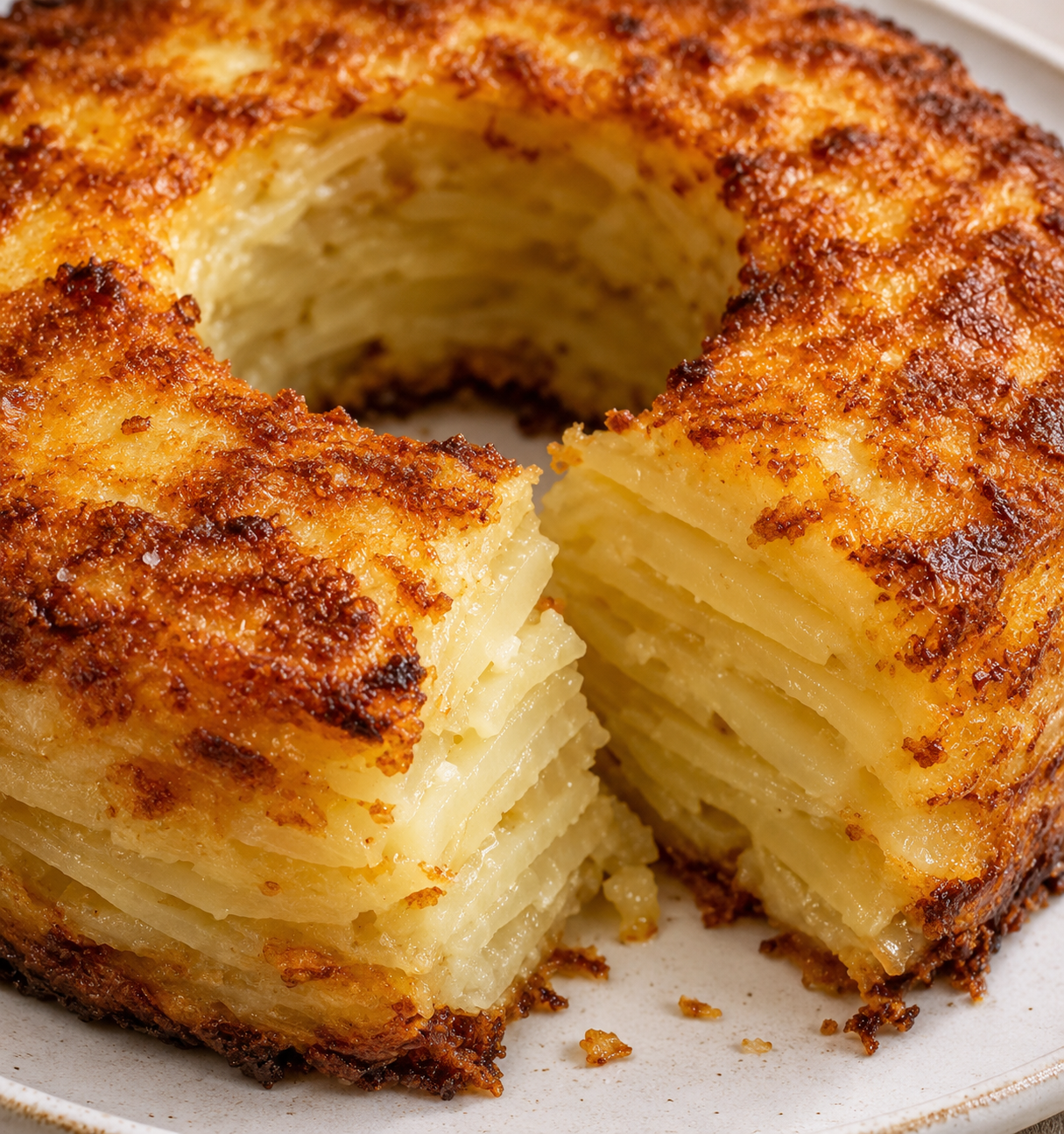
“Crispy Cheesy Potato Ring”,
Ingredients
Equipment
Method
- Preheat the oven to 375°F (190°C). Generously grease the inside of a 10- or 12-cup Bundt pan with butter or cooking spray.
- In a large mixing bowl, whisk together the melted butter, minced garlic, heavy cream, salt, black pepper, and optional dried thyme.
- Add the thinly sliced potatoes to the garlic cream mixture and gently toss until every slice is evenly coated.
- Sprinkle 1/4 cup grated Parmesan and 1/2 cup shredded cheese into the bottom of the greased Bundt pan.
- Arrange overlapping potato slices around the ring, alternating with layers of the remaining shredded cheese and Parmesan. Repeat until all the potatoes are used, pressing the layers down firmly as you work.
- Pour any remaining garlic cream mixture over the potatoes. Cover the Bundt pan tightly with aluminum foil.
- Bake for 45–50 minutes, until a knife slides easily through the potato layers. Continue baking covered if additional time is needed.
- Remove the foil and bake uncovered for another 15–20 minutes until golden brown and bubbling.
- Remove from the oven and allow the potato ring to rest in the pan for 15 minutes so the layers settle.
- Carefully loosen the outer edge and center tube. Place a large serving plate over the Bundt pan and carefully invert to release the potato ring. Slice into wedges and serve warm.
Notes
Why You Will Love Crispy Cheesy Potato Ring
Crispy outside and creamy inside
The combination of thinly sliced potatoes, garlic butter, heavy cream, and cheese creates a particularly satisfying texture.
As the potatoes bake, they gradually absorb the creamy garlic mixture and become beautifully tender.
The shredded cheese melts between the potato layers, helping create a rich and flavorful interior.
Parmesan contributes a savory, slightly nutty flavor and helps develop the crispy exterior.
The cheese placed directly against the bottom of the Bundt pan becomes golden during baking.
Once the potato ring is inverted onto a serving plate, this golden crust becomes the attractive top of the finished dish.
Every wedge contains a delicious combination of tender potatoes, creamy cheese, and crispy browned edges.
An impressive side dish with simple ingredients
Although this potato ring looks elaborate, the preparation is surprisingly straightforward.
You do not need complicated cooking techniques or specialty ingredients.
The recipe begins with thinly sliced potatoes coated in a simple garlic cream mixture.
The potatoes are then arranged in overlapping layers inside a greased Bundt pan, alternating with shredded cheese and Parmesan.
Most of the cooking takes place in the oven, allowing you to prepare the remaining components of your meal.
The ring shape makes this dish especially attractive for entertaining.
Instead of serving ordinary scalloped potatoes in a rectangular casserole dish, you can bring an impressive golden potato ring directly to the table.
It is a wonderful way to make a familiar comfort-food favorite feel a little more special.
Choosing the Best Ingredients
Selecting and preparing the potatoes
Yukon Gold potatoes are an excellent choice for this recipe because of their naturally buttery flavor and tender texture.
They generally maintain their shape well during baking, helping create distinct layers when the potato ring is sliced.
Russet potatoes are another suitable option.
Their higher starch content can help the layers bind together and develop a soft interior.
Choose potatoes that are firm and free from green areas or signs of spoilage.
Peel the potatoes before slicing them into thin rounds.
The slices should be approximately one-eighth of an inch thick, or about two to three millimeters.
Keeping the slices uniform is important because thicker pieces may require considerably more cooking time.
A mandoline slicer is particularly useful for achieving consistent potato slices.
Always use the protective hand guard when operating a mandoline.
A sharp kitchen knife can also be used if a mandoline is unavailable.
Avoid cutting the potatoes too far in advance, since their exposed surfaces may discolor.
Preparing the garlic cream mixture before slicing the potatoes allows you to coat them immediately.
Garlic butter, cream, and cheese
Melted unsalted butter contributes richness and helps distribute the garlic throughout the potato layers.
Freshly minced garlic provides a fragrant savory flavor.
Garlic powder can be substituted if fresh garlic is unavailable.
Heavy cream is recommended for its rich consistency and ability to create tender, creamy potato layers.
All-purpose cream or evaporated milk can also be used, although the finished texture may differ slightly.
The shredded cheese can be customized according to your preferences.
Mozzarella creates a mild, stretchy melted texture.
Gruyère offers a richer, nutty flavor that pairs particularly well with potatoes au gratin.
Cheddar introduces a stronger savory flavor and an attractive golden color.
You can also combine two varieties of cheese for a more complex flavor.
Freshly grated Parmesan is especially important for creating the signature golden crust.
Salt and freshly cracked black pepper balance the richness of the cream and cheese.
Dried thyme or Italian seasoning provides an optional herbal finish.
Because Parmesan and shredded cheese already contain salt, adjust the additional seasoning according to the varieties you choose.
How to Make Perfect Crispy Cheesy Potato Ring
Preparing the Bundt pan and garlic cream
Begin by preheating your oven to 375°F (190°C).
Choose a 10- or 12-cup Bundt pan with enough capacity to hold the potato layers.
Generously grease the entire interior of the pan with butter or cooking spray.
Pay particular attention to the center tube, curved edges, and decorative ridges.
Thorough greasing is especially important because the cheese can stick to the pan as it browns.
A nonstick Bundt pan with a relatively simple shape may make unmolding easier.
In a large mixing bowl, combine the melted butter, minced garlic, heavy cream, salt, black pepper, and optional dried thyme.
Whisk until the ingredients are evenly distributed.
Add the thinly sliced potatoes to the bowl.
Gently toss the slices until they are coated with the garlic cream mixture.
Separate any slices that have stuck together so the cream can reach their surfaces.
Avoid breaking the potato slices unnecessarily.
Keeping them relatively intact helps create the attractive layered appearance of the finished ring.
Layering the potatoes and cheese
Sprinkle approximately one-quarter cup of grated Parmesan into the bottom of the greased Bundt pan.
Add half a cup of shredded cheese.
This initial cheese layer will form part of the golden exterior once the potato ring is unmolded.
Arrange the first layer of potato slices around the bottom of the pan.
Overlap the slices slightly to create an even circular layer.
Sprinkle a portion of the remaining shredded cheese and Parmesan over the potatoes.
Continue alternating layers of potato slices and cheese until all the potatoes have been used.
Gently press the layers down as you work.
Packing the potatoes snugly helps the finished ring maintain its shape after baking.
Distribute the cheese evenly rather than concentrating it in only a few layers.
Once the pan is filled, pour any remaining garlic cream mixture over the potatoes.
Allow the cream to settle naturally between the layers.
Make sure the pan is not excessively full, leaving sufficient space for the ingredients to bubble during baking.
Baking and Unmolding the Potato Ring
Baking until tender and golden
Cover the Bundt pan tightly with aluminum foil.
Place it in the preheated oven and bake for approximately forty-five to fifty minutes.
Covering the pan during the initial cooking stage traps steam and helps the thin potato slices become tender.
It also prevents the exposed cheese and potatoes from browning too quickly.
After the initial baking period, carefully remove the foil.
Insert a thin knife into the potatoes to check their tenderness.
The knife should slide through the layers with little resistance.
If the potatoes are still firm, cover the pan again and continue baking until tender.
Once the potatoes are cooked through, remove the foil and return the pan to the oven.
Bake uncovered for another fifteen to twenty minutes.
During this final cooking stage, the exposed surface should become golden brown and bubbling.
The cheese around the edges will also continue to develop its crispy texture.
Cooking times may vary depending on the thickness of the potato slices, the depth of the pan, and the performance of your oven.
Always check the tenderness of the potatoes rather than relying entirely on the suggested baking time.
Resting and carefully inverting the ring
Once the potatoes are tender and beautifully golden, remove the Bundt pan from the oven.
Allow the potato ring to rest in the pan for approximately fifteen minutes.
This resting period is important because the melted cheese and creamy potato layers need time to settle.
Attempting to unmold the ring immediately may cause the layers to separate or collapse.
Carefully run a thin butter knife or flexible spatula around the outer edge of the pan and the center tube.
Avoid scratching the nonstick surface.
Place a large serving plate over the top of the Bundt pan.
Using oven mitts if the pan is still hot, hold the plate and pan securely together.
Carefully invert them in one controlled movement.
Allow the potato ring to release onto the serving plate.
If it does not release immediately, gently loosen the edges further rather than shaking the pan aggressively.
Once unmolded, the golden cheese crust should be visible on the outside of the ring.
Slice into wedges and serve warm.
Serving, Storage, and Delicious Variations
The best ways to serve cheesy potato ring
Crispy Cheesy Potato Ring is a versatile side dish that pairs beautifully with a variety of main courses.
Serve it alongside roasted chicken, grilled steak, roast turkey, or baked salmon.
The creamy potatoes also work well with roasted vegetables and fresh green salads.
For a traditional holiday dinner, pair the potato ring with turkey, green beans, and cranberry sauce.
Its attractive golden appearance makes it particularly suitable for festive table settings.
For a simple presentation, serve the entire ring on a large white plate.
Cut the potatoes into individual wedges so that the delicate layers remain visible.
If desired, garnish with freshly chopped parsley or thyme.
A light sprinkle of additional Parmesan can also enhance the savory flavor.
The potato ring is particularly delicious when served warm, while the interior remains creamy and the exterior retains its crispness.
It is rich enough to enjoy as a comforting vegetarian main dish when served with a generous salad, provided the cheeses used are suitable for vegetarians.
Storage tips and make-ahead preparation
Although this potato ring is best served freshly baked, leftovers can still be enjoyed the following day.
Refrigerate leftovers within two hours of cooking.
Transfer individual wedges to an airtight container and refrigerate for up to three to four days.
To reheat, place the potato wedges in an oven at approximately 350°F until thoroughly heated to 165°F.
Oven reheating generally helps preserve more of the original crispy texture than microwaving.
If the potatoes appear slightly dry, add a small splash of cream before reheating.
You can prepare some ingredients ahead of time to simplify cooking.
Grate the cheese, mince the garlic, and measure the seasonings in advance.
For the best appearance, slice and coat the potatoes shortly before assembling the dish.
Freezing is possible, although the potatoes and cream may develop a different texture after thawing.
Easy flavor variations
For an extra-cheesy potato ring, combine Gruyère and mozzarella with freshly grated Parmesan.
For a stronger garlic flavor, add another minced garlic clove to the cream mixture.
Smoked paprika can introduce a subtle smoky flavor and complement the golden cheese crust.
If you enjoy spicy food, add a pinch of cayenne pepper or crushed red pepper flakes.
Fresh rosemary can replace dried thyme for a more aromatic variation.
You can also add a small amount of finely chopped sautéed onion between the potato layers.
Make sure any additional vegetables are well drained before incorporating them.
Avoid adding excessive amounts of extra ingredients because they may prevent the potato layers from holding together when unmolded.
The original recipe already provides a delicious combination of creamy potatoes, garlic butter, and melted cheese.
Ingredients
- 2 1/2 to 3 pounds (about 1.2 kilograms) Yukon Gold or Russet potatoes, peeled and sliced into 1/8-inch rounds
- 4 tablespoons (55 grams) unsalted butter, melted
- 3 garlic cloves, minced, or 1 teaspoon garlic powder
- 1 cup (240 milliliters) heavy cream, all-purpose cream, or evaporated milk
- 2 cups (200 grams) shredded mozzarella, Gruyère, or cheddar cheese, divided
- 1/2 cup (50 grams) freshly grated Parmesan cheese, divided
- 1 1/2 teaspoons salt
- 1/2 teaspoon freshly cracked black pepper
- 1/2 teaspoon dried thyme or Italian seasoning, optional
Instructions
- Preheat the oven to 375°F (190°C).
- Generously grease the inside of a 10- or 12-cup Bundt pan with butter or cooking spray.
- In a large mixing bowl, whisk together the melted butter, minced garlic, heavy cream, salt, black pepper, and optional dried thyme.
- Peel the potatoes and slice them into approximately 1/8-inch-thick rounds.
- Add the potato slices to the garlic cream mixture and gently toss until evenly coated.
- Sprinkle 1/4 cup grated Parmesan and 1/2 cup shredded cheese into the bottom of the prepared Bundt pan.
- Arrange a layer of overlapping potato slices around the ring.
- Sprinkle with some of the remaining shredded cheese and Parmesan.
- Repeat the potato and cheese layers until all the potatoes have been used, pressing the layers down firmly as you work.
- Pour any remaining garlic cream mixture over the potatoes.
- Cover the Bundt pan tightly with aluminum foil.
- Bake for 45–50 minutes, until a knife slides easily through the potato layers.
- Remove the foil and bake uncovered for another 15–20 minutes, until golden brown and bubbling.
- Remove from the oven and allow the potato ring to rest in the pan for 15 minutes.
- Carefully loosen the outer edge and center tube using a thin butter knife or flexible spatula.
- Place a large serving plate over the Bundt pan and carefully invert to release the potato ring.
- Slice into wedges and serve warm.
Frequently Asked Questions
Why did my potato ring fall apart?
The potatoes may not have been packed tightly enough, or the ring may have been unmolded before it had sufficient time to rest.
Arrange the potato slices in snug, overlapping layers and allow the baked ring to rest for at least fifteen minutes before inverting.
Do I need to boil the potatoes before baking?
No. The thinly sliced potatoes cook directly in the Bundt pan.
Covering the pan during the initial baking stage allows the potatoes to soften in the garlic cream mixture.
What is the best cheese for a crispy potato ring?
Gruyère, cheddar, and mozzarella all work well.
Parmesan is particularly useful for creating a flavorful golden crust.
A combination of Gruyère and Parmesan provides a rich, nutty flavor.
Can I make this recipe without a Bundt pan?
Yes. You can use a suitable tube pan or prepare the layered potatoes in a conventional baking dish.
The flavor will remain similar, although the finished dish will not have the same decorative ring shape.
Why are my potatoes still hard?
The slices may be too thick, or the potatoes may need additional covered baking time.
Keep the pan covered until a knife passes easily through the layers before proceeding with the final uncovered baking stage.
How do I prevent the cheese from sticking to the pan?
Generously grease every part of the Bundt pan before adding the cheese.
Allow the baked potatoes to rest and carefully loosen both the outer edges and center tube before inverting.
Conclusion
Crispy Cheesy Potato Ring is a delicious way to transform everyday potatoes into an impressive golden side dish.
With layers of tender potatoes, creamy garlic butter, melted cheese, and a crispy Parmesan exterior, this savory bake combines classic comfort-food flavors with a beautiful presentation.
Its simple ingredients and straightforward preparation make it suitable for holiday celebrations, family dinners, and special gatherings.
Serve it warm, slice into generous wedges, and enjoy every crispy, creamy, cheesy bite.