Baby Neck Redness is extremely common, especially during the first year of life. A baby’s neck has soft folds where drool, milk, sweat, and moisture can easily collect. When those folds stay damp, the skin can rub against itself and become red, tender, or irritated.
In many cases, Baby Neck Redness comes from a simple combination of heat, friction, and trapped moisture. Doctors often describe this type of skin-fold irritation as intertrigo. Babies are especially prone to it because their skin is delicate and their neck folds frequently stay moist from drooling.
However, not every red neck rash has the same cause. Heat rash, eczema, seborrheic dermatitis, contact irritation, yeast overgrowth, and bacterial infection can sometimes look similar at first. Therefore, parents and caregivers should focus on the rash’s appearance, whether it is spreading, how the baby feels, and whether the skin is improving with gentle care.
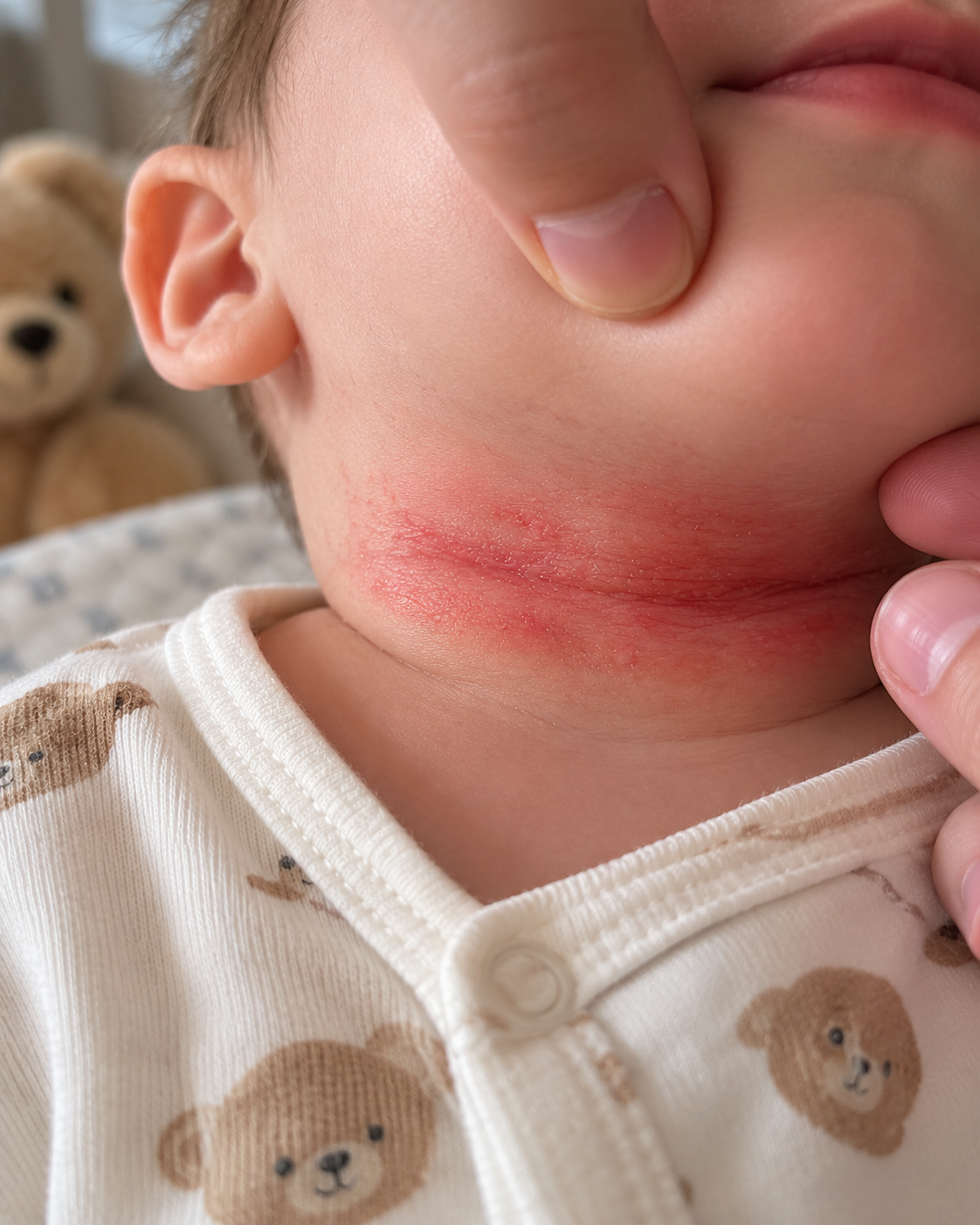
I remember helping care for a baby who developed a bright red line deep inside the neck folds during a particularly warm week. At first, it looked alarming because the redness seemed to appear overnight. However, once we carefully opened the folds, we found dampness from drool and a little milk that had collected after feedings. We started gently cleaning and thoroughly drying the area several times a day, while keeping clothing loose around the neck. The skin gradually looked calmer. That experience taught me that small baby skin problems can change quickly, but careful observation and simple, gentle care can make a noticeable difference.
Why Baby Neck Redness Happens So Easily
Moisture and Friction Can Irritate Delicate Skin
The most common explanation for Baby Neck Redness is mechanical irritation.
A baby’s neck contains folds where two skin surfaces touch. When those surfaces stay dry, they may cause no problem. However, when drool, milk, sweat, or bath water becomes trapped between them, the skin softens.
Then friction increases.
As the baby moves their head, the damp surfaces rub together. Eventually, the skin may become red and inflamed.
This pattern closely resembles intertrigo, an inflammatory skin condition caused by friction that becomes worse in warm, moist skin folds. Babies are particularly susceptible because they have delicate skin and often develop moisture in neck folds from drooling.
Warm weather can make Baby Neck Redness more noticeable.
When babies sweat, moisture can collect quickly beneath the chin and around the neck. Thick clothing can trap even more heat.
Likewise, frequent drooling during teething can keep the area constantly damp.
Feeding creates another source of moisture.
Milk may run down the chin and settle deep inside a fold where it is easy to miss. Even after wiping the baby’s face, a small amount can remain hidden against the skin.
Therefore, gently checking the folds matters.
The goal is not aggressive scrubbing. Instead, clean the skin softly and then dry it completely.
This simple routine often helps mild irritation because it removes moisture and reduces friction.
However, Baby Neck Redness that continues to worsen despite careful cleaning and drying deserves a closer look.
Heat Rash and Sensitive Skin Can Look Similar
Not every red neck rash is intertrigo.
Heat rash can also affect the neck, especially during warm weather.
The American Academy of Pediatrics notes that heat rash in babies and young children can appear as patches of tiny red bumps or small fluid-filled blisters. Neck folds are among the places where it commonly appears because sweat can become trapped there.
Heat rash often improves when the baby cools down.
Loose cotton clothing, a comfortably cool environment, gentle bathing, and allowing air to reach the affected skin may help. The American Academy of Pediatrics specifically recommends cleansing sweaty or drool-prone folds and drying them thoroughly.
Sensitive skin conditions can create another possibility.
Seborrheic dermatitis, the condition commonly associated with cradle cap, can sometimes extend beyond the scalp. It may cause scaling or redness on the face, behind the ears, in the neck folds, and in other creases.
Contact irritation can also matter.
A fragranced lotion, strongly scented detergent, soap, wipe, or fabric product may irritate sensitive skin.
Therefore, Baby Neck Redness sometimes improves when caregivers simplify the baby’s skincare routine.
Use mild products.
Avoid unnecessary fragrance.
Choose soft fabrics.
And introduce new products cautiously.
If a rash appears shortly after a new soap, detergent, lotion, bib, or clothing material, consider whether contact irritation may be contributing.
How to Care for Mild Baby Neck Redness at Home
Clean Gently and Keep the Folds Dry
For mild Baby Neck Redness without signs of infection, moisture control is usually one of the most helpful first steps.
Begin with gentle cleaning.
Use lukewarm water and a soft cloth to remove milk, sweat, drool, or other residue.
Avoid vigorous rubbing.
Irritated skin becomes more fragile, so aggressive scrubbing can make redness worse.
After cleaning, carefully pat the folds dry.
Do not leave hidden dampness beneath the chin.
You may need to gently lift the baby’s chin or turn the head slightly so you can see each fold.
Take your time.
The skin should feel dry before clothing or a bib covers it again.
Cleveland Clinic recommends keeping skin folds as clean, cool, and dry as possible when intertrigo develops. Because moisture and friction drive the irritation, reducing both can help the skin recover.
Changing damp bibs and clothing also helps.
If a bib becomes soaked with drool, replace it instead of leaving the wet fabric against the neck.
Likewise, change clothing after significant spit-up or milk spills.
During warm weather, choose lightweight, breathable clothing.
The American Academy of Pediatrics recommends thin, loose-fitting cotton clothing for heat-related rashes because airflow helps keep the skin cooler and drier.
Baby Neck Redness often improves when caregivers make these small adjustments consistently.
However, improvement should happen gradually.
If the skin becomes increasingly raw, painful, or wet-looking, seek professional advice rather than continuing to experiment with home remedies.
Avoid Products That Can Make Irritation Worse
When Baby Neck Redness appears, the instinct to apply several creams at once can backfire.
More products do not necessarily mean faster healing.
In fact, fragranced lotions, essential oils, powders, harsh cleansers, and strongly scented wipes can irritate delicate skin.
Therefore, keep the routine simple.
Avoid applying medicated antifungal, antibiotic, or steroid creams unless a healthcare professional recommends the appropriate treatment for the baby’s specific rash.
Different rashes require different approaches.
For example, intertrigo without infection mainly benefits from reducing friction and moisture. However, secondary yeast or bacterial infections may require targeted medication. MSD Manual notes that doctors sometimes use antifungal or antibacterial treatments when infection is actually present.
That distinction matters because Baby Neck Redness cannot always be diagnosed accurately from color alone.
A caregiver may assume a rash is yeast when it is actually irritant dermatitis.
Another person may mistake ordinary friction for eczema.
Using the wrong medication can delay proper treatment or make the skin more irritated.
Powders also deserve caution.
Loose powder can become airborne near an infant’s face, so avoid relying on it as a routine way to keep neck folds dry.
Instead, use gentle drying and breathable clothing.
If a healthcare professional recommends a barrier product, use it exactly as directed.
The simplest rule is this: clean gently, dry thoroughly, reduce moisture and friction, and avoid turning a mild rash into a chemistry experiment.
When Baby Neck Redness May Be More Than Simple Irritation
Yeast or Bacteria Can Grow in Damaged Skin Folds
When skin remains damp and irritated, its protective barrier can break down.
That creates an environment where microorganisms already present on the skin can overgrow.
Intertrigo itself is not necessarily an infection. However, yeast and bacteria can cause secondary infections after moisture and friction damage the skin. Candida is one of the most common yeast organisms involved.
This possibility becomes more important when Baby Neck Redness looks unusually intense or fails to improve.
A yeast-related rash may appear very red and moist and can sometimes develop nearby small bumps or pustules. However, appearance varies, and parents should not diagnose Candida from photographs alone.
A bacterial infection can also complicate irritated skin.
Watch for increasing warmth, swelling, tenderness, drainage, crusting, or rapidly spreading redness.
An unpleasant odor can also suggest that the skin needs closer evaluation, especially when the area looks raw or wet.
Because these conditions may require specific treatment, persistent Baby Neck Redness should be assessed rather than repeatedly treated with random over-the-counter products.
The baby’s general behavior matters too.
A baby who remains comfortable, feeds normally, and has a small stable patch of redness presents differently from a baby who becomes very irritable when the neck is touched.
Therefore, look at both the skin and the child.
The rash is only one piece of information.
Certain Warning Signs Deserve a Pediatrician’s Attention
Some Baby Neck Redness should not be managed only at home.
The American Academy of Pediatrics recommends medical advice for localized rashes that are very painful, occur with fever, look infected, or remain in a skin fold. It also advises evaluation when a localized rash lasts longer than about a week.
Seek prompt care if the redness spreads rapidly.
Likewise, contact a healthcare professional if you notice bright red streaking, significant swelling, blisters without a clear explanation, open sores, pus, or increasing pain.
Fever changes the situation.
A fever in a young infant deserves appropriate medical guidance, especially when a new rash appears at the same time.
The baby’s age matters as well.
Very young infants have less reserve when they become ill, so clinicians generally use a lower threshold for evaluating concerning skin changes.
Baby Neck Redness also deserves professional attention when the rash repeatedly returns despite careful moisture control.
Recurring inflammation may point to persistent drooling, eczema, seborrheic dermatitis, yeast overgrowth, an allergic or irritant trigger, or another skin condition.
A pediatrician can examine the distribution and texture of the rash and decide whether testing or prescription treatment is needed.
That evaluation provides more reliable answers than comparing the rash with dozens of internet photographs.
How to Prevent Baby Neck Redness From Returning
Build a Simple Daily Neck-Fold Routine
Preventing Baby Neck Redness often comes down to consistency.
During bath time, gently clean beneath the baby’s chin and inside each visible fold.
Then dry carefully.
After feedings, check whether milk has run into the neck.
After heavy drooling, replace wet bibs.
During hot weather, check the folds more frequently because sweat can accumulate quickly.
These habits require only a minute or two.
However, they can prevent hours of irritation later.
Keep the baby’s clothing comfortable and breathable.
Avoid collars that fit tightly around the neck.
Choose bibs that do not constantly rub the same area.
Then wash clothing and bibs with a mild detergent if the baby’s skin seems sensitive.
Baby Neck Redness may return during developmental stages when drooling increases.
That does not necessarily mean something is wrong.
Teething, frequent feedings, warm weather, and limited neck control can all make moisture management more challenging.
Therefore, adjust the routine as the baby’s needs change.
A newborn who mostly lies still may have different skin-fold issues from an older infant who drools heavily and turns their head constantly.
As neck control improves and the folds become less deep, some babies develop fewer episodes.
Until then, gentle maintenance can make a major difference.
Track Patterns Instead of Guessing at the Cause
If Baby Neck Redness keeps returning, look for patterns.
Does it happen after especially warm days?
Does it worsen when the baby drools heavily?
Does it appear after using a certain lotion or detergent?
Does milk regularly collect in one deep fold?
Does scaling also appear on the scalp or behind the ears?
Those observations can help a healthcare professional narrow the cause.
Take clear photographs when the rash is at its worst.
Skin can change quickly, and the rash may look different by the time you reach an appointment.
A photo can show how widespread or intense it was earlier.
Also note how long the rash lasts and what care you tried.
Avoid changing five things at once.
If you switch detergent, add a new cream, stop a lotion, and change clothing all on the same day, you may never know what actually helped.
Instead, use a simple, gentle routine and seek medical advice when the rash does not behave like ordinary moisture irritation.
Most cases of Baby Neck Redness remain manageable.
Still, good care means recognizing when the skin needs more than cleaning and drying.
Frequently Asked Questions
Is Baby Neck Redness usually caused by poor hygiene?
No. Baby Neck Redness can happen even with excellent care because infant neck folds naturally trap drool, sweat, and milk. Moisture and friction can irritate delicate skin very quickly.
Can drooling cause a rash in a baby’s neck folds?
Yes. Frequent drooling keeps skin folds moist, which can increase friction and irritation. Babies are especially prone to intertrigo in the neck because drool commonly collects there.
How can I tell whether Baby Neck Redness is a yeast infection?
You cannot reliably confirm yeast from color alone. Yeast may complicate moist intertrigo, but diagnosis depends on the rash’s appearance and sometimes clinical testing. A healthcare professional should evaluate persistent or worsening rashes.
Should I use antifungal cream on a baby’s red neck?
Do not automatically apply antifungal medication unless a healthcare professional recommends it. Moisture irritation, eczema, heat rash, seborrheic dermatitis, and infection can look similar, yet they may need different treatment.
When should I contact a doctor about Baby Neck Redness?
Seek medical advice when the rash is painful, rapidly spreading, associated with fever, looks infected, develops significant drainage or sores, or fails to improve. The American Academy of Pediatrics also recommends contacting a doctor about red rashes in skin folds.
Conclusion
Baby Neck Redness is often caused by something simple: delicate skin, deep folds, moisture, and friction.
Drool can collect beneath the chin.
Milk can run into a crease after feeding.
Sweat can build up during warm weather.
Then the damp surfaces rub together and become irritated.
This common pattern closely resembles intertrigo, which develops when friction combines with trapped moisture in a skin fold. Babies are especially vulnerable because their skin is sensitive and their neck folds often remain damp.
Fortunately, mild Baby Neck Redness often responds to gentle care.
Clean the folds with lukewarm water.
Pat the skin completely dry.
Change wet bibs and clothing promptly.
Keep the baby comfortably cool.
Use loose, breathable fabrics.
And avoid unnecessary fragranced or irritating products.
At the same time, pay attention to changes.
A rash that becomes increasingly painful, swollen, cracked, warm, foul-smelling, draining, or widespread deserves medical attention.
Likewise, fever or significant changes in the baby’s behavior make professional evaluation more important.
Persistent moisture damage can also allow yeast or bacteria to overgrow, so a rash that keeps worsening despite careful drying should not simply be ignored.
Most importantly, Baby Neck Redness is not a reason to panic.
It is a reason to look closely.
Gentle cleaning, careful drying, and a little attention to moisture solve many mild cases. However, when the rash does not improve or develops concerning features, a pediatrician can determine whether another skin condition or infection needs treatment.
More Home Remedies
- Wrinkled Fingers After Water Exposure: What Your Skin May Be Telling You
- Skin Rash With Breathing Trouble? It Could Be a Life-Threatening Allergic Reaction
- I Thought It Was a Piece of Trash on the Bathroom Floor—Until It Moved
- If You Are Getting White Pimples on Your Lips or Intimate Area, Here’s What They Could Mean