Most drivers have experienced that moment.
You’re driving along when flashing red and blue lights suddenly appear in your rearview mirror. Your heart rate rises slightly as you signal, pull over safely, and wait for the officer to approach.
Then something curious happens.
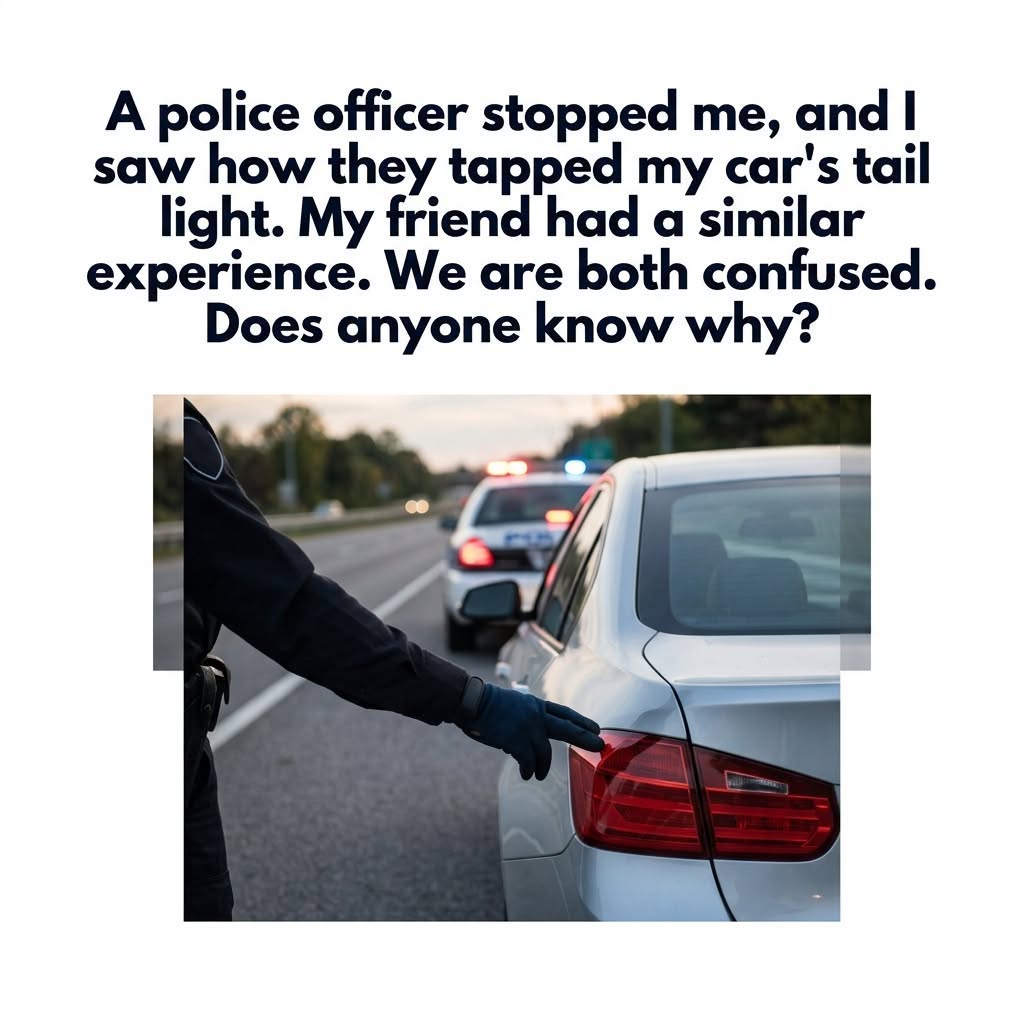
As the officer walks toward your vehicle, they briefly touch the rear of your car—often the tail light or trunk area.
Many people notice it but never ask about it.
Others wonder if it’s some kind of secret signal, a way to check for contraband, or even a tactic used to intimidate drivers.
The reality is far less dramatic but far more interesting.
That simple tap on your tail light has a long history rooted in officer safety, documentation, training, and psychology. While not every officer performs this action today, the practice remains one of the most widely discussed traditions associated with traffic stops.
Let’s take a closer look at why some officers do it and what that small gesture actually means.
The Origins of the Tail-Light Tap
Long before body cameras, GPS tracking, license plate readers, and sophisticated police databases existed, officers had far fewer tools available during traffic stops.
A routine traffic stop has always been one of the most unpredictable situations officers face.
Even a seemingly minor stop for speeding or a broken tail light can unexpectedly become dangerous.
Because of this uncertainty, officers developed habits designed to increase safety and create evidence if something went wrong.
One of those habits was touching the vehicle as they approached.
Over time, this became associated specifically with tapping the tail light or rear of the vehicle.
Although modern technology has changed policing dramatically, the practice remains part of law enforcement culture in many areas.
The Fingerprint Theory: Leaving Evidence Behind
Perhaps the most widely known explanation involves fingerprints.
The theory is simple.
When an officer touches the tail light, they leave behind a fingerprint on the vehicle.
If an emergency occurs during the stop, investigators may later be able to use that fingerprint to establish that the officer approached that specific vehicle.
Imagine a worst-case scenario:
An officer initiates a traffic stop and exits their patrol car. Before they can communicate details to dispatch, something unexpected happens.
If investigators later find the officer’s fingerprint on the vehicle, it creates a physical link between the officer and that specific car.
In earlier decades, before dashboard cameras and body-worn cameras became common, this could serve as valuable evidence.
Why Physical Evidence Matters
Even though modern police vehicles are equipped with technology, physical evidence remains important because:
- Electronics can malfunction.
- Cameras can be damaged.
- Radio communication can fail.
- Witness accounts can conflict.
A fingerprint provides an additional layer of documentation.
Think of it as a backup system.
Most officers never expect to need it, but it may prove useful if circumstances become serious.
Officer Safety Is the Primary Goal
While the fingerprint explanation receives most of the attention, many law enforcement professionals emphasize that safety is often the more important reason.
Traffic stops can be unpredictable.
The officer approaching the vehicle usually has very limited information.
They may not know:
- Who is inside the vehicle.
- Whether passengers are present.
- Whether weapons are involved.
- Whether the driver intends to cooperate.
- Whether someone is hiding inside the vehicle.
Every movement matters.
A brief touch on the vehicle can help officers maintain awareness and control during the approach.
Checking the Trunk
Another practical reason involves the trunk.
Historically, some officers were trained to lightly touch the trunk lid.
Why?
Because a quick touch could reveal whether the trunk was properly latched.
If the trunk pops open unexpectedly, it may indicate someone is hiding inside.
While such situations are rare, officer training often focuses on preparing for unlikely but dangerous possibilities.
Traffic stops are about managing risk, not assuming everything will go wrong.
Observing Occupants Inside the Vehicle
The tail-light tap can also serve as a subtle distraction.
When drivers or passengers hear the sound, they often look up or turn their attention toward the rear of the vehicle.
This momentary reaction can help officers observe:
- Hand movements
- Passenger behavior
- Attempts to hide objects
- Sudden movements inside the car
Officers are trained to pay close attention to hands because hands are what can reach for documents—or weapons.
By encouraging occupants to briefly reveal their movements, officers gain valuable information before reaching the driver’s window.
A Psychological Benefit for Officers
Interestingly, the practice may also provide psychological benefits.
Human beings perform better under stress when they follow routines.
Pilots use checklists.
Athletes develop pre-game rituals.
Surgeons follow standard preparation procedures.
Police officers are no different.
The tail-light tap can function as a small ritual that helps officers focus.
That brief action may:
- Reinforce awareness.
- Create consistency.
- Reduce anxiety.
- Signal the beginning of the interaction.
When performed repeatedly over years of service, the action becomes part of an officer’s mental preparation process.
Modern Technology Has Changed Things
Today, police departments have access to tools that previous generations could only imagine.
Many officers now wear body cameras that record interactions from start to finish.
Patrol vehicles frequently contain:
- Dash cameras
- GPS tracking systems
- License plate recognition technology
- Digital reporting software
- Mobile data terminals
Because of these advancements, the need for physical fingerprint evidence has diminished significantly.
Many departments now rely primarily on digital documentation.
As a result, some officers no longer perform the tail-light tap at all.
Others continue doing it because it remains part of their training or personal routine.
Is the Practice Universal?
No.
This is one of the biggest misconceptions surrounding the tail-light tap.
Not every police officer does it.
Not every department teaches it.
Not every academy includes it in training.
Law enforcement practices vary widely depending on:
- Country
- State
- Province
- Department policy
- Individual officer preference
Some officers tap every vehicle they approach.
Others never touch vehicles during traffic stops.
Neither approach is necessarily right or wrong.
Both can be consistent with safe policing practices.
Does It Mean the Officer Suspects You?
Absolutely not.
Drivers sometimes assume the tap indicates suspicion.
In reality, it is usually just a standard habit.
Officers perform the same safety procedures regardless of whether the stop involves:
- Speeding
- A broken tail light
- Expired registration
- Failure to signal
The tap is generally about routine, not suspicion.
It does not mean the officer thinks you are dangerous.
It does not mean you are under investigation.
It does not mean you are in more trouble than you thought.
What Should Drivers Do During a Traffic Stop?
The best approach is simple.
Stay calm.
Follow instructions.
Keep your hands visible.
Avoid sudden movements.
If you need to reach for documents, tell the officer what you’re doing before moving.
For example:
“My registration is in the glove box. May I reach for it?”
Clear communication helps everyone feel safer.
Most traffic stops end quickly and without incident.
Common Myths About the Tail-Light Tap
Myth #1: Officers Are Looking for Drugs
False.
The tap itself is not a drug-detection technique.
Myth #2: It Damages the Vehicle
False.
The touch is typically gentle and causes no damage.
Myth #3: Every Officer Must Do It
False.
Many officers never perform this action.
Myth #4: It Means You’re Being Investigated
False.
It is generally a routine safety measure.
Myth #5: It Is Required by Law
False.
No universal law requires officers to tap tail lights during traffic stops.
Why This Small Gesture Fascinates People
Part of the fascination comes from the fact that it appears mysterious.
Most people only interact with law enforcement occasionally.
When they notice an unusual behavior, curiosity naturally follows.
The tail-light tap is a reminder that many professional occupations develop routines outsiders rarely understand.
Pilots perform checks passengers never notice.
Doctors follow procedures patients never see.
Police officers use tactics the public may not immediately recognize.
What looks unusual often has a practical explanation.
The Bottom Line
That quick tap on your tail light is not a secret code, a threat, or a sign that something is wrong with your vehicle.
Historically, the practice served as a way to leave fingerprint evidence connecting the officer to the vehicle. Over time, it also became associated with broader officer-safety tactics, including observing occupants, checking the trunk, and maintaining situational awareness.
Today, some officers still do it, while others rely on modern technology such as body cameras and GPS systems.
The next time you see an officer touch a vehicle during a traffic stop, you’ll know there’s usually a simple reason behind it.
It’s not about intimidation.
It’s not about suspicion.
It’s about preparation, awareness, and safety in one of the most unpredictable situations officers encounter on the job.
Understanding these small details can make traffic stops feel a little less mysterious and remind us that many professional habits exist for one simple purpose: helping everyone get home safely.
More Home Remedies
- Wrinkled Fingers After Water Exposure: What Your Skin May Be Telling You
- Skin Rash With Breathing Trouble? It Could Be a Life-Threatening Allergic Reaction
- I Thought It Was a Piece of Trash on the Bathroom Floor—Until It Moved
- If You Are Getting White Pimples on Your Lips or Intimate Area, Here’s What They Could Mean