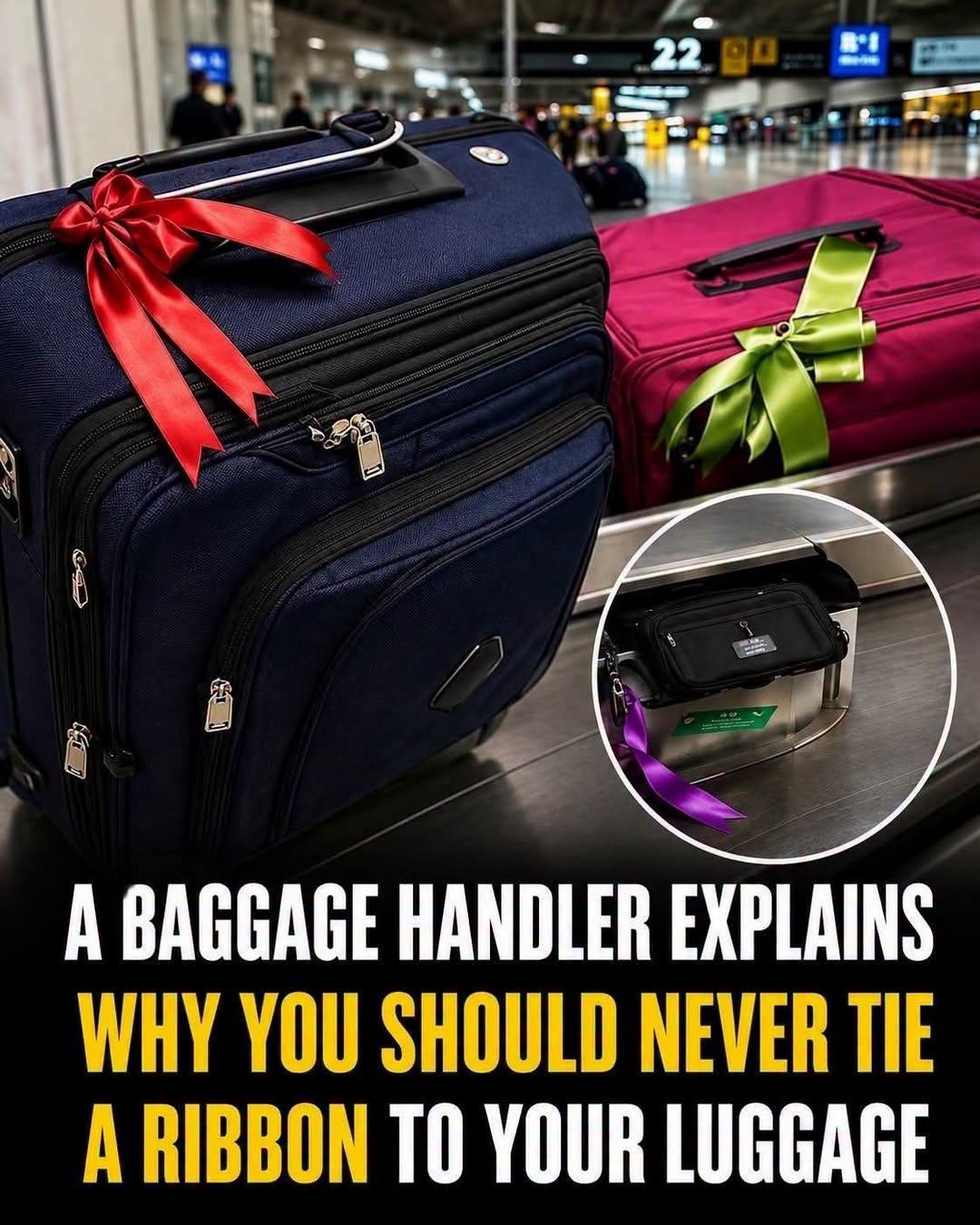
Why Baggage Handlers Say You Should Never Tie a Ribbon to Your Suitcase has become a popular travel warning because ribbons seem like such an easy way to make luggage recognizable. At a crowded baggage carousel, a bright ribbon can help you spot your black or navy suitcase among dozens of nearly identical bags.
However, checked luggage does not move gently from the check-in desk straight onto the aircraft. Airports often send bags through conveyors, scanners, sorting equipment, transfer points, carts, and loading systems. Therefore, long ribbons, loose straps, scarves, cords, and other dangling accessories can create unnecessary problems.
London Gatwick specifically advises travelers to remove loose or unsecured items before checking luggage. Its current guidance names straps, bag covers, ribbons, and scarves because they can potentially jam baggage systems and cause delays or luggage damage. Gatwick recommends alternatives such as a bright sticker, handle wrap, or small luggage tag.
Still, the advice does not mean every ribbon automatically causes a lost suitcase. In fact, Heathrow even suggests bright tags, ribbons, or luggage straps as identification aids in some circumstances. The important distinction involves keeping anything attached to a checked bag secure and avoiding loose parts that may detach or snag.
I once waited at a baggage carousel where almost every suitcase seemed to be black, medium-sized, and nearly identical. I understood immediately why travelers tied ribbons around handles. However, I also noticed several bags arriving with loose straps twisted around their sides and tags bent backward from handling. Since then, I have preferred simple identification that stays close to the suitcase instead of dangling from it. A small bright tag, a distinctive case color, and a recent photo of the bag make recognition easy without adding much that can catch during handling. That small change makes baggage claim simpler while keeping the suitcase streamlined.
Why Baggage Handlers Say You Should Never Tie a Ribbon to Your Suitcase
Checked Luggage Travels Through Automated Equipment
To understand Why Baggage Handlers Say You Should Never Tie a Ribbon to Your Suitcase, it helps to understand what happens after you check your bag.
Once airline staff accept your suitcase, it may enter an automated baggage-handling system.
The bag can move along conveyor belts.
Then scanners may read the baggage tag.
Sorting equipment directs it toward the correct loading area.
From there, workers and ground equipment move the suitcase toward the aircraft.
If your journey includes a connection, the process may happen again at another airport.
Finally, destination baggage systems deliver the suitcase to the reclaim carousel.
Throughout that journey, the exterior of the suitcase may touch belts, rollers, guides, carts, containers, and other luggage.
Therefore, loose accessories create more opportunities for something to snag, tear, loosen, or disappear.
Gatwick’s official passenger guidance addresses this issue directly. The airport tells travelers to make sure checked bags are securely closed and to remove loose or unsecured items. It specifically warns that ribbons, scarves, loose straps, and bag covers can jam baggage systems.
That does not make decorative identification forbidden everywhere.
Instead, it shows why secure attachment matters.
A short marker that sits firmly against the luggage creates a very different handling profile from a long ribbon with several inches hanging freely.
The main idea behind Why Baggage Handlers Say You Should Never Tie a Ribbon to Your Suitcase is therefore less dramatic than the headline sounds.
Keep checked luggage streamlined.
Reduce loose exterior pieces.
Make identification secure rather than floppy or easily detached.
Loose Accessories Can Catch, Tear, or Fall Off
A ribbon may look secure when you tie it at home.
However, checked luggage experiences repeated movement.
A suitcase can shift on a conveyor.
Another bag can press against it.
Workers may lift it by different handles.
Equipment can move it through narrow transitions.
Consequently, a knot can loosen over time.
Long ribbon ends may also move into spaces where they can catch.
The same problem applies to several other accessories.
Loose luggage straps can shift.
Decorative chains can snag.
Long cords can wrap around something.
Large dangling tags can bend or tear.
Scarves attached to handles can become caught.
Therefore, Why Baggage Handlers Say You Should Never Tie a Ribbon to Your Suitcase applies broadly to loose decorations rather than to ribbon material itself.
Gatwick recommends compact alternatives such as bright stickers, small luggage tags, and handle wraps.
These options still make a suitcase easier to recognize.
However, they stay closer to the surface of the bag.
Meanwhile, Heathrow offers a useful reminder that identifying accessories can still help travelers and airport assistance staff recognize luggage. Its guidance suggests bright tags, ribbons, or luggage straps while also advising travelers to secure equipment and remove detachable pieces that may become lost during transit.
Together, those recommendations suggest a practical middle ground.
You do not need to make your suitcase completely plain.
Instead, choose identification that remains firmly attached.
Avoid long, loose, or dangling pieces.
Then check everything before handing the bag over.
Better Ways to Make Checked Luggage Easy to Identify
Use Secure Markers Instead of Long Ribbons
Why Baggage Handlers Say You Should Never Tie a Ribbon to Your Suitcase does not mean you should give up on making your luggage distinctive.
In fact, recognizable luggage can make baggage claim faster and reduce the chance of accidentally picking up a similar suitcase.
The goal is simply to use safer identification methods.
A bright luggage tag provides one easy option.
Choose a compact tag with a sturdy attachment point.
Make sure it does not hang from an excessively long cord.
A colorful handle wrap can also work well because it sits directly around the handle rather than trailing behind the suitcase.
Gatwick specifically recommends a bright sticker, handle wrap, or small luggage tag when passengers want an easily recognizable checked bag.
A distinctive suitcase color also removes much of the problem from the beginning.
Bright blue, orange, green, patterned, or textured luggage usually stands out more easily than common black cases.
Likewise, durable stickers designed for travel can create unique visual markers.
If you prefer a luggage strap, choose one designed specifically to fit tightly around a suitcase.
Secure any loose end.
Then confirm that the strap cannot slide off easily.
Heathrow notes that travelers may use bright tags, ribbons, or luggage straps to make bags recognizable, which shows that accessories themselves are not universally prohibited.
Therefore, Why Baggage Handlers Say You Should Never Tie a Ribbon to Your Suitcase should not be interpreted as a blanket rule against personalization.
The better lesson involves secure, compact identification.
Put Identification Inside the Suitcase Too
Exterior identification can disappear.
A tag can tear.
A sticker can peel off.
A ribbon can loosen.
Even a durable accessory can become damaged during a long trip.
Therefore, never rely entirely on something attached to the outside of the suitcase.
Instead, place identifying information inside your checked bag as well.
You can include your name and a reliable contact method on a card or sheet of paper near the top of the packed contents.
That information creates a backup if external identification becomes separated from the suitcase.
You should also keep your baggage receipt after check-in.
Heathrow’s departure guidance specifically advises passengers to retain the baggage receipt they receive when bags are tagged and dropped off.
In addition, take a photo of your suitcase before checking it.
Photograph the full exterior.
Capture its color, shape, size, visible logos, stickers, scratches, handle wraps, or other distinctive features.
You may also want a clear record of your baggage receipt or tracking number.
If the bag becomes delayed or missing, you can show airline staff exactly what it looks like instead of relying only on memory.
Heathrow explains that airlines manage checked baggage from check-in through arrival and advises passengers whose bags do not appear at reclaim to report them to the airline as soon as possible.
That makes preparation useful.
A visual marker helps you recognize the bag.
Internal identification helps establish ownership.
A baggage receipt helps the airline trace the checked item.
A photo makes the bag easier to describe.
Together, these methods provide much stronger identification than a ribbon alone.
How to Prepare Your Suitcase Before Checking It
Remove Old Tags and Secure Everything on the Outside
Why Baggage Handlers Say You Should Never Tie a Ribbon to Your Suitcase becomes even more useful when you treat it as part of a larger pre-flight luggage check.
Before leaving for the airport, inspect the suitcase carefully.
Close every zipper completely.
Secure zipper pulls when appropriate.
Make sure telescoping handles retract properly.
Check side handles for damage.
Remove anything that hangs loosely from the case.
If you use a luggage strap, tighten it securely.
If you use a tag, confirm that the attachment feels strong.
Also inspect old airline labels and stickers from previous journeys.
Whenever possible, remove obsolete baggage labels so only information related to the current journey remains prominent.
The current airline baggage tag plays a major role in routing checked luggage.
Therefore, keep that tag visible and avoid wrapping decorative materials around it.
Likewise, do not place a large accessory where it can obscure or interfere with the tag.
A small exterior marker should help you recognize the suitcase without competing with the identification the airline uses.
Gatwick’s checked-luggage guidance emphasizes removing loose or unsecured items because they may jam the baggage system, delay processing, or damage luggage.
That advice gives travelers a simple rule.
Before check-in, run your hand around the outside of the suitcase.
If something dangles, flaps, slides, or looks easy to tear away, secure it or remove it.
That small inspection may prevent unnecessary problems.
Do Not Overpack or Depend on Decorative Straps
Another useful part of Why Baggage Handlers Say You Should Never Tie a Ribbon to Your Suitcase involves keeping the suitcase itself ready for rough movement.
Avoid packing the bag so tightly that the zipper struggles to close.
An overfilled suitcase places additional pressure on zippers, seams, and closures.
Instead, leave enough room for the suitcase to close naturally.
If you need a strap merely because the suitcase may burst open, consider reducing the contents.
A properly fitted travel strap can provide extra security, but it should supplement a functioning suitcase rather than compensate for a damaged zipper or excessive packing.
Also avoid tying ropes, scarves, or improvised cords around checked luggage.
Even when they seem tight at first, these materials may loosen as the bag moves.
If your suitcase includes detachable straps, tuck them away or remove them when possible.
The same principle applies to removable hooks, charms, keychains, and oversized decorative tags.
Simpler exteriors generally create fewer snagging points.
At the same time, do not assume a streamlined suitcase guarantees perfect baggage handling.
Delayed and damaged luggage can result from many different factors.
The point of preparation is simply to remove preventable complications.
Why Baggage Handlers Say You Should Never Tie a Ribbon to Your Suitcase is therefore best viewed as one practical piece of travel preparation.
Keep the suitcase strong.
Keep accessories secure.
Keep the airline’s baggage tag visible.
Then use compact identification to make the bag recognizable when it reaches the carousel.
Smart Baggage-Claim and Lost-Luggage Habits
Confirm the Bag Before Leaving the Carousel
Even if your luggage has a distinctive marker, never rely on that feature alone.
Two travelers may use the same luggage tag.
Someone else may own the same colorful strap.
Several bags may even carry similar stickers.
Therefore, confirm that the suitcase is actually yours before leaving baggage claim.
Check the size.
Look at the brand.
Confirm scratches, dents, stickers, or other familiar features.
Most importantly, check the baggage tag or identifying information.
A quick confirmation can prevent the frustrating mistake of walking away with someone else’s luggage.
Heathrow advises passengers to collect checked baggage before leaving the reclaim hall because passengers generally cannot simply return to the secure reclaim area after exiting.
So take a few seconds before heading through customs or leaving the airport.
If you think someone accidentally took your bag, contact the airline baggage desk rather than attempting to solve the problem by yourself.
Likewise, if your suitcase arrives damaged, document the condition promptly.
Take photographs.
Then contact the airline according to its baggage procedures.
A distinctive, securely attached marker still provides real value here.
You can spot your luggage more quickly as it approaches.
However, Why Baggage Handlers Say You Should Never Tie a Ribbon to Your Suitcase reminds travelers that recognition should not create another handling problem.
Choose something compact.
Then verify the bag rather than relying only on color.
Report a Missing Suitcase Before Leaving
If the carousel stops and your suitcase never appears, take action before leaving the baggage area whenever possible.
Go to your airline’s baggage service desk or follow the airline’s reporting procedure.
Heathrow states that airlines manage checked baggage and advises travelers to report delayed or missing bags to their airline as soon as possible.
Keep your baggage receipt available.
Then provide a detailed description.
Mention the suitcase color, approximate size, brand if known, shell type, wheels, handles, stickers, tags, or other distinguishing marks.
A photo taken before check-in can make this much easier.
Instead of saying, “It is a medium black suitcase,” you can show staff exactly what they are trying to locate.
This is another reason Why Baggage Handlers Say You Should Never Tie a Ribbon to Your Suitcase should not be interpreted as a reason to make a bag anonymous.
Distinctive identification remains helpful.
The better approach combines secure exterior identification with documentation.
Use a small tag, handle wrap, sticker, distinctive suitcase color, or snug travel strap.
Add contact information inside.
Keep the baggage receipt.
Take a photo.
Then remove unnecessary dangling accessories.
Those simple steps make the suitcase easier for you to recognize while reducing loose material on the outside.
Frequently Asked Questions
Is it actually forbidden to tie a ribbon to checked luggage?
No universal rule bans every ribbon. In fact, Heathrow mentions bright ribbons as one possible way to identify luggage. However, Gatwick warns travelers to remove loose ribbons and other unsecured items that could jam baggage systems. Therefore, a long dangling ribbon creates more concern than a short, tightly secured identifier.
Why Baggage Handlers Say You Should Never Tie a Ribbon to Your Suitcase?
The concern comes from loose exterior material moving through baggage-handling systems. Ribbons, straps, scarves, and similar accessories may snag, detach, or interfere with equipment when they hang freely. Gatwick specifically warns about these loose items.
What is the safest way to make a black suitcase stand out?
Use a compact bright luggage tag, handle wrap, durable travel sticker, distinctive suitcase color, or properly fitted luggage strap. Keep the identification firmly attached and avoid long dangling sections.
Should I take a photo of checked luggage?
Yes. A recent photo gives you a clear record of your bag’s appearance, distinctive features, and condition. It can make describing a delayed or missing suitcase much easier when speaking with airline staff.
What should I do if my checked suitcase does not arrive?
Report the missing bag to your airline as soon as possible. Keep your baggage receipt and provide a detailed description or photograph. Heathrow notes that airlines handle baggage from check-in to arrival and directs passengers to their airline for delayed or missing bags.
Conclusion
Why Baggage Handlers Say You Should Never Tie a Ribbon to Your Suitcase sounds like a dramatic warning, but the practical lesson is simple.
Checked bags move through complicated handling systems.
They travel on conveyors.
They pass through sorting equipment.
They move between carts, loading areas, aircraft, and baggage reclaim.
Therefore, anything loose on the outside of the bag creates another potential snagging or detachment point.
Gatwick directly advises passengers to remove loose ribbons, straps, scarves, and bag covers because these items can jam baggage systems and lead to delays or luggage damage.
However, travelers do not need to abandon luggage personalization.
Heathrow acknowledges that bright tags, ribbons, and straps can help identify bags.
The key difference involves security.
A small, tightly attached marker makes sense.
A long ribbon with loose ends creates more unnecessary risk.
Therefore, choose a compact luggage tag, bright handle wrap, distinctive case color, durable sticker, or snug travel strap.
Before check-in, secure all exterior pieces.
Keep the airline baggage tag visible.
Remove old or unnecessary labels.
Place contact information inside the suitcase.
Keep your baggage receipt.
Finally, photograph the bag before handing it over.
At baggage claim, confirm that the suitcase is actually yours before leaving the secure area.
If the bag never arrives, report it promptly to the airline.
Ultimately, Why Baggage Handlers Say You Should Never Tie a Ribbon to Your Suitcase is not really about eliminating color or personality from your luggage.
It is about making identification secure.
When your suitcase travels through an airport without you, compact, durable, and firmly attached identification offers a better balance than anything loose enough to flap, snag, or fall away.
More The Crafty Nest
- The Mystery of Lobster’s Green Goodies: What That Green Stuff Really Is
- Which Sitting Position Matches Your Personality? What Your Posture May Reveal
- What Your Sleep Position Says About Your Personality: 6 Fascinating Sleep Styles
- What Does a Handshake Symbol on a Parking Space Mean? Here’s What You Should Know