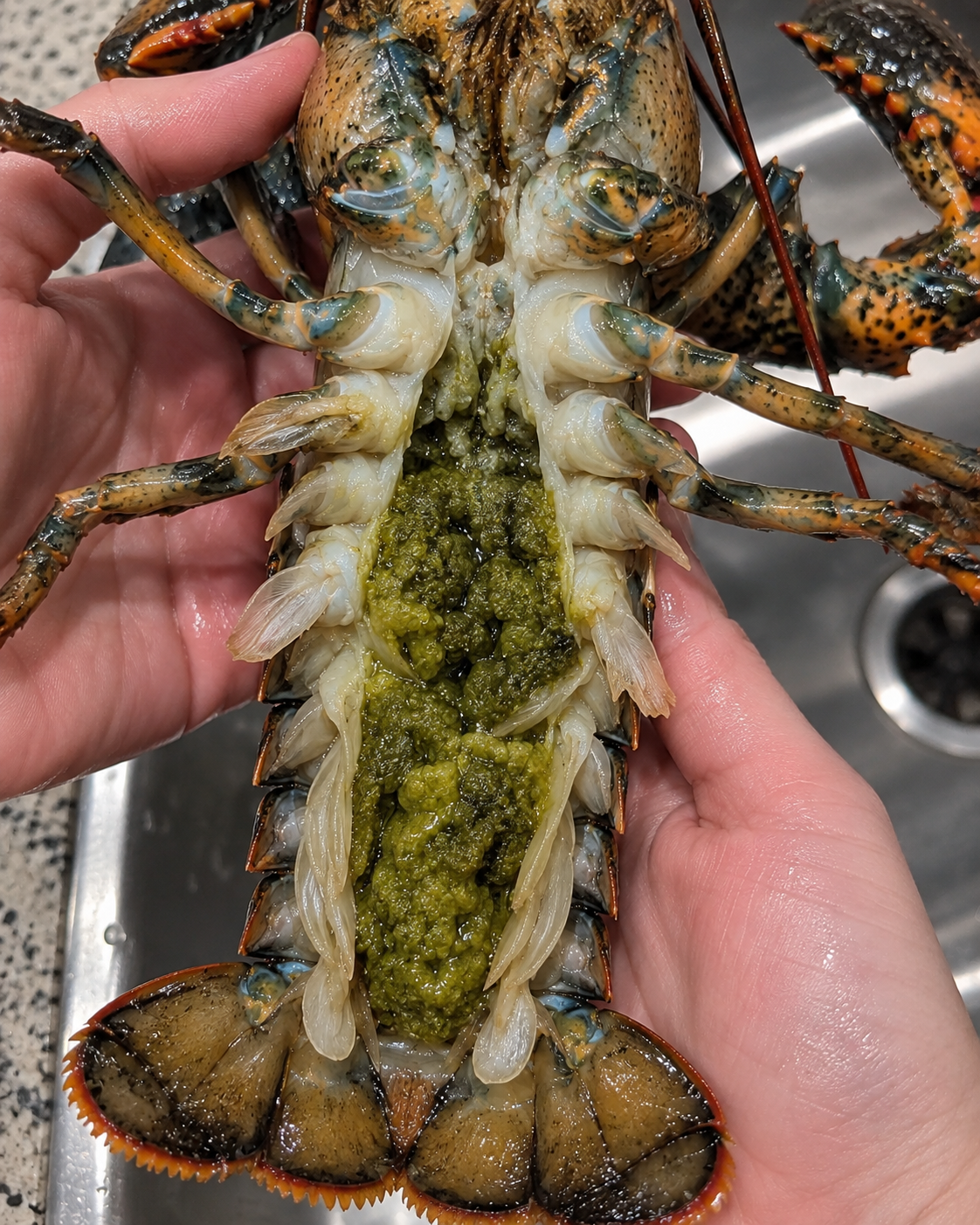
The Mystery of Lobster’s Green Goodies begins the moment you crack open a cooked lobster and discover soft green material inside the body cavity. If you have never seen it before, the color can make you wonder whether the lobster has spoiled. However, that green substance is usually tomalley, the lobster’s hepatopancreas, an organ that performs functions similar to the liver and pancreas.
Tomalley has traditionally been treated as a delicacy by some seafood lovers because of its rich, concentrated flavor. Still, The Mystery of Lobster’s Green Goodies comes with an important food-safety distinction that deserves more attention than the source article gives it. Current Maine public-health guidance advises everyone not to consume lobster tomalley because the organ can accumulate environmental contaminants.
Fortunately, that warning does not mean ordinary lobster meat carries the same concern. Maine’s guidance specifically distinguishes the meat from the tomalley, while federal fish advice lists American and spiny lobster among its “Best Choices.”
The first time I opened a whole lobster and noticed the green material inside, I stopped immediately. Nobody had warned me about it, and green was definitely not the color I expected to find in freshly cooked seafood. Someone at the table casually explained that it was tomalley and that many people considered it a delicacy. That answer made the discovery less mysterious, but it also made me curious enough to look beyond tradition. I eventually learned that knowing what a food is does not automatically answer whether you should eat it. With lobster, the difference between the green tomalley and the familiar meat matters.
What the Green Stuff Inside a Lobster Actually Is
Tomalley Is the Lobster’s Hepatopancreas
The soft green material inside a lobster’s body cavity has an anatomical purpose.
It is called tomalley.
More precisely, it is the hepatopancreas. The organ performs digestive and filtering functions that resemble functions performed by the liver and pancreas in other animals. Maine’s current shellfish guidance describes tomalley as the soft green substance in the lobster’s body cavity and notes its liver-like filtering role.
That explanation solves the first part of The Mystery of Lobster’s Green Goodies.
It is not simply an unidentified sauce created during cooking.
Nor does the green color automatically indicate spoilage.
Instead, it is a normal part of lobster anatomy.
Its texture differs noticeably from lobster meat.
Cooked lobster tail and claw meat should feel firm and fibrous. Tomalley, by comparison, usually has a much softer, paste-like consistency.
Some people historically prized that texture and concentrated seafood flavor.
They ate tomalley directly or incorporated it into sauces, stocks, and other preparations.
However, knowing that people traditionally ate an organ does not establish that eating it carries no risk.
The hepatopancreas helps process materials the lobster encounters in its environment. Consequently, contaminants can become concentrated there.
That filtering role explains why food-safety advice can differ sharply between lobster meat and tomalley.
So, if you open a lobster and find green paste in the body cavity, you do not need to assume the entire lobster has spoiled.
Instead, identify the material correctly and follow appropriate consumption guidance.
Green Material Is Not Always the Same Thing as Roe
The Mystery of Lobster’s Green Goodies becomes slightly more confusing because a female lobster can also contain roe.
Roe means eggs.
Depending on their stage and whether they have been cooked, lobster eggs can look quite different from tomalley.
Texture offers one clue.
Tomalley generally appears soft, smooth, or paste-like.
Roe has a more granular structure because it consists of many individual eggs.
Cooked mature roe can also develop a reddish or coral appearance, which explains the culinary term “coral” sometimes associated with lobster roe.
Therefore, do not rely entirely on the word “green” when identifying what you see.
Instead, consider both location and texture.
A smooth green paste inside the body cavity strongly suggests tomalley.
A mass composed of distinct tiny eggs suggests roe.
The distinction matters because they are different anatomical materials.
If you remain uncertain, you do not need to eat either substance.
You can remove the unfamiliar material and enjoy the properly cooked tail, claw, and knuckle meat.
That approach keeps The Mystery of Lobster’s Green Goodies simple for anyone who does not particularly want to eat lobster organs.
Why Tomalley Became a Delicacy and Why Guidance Has Changed
Its Rich Flavor Explains the Traditional Appeal
Tomalley has a long culinary reputation because it carries a concentrated lobster flavor.
People who enjoy it often describe the flavor as rich, briny, creamy, and intensely marine.
Its soft consistency also makes it easy to blend into other foods.
Traditionally, diners might eat a small amount directly from the shell.
Others might mix it with melted butter or incorporate it into seafood sauces and soups.
That culinary history explains why The Mystery of Lobster’s Green Goodies often gets framed as the discovery of a hidden delicacy.
Yet traditional popularity and current safety recommendations can coexist.
People have eaten many foods for generations before scientists gained a better understanding of environmental contaminants and natural marine toxins.
Modern guidance can therefore change how we approach a traditional ingredient.
In this case, Maine’s current recommendation is particularly straightforward: when eating lobster, do not eat the tomalley. The state notes that advisories have existed for years because of contaminants and biotoxins that can accumulate in this organ.
That guidance is more cautious than saying tomalley is simply “safe in moderation.”
Therefore, anyone rewriting older or simplified information about lobster should make that distinction clear.
You can appreciate why people historically valued tomalley without presenting it as a risk-free delicacy.
Meanwhile, the familiar lobster meat remains a separate part of the food-safety discussion.
Tomalley Can Concentrate Environmental Contaminants
The function of the hepatopancreas explains much of the concern.
Because the organ processes and filters materials from the lobster’s environment, contaminants can accumulate there.
Maine public-health authorities specifically cite this accumulation when advising against tomalley consumption.
Natural marine biotoxins can create another concern.
Certain algae produce potent toxins in ocean environments. Marine animals can accumulate these toxins without looking or tasting obviously contaminated.
Importantly, cooking does not necessarily solve that problem.
FDA guidance on paralytic shellfish toxins notes that contaminated seafood can appear normal and that these toxins cannot simply be removed by cooking or freezing.
Historically, the FDA has also warned consumers about paralytic shellfish poisoning toxins in American lobster tomalley during specific contamination events. That warning applied to the tomalley rather than ordinary lobster meat.
This distinction changes the practical answer to The Mystery of Lobster’s Green Goodies.
Seeing tomalley does not mean you should discard every edible piece of the lobster.
Instead, avoid the tomalley according to applicable public-health guidance and focus on the meat.
That approach preserves the enjoyable part of the meal without treating every internal lobster organ as equally desirable.
How to Handle Lobster Tomalley and Roe at the Table
Separate the Tomalley From the Meat
If you prefer to follow the cautious public-health approach, removing tomalley is straightforward.
After cooking and opening the lobster, identify the soft green material in the body cavity.
Use a spoon or utensil to remove it rather than mixing it into melted butter, sauce, stuffing, or broth.
Then continue extracting the familiar meat from the claws, knuckles, tail, and other edible areas.
If a small amount of green material touches the meat, you can wipe or scrape it away rather than assuming the entire lobster must go into the trash.
The goal is to avoid deliberately consuming the tomalley.
This method also makes serving whole lobster easier to understand for beginners.
Instead of wondering whether every substance inside the shell should be eaten, concentrate on the firm meat.
The Mystery of Lobster’s Green Goodies becomes much less confusing once you recognize that whole-animal cooking naturally exposes organs that diners do not necessarily need to consume.
The same basic principle applies when preparing lobster for another recipe.
If you plan to make lobster rolls, pasta, salad, or another dish, remove the meat and leave the tomalley out.
Likewise, do not automatically add the green material to stock simply because an older recipe suggests doing so.
Current safety guidance deserves priority over a traditional technique when the two conflict.
Treat Roe as a Separate Ingredient
If you discover roe rather than tomalley, identify it separately.
Roe consists of eggs, so it generally has a granular appearance rather than the smooth, paste-like consistency associated with tomalley.
The source article describes roe as another delicacy and notes a sweet, briny flavor.
However, source material alone does not establish a universal safety recommendation for every lobster roe preparation or harvesting location.
Therefore, local seafood advisories still matter.
Marine conditions can change.
Harvest restrictions and biotoxin closures can also vary by place and time.
For recreationally harvested seafood, checking local closure notices becomes especially important. Maine’s marine authorities, for example, actively monitor harmful algal biotoxins and publish closure information for affected harvesting areas.
For consumers buying lobster, purchasing from reputable commercial sources simplifies the process because regulated seafood channels incorporate safety controls.
Still, normal seafood-handling practices remain important.
Keep lobster cold before cooking.
Cook and serve it appropriately.
Refrigerate leftovers promptly.
And discard seafood that has been mishandled or shows genuine signs of spoilage.
The Mystery of Lobster’s Green Goodies should not distract from those ordinary food-safety practices.
Identifying tomalley correctly answers one question.
Handling the entire lobster safely answers another.
What You Should Remember Before Eating the Green Stuff
Lobster Meat and Tomalley Have Different Safety Profiles
One of the biggest mistakes people make with The Mystery of Lobster’s Green Goodies involves treating the entire lobster as one uniform food.
It is not.
The tail and claw meat differ anatomically from the hepatopancreas.
That difference matters because contaminants do not necessarily accumulate equally throughout the animal.
Current Maine guidance explicitly says there are no known safety considerations of the same type for lobster meat while advising consumers to refrain from eating tomalley.
Meanwhile, FDA fish-consumption guidance lists lobster among its “Best Choices” for mercury-focused fish advice.
Therefore, warnings about tomalley should not become generalized claims that lobster itself is unsafe.
The practical takeaway is much simpler.
Enjoy the properly sourced and cooked lobster meat.
Avoid tomalley when following current public-health recommendations.
Check local advisories when harvesting seafood yourself.
And remember that cooking cannot neutralize every marine toxin.
This balanced approach avoids two extremes.
You do not need to panic because you found green material inside a lobster.
However, you also should not assume that a traditional delicacy carries no modern safety concerns.
A Green Color Does Not Tell the Whole Story
Color catches our attention, but color alone provides limited information.
The green appearance of tomalley does not automatically mean spoilage.
Likewise, seafood that looks completely normal can sometimes contain toxins.
That is why official harvest monitoring and consumption advisories matter.
Maine’s marine authorities emphasize that shellfish affected by biotoxins may not look or taste different and that toxins cannot simply be cooked away.
Consequently, visual inspection cannot replace reliable sourcing.
Buy lobster from reputable sellers.
If you harvest seafood yourself, check current local closures and regulations.
Then distinguish the firm meat from the internal organs when preparing the lobster.
The Mystery of Lobster’s Green Goodies ultimately has a fairly simple answer.
The paste-like green substance is usually tomalley, the lobster’s hepatopancreas.
It has historically been eaten as a delicacy.
However, because this organ can accumulate contaminants, current public-health guidance in places such as Maine advises consumers not to eat it.
That is more useful than either calling the green material disgusting or celebrating it uncritically as a superfood.
Understanding what you are looking at allows you to make a more informed decision.
Frequently Asked Questions
What is the green stuff inside a lobster?
The soft green paste is usually tomalley, the lobster’s hepatopancreas. This organ performs functions similar to the liver and pancreas and can accumulate environmental contaminants.
Is lobster tomalley safe to eat?
Current Maine public-health guidance advises everyone not to consume lobster tomalley because contaminants and biotoxins can accumulate in the organ. That is more cautious than the source article’s claim that it is simply safe in moderation.
Does green tomalley mean the lobster is spoiled?
No. Tomalley is a normal organ, so its presence does not automatically indicate spoilage. However, its normal appearance also does not guarantee that it is free of environmental contaminants.
Is lobster roe the same as tomalley?
No. Roe consists of eggs, while tomalley is the hepatopancreas. Tomalley usually looks soft and paste-like, while roe has a more granular structure.
Can cooking remove toxins from lobster tomalley?
Do not rely on cooking to make contaminated tomalley safe. Certain marine biotoxins, including paralytic shellfish toxins, can withstand normal cooking.
Conclusion
The Mystery of Lobster’s Green Goodies has fascinated seafood eaters because the material looks so different from the familiar white lobster meat.
The answer begins with anatomy.
The soft green paste is generally tomalley, the lobster’s hepatopancreas.
Historically, many diners have prized it for its rich, concentrated seafood flavor.
However, modern food-safety guidance adds an important qualification.
Because the hepatopancreas acts as a filtering and digestive organ, it can accumulate contaminants from the lobster’s environment. Maine currently advises consumers not to eat lobster tomalley.
That recommendation does not mean you need to avoid lobster meat.
The meat has a different safety profile, and FDA fish advice lists lobster among its “Best Choices.”
So, when you crack open your next lobster and encounter the mysterious green material, you will know what you are seeing.
You can distinguish paste-like tomalley from granular roe.
You can remove the tomalley rather than mixing it into sauces or butter.
And you can continue enjoying properly sourced and prepared lobster meat.
Most importantly, The Mystery of Lobster’s Green Goodies shows why traditional food knowledge and current safety information should work together.
A food can have a long culinary history while still deserving updated advice.
Knowing the difference lets you enjoy lobster with curiosity, confidence, and a clearer understanding of what is actually inside the shell.
More The Crafty Nest
- Which Sitting Position Matches Your Personality? What Your Posture May Reveal
- What Your Sleep Position Says About Your Personality: 6 Fascinating Sleep Styles
- What Does a Handshake Symbol on a Parking Space Mean? Here’s What You Should Know
- A Teacher Deleted a Classroom Nap Photo Seconds After Posting It—One Parent Had Already Saved It