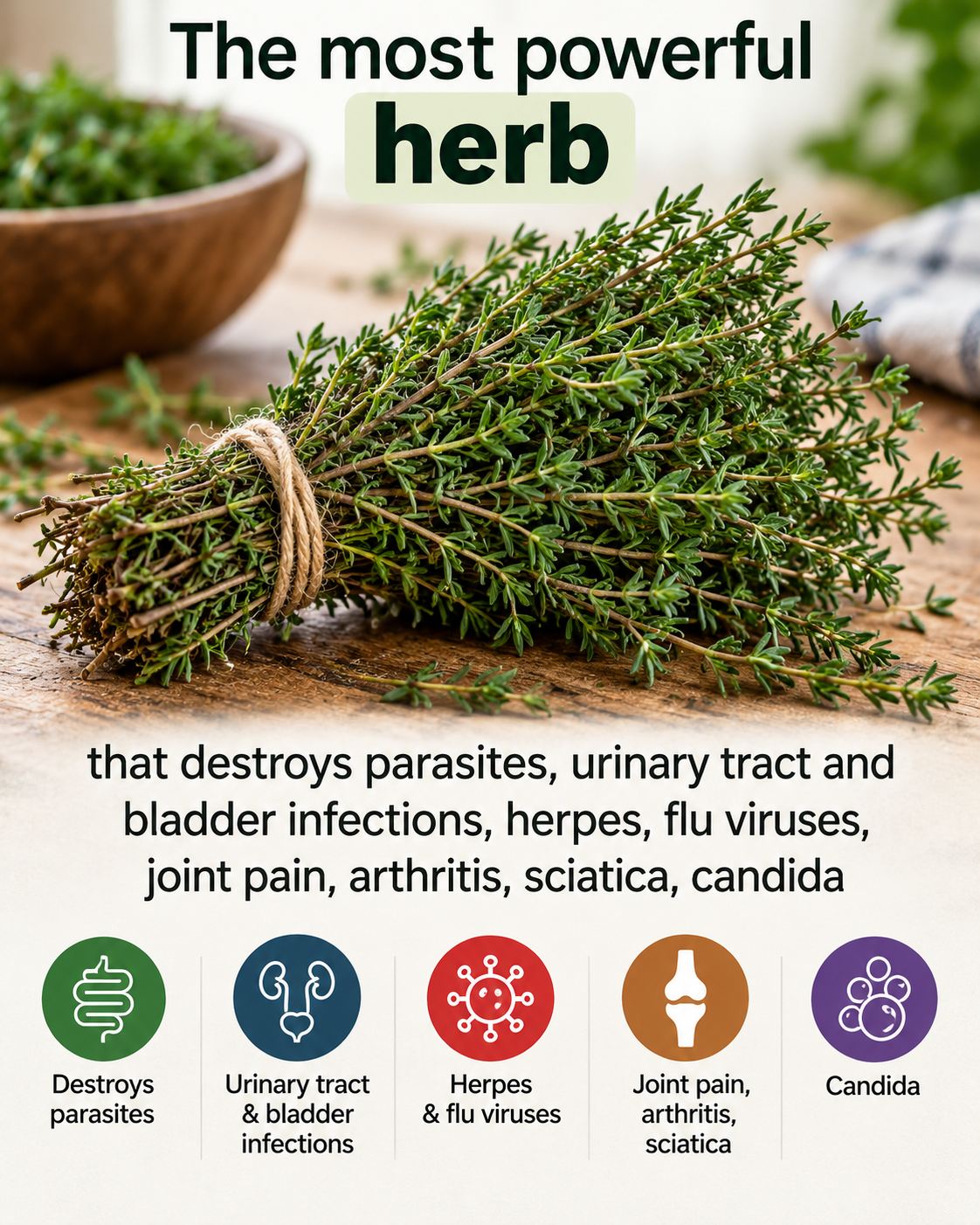
Thyme: What This Powerful Herb Can Really Do for Your Health sounds like a simple question, yet the answer deserves more nuance than many viral health claims provide. Thyme has a long culinary and traditional history, and researchers have studied several of its natural compounds, especially thymol and carvacrol. These compounds show antimicrobial, antioxidant, and anti-inflammatory activity in laboratory research. However, those findings do not mean that thyme can cure parasites, viral infections, arthritis, urinary problems, Candida infections, or other medical conditions in people.
The strongest practical case for thyme remains simple. It adds flavor, it contains biologically active plant compounds, and some regulated herbal preparations have a traditional role in relieving productive cough associated with colds. The European Medicines Agency classifies that cough use as traditional rather than as firmly proven by high-quality clinical trials.
I once started paying more attention to thyme after realizing how often dramatic health claims surrounded ordinary kitchen herbs. One post described thyme almost like a cure-all, while another dismissed it as nothing more than seasoning. Neither extreme felt useful. I began looking at what the evidence actually supported. That changed the way I used the herb. I stopped thinking of thyme as medicine in a spice jar and started appreciating it for what it does well: adding intense flavor, contributing useful plant compounds, and making simple foods more enjoyable. That approach felt much more practical, and it also made the health claims surrounding herbs easier to evaluate.
Why Thyme Attracts So Much Health Interest
Thymol and Carvacrol Explain Much of the Scientific Attention
Thyme contains many aromatic compounds, but thymol and carvacrol receive much of the scientific attention.
Researchers have studied both compounds extensively because they can interact with microbial cell membranes and other cellular targets. Reviews of thyme oil report antibacterial and antifungal activity in laboratory experiments, particularly from phenolic compounds such as thymol and carvacrol.
That sounds impressive, but context matters.
A substance can kill or inhibit bacteria in a laboratory dish without working safely or effectively as a treatment inside the human body.
Researchers control concentration, exposure time, temperature, and other conditions in laboratory experiments. Human treatment involves absorption, metabolism, dosage, tissue penetration, side effects, interactions, and many other factors.
Therefore, lab activity should create scientific interest rather than certainty.
Recent reviews continue to describe thymol and carvacrol as promising compounds with antimicrobial and anti-inflammatory properties. However, they also emphasize the need for more research before translating many of these findings into therapeutic use.
That distinction helps explain why thyme can appear in both traditional medicine and modern scientific research without qualifying as a cure for a long list of diseases.
Thyme: What This Powerful Herb Can Really Do for Your Health becomes much clearer when you separate promising compounds from proven treatments.
The herb contains interesting chemistry.
That chemistry deserves study.
However, it does not automatically justify every claim attached to thyme online.
Traditional Cough Use Has More Support Than Most Viral Claims
Among the many health claims attached to thyme, respiratory use has one of the clearest traditional foundations.
The European Medicines Agency states that certain thyme preparations can be used traditionally for productive coughs associated with colds. Importantly, the agency bases this conclusion on long-standing use rather than strong clinical-trial evidence. It also notes that available studies have limitations.
That makes the wording important.
Thyme may have a traditional role in easing cough symptoms.
That does not mean thyme cures respiratory infections.
Likewise, a warm thyme tea may feel soothing because of the warmth, aroma, hydration, and ritual itself.
Comfort still has value.
However, comfort differs from curing an infection.
If a cough becomes severe, lasts longer than expected, causes breathing difficulty, produces blood, or occurs with other concerning symptoms, medical evaluation matters more than any herbal tea.
The EMA also notes that users should seek professional advice if symptoms worsen or persist beyond the recommended period for a thyme preparation.
This balanced view gives thyme appropriate credit without exaggeration.
It has a long traditional history.
Some standardized products may have a place in cough care.
However, researchers still lack the level of evidence required to support the sweeping claims that frequently appear in social media posts.
What Thyme Can Realistically Contribute to Everyday Health
It Adds Strong Flavor Without Requiring Heavy Sauces or Excess Salt
One of thyme’s most practical strengths sits right in the kitchen.
Fresh or dried thyme can make vegetables, beans, soups, chicken, fish, eggs, potatoes, sauces, and whole grains taste richer without depending on large amounts of salt, sugar, or heavy sauces.
That matters because sustainable healthy eating often depends on flavor.
People may know that they should eat more vegetables or cook more meals at home, yet bland food rarely inspires consistency.
Herbs solve that problem beautifully.
Thyme brings an earthy, savory flavor that works across many dishes.
You can add it to roasted carrots.
You can stir it into lentil soup.
You can season chicken with thyme, garlic, and lemon.
You can sprinkle it over potatoes before roasting.
You can also combine it with parsley, rosemary, oregano, or sage.
Therefore, thyme can support a healthier dietary pattern indirectly by making minimally processed foods more enjoyable.
The herb itself does not need to perform a dramatic medicinal function to contribute something useful.
That point often gets lost when online claims focus on parasites, viruses, or miracle detox effects.
Thyme: What This Powerful Herb Can Really Do for Your Health includes ordinary benefits too.
Sometimes the most valuable health contribution comes from helping people cook flavorful meals more often.
Moreover, culinary thyme gives people exposure to the herb in a form with a long history of normal food use.
That approach differs dramatically from consuming concentrated essential oils or unusually large supplement doses.
Thyme Provides Plant Compounds With Antioxidant and Antimicrobial Activity
Scientists have documented antioxidant, antimicrobial, and anti-inflammatory properties in thyme-derived compounds.
Recent scientific reviews describe thymol and carvacrol as biologically active substances with broad experimental effects.
However, these properties often come from test-tube, animal, food-science, or concentrated-extract research.
That distinction matters because eating thyme on roasted vegetables does not produce the same exposure as applying purified thymol to cultured bacteria in a laboratory.
Still, these findings explain why scientists remain interested in thyme.
For example, food scientists have investigated thyme essential oil and its compounds as potential antimicrobial agents in food preservation. Reviews describe activity against several bacteria and fungi under controlled conditions.
Researchers have also studied carvacrol and thymol against Candida species and other microorganisms in vitro. Those results support further study, but they do not prove that eating thyme or drinking thyme tea can cure candidiasis.
The same principle applies to antioxidant effects.
A compound can neutralize oxidative reactions in an experiment without becoming a proven treatment for chronic disease.
Therefore, the evidence supports a modest conclusion.
Thyme contains interesting plant chemistry.
That chemistry may have useful applications.
Yet consumers should not convert laboratory findings into medical promises.
Claims About Parasites, Viruses, Candida, and Pain Need Caution
Laboratory Activity Does Not Prove Thyme Can Cure Infections
One of the biggest problems with viral thyme claims involves the jump from laboratory findings to human treatment.
Researchers have reported antimicrobial, antifungal, and antiviral activity from thyme oils or isolated compounds under controlled experimental conditions. Some reviews describe laboratory activity against Candida, herpes simplex virus, influenza strains, and several bacterial species.
However, those findings do not establish thyme as a treatment for those infections in humans.
A person with herpes, influenza, candidiasis, a urinary tract infection, or a parasitic infection needs the correct diagnosis.
Different infections require different treatments.
Some conditions resolve with supportive care.
Others need antiviral, antifungal, antibiotic, or antiparasitic medication.
Therefore, using thyme instead of appropriate treatment can create a real problem if it delays diagnosis.
Claims about parasites deserve particular caution.
The phrase “kills parasites” sounds dramatic, yet parasites include many different organisms with completely different life cycles and treatments.
A laboratory result involving one compound and one organism cannot justify a general statement about all parasitic infections.
Likewise, urinary symptoms do not automatically mean infection.
Painful urination, urgency, blood in the urine, fever, back pain, or repeated urinary symptoms deserve proper evaluation.
Thyme: What This Powerful Herb Can Really Do for Your Health should never turn into advice to replace testing or treatment with herbs.
The evidence simply does not support that leap.
Thyme Does Not Have Proven Curative Effects for Arthritis or Sciatica
Online posts also connect thyme with arthritis, joint pain, nerve pain, and sciatica.
These claims often rely on the fact that thymol and carvacrol show anti-inflammatory activity in experimental systems.
However, anti-inflammatory activity in cells or animals does not prove that culinary thyme can treat arthritis in people.
Arthritis itself includes several different conditions.
Osteoarthritis involves joint degeneration.
Rheumatoid arthritis involves autoimmune inflammation.
Gout involves uric acid crystal deposition.
Other forms have different causes.
Sciatica creates an even clearer example.
Sciatica usually involves irritation or compression of the sciatic nerve.
That problem can come from a herniated disc, spinal narrowing, or another structural cause.
Therefore, calling thyme a sciatica treatment oversimplifies the condition.
Persistent pain deserves proper evaluation, particularly when it causes weakness, numbness, difficulty walking, or changes in bladder or bowel control.
A culinary herb cannot replace that assessment.
Thyme may still belong in an overall nutritious diet.
It may also provide flavor when someone wants to reduce reliance on rich sauces or excessive salt.
However, that practical role differs from treating a musculoskeletal or neurological disorder.
Keeping those categories separate protects people from unrealistic expectations.
How to Use Thyme Safely and Sensibly
Culinary Thyme and Thyme Essential Oil Are Very Different Products
This distinction matters more than almost any other point in the discussion.
A pinch of dried thyme in soup does not equal a bottle of thyme essential oil.
Essential oils contain highly concentrated volatile compounds.
Therefore, a quantity that looks small can deliver far more active material than a normal culinary serving.
That concentration changes the safety picture.
People should not assume that because thyme leaves are commonly used in food, swallowing thyme essential oil carries the same risk.
Concentrated essential oils can irritate tissues, trigger allergic reactions, and create toxicity problems when people use them incorrectly.
Therefore, avoid treating essential oils like beverages, seasonings, or casual supplements.
Pregnant people, children, people taking medications, and individuals with significant medical conditions deserve particular caution with concentrated herbal products.
Standardization matters too.
Commercial herbal preparations can vary greatly in concentration and formulation.
The EMA’s thyme monograph applies to specific traditional preparations rather than every homemade extract or essential oil sold online.
That point prevents another common mistake.
You cannot automatically transfer evidence from one standardized product to another preparation with a completely different concentration.
Thyme: What This Powerful Herb Can Really Do for Your Health therefore has two very different answers depending on the product.
Culinary thyme offers flavor and normal food use.
Concentrated extracts and essential oils require much more caution.
The Best Everyday Approach Keeps Thyme in the Kitchen
For most people, the easiest way to enjoy thyme involves food.
Use fresh thyme leaves in soups.
Add dried thyme to beans.
Season roasted vegetables with thyme and olive oil.
Combine it with garlic and lemon for chicken or fish.
Mix it into eggs.
Stir it into whole grains.
Add it to tomato-based sauces.
This approach gives you the herb’s flavor without requiring exaggerated health promises.
Thyme tea may also fit into a normal routine for many adults, especially as a warm beverage.
However, treat it as tea rather than as a cure.
If you use a packaged herbal medicinal product, follow the product instructions and pay attention to age restrictions, warnings, and duration of use.
The EMA notes that traditional thyme cough preparations come in different forms and that suitability can vary by age and formulation.
Finally, place thyme within a broader dietary pattern.
No single herb can compensate for an unbalanced diet, untreated disease, poor sleep, smoking, or other major health factors.
A varied eating pattern built around vegetables, fruits, legumes, whole grains, nuts, seeds, adequate protein, and minimally processed foods provides a stronger foundation.
Thyme can make that pattern taste better.
That may sound less exciting than “destroying parasites,” but it reflects the evidence far more accurately.
Frequently Asked Questions
Can thyme kill parasites in humans?
Current evidence does not establish culinary thyme or thyme tea as a proven treatment for human parasitic infections. Laboratory findings involving thyme compounds do not replace diagnosis or prescription antiparasitic treatment when needed.
Is thyme useful for coughs?
Certain thyme preparations have a recognized traditional use for productive cough associated with colds. However, the European Medicines Agency notes that strong clinical evidence remains limited.
Can thyme cure Candida?
No reliable clinical evidence shows that eating thyme or drinking thyme tea cures candidiasis. Thyme compounds show antifungal activity against Candida in laboratory studies, but laboratory activity does not equal proven treatment in humans.
Can thyme treat flu or herpes?
Laboratory studies have explored antiviral activity from thyme essential oil, but that does not establish thyme as a clinical treatment for influenza or herpes infections.
Is thyme essential oil safe to swallow?
Do not assume thyme essential oil has the same safety profile as culinary thyme. Essential oils contain highly concentrated compounds, so misuse can create irritation or toxicity risks.
Conclusion
Thyme: What This Powerful Herb Can Really Do for Your Health has a more interesting answer than either extreme suggests.
Thyme is not meaningless.
It contains compounds such as thymol and carvacrol that researchers continue to study for antimicrobial, antioxidant, and anti-inflammatory properties.
Likewise, certain thyme preparations have a recognized traditional role in managing productive cough associated with colds, although strong clinical-trial evidence remains limited.
However, thyme does not have established evidence as a cure for parasites, influenza, herpes, Candida infections, arthritis, sciatica, urinary infections, or a long list of unrelated diseases.
That distinction matters.
Promising laboratory findings can guide future research.
They cannot automatically guide home treatment.
The safest everyday approach keeps thyme where it already works exceptionally well: in food.
Use it to flavor roasted vegetables.
Add it to soups and beans.
Season fish, chicken, eggs, potatoes, and whole grains.
Enjoy thyme tea as a beverage if it suits you.
At the same time, treat essential oils and concentrated extracts with much greater caution.
Most importantly, seek appropriate medical care for suspected infections, persistent pain, significant respiratory symptoms, or other ongoing health problems.
Thyme deserves appreciation without exaggeration.
Its strongest story does not depend on miracle claims.
It already offers flavor, aromatic plant compounds, a long culinary tradition, and scientifically interesting chemistry.
Sometimes the most sensible way to enjoy a powerful herb really is the simplest one: put it on dinner.
More Home Remedies
- Wrinkled Fingers After Water Exposure: What Your Skin May Be Telling You
- Skin Rash With Breathing Trouble? It Could Be a Life-Threatening Allergic Reaction
- I Thought It Was a Piece of Trash on the Bathroom Floor—Until It Moved
- If You Are Getting White Pimples on Your Lips or Intimate Area, Here’s What They Could Mean