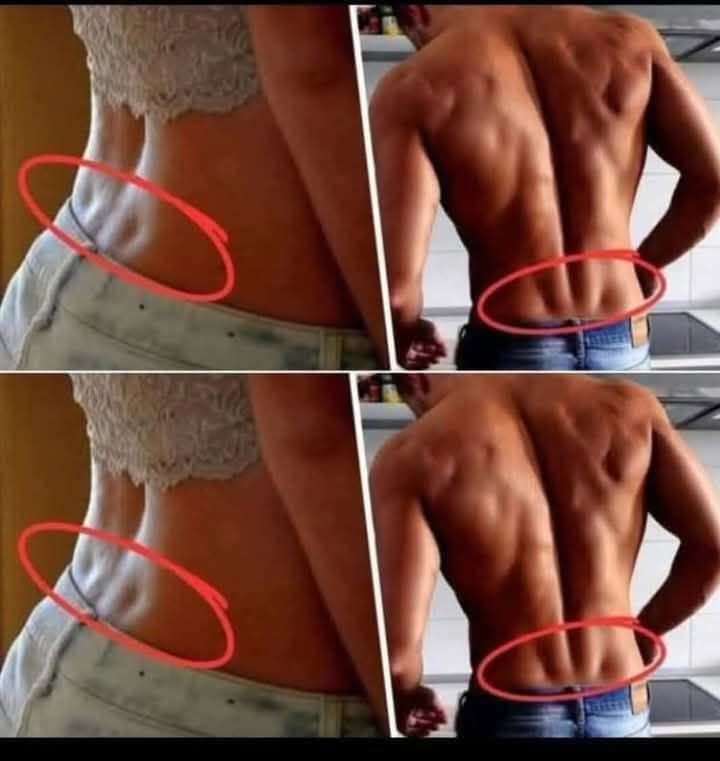
Have you ever looked in the mirror while getting dressed and noticed two small, symmetrical indentations on your lower back?
Maybe you’ve always had them. Or perhaps you only recently noticed them and wondered what they were.
These little marks are sometimes called “Dimples of Venus” in women and “Dimples of Apollo” in men. They have inspired plenty of myths about beauty, fitness, health, and even fertility.
But what do these dimples actually mean?
The answer is much simpler — and just as fascinating. They are usually a normal feature of human anatomy and are found in the area around the back of the pelvis.
Let’s take a closer look.
What Are Lower-Back Dimples?
The small indentations are typically located over the posterior superior iliac spines (PSIS), which are two bony points that can be felt near the back of the pelvis.
If you place your hands on your lower back and feel for the two prominent points of bone on either side, you’re approximately locating this area.
The appearance of the dimples is influenced by the underlying shape of the pelvis, the arrangement of connective tissues, muscles, and ligaments, and the way the skin and soft tissues attach around the area.
In other words, they’re part of your individual anatomy.
They aren’t holes, wounds, or abnormalities.
Why Do Some People Have Them?
Human bodies come in countless shapes and variations.
Some people have very visible lower-back dimples, while others have subtle ones. Some people don’t have them at all.
Their visibility can also change depending on factors such as body composition, muscle development, posture, and the way light falls across the skin.
That means a person may notice the dimples becoming more or less prominent over time without anything being wrong.
There isn’t a simple rule that says everyone with a particular body type will have them.
Are They Genetic?
Genetics certainly influence the shape of our bones, connective tissues, and overall body structure, so inherited anatomy likely plays a role in whether these dimples are noticeable.
However, it’s too simplistic to say that they are caused by one specific gene or a particular “short ligament” inherited from your parents.
Like many physical characteristics, their appearance is probably the result of multiple anatomical and genetic factors.
Are Lower-Back Dimples a Sign of Good Health?
Not necessarily.
This is one of the most common misconceptions surrounding them.
Having lower-back dimples doesn’t mean that you’re healthier, fitter, stronger, or more physically attractive according to any medical standard.
Likewise, not having them doesn’t indicate poor health.
They are simply one of the many natural variations in human anatomy.
A person can be extremely fit and have no visible dimples, while another person who rarely exercises may have very prominent ones.
Do They Say Anything About Your Pelvic Alignment?
You may have encountered claims online suggesting that these dimples prove that your pelvis is perfectly aligned.
That’s not something you should rely on.
The appearance of the skin over your pelvis isn’t a reliable way to determine whether your spine or pelvis is properly aligned.
If you’re experiencing persistent back pain, hip pain, numbness, weakness, or difficulty moving, a healthcare professional can assess your musculoskeletal system properly.
Your dimples can’t perform that job.
What About Beauty and the Name “Dimples of Venus”?
The name “Dimples of Venus” comes from the association of Venus, the Roman goddess of love and beauty, with physical attractiveness.
The term is mostly aesthetic rather than medical.
Throughout history, artists have often celebrated particular body features as symbols of beauty. But beauty standards change dramatically between cultures and generations.
So while many people find lower-back dimples attractive, there’s nothing medically superior about having them.
They’re simply one of the countless details that can make an individual body distinctive.
What About Fertility?
Another popular claim is that women with these dimples are more fertile.
There is no good medical evidence that the presence of lower-back dimples determines fertility.
Fertility is influenced by many complex factors, including reproductive anatomy, hormones, age, genetics, and overall health.
A pair of dimples on the lower back cannot tell you whether someone is fertile.
Don’t Confuse Them With a Sacral Dimple
There is one important distinction worth knowing.
A sacral dimple is different from the typical dimples located symmetrically over the upper part of the buttocks.
A sacral dimple is usually a small indentation located in the midline, around the lower spine or sacral area. Most are harmless, particularly when they are small and isolated.
However, certain unusual features can warrant medical evaluation.
Seek medical advice if a dimple is accompanied by things such as:
- A tuft of hair
- A skin tag
- Significant discoloration
- Drainage or bleeding
- A deep or unusually large indentation
- A nearby lump
- Changes that develop suddenly
- Neurological symptoms such as leg weakness or numbness
These features don’t automatically mean something serious is happening, but they are worth having checked.
What About a Pilonidal Dimple?
There’s another condition that can sometimes be confused with an ordinary skin indentation: a pilonidal sinus or cyst.
Pilonidal disease usually develops in the cleft between the buttocks, near the tailbone. Unlike ordinary anatomical dimples, it can become painful, swollen, infected, or produce drainage.
If an indentation becomes red, painful, swollen, warm, or starts draining pus or blood, don’t assume it’s simply a cosmetic dimple. Have it evaluated by a healthcare professional.
Your Body Doesn’t Need to Be “Perfect”
It’s easy to get caught up in the endless list of things the internet tells us our bodies are supposed to mean.
A certain mark supposedly reveals your personality.
A particular body shape supposedly proves you’re healthy.
A tiny feature supposedly predicts your attractiveness or fertility.
Most of the time, human anatomy is far more complicated than these claims suggest.
Those two little indentations on your lower back don’t need to have a hidden meaning.
They don’t have to prove anything about you.
They’re simply part of the remarkable variation that makes every human body different.
The Bottom Line
If you have two small, symmetrical dimples on your lower back, they’re most likely a normal anatomical feature.
They don’t automatically indicate exceptional fitness, perfect pelvic alignment, fertility, or superior health. Their appearance is influenced by your individual anatomy, including the structure of your pelvis and the surrounding soft tissues.
And if you don’t have them?
That’s completely normal too.
Our bodies aren’t manufactured from a single template. Some people have freckles. Some have dimples in their cheeks. Some have distinctive birthmarks. Others have small anatomical features that nobody else notices.
Those differences are part of what makes the human body so interesting.
So the next time you notice those little lower-back dimples in the mirror, you don’t need to wonder whether they’re trying to tell you a secret.
They may simply be reminding you of something much more beautiful:
Your body has its own design. And it doesn’t have to look like anyone else’s to be perfectly normal.
More Home Remedies
- Wrinkled Fingers After Water Exposure: What Your Skin May Be Telling You
- Skin Rash With Breathing Trouble? It Could Be a Life-Threatening Allergic Reaction
- I Thought It Was a Piece of Trash on the Bathroom Floor—Until It Moved
- If You Are Getting White Pimples on Your Lips or Intimate Area, Here’s What They Could Mean