There is nothing more disappointing than bringing home a big, beautiful watermelon, cutting it open, and discovering that it is pale, bland, or disappointingly dry.
Fortunately, you don’t need to rely entirely on the traditional “thump test” to choose a good watermelon. A few simple visual and physical clues can help you select a melon that is more likely to be ripe, juicy, and flavorful.
The next time you’re at the grocery store, farmers’ market, or roadside stand, look for these signs.
1. Look for a Large Yellow Field Spot
One of the easiest clues to spot is the field spot — the area where the watermelon rested on the ground while growing.
Look for a creamy yellow, deep yellow, or even yellow-orange patch.
A very white or pale-green field spot can indicate that the watermelon may have been harvested before it had fully matured.
The field spot isn’t an absolute guarantee of sweetness, but it is one of the more useful visual clues when comparing several watermelons.
2. Don’t Be Afraid of Brown Webbing
Those rough, brown, web-like marks on the rind may make a watermelon look less attractive, but they aren’t necessarily a bad thing.
These markings are areas where the rind has developed scar tissue as the fruit grew. They can occur for several reasons, including insect activity and natural growth.
Rather than rejecting a watermelon simply because it isn’t perfectly smooth, consider the whole melon. A little surface scarring doesn’t mean the fruit will be poor quality.
3. Check the Stem
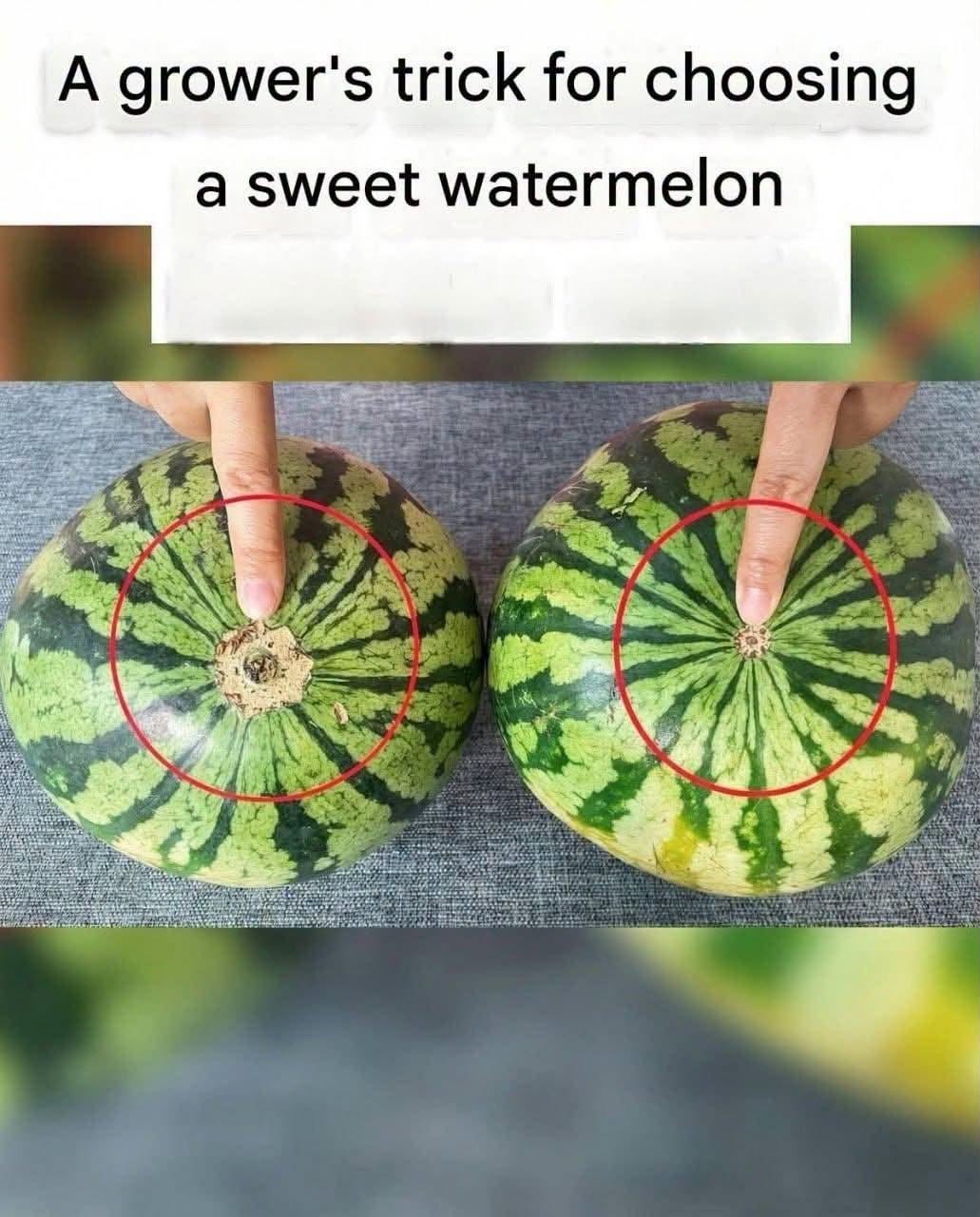
If the watermelon still has part of its stem attached, take a look at its color.
A dry, brownish stem can be a useful indication that the fruit was harvested after reaching a more mature stage.
A bright green stem may suggest that the watermelon was harvested relatively recently or before it had fully matured.
However, don’t use the stem as your only test. A stem can change appearance after harvest, so it is best considered together with the other signs.
4. Choose a Symmetrical Watermelon
Look for a watermelon that is fairly symmetrical and evenly developed.
It can be round, oval, elongated, or another shape depending on the variety. What matters more is that it doesn’t have major dents, soft-looking areas, or unusual irregularities.
A misshapen watermelon isn’t automatically bad, but when you’re choosing between several similar melons, an evenly formed one can be a reasonable choice.
5. Pick the Heaviest One for Its Size
This is one of the simplest tests you can perform.
Pick up two or three watermelons that are approximately the same size. Choose the one that feels heavier than the others.
A watermelon contains a lot of water, so a heavier melon for its size can be a good sign that it is juicy and well hydrated.
You don’t need to calculate anything. Just compare them in your hands.
6. Look for a Dull, Healthy Rind
A very shiny watermelon isn’t necessarily a bad watermelon, but many ripe watermelons develop a somewhat duller appearance as they mature.
Look for a rind that appears healthy and firm, without obvious soft spots, deep bruises, cracks, or areas that look damaged.
The color and pattern will vary depending on the variety, so don’t worry if your watermelon doesn’t look exactly like another one at the market.
A Simple Watermelon-Picking Routine
When you’re faced with a pile of watermelons, don’t overthink it.
Start by looking for a large creamy-yellow field spot. Then compare several melons and pick one that feels heavy for its size.
Next, check that it has a firm, reasonably symmetrical shape and doesn’t have obvious bruises, cracks, or soft areas. If a stem is visible, a dry or brown stem can be another positive clue.
You can then use the rind’s appearance and markings as additional information rather than relying on any single feature.
What About the Thump Test?
The familiar practice of tapping or thumping a watermelon is still popular, but it can be difficult to interpret consistently.
Some people say a ripe watermelon should produce a deep, hollow sound, while an unripe or overripe melon may sound different. The problem is that judging these subtle differences takes experience, and even experienced shoppers won’t always get it right.
That’s why a combination of appearance, weight, and condition can be more practical than relying on sound alone.
The Bottom Line
There is no completely foolproof way to predict exactly how sweet a whole watermelon will taste before cutting it open. Variety, growing conditions, maturity, and harvesting all influence the final flavor.
Still, you can improve your chances considerably by remembering a few simple rules:
- Look for a creamy yellow field spot.
- Choose a watermelon that feels heavy for its size.
- Avoid obvious bruises, cracks, and soft spots.
- Prefer a reasonably symmetrical, well-developed shape.
- Don’t automatically reject a melon because of brown webbing or surface markings.
- If there is a stem, a dry brown stem can be a useful maturity clue.
The next time you’re shopping for watermelon, skip the guesswork and give your selection a quick visual inspection. With a little practice, you’ll become much better at spotting the melons most likely to be juicy, ripe, and delicious.
More Home Remedies
- Wrinkled Fingers After Water Exposure: What Your Skin May Be Telling You
- Skin Rash With Breathing Trouble? It Could Be a Life-Threatening Allergic Reaction
- I Thought It Was a Piece of Trash on the Bathroom Floor—Until It Moved
- If You Are Getting White Pimples on Your Lips or Intimate Area, Here’s What They Could Mean