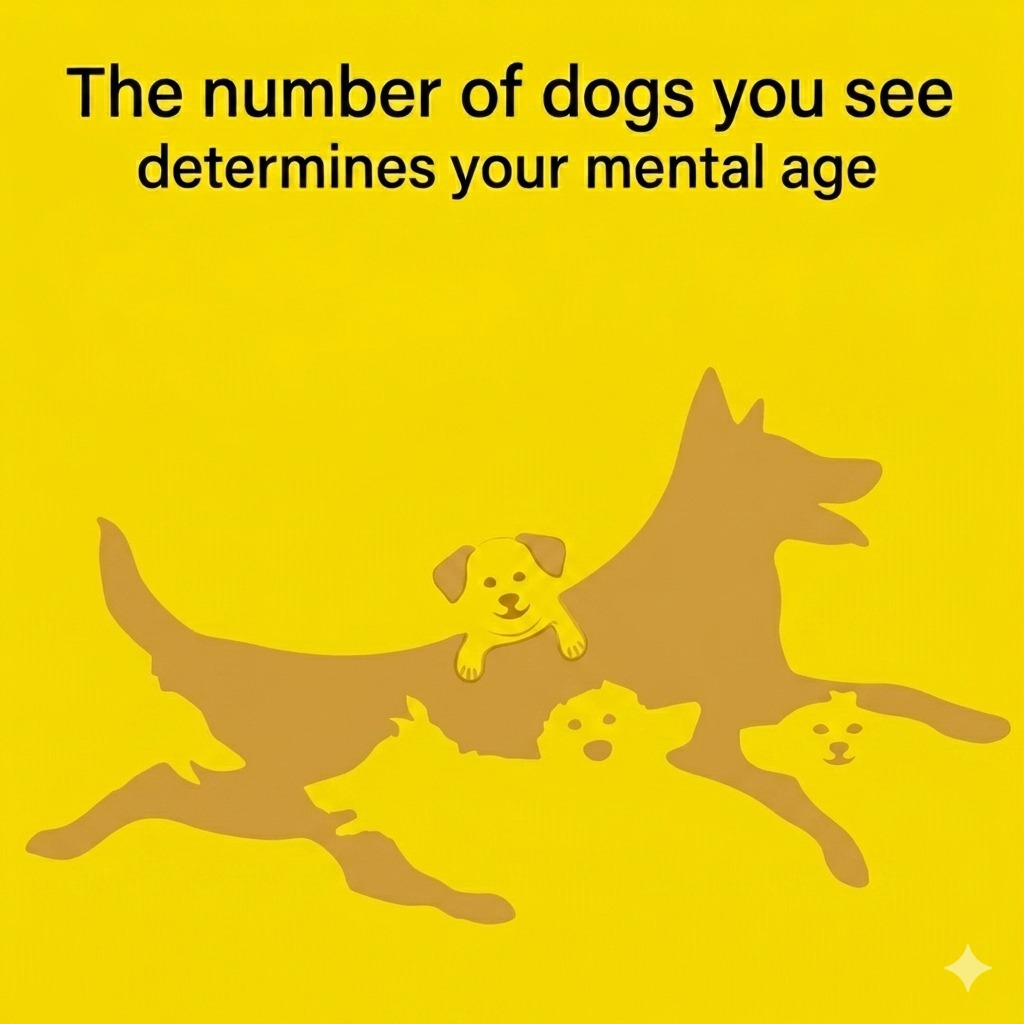
How Many Dogs Do You See is one of those viral visual puzzles that instantly grabs attention. At first glance, it seems like a simple question. However, as you look closer, more shapes begin to appear, and suddenly the answer isn’t so obvious. While many claim your answer reveals your “mental age,” the truth is much more interesting—and far more grounded in how your brain processes visual information.
I remember the first time I saw one of these images. I quickly counted a few dogs and felt confident in my answer. Then a friend pointed out shapes I completely missed. Suddenly, I saw more dogs hidden in the image, and my answer changed. That moment made me realize how differently our brains interpret the same picture. Since then, I’ve enjoyed these puzzles not for what they claim to reveal, but for how they challenge the way I see things.
Why Your Brain Sees Different Numbers
How Visual Perception Works
Your brain constantly tries to simplify what you see. When looking at a complex image, it focuses on the most obvious shapes first. These are usually the largest or most clearly defined objects.
However, once your brain processes those, it may start identifying smaller or hidden details. This is why you might initially see only a few dogs, but later notice more.
Because of this layered processing, everyone experiences the image differently. Some people naturally scan for details, while others focus on the bigger picture.
The Role of Attention and Focus
Attention plays a major role in what you see. If you quickly glance at the image, you may only notice the most obvious dogs. On the other hand, if you take your time, you’re more likely to spot hidden shapes.
Your focus also shifts depending on how you approach the puzzle. For example, actively searching for more dogs encourages your brain to look deeper into the image.
As a result, the number you see can change within seconds simply by adjusting your focus.
The Truth Behind the “Mental Age” Claim
Why It’s Not Scientifically Accurate
Many viral posts suggest that the number of dogs you see reveals your mental age. While this idea is fun, it lacks scientific evidence.
Your answer depends more on observation skills, patience, and visual interpretation than on age or intelligence. Two people of the same age can see completely different numbers.
Because of this, these tests should be viewed as entertainment rather than a serious assessment.
What It Actually Reflects
Instead of revealing mental age, this puzzle highlights how your brain processes patterns. It shows how quickly you identify shapes and how willing you are to search for hidden details.
It also reflects your attention to detail. People who take more time often find more shapes, not because they are “younger” mentally, but because they explore the image more thoroughly.
Understanding this makes the experience more enjoyable and less misleading.
How to Spot More Hidden Dogs
Simple Techniques That Help
If you want to find more dogs in the image, a few simple strategies can make a difference.
Start by scanning the image slowly from one side to the other. This prevents your brain from skipping over details.
Next, change your perspective. Sometimes stepping back or looking at the image from a distance helps reveal hidden shapes.
You can also try focusing on negative space—the areas between obvious shapes. Many hidden dogs are cleverly blended into these spaces.
Training Your Brain to See More
Like any skill, observation improves with practice. The more you engage with visual puzzles, the better your brain becomes at spotting patterns.
Over time, you may notice that you can identify hidden shapes more quickly. This doesn’t mean your brain has changed dramatically—it simply means you’ve trained it to look differently.
This process can be both fun and mentally stimulating.
Why These Puzzles Are So Popular
The Appeal of Quick Challenges
People enjoy puzzles that are easy to start but challenging to solve. These images offer instant engagement while still providing a sense of accomplishment.
They also create curiosity. Once you realize there are more shapes than you initially saw, you feel motivated to keep searching.
Because of this, these puzzles spread quickly and capture attention across different audiences.
Social Sharing and Comparison
Another reason for their popularity is the ability to compare answers. People enjoy discussing how many dogs they found and seeing how others respond.
This creates a shared experience. Even though the puzzle is simple, it sparks conversation and interaction.
In the end, it’s less about the “correct” answer and more about the experience of discovering something new.
Frequently Asked Questions
Is there a correct number of dogs in the image?
Yes, most puzzles have a set number. However, it depends on how the image is designed and interpreted.
Why do some people see more dogs than others?
Differences in attention, focus, and observation skills all play a role.
Does this test measure intelligence?
No, it does not measure intelligence or mental age. It reflects visual perception only.
Can I improve my ability to spot hidden shapes?
Yes, practicing with similar puzzles can improve your observation skills over time.
Why do I see more dogs after looking longer?
Your brain begins to process deeper details once it moves past the most obvious shapes.
Conclusion
How Many Dogs Do You See is a fun and engaging puzzle that reveals more about how your brain works than about your age or personality. While the idea of a “mental age” adds excitement, the real value lies in understanding perception and attention.
By taking your time and exploring the image carefully, you can uncover more hidden details and enjoy the challenge even more. In the end, it’s not about the number you find—it’s about the experience of seeing something new each time you look.
More Home Remedies
- Wrinkled Fingers After Water Exposure: What Your Skin May Be Telling You
- Skin Rash With Breathing Trouble? It Could Be a Life-Threatening Allergic Reaction
- I Thought It Was a Piece of Trash on the Bathroom Floor—Until It Moved
- If You Are Getting White Pimples on Your Lips or Intimate Area, Here’s What They Could Mean