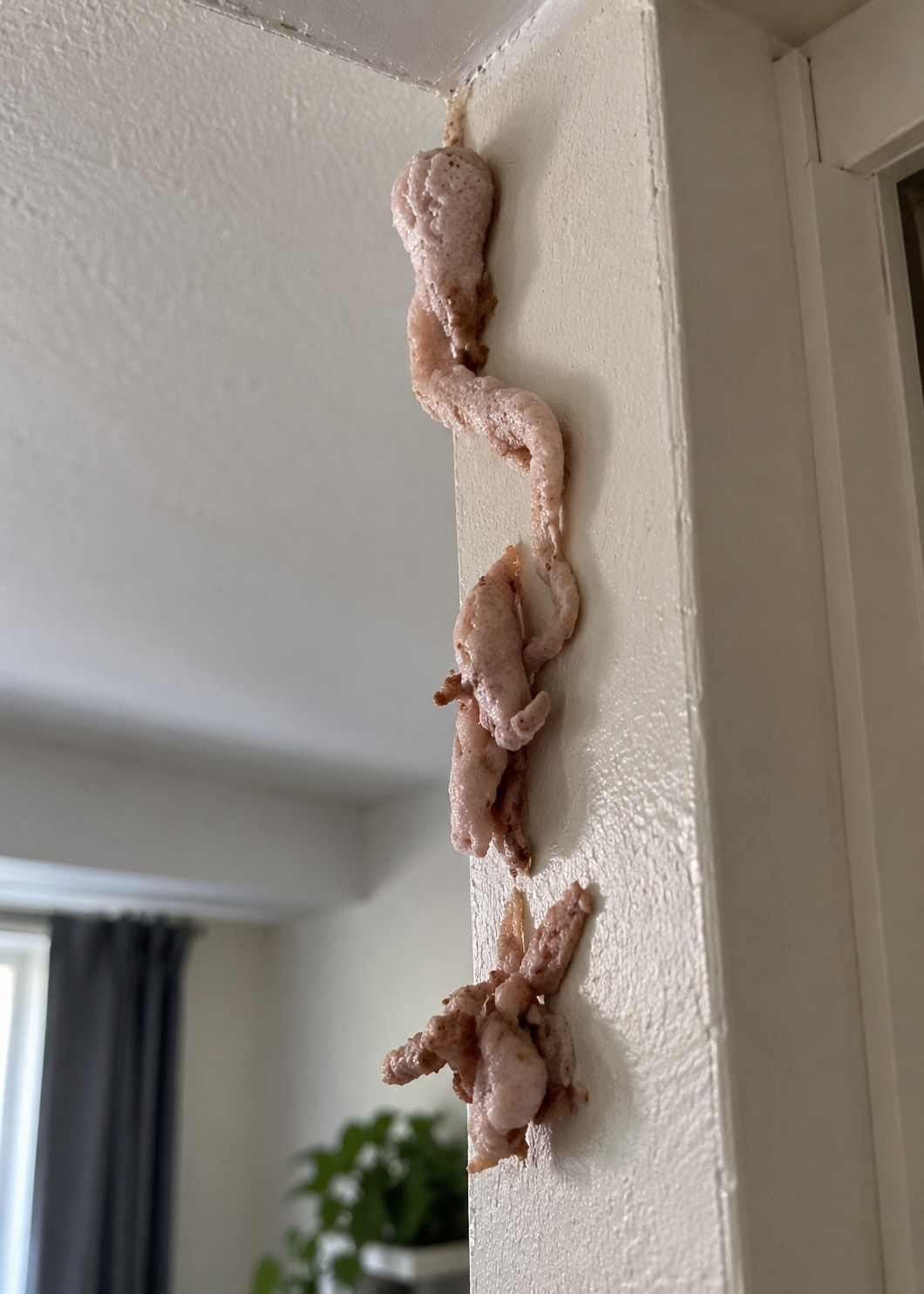
Crunchy Pink Surprise on Wall can make an ordinary room suddenly feel unsettling. In the reference photo, a pale pink, irregular, bubbly-looking material appears to protrude from a narrow seam near a doorway and continues downward in several hardened-looking masses. At first glance, it can look biological. You might wonder whether you have found fungus, mold, an insect nest, or something even stranger.
However, the photograph alone cannot establish exactly what the material is. Based on its bubbly, expanded texture and its apparent emergence from a construction seam, cured expanding foam or another building material belongs high on the list of possibilities. Expanding polyurethane foam commonly fills gaps and cracks, and it expands after application before curing into a rigid cellular material.
Still, Crunchy Pink Surprise on Wall should prompt a little investigation before you scrape it away. Its location, texture, surrounding moisture, recent repairs, and what lies behind the wall can provide much better clues than color alone.
I once noticed a strange hardened blob beside a trim joint and immediately assumed something had started growing from inside the wall. The shape looked organic enough that I avoided touching it until I could inspect the surrounding area. Then I remembered that repair work had been completed nearby months earlier. Looking closely, the material had tiny bubbles throughout it and seemed to originate from a narrow construction gap. The mystery suddenly became much less dramatic. That experience taught me to inspect unusual household discoveries carefully without immediately deciding they must be pests or mold. Construction materials can look remarkably strange once they expand, age, or squeeze through a small opening.
What the Crunchy Pink Surprise on Wall Could Actually Be
Expanding Foam Is a Strong Possibility
The reference image provides several useful visual clues.
First, the material appears attached directly to the painted wall or trim rather than sitting loosely on the surface.
Second, its upper portion seems to originate at a seam near the ceiling or doorway.
Third, the surface looks bubbly and cellular.
Those characteristics make expanding foam a reasonable possibility, although a photograph cannot confirm the identification.
Polyurethane spray foam products expand after application. Builders and homeowners commonly use them to seal cracks, gaps, penetrations, and other openings. Once the material cures, it can become rigid or semi-rigid depending on the formulation.
If someone previously applied too much foam inside a cavity, the expanding material could push through an available seam.
That would explain why the Crunchy Pink Surprise on Wall seems to follow a narrow vertical area rather than spreading like a surface stain.
The shape also matters.
Foam does not necessarily cure into neat, smooth blobs. When it squeezes through an irregular opening, it can form folds, bubbles, strings, bulges, and surprisingly organic-looking shapes.
Color alone cannot settle the question.
Building foams come in different colors, and aging, paint, dust, lighting, or other surface changes can alter their appearance.
Therefore, avoid deciding that the material must be biological simply because it looks pink or flesh-colored.
Instead, inspect how it connects to the structure.
If the material clearly emerges from a gap, feels lightweight and rigid after curing, and has a porous cellular interior, those observations would fit expanding foam better than many biological explanations.
Why Mold and Pests May Come to Mind
The Crunchy Pink Surprise on Wall naturally invites other theories.
Mold is one of the first.
However, mold commonly appears as discoloration, spotting, fuzzy growth, staining, or patches associated with moisture. The large, rope-like expanded masses shown in the reference image are not enough by themselves to diagnose mold.
Nevertheless, moisture still deserves investigation.
Indoor mold growth indicates a moisture problem, and controlling moisture remains central to controlling mold. If you see water staining, damp drywall, peeling paint, condensation, or a persistent musty odor around the area, investigate the moisture source rather than concentrating only on the visible material.
Pests can also produce unusual structures.
Certain insects construct nests from mud, paper-like fibers, silk, or other materials. Therefore, people understandably wonder whether an unfamiliar wall deposit came from an insect.
Yet appearance alone does not prove that explanation either.
Look for supporting evidence.
Are insects entering and leaving the area?
Are there small holes?
Do you see wings, droppings, webbing, larvae, mud tubes, or repeated new material?
Without those signs, jumping directly to a pest diagnosis can create unnecessary alarm.
The same principle applies to fungus.
A photograph may suggest possibilities, but identification should rely on more than a superficial resemblance.
With Crunchy Pink Surprise on Wall, the bubbly texture and seam location make construction material particularly worth checking first.
How to Investigate the Strange Material Safely
Examine the Area Before Removing Anything
Do not begin by aggressively pulling the Crunchy Pink Surprise on Wall from the surface.
First, document it.
Take photographs from several angles, including a wider shot showing the doorway, ceiling, wall, and surrounding trim.
The reference photo already demonstrates why context matters. The object looks much more informative when you can see that it follows an architectural seam.
Next, inspect the surrounding paint and drywall.
Look for brown or yellow water stains.
Check for bubbling paint.
Notice whether the wall feels damp.
Look for cracks or openings where the material originates.
Also consider the history of the property.
Did someone recently replace a window or door?
Was insulation installed?
Did a contractor seal drafts?
Has the wall been repaired?
Did previous owners perform renovation work?
Answers to those questions can quickly strengthen the construction-foam explanation.
If you rent the property, documenting the area before altering it can also help your landlord or maintenance professional understand what happened.
Avoid smelling an unidentified material closely.
Likewise, avoid grinding, sanding, burning, or pulverizing it simply to determine what it is.
Those actions can create unnecessary dust or fumes.
If you suspect active spray foam installation or uncured chemical material, keep people away and consult the product documentation or an appropriate professional. Polyurethane spray-foam chemicals require precautions during application, particularly before the material has cured.
A cured old deposit and freshly applied foam present very different situations.
Therefore, identifying whether the material is new or longstanding matters.
Check the Wall for Moisture and Structural Clues
Next, look beyond the Crunchy Pink Surprise on Wall itself.
An unexplained object can distract you from the condition that caused it.
If foam pushed through a seam, ask why the seam exists.
Perhaps ordinary building movement created a small opening.
Maybe trim separated slightly.
Possibly a previous repair left excess foam behind the surface.
On the other hand, if the wall feels damp, you may have a moisture problem that deserves attention regardless of what the pink material turns out to be.
Inspect the ceiling above it.
Check the opposite side of the wall when accessible.
Look around nearby windows, plumbing fixtures, roof penetrations, bathrooms, and exterior walls.
Moisture can travel before becoming visible, so the source may not sit directly beside the stain or opening.
If you have a moisture meter and know how to use it, comparing the affected wall with a nearby dry area can provide additional information.
However, you do not need specialized equipment for the first inspection.
Your eyes can reveal plenty.
Peeling paint, softened drywall, swollen trim, staining, musty odors, and recurring dampness all justify further investigation.
If you suspect substantial hidden moisture or widespread mold, professional evaluation may make more sense than opening the wall yourself.
The key is to treat the Crunchy Pink Surprise on Wall as a clue rather than automatically treating the visible blob as the entire problem.
What to Do If It Turns Out to Be Expanding Foam
Cured Foam Can Often Be Trimmed During a Repair
Suppose inspection strongly indicates that the Crunchy Pink Surprise on Wall is old cured expanding foam.
In that case, the next goal involves understanding why it became exposed.
If the foam simply squeezed through an old gap and has remained stable, the repair may be mostly cosmetic.
Cured foam can often be mechanically trimmed. However, work carefully around painted surfaces, trim, wiring, plumbing, and other concealed components.
Do not blindly push a blade deep into a wall cavity.
Instead, remove only material you can clearly see and safely access.
After trimming, the opening may need an appropriate patch, caulk, joint compound, trim repair, or other finish depending on the location.
The correct finishing material depends on what created the seam.
A gap between trim and a painted wall may need a different repair than damaged drywall.
Likewise, an opening around a window or exterior penetration may need proper weather sealing rather than a purely decorative patch.
If you discover a large cavity, repeated foam movement, water damage, electrical components, or significant deterioration, stop and have the area evaluated.
The Crunchy Pink Surprise on Wall may ultimately prove harmless, but you still want the underlying building assembly to remain sound.
Also remember that foam should not automatically replace every type of sealant or fire-resistant material.
Different gaps have different building-code requirements.
When the opening passes between fire-rated assemblies or surrounds certain mechanical systems, an appropriate professional can determine the correct repair.
Do Not Ignore the Reason It Appeared
Removing the Crunchy Pink Surprise on Wall solves the visual problem.
However, it may not answer the more important question: why did the material appear there?
If it has existed since an old renovation and simply went unnoticed, the explanation may be straightforward.
If it suddenly emerged from a previously closed seam, investigate further.
Building materials can move slightly as temperature and humidity change.
Trim can separate.
Paint can crack.
Old repairs can become exposed.
However, significant movement may indicate a larger issue.
Compare older photographs if you have them.
Mark the edge of a crack lightly and monitor whether it grows.
Check whether doors nearby suddenly stick or stop closing properly.
Look for additional cracks around the same opening.
One small cosmetic seam rarely proves structural trouble.
Still, several new changes appearing together deserve attention.
Likewise, recurring moisture changes the situation.
If the area becomes wet after rain or plumbing use, solve the water source before making a cosmetic repair.
Otherwise, new paint and patching may only conceal the symptoms temporarily.
That is why the best response to Crunchy Pink Surprise on Wall combines curiosity with basic home-maintenance awareness.
Identify the material as carefully as possible.
Then identify the reason it became visible.
Those two questions lead to a much better repair than simply scraping off the strange-looking object and forgetting about it.
When to Call a Professional Instead of Handling It Yourself
Moisture, Mold, Pests, or Unknown Material Deserve Extra Caution
Some situations move beyond a simple DIY inspection.
If the Crunchy Pink Surprise on Wall sits beside extensive water damage, investigate the leak.
If you see widespread suspected mold, address the moisture source and consider appropriate professional guidance.
If insects repeatedly enter or leave the material, a pest professional may help identify the species and determine whether treatment is necessary.
Likewise, if the substance remains soft, wet, sticky, strongly odorous, or apparently fresh, avoid assuming it is harmless cured foam.
The reference photograph cannot tell us how the object feels or how long it has been present.
Those details matter.
You should also get professional help when the wall contains suspected electrical problems.
Discoloration, heat, buzzing, burning odors, or damaged wiring require a different level of caution.
Do not cut into an unknown wall cavity around electrical components.
Similarly, older homes may contain building materials that deserve careful handling during renovation.
If removal requires disturbing substantial wall material rather than simply trimming a known cured foam deposit, determine what materials you are working with before creating dust.
Crunchy Pink Surprise on Wall may have a boring explanation.
That is good news.
However, safe investigation means remaining open to other explanations when the surrounding evidence points elsewhere.
Use Evidence Instead of the Most Frightening Theory
The strangest-looking explanation is not necessarily the correct one.
A pink, twisted mass can look biological because the human brain naturally compares unfamiliar shapes with familiar objects.
However, construction materials can produce remarkably organic forms.
Foam expands unpredictably.
Adhesive squeezes through seams.
Caulk deforms.
Insulation becomes exposed.
Paint and repair compounds discolor.
Therefore, begin with evidence.
Where does the object originate?
Does it have a cellular interior?
Is it rigid or soft?
Is the wall dry?
Did repairs occur nearby?
Does the material return after removal?
Are insects present?
Is there an odor?
Does the surrounding structure show damage?
Each answer narrows the possibilities.
In the reference image, the apparent foam-like texture and the way the material follows a narrow architectural seam make cured construction foam a plausible explanation.
Still, the photograph does not justify declaring that identification certain.
That distinction matters.
Good home maintenance does not require dramatic guesses.
It requires observation, documentation, safe handling, and knowing when the evidence supports professional inspection.
Frequently Asked Questions
What is the Crunchy Pink Surprise on Wall in the photo?
The photograph alone cannot confirm the material. However, its bubbly, expanded texture and apparent emergence from a construction seam make cured expanding foam or another building material a plausible possibility.
Could the pink material be mold?
A photograph cannot completely rule out biological growth, but the protruding foam-like shape does not by itself establish mold. Look for moisture, staining, musty odors, damp drywall, or recurring growth. Mold problems require moisture, so any suspected mold should also prompt investigation of the water source.
Should I pull strange foam-like material out of my wall?
Do not pull or cut deeply into an unknown wall cavity. First determine what the material appears to be and what may sit behind the surface. If it is clearly old cured foam, exposed excess material may be trimmable, but concealed wiring, plumbing, or other components require caution.
Why would expanding foam come through a wall?
Foam expands after application. If someone applied it inside a cavity or around a gap, excess material may push through an opening before curing. Later movement or separation of trim can also expose previously hidden foam.
When should I call a professional?
Call for help when you find active moisture, extensive suspected mold, repeated pest activity, significant wall damage, electrical warning signs, an unknown wet or chemical-smelling substance, or a repair that requires opening a wall you cannot safely assess.
Conclusion
Crunchy Pink Surprise on Wall looks dramatic because its color and irregular shape resemble something biological.
However, appearances can mislead.
In the supplied reference image, the material has a bubbly, expanded surface and appears to follow a narrow seam beside a doorway. Those details make cured expanding foam or another construction material an important possibility to investigate.
Still, a photograph cannot provide a definitive identification.
Start by documenting the area.
Then inspect the wall for moisture, cracks, insects, staining, odors, and signs of previous repair work.
Consider whether someone may have used spray foam around the doorway, ceiling, insulation, or nearby gaps.
If the material proves to be old cured foam and the surrounding wall remains dry and stable, the solution may involve carefully trimming exposed excess and repairing the finish.
However, do not stop at appearance alone.
Ask why the material became visible.
A simple old repair may explain everything.
On the other hand, moisture, recurring movement, pest activity, or significant structural changes deserve additional attention.
Most importantly, avoid turning an unfamiliar household discovery into a frightening diagnosis based only on its shape.
Crunchy Pink Surprise on Wall may look like a strange organism emerging from your home, but ordinary building materials can create surprisingly bizarre forms.
Observe first.
Investigate the surrounding area.
Handle unknown material cautiously.
Then choose the repair that fits the evidence rather than the most alarming theory.
More Home Remedies
- Wrinkled Fingers After Water Exposure: What Your Skin May Be Telling You
- Skin Rash With Breathing Trouble? It Could Be a Life-Threatening Allergic Reaction
- I Thought It Was a Piece of Trash on the Bathroom Floor—Until It Moved
- If You Are Getting White Pimples on Your Lips or Intimate Area, Here’s What They Could Mean