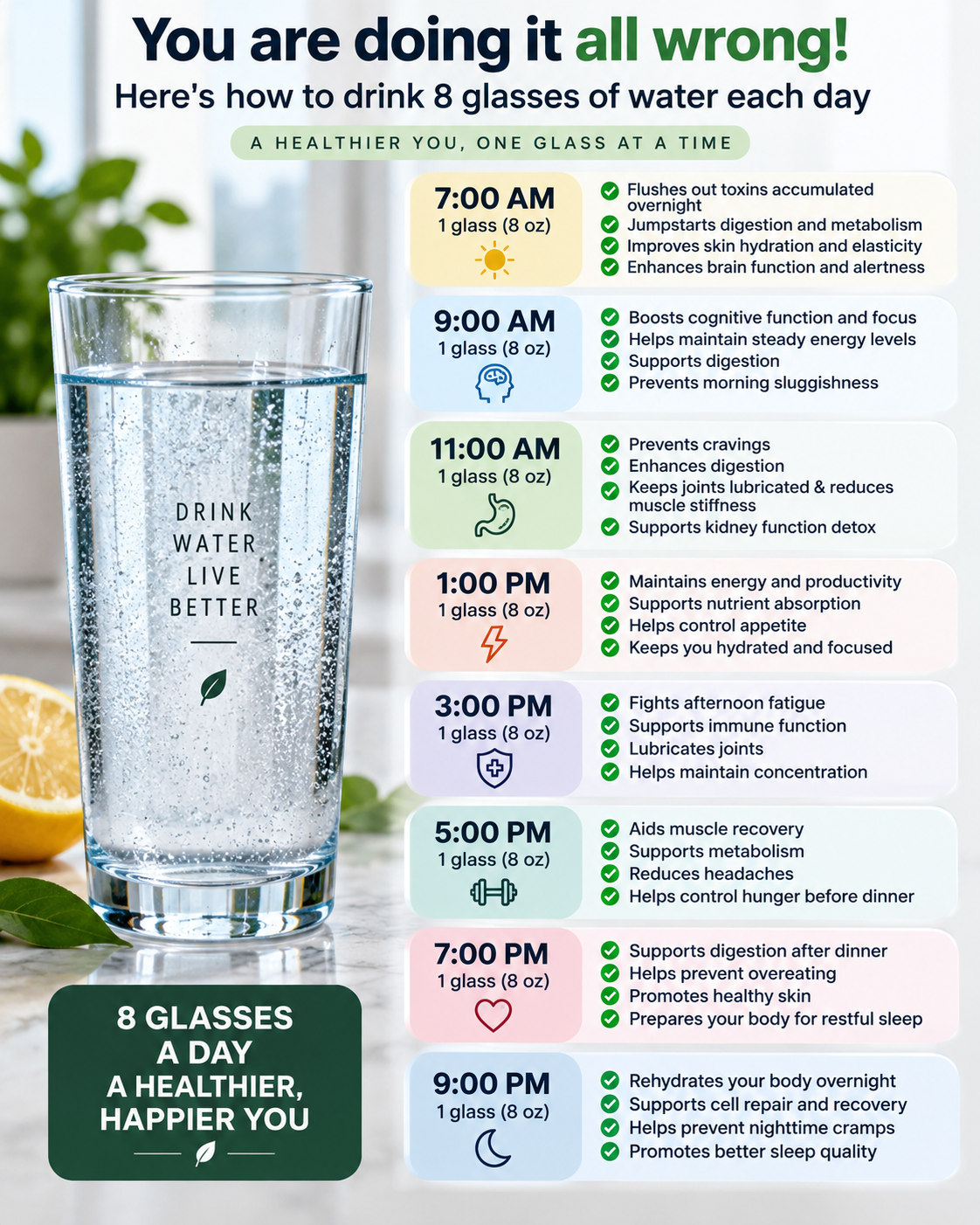
You Are Doing It All Wrong: Here’s How to Drink 8 Glasses of Water Each Day sounds like there must be a perfect hydration timetable that everyone should follow. The familiar idea is simple: drink one 8-ounce glass every couple of hours, beginning in the morning and finishing in the evening.
That routine can certainly make drinking water easier. However, the clock itself does not unlock special health benefits, and eight glasses is not a universal requirement.
Your actual water needs depend on factors such as body size, activity, temperature, pregnancy or breastfeeding, illness, diet, and how much fluid you get from other beverages and foods. The CDC specifically notes that daily water needs vary from person to person.
So, rather than treating 7:00 a.m., 9:00 a.m., and the other suggested times as medical rules, use them as convenient reminders. The real goal is much simpler: drink regularly enough to stay comfortably hydrated.
For years, I treated water like something I would remember only after I felt extremely thirsty. I would start the morning with good intentions, get distracted by work, and suddenly realize late in the afternoon that my water bottle was still nearly full. What finally helped was not forcing myself to drink huge amounts at once. Instead, I connected small drinks with things I already did every day: waking up, starting work, eating lunch, taking an afternoon break, and having dinner. The routine felt effortless after a while. More importantly, I stopped treating hydration like a test I could either pass or fail.
The Truth Behind the 8-Glasses-a-Day Rule
Eight Glasses Can Be a Handy Habit, Not a Universal Prescription
Eight 8-ounce glasses equal 64 fluid ounces, or roughly 1.9 liters.
That amount gives many people an easy number to remember. However, authoritative guidance does not say every healthy adult must drink exactly eight glasses of plain water each day.
The National Academies established Adequate Intake values for total water of about 3.7 liters per day for adult men and 2.7 liters for adult women. Importantly, those totals include water from drinking water, other beverages, and food. The values also represent adequate population-level intakes rather than a precise requirement that every individual must hit each day.
Food can contribute a meaningful share of hydration. Fruits, vegetables, soups, yogurt, and many other foods contain water.
Other drinks count too.
The idea that only plain water contributes to hydration creates unnecessary confusion. The CDC notes that daily intake comes mostly from water and other beverages, with high-water foods contributing as well.
Therefore, someone who drinks six glasses of plain water but also consumes milk, tea, soup, fruit, and vegetables may receive more total water than someone who drinks eight glasses while eating very dry foods.
Your needs can also rise.
Hot weather increases fluid losses. Exercise does the same. Fever, vomiting, and diarrhea can increase the need for fluids as well.
Consequently, You Are Doing It All Wrong: Here’s How to Drink 8 Glasses of Water Each Day works best as a habit-building framework, not a rigid biological formula.
Why Staying Hydrated Still Matters
Correcting exaggerated hydration claims should not obscure the basic point: water remains essential.
Your body uses water to regulate temperature, lubricate and cushion joints, protect sensitive tissues, and remove waste through urine, perspiration, and bowel movements. Inadequate intake can lead to dehydration, which may contribute to problems such as unclear thinking, mood changes, overheating, and constipation.
Therefore, drinking regularly throughout the day makes practical sense.
What you should avoid is attaching unsupported promises to individual glasses.
For example, the infographic suggests that a specific morning glass “flushes toxins,” while later glasses supposedly produce distinct effects on metabolism, immunity, skin, appetite, or sleep.
Water supports normal body functions, including waste removal. However, credible hydration guidance does not establish that drinking exactly eight ounces at 7:00 a.m. triggers a special detoxification process or that a 9:00 p.m. glass automatically improves sleep.
Your kidneys and other organs continually handle waste.
Likewise, hydration supports normal physical and mental function, but no particular two-hour interval turns ordinary water into a special treatment.
A more useful approach focuses on consistency.
Drink when thirsty. Keep water accessible. Have fluids with meals. Increase intake when you lose more fluid through heat, exercise, fever, vomiting, or diarrhea.
That approach respects both the importance of hydration and the fact that individual needs differ.
A Practical 8-Glass Water Schedule You Can Actually Follow
Morning Through Early Afternoon: Glasses 1 to 4
If eight glasses helps you remember to drink, a schedule can provide useful structure.
Start with Glass 1 around 7:00 a.m.
An 8-ounce glass after waking can replace some of the fluid you went without while sleeping. However, you do not need to force it immediately if you are not thirsty. Think of it as a convenient way to begin the day.
Have Glass 2 around 9:00 a.m.
This works particularly well with breakfast or when you begin work. Keeping a reusable bottle beside you can make the habit almost automatic.
Drink Glass 3 around 11:00 a.m.
By midmorning, another glass keeps your intake spread across the day instead of forcing you to catch up later.
Then have Glass 4 around 1:00 p.m., perhaps with lunch.
Drinking water with meals offers an easy way to build hydration into a routine you already follow. The CDC specifically suggests serving water during meals and carrying a reusable bottle as practical ways to increase intake.
These four glasses provide 32 ounces by early afternoon.
Still, do not interpret the schedule as a restriction.
If you exercise at 10:00 a.m., spend the morning outside in hot weather, or simply feel thirsty, drink more.
Likewise, you may need less plain water if breakfast and lunch contain plenty of water-rich foods and beverages.
The schedule should support your body’s signals rather than override them.
Afternoon and Evening: Glasses 5 to 8
Continue with Glass 5 around 3:00 p.m.
An afternoon drink creates a useful break, particularly if several hours have passed since lunch.
Then have Glass 6 around 5:00 p.m.
This timing may fit naturally at the end of work or before preparing dinner. If you exercise around this time, however, your fluid needs may increase beyond a single 8-ounce serving.
Have Glass 7 around 7:00 p.m., perhaps with dinner.
Finally, the sample plan places Glass 8 around 9:00 p.m.
This last glass deserves flexibility.
If drinking eight ounces close to bedtime repeatedly wakes you to use the bathroom, move that serving earlier. There is no hydration prize for drinking the final glass at exactly 9:00 p.m.
Likewise, you do not need to deliberately drink a bedtime glass to “detox” while sleeping.
Instead, organize the schedule around comfort and consistency.
A modified timetable might place your final drink with dinner. Someone who works late might prefer another arrangement entirely.
The most useful lesson from You Are Doing It All Wrong: Here’s How to Drink 8 Glasses of Water Each Day is therefore not the exact times.
It is the spacing.
Eight smaller opportunities can feel much easier than realizing at 8:00 p.m. that you barely drank anything all day and then trying to consume a large volume at once.
How to Personalize Your Daily Hydration Routine
Let Activity, Weather, Diet, and Thirst Guide You
Your water needs do not remain identical every day.
Imagine spending one day working indoors in a cool environment and another hiking for several hours in summer heat. Using exactly the same fluid intake for both days would ignore the enormous difference in water loss.
The National Academies specifically notes that people who exercise or experience hot conditions may need higher total water intake.
Illness matters too.
The CDC advises that the body needs more water during fever, diarrhea, and vomiting.
Pregnancy and breastfeeding also change typical intake levels. National Academies guidance lists higher total-water Adequate Intake values during pregnancy and especially lactation.
Diet creates another variable.
A meal containing soup, watermelon, cucumber, oranges, yogurt, and other high-water foods contributes considerably more fluid than crackers and other dry foods.
Therefore, counting only glasses can give an incomplete picture.
For most healthy people, thirst provides a useful signal. The National Academies has noted that the vast majority of healthy individuals can generally meet hydration needs by responding to thirst and consuming beverages with meals.
Still, some people may need individualized medical advice about fluids, especially when a health condition or medication affects fluid balance.
In those situations, a generic eight-glass schedule should never replace personalized instructions from a healthcare professional.
Coffee, Tea, and Food Can Contribute Too
One common hydration myth claims that coffee and tea simply “dehydrate” you and therefore cannot count.
That oversimplifies the issue.
The National Academies found no convincing evidence that caffeine causes cumulative total-body water deficits under typical conditions, while the CDC includes plain coffee and tea among low- or no-calorie beverage options.
That does not mean unlimited caffeine makes sense.
The CDC states that moderate caffeine consumption—up to about 400 milligrams daily—can fit into a healthy diet for most adults.
Meanwhile, water remains an excellent default beverage because it contains no calories or added sugar.
Replacing sugary beverages with plain water can also reduce calorie intake.
If plain water feels boring, make it more appealing.
Add lemon, lime, cucumber, or berries. The CDC specifically recommends fruit or citrus additions as simple flavor options.
Sparkling water can offer variety too.
Ultimately, the easiest hydration routine is one you can maintain.
You do not need eight identical glasses lined up on the counter.
You need a sensible pattern of fluids and water-containing foods that fits your body and your day.
Simple Ways to Make Drinking Water an Automatic Habit
Connect Each Glass With Something You Already Do
Habits become easier when they attach to existing routines.
Instead of depending on memory, connect drinking water with predictable moments.
For example, drink some water after getting up.
Then keep a bottle beside you while working.
Have another serving with breakfast or during your first break.
Drink with lunch.
Refill your bottle during the afternoon.
Have water with dinner.
This strategy makes the schedule flexible while preserving the central idea behind You Are Doing It All Wrong: Here’s How to Drink 8 Glasses of Water Each Day.
You can also use a marked bottle.
If your bottle holds 32 ounces, finishing one by early afternoon and another by evening gives you the equivalent of eight 8-ounce glasses.
However, again, 64 ounces remains a convenient example rather than a universal target.
Visual reminders help too.
Keep water where you can see it.
A bottle hidden inside a bag or cupboard becomes easy to forget. A glass beside your computer creates an immediate cue.
The CDC recommends carrying a reusable bottle and choosing water over sugary drinks as practical hydration strategies.
Finally, avoid turning the routine into an all-or-nothing challenge.
Missing your 11:00 a.m. glass does not ruin the day.
Simply drink when convenient and continue.
Consistency over time matters more than following a clock perfectly.
Know When the Infographic Goes Too Far
The reference image offers an attractive and memorable schedule, but several of its benefit claims sound more precise than the evidence supports.
For instance, it assigns specific outcomes such as “detox,” immune support, appetite control, cell repair, and better sleep to individual glasses consumed at particular hours.
Hydration certainly supports normal body function.
However, the evidence cited by major health authorities supports broader benefits—preventing dehydration, regulating temperature, cushioning joints, and supporting waste elimination—rather than unique effects tied to drinking one glass at 3:00 p.m. or 9:00 p.m.
Likewise, “eight glasses” should not become a ceiling.
A person sweating heavily during exercise may require more fluid.
Nor should it become a mandatory minimum for every individual regardless of food, beverages, body size, environment, or medical circumstances.
The healthiest interpretation is straightforward:
Use the eight-glass schedule if it helps you remember.
Adjust the amount when your circumstances change.
Count water from food and other beverages toward overall hydration.
Respond to thirst.
And avoid assuming that one particular glass has a magical metabolic or detoxifying effect.
That version keeps the useful part of the original idea while removing the unnecessary rules.
Frequently Asked Questions
Do I really need exactly eight glasses of water every day?
No. Eight 8-ounce glasses provide a convenient hydration habit, but individual needs vary. Total water also includes water from other beverages and foods.
Is 64 ounces of water enough for everyone?
Not necessarily. Activity, heat, pregnancy, breastfeeding, illness, diet, and other factors can change fluid needs. Therefore, 64 ounces should not serve as a universal requirement or limit.
Does coffee count toward hydration?
Yes, beverages such as coffee can contribute to total fluid intake. Evidence does not support the idea that typical caffeine consumption inevitably creates a cumulative body-water deficit.
Is it important to drink a glass of water at 9:00 p.m.?
No specific health rule requires a 9:00 p.m. glass. If evening water disrupts your sleep with bathroom trips, move that serving earlier and organize your intake around your comfort and needs.
What is the easiest way to remember to drink more water?
Keep a reusable bottle visible, drink water with meals, refill during routine breaks, and add lemon, lime, cucumber, or fruit if flavor helps you drink more.
Conclusion
You Are Doing It All Wrong: Here’s How to Drink 8 Glasses of Water Each Day offers one genuinely useful idea: spreading fluid intake across the day can make hydration easier to remember.
However, you do not need to treat the eight specific times as biological deadlines.
Nor does each glass produce a unique health effect simply because you drink it at a certain hour.
A 7:00 a.m. glass can start your routine.
A 9:00 a.m. glass can keep the habit going.
Then 11:00 a.m., 1:00 p.m., 3:00 p.m., 5:00 p.m., 7:00 p.m., and 9:00 p.m. can serve as reminders if those times fit your schedule.
Together, eight 8-ounce glasses equal 64 ounces.
Yet your body may need more or less plain water because hydration also comes from other beverages and food. The National Academies’ adult Adequate Intake values refer to total water from all sources, not simply glasses of plain water.
Therefore, flexibility matters.
Drink more when exercise, heat, or illness increases fluid loss.
Move the evening glass earlier if drinking before bed disrupts your sleep.
Enjoy unsweetened tea, coffee, sparkling water, or water-rich foods as part of your overall intake.
Most importantly, make hydration easy enough that you do not have to think about it constantly.
Keep water nearby.
Drink with meals.
Respond to thirst.
Build reminders into your normal day.
That approach turns hydration from another complicated wellness rule into a simple, sustainable habit.