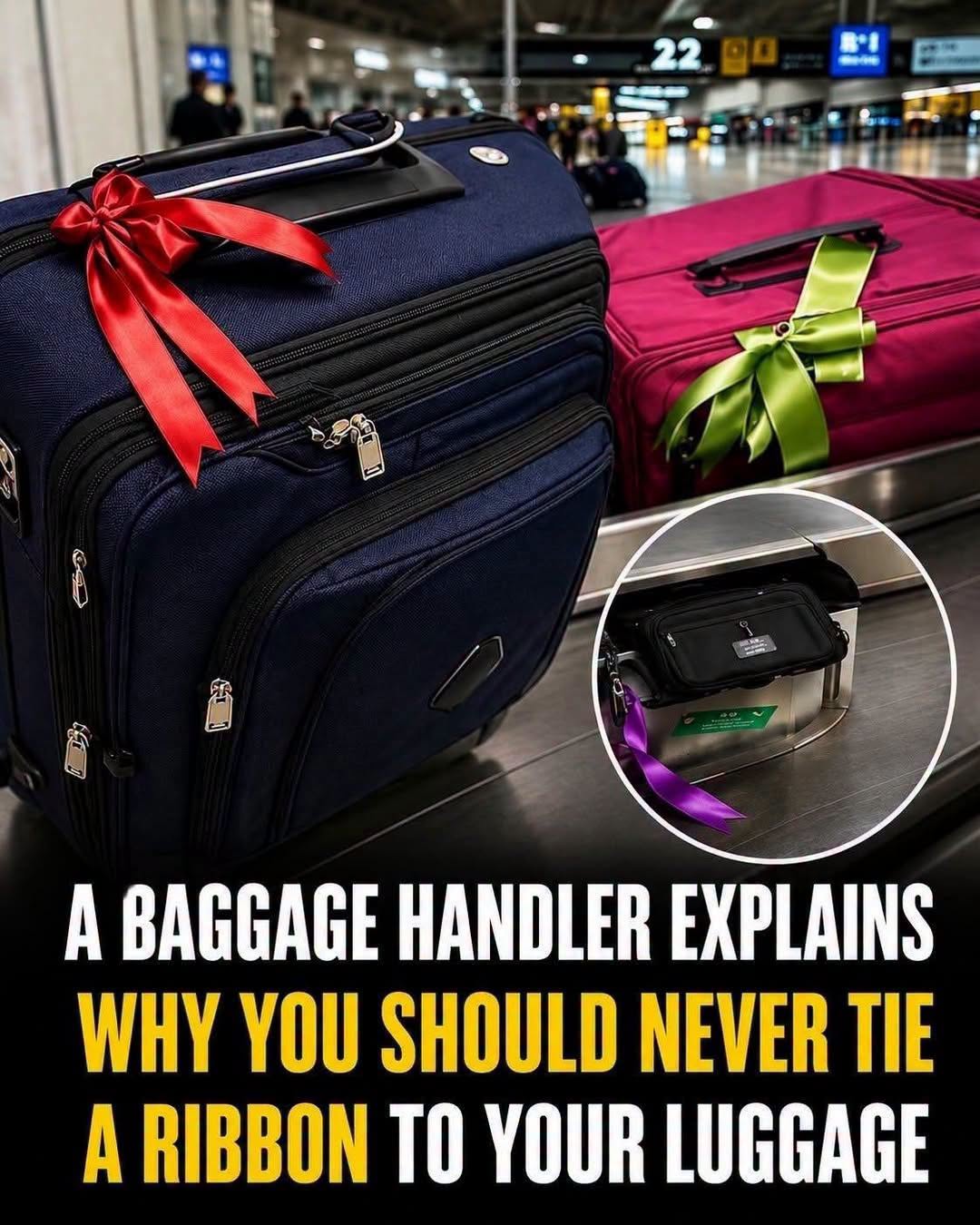
Why Baggage Handlers Say You Should Never Tie a Ribbon to Your Suitcase? It sounds like surprising advice because colorful ribbons have helped travelers identify checked bags for decades. At a crowded baggage carousel, a bright ribbon can separate your suitcase from dozens of nearly identical black and gray bags.
However, checked luggage faces a very different environment after it disappears behind the check-in counter. Conveyor belts, scanners, rollers, sorting equipment, carts, and baggage workers move bags through several stages. Therefore, anything loose on the outside of a suitcase can create an unnecessary problem.
A ribbon does not automatically cause luggage to become lost or delayed. Still, a long or dangling ribbon can snag, loosen, fall off, or interfere with handling. Fortunately, travelers can make their luggage distinctive without relying on loose decorations.
I learned the value of simple luggage preparation after watching a crowded airport carousel where several nearly identical black suitcases kept circling past waiting passengers. One traveler grabbed a bag, checked it briefly, and then realized it belonged to someone else. A bright marker would have helped, yet the experience also showed why identification needs to remain secure. Since then, I have preferred compact luggage tags, clear contact information inside the suitcase, and a quick photo before check-in. These small habits require almost no extra effort. More importantly, they make baggage claim easier without adding loose material that might cause trouble during handling.
Why Ribbons on Checked Luggage Can Cause Problems
Automated baggage systems change the equation
Why Baggage Handlers Say You Should Never Tie a Ribbon to Your Suitcase? The answer becomes clearer once you understand what happens after check-in.
Many travelers imagine airport employees carrying their suitcases directly from the counter to an aircraft. In reality, large airports rely heavily on automated baggage systems. Your suitcase can travel along conveyor belts, through security screening equipment, around turns, across rollers, and into automated sorting areas.
Next, workers may transfer the suitcase onto carts or other loading equipment. If your itinerary includes a connection, the bag may repeat several stages before it reaches the final destination.
Consequently, checked luggage experiences considerably more mechanical handling than carry-on luggage.
A tightly packed suitcase presents a relatively smooth exterior. However, ribbons, cords, decorative chains, loose straps, and dangling accessories add objects that can potentially catch against surrounding equipment.
A ribbon might remain attached throughout the entire journey. In fact, many travelers use ribbons without experiencing a problem. Nevertheless, removing unnecessary loose material eliminates one possible point of failure.
Therefore, the concern does not center on the color or material of the ribbon. Instead, the problem involves its shape, length, position, and security.
Why loose accessories create unnecessary risk
A small ribbon looks harmless while a suitcase sits on your bedroom floor. However, airport baggage equipment creates a much more demanding environment.
First, repeated movement can loosen knots. Then, a loose end can become longer as the ribbon shifts around a handle. Additionally, the ribbon can rub against other bags, carts, belts, and equipment.
Eventually, it might tear away completely.
Long luggage straps, dangling cords, decorative keychains, and oversized tags can create similar concerns. Therefore, travelers should examine everything attached to the exterior of checked luggage before leaving for the airport.
Try to create a smooth, streamlined exterior. Secure zippers properly. Moreover, tuck away retractable handles and loose straps whenever the suitcase design allows it.
If you still prefer a ribbon, keep it short and tightly secured. Additionally, position it away from the airline’s baggage tag.
Why Baggage Handlers Say You Should Never Tie a Ribbon to Your Suitcase? Ultimately, baggage workers want luggage that moves easily through the system. A streamlined suitcase gives loose objects fewer opportunities to snag, detach, or create delays.
Protect the Most Important Identification on Your Bag
Keep the airline baggage tag visible
The official airline baggage tag matters much more than any decorative marker.
When you check a suitcase, airline staff attach a tag that connects the bag with its intended journey. Depending on the baggage system, machines and workers use machine-readable information on that tag to help route luggage correctly.
Therefore, never cover or obstruct the current baggage tag with ribbons, straps, stickers, or other accessories.
You should also remove old airline tags and outdated baggage stickers before checking the suitcase. Although an old sticker may remind you of a favorite trip, your bag only needs identification relevant to its current journey.
Additionally, inspect the current tag after the airline attaches it. Make sure nothing on your suitcase sits directly over it.
If you use a luggage strap, position the strap carefully. Similarly, keep decorative markers away from the tag.
Why Baggage Handlers Say You Should Never Tie a Ribbon to Your Suitcase? One concern involves keeping the bag as straightforward as possible for automated and manual processing. Consequently, protecting the current airline tag should take priority over making the suitcase visually distinctive.
However, do not rely exclusively on that external tag.
Put your name and reliable contact details inside the suitcase as well. If an external identifier becomes damaged or detached, information inside the bag provides another way to establish ownership.
Take photos before handing over your suitcase
A smartphone gives travelers another simple identification tool: photographs.
Before you check your luggage, place the suitcase somewhere with good lighting and take a clear picture of the entire bag. Capture its color, shape, size, distinctive markings, stickers, scratches, and other recognizable details.
Additionally, photograph identifying information associated with your checked bag and keep your baggage receipt accessible.
These pictures can help if the suitcase does not arrive at baggage claim. Instead of trying to remember whether your bag has two silver stripes or three, you can show airline staff exactly what it looks like.
Furthermore, a photograph records the suitcase’s general condition before the journey.
Take another photo whenever you significantly change the bag’s appearance. For example, photograph a new strap, sticker, luggage tag, or other distinctive feature.
This approach works particularly well for common luggage colors. Black suitcases remain popular because they look practical and hide dirt well. Unfortunately, dozens of passengers on the same flight may own similar bags.
Therefore, visual documentation can prove especially helpful.
A photograph cannot prevent a baggage delay. However, it can help you provide an accurate description if something goes wrong.
Better Ways to Make Your Suitcase Easy to Identify
Choose secure identification instead of dangling decorations
You do not need to make your suitcase completely plain.
Instead, choose identification methods that remain close to the bag and resist snagging.
A durable luggage tag offers one practical option. Choose a tag with a strong attachment point and avoid excessively long loops or straps.
Likewise, a compact fixed marker can make a suitcase recognizable without hanging several inches from the handle.
Distinctive luggage colors also solve the identification problem. Bright blue, green, orange, patterned, or textured luggage can stand out immediately among rows of black suitcases.
Additionally, luggage-safe stickers can create recognizable visual features. Apply them securely to clean surfaces so they remain flat against the suitcase.
A fitted luggage strap can provide another option. However, choose a product specifically designed for luggage and secure it tightly around the case. Most importantly, do not leave a long section dangling.
Why Baggage Handlers Say You Should Never Tie a Ribbon to Your Suitcase? The advice does not mean travelers must abandon personalization. Instead, it encourages travelers to choose secure identification that does not introduce unnecessary loose material.
You can still recognize your suitcase quickly. You simply need a better marker.
Never identify your bag by color alone
Even a distinctive suitcase deserves a second check at baggage claim.
When luggage starts arriving, passengers often move quickly toward the carousel. After a long flight, everyone wants to collect their belongings and leave. Consequently, mistakes can happen.
A red suitcase might look unique when you buy it. However, another passenger can own the same model.
Therefore, check several features before leaving with a bag.
Look at the size, shell design, handles, wheels, brand markings, luggage tag, stickers, and other distinctive characteristics. Most importantly, verify the identifying information before walking away.
This habit becomes especially important if you use a ribbon or strap. Another passenger may use the same color.
Furthermore, never assume that a distinctive decoration proves ownership. Ribbons can fall off, while straps can shift or become damaged.
Instead, treat your visual marker as a quick way to spot a possible match. Then, verify the bag before leaving baggage claim.
This two-step approach combines speed with accuracy.
Prepare Your Checked Luggage for a Smoother Journey
Follow a simple pre-flight luggage routine
Why Baggage Handlers Say You Should Never Tie a Ribbon to Your Suitcase? The question points toward a larger lesson: simple luggage preparation can reduce avoidable problems.
Before leaving home, inspect the suitcase carefully.
First, remove old airline baggage tags and stickers. Next, secure every zipper and pocket. Then, look for loose straps, cords, ribbons, or accessories.
If your suitcase includes expandable sections, close them properly unless you need the extra space. Additionally, avoid packing the bag so tightly that the zippers remain under extreme pressure.
Put your contact information inside the suitcase. However, avoid displaying unnecessary personal information prominently on the exterior.
Next, add one secure visual identifier if you want easier recognition at baggage claim.
Finally, photograph the suitcase.
After check-in, keep your baggage receipt or tracking information available until you collect the suitcase at your destination.
These steps take only a few minutes. Nevertheless, they create a useful routine that you can repeat before every flight.
Preparation matters even more when your journey includes connections because your luggage may pass through additional handling stages.
Know what to do when luggage does not arrive
Even careful preparation cannot guarantee that every checked bag will arrive on schedule.
If your suitcase does not appear on the carousel, stay at the airport and locate the airline’s baggage service desk or appropriate baggage assistance point.
Have your baggage receipt or claim information ready. Then, provide an accurate description of the suitcase.
This is where your pre-flight photograph becomes useful. Show the image and point out recognizable characteristics.
For example, describe the bag as a medium black hard-shell suitcase with a silver logo, gray luggage tag, and distinctive white sticker rather than simply calling it a black suitcase.
Additionally, provide the requested contact and itinerary details so the airline can follow its baggage tracing process.
Keep relevant documentation until the issue reaches a resolution.
Why Baggage Handlers Say You Should Never Tie a Ribbon to Your Suitcase? Because good luggage preparation focuses on secure identification rather than a single decoration. A ribbon can disappear. Therefore, use several practical safeguards: internal identification, secure external identification, photographs, and airline baggage documentation.
Frequently Asked Questions
Why do baggage handlers advise against ribbons on suitcases?
Loose or dangling ribbons can potentially snag, loosen, detach, or complicate baggage handling. Checked luggage travels through conveyors, rollers, sorting systems, carts, and other equipment. Therefore, keeping the exterior streamlined can reduce unnecessary handling risks.
Will tying a ribbon to my suitcase make the airline lose it?
No. A ribbon does not automatically cause a suitcase to become lost. Many travelers use ribbons without experiencing problems. However, a long or loose ribbon adds an unnecessary external item that could detach or snag. A short, secure identifier presents a more practical option.
What should I use instead of a ribbon?
Consider a durable luggage tag, distinctive suitcase color, securely applied luggage sticker, compact fixed marker, or properly fitted luggage strap. Additionally, place contact information inside the suitcase and take a photograph before check-in.
Should I remove old airline baggage tags?
Yes. Remove old baggage tags, barcode stickers, and outdated destination labels before checking luggage for a new journey. Keeping only current travel identification makes the exterior cleaner and prevents old travel labels from adding unnecessary clutter.
Can I put a ribbon on carry-on luggage?
Carry-on luggage usually remains under your control rather than traveling through the same checked-baggage handling process. Therefore, the concern differs. Nevertheless, keep ribbons and other accessories short and secure so they do not snag while you move through airports or store the bag.
Conclusion
Why Baggage Handlers Say You Should Never Tie a Ribbon to Your Suitcase? The advice comes down to keeping checked luggage simple, secure, and ready for repeated handling.
A bright ribbon certainly makes a suitcase easier to recognize. However, long or loose ribbons can create unnecessary problems as bags travel through conveyors, scanners, sorting areas, carts, and aircraft-loading operations.
Fortunately, you do not need to sacrifice easy identification.
Choose a secure luggage tag, a distinctive suitcase, a compact fixed marker, or a properly fitted luggage strap. Additionally, remove old airline labels, keep the current baggage tag unobstructed, place contact information inside the suitcase, and photograph your bag before check-in.
Finally, verify the baggage tag before leaving the carousel. A colorful marker helps you spot your suitcase, but it should never replace proper identification.
A few minutes of preparation can make baggage claim easier and give you better information if your suitcase gets delayed. When it comes to checked luggage, secure and streamlined usually beats loose and decorative.