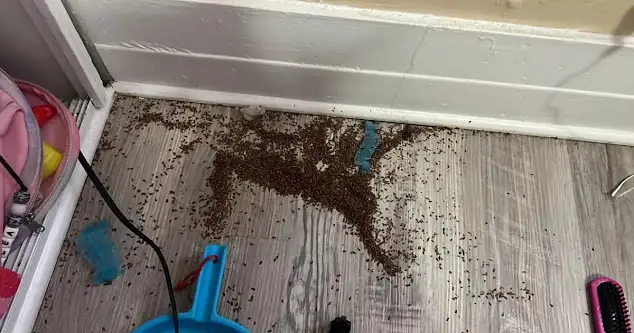
One of the most frustrating parts of dealing with unidentified debris is cleaning everything thoroughly, only to discover another small pile a day or two later. That repeated appearance often convinces homeowners that the problem is becoming worse, but it doesn’t always mean an infestation is growing rapidly.
Many insects and small animals create waste or shed materials gradually. If the source remains hidden behind a wall, inside furniture, beneath carpeting, or inside wooden structures, new material may continue appearing until the underlying issue is resolved.
Rather than becoming discouraged, consider each new pile another clue.
Ask yourself a few questions:
- Is it always in exactly the same location?
- Does it appear overnight?
- Is it larger after rainy weather?
- Does it appear near wooden furniture?
- Is there a nearby window or heating vent?
- Has anyone recently moved furniture?
Keeping a simple notebook or taking photographs every day can reveal patterns that are impossible to notice from memory alone.
Sometimes these observations become the key that helps professionals quickly identify the source.
Small Clues That Can Solve the Mystery
Professional inspectors rarely rely on a single piece of evidence.
Instead, they combine dozens of tiny observations.
For example:
Color
Different materials have surprisingly consistent colors.
Very dark black particles often point toward one group of insects.
Light tan pellets suggest something entirely different.
Golden brown shells may indicate shed insect skins.
The exact shade can narrow possibilities considerably.
Shape
Under magnification, many mystery piles are remarkably uniform.
Some resemble tiny grains of rice.
Others look like pepper flakes.
Some appear cylindrical.
Others resemble miniature seeds.
Uniformity usually suggests biological activity rather than random household dirt.
Texture
Gently examining texture—while wearing disposable gloves—is another useful clue.
Does it crumble?
Does it flatten?
Is it brittle?
Does it feel hollow?
Does it smear?
Each characteristic helps eliminate certain possibilities.
Location
Perhaps the biggest clue is where the material appears.
For example:
Near baseboards
Inside closets
Under beds
Behind appliances
Around windows
Inside cabinets
Near wooden beams
Around plumbing
Certain pests strongly prefer very specific environments.
Location frequently tells inspectors where to begin searching.
Why Social Media Doesn’t Always Have the Answer
The original Facebook discussion attracted thousands of comments.
While many people offered sincere advice, the sheer number of conflicting opinions illustrates an important lesson about the internet.
For every accurate suggestion, dozens of incorrect guesses appeared.
People suggested:
- Mouse droppings
- Bed bugs
- Roaches
- Spiders
- Ant colonies
- Dry rot
- Mold
- Seeds
- Coffee grounds
- Bat guano
- Plant fertilizer
- Pet food
- Potting soil
- Dead insects
- Sawdust
Some comments were based on professional experience.
Others were simply educated guesses.
Many were humorous.
Unfortunately, popularity doesn’t equal accuracy.
A comment with 10,000 likes isn’t necessarily correct.
That’s why photographs should never replace a proper inspection when structural pests are a possibility.
Could Weather Play a Role?
Surprisingly, yes.
Environmental conditions influence many household pests.
Heavy Rain
Periods of heavy rainfall often drive insects indoors searching for dry shelter.
Cracks around foundations become highways for pests escaping saturated soil.
Hot Summers
Extended heat speeds up insect development.
Eggs hatch faster.
Larvae mature more quickly.
Adults reproduce sooner.
Homeowners may suddenly notice evidence that had been building quietly for weeks.
Cold Weather
When temperatures drop, rodents frequently seek warmth inside homes.
Their activity often increases in attics, garages, crawl spaces, and wall cavities.
Humidity
Many insects thrive where moisture is abundant.
Bathrooms
Laundry rooms
Basements
Kitchens
Poor ventilation can unintentionally create ideal conditions for unwanted visitors.
How Often Should You Inspect Your Home?
Regular inspections help identify small issues before they become expensive repairs.
Many professionals recommend performing a simple walkthrough every few months.
Look for:
- Water stains
- Cracks in walls
- Loose trim
- Damaged caulking
- Sawdust-like material
- Dead insects
- Moisture under sinks
- Soft wood
- New gaps around doors
These inspections usually take less than thirty minutes.
Yet they can prevent thousands of dollars in future repairs.
Hidden Places Most People Never Check
Many household pests stay completely out of sight.
Their favorite hiding places include:
Behind refrigerators
Under dishwashers
Inside utility closets
Attics
Garage corners
Window frames
HVAC ducts
Basement ceilings
Behind stored boxes
Under staircases
Because these locations receive little attention, small problems often remain unnoticed for months.
Adding these areas to seasonal cleaning routines makes a surprising difference.
Why Clean Homes Can Still Have Pest Problems
One of the biggest misconceptions is that pests only invade dirty homes.
That’s simply not true.
Even spotless houses provide resources insects need.
Water from plumbing leaks.
Warmth from appliances.
Shelter inside wall cavities.
Food from pet bowls.
Tiny crumbs invisible to the human eye.
Many insects require astonishingly little food.
Some survive on:
Paper glue
Pet hair
Natural fibers
Dead skin cells
Cardboard
Stored fabrics
Because of this, homeowners should avoid blaming themselves.
A pest issue isn’t automatically a reflection of cleanliness.
It’s usually a combination of opportunity and access.
When DIY Solutions Are Enough
Not every mystery requires expensive treatment.
If the material turns out to be carpet beetle casings or minor insect debris, homeowners often resolve the issue through thorough cleaning.
Helpful steps include:
Vacuuming carpets carefully.
Cleaning beneath furniture.
Washing fabrics in hot water.
Reducing clutter.
Storing seasonal clothing in sealed containers.
Removing lint accumulation.
Monitoring for additional activity.
Consistency matters more than intensity.
Small weekly cleaning habits often outperform occasional deep-cleaning marathons.
When You Shouldn’t Wait
Certain warning signs deserve immediate attention.
Contact a professional promptly if you notice:
Large quantities appearing daily.
Wood damage.
Hollow-sounding trim.
Live termites.
Live rodents.
Droppings near food.
Electrical wiring damage.
Strong ammonia odors.
Visible nesting materials.
Unusual scratching sounds inside walls.
Ignoring these warning signs can allow small issues to become much larger structural or health concerns.
Learning From the Experience
Although discovering unexplained debris can feel unsettling, many homeowners later describe the experience as educational.
They learn more about:
How their house is built.
Where moisture collects.
How insects behave.
The importance of regular maintenance.
Simple preventive habits.
Many even begin performing seasonal inspections that help prevent entirely unrelated home problems.
Sometimes one mystery encourages better overall home care.
Frequently Overlooked Prevention Tips
Simple habits often make the greatest difference.
Consider adding these routines:
Inspect weather stripping every spring.
Vacuum under furniture monthly.
Store firewood away from exterior walls.
Repair leaking faucets immediately.
Replace damaged window screens.
Reduce cardboard storage.
Keep gutters clean.
Trim shrubs away from siding.
Inspect attic ventilation.
Check crawl spaces after heavy rain.
None of these tasks require specialized equipment.
Together, however, they create an environment that is much less attractive to unwanted pests.
Final Thoughts
The internet loves a mystery, especially when a strange photograph appears online without an obvious explanation. Thousands of people enjoy offering theories, comparing experiences, and debating possible causes. While these discussions can be entertaining, the real solution usually comes from patient observation, careful investigation, and evidence rather than speculation.
Whether the mysterious brown piles turn out to be carpet beetle casings, termite frass, rodent droppings, harmless household debris, or something entirely unexpected, the process remains the same. Stay calm, document what you find, monitor the area, and seek qualified help whenever the evidence suggests a larger problem.
Most household mysteries have logical explanations. Acting methodically instead of emotionally helps protect both your home and your peace of mind. By understanding the signs, recognizing when professional assistance is needed, and practicing regular home maintenance, you’ll be better prepared to solve future mysteries before they become costly repairs.
The next time you discover something unusual on the floor, remember that observation is your greatest tool. Every small clue—from the texture and color to the location and timing—brings you one step closer to the answer.
More Home Remedies
- Wrinkled Fingers After Water Exposure: What Your Skin May Be Telling You
- Skin Rash With Breathing Trouble? It Could Be a Life-Threatening Allergic Reaction
- I Thought It Was a Piece of Trash on the Bathroom Floor—Until It Moved
- If You Are Getting White Pimples on Your Lips or Intimate Area, Here’s What They Could Mean