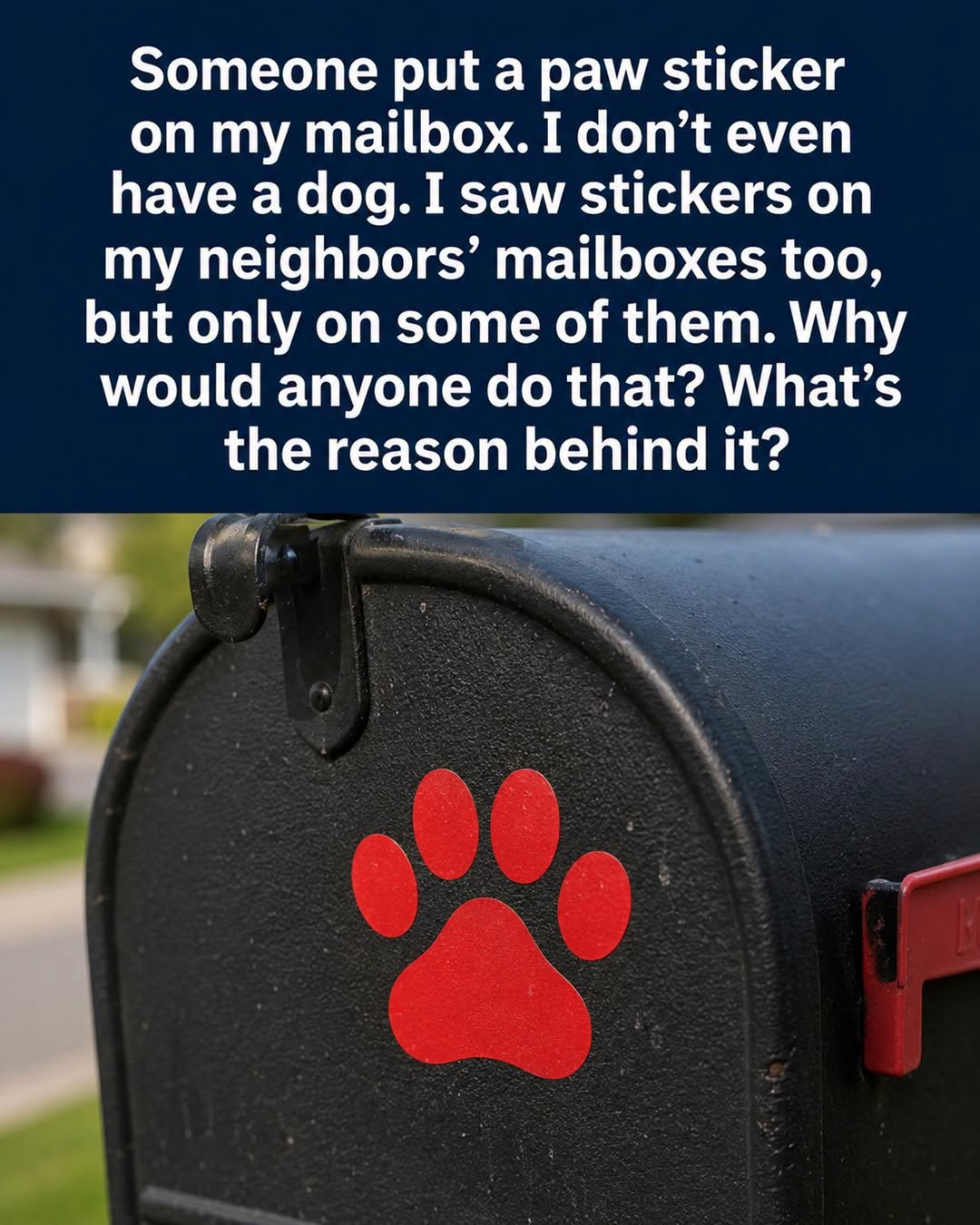
Have you ever walked through your neighborhood and noticed a small paw-print sticker attached to someone’s mailbox? At first glance, it may seem like nothing more than a decorative touch or a way for pet owners to show off their love for their dogs. However, those little paw prints often have a much more meaningful story behind them.
For many years, these stickers served an important purpose: helping protect mail carriers from unexpected encounters with dogs. Although the official program that distributed them has ended in many areas, the stickers can still be found on mailboxes across the country, quietly reminding us of the daily challenges faced by postal workers.
Understanding why these stickers were created not only reveals an interesting piece of postal history but also highlights the importance of community cooperation, responsible pet ownership, and workplace safety.
The Story Behind the Paw-Print Sticker
Most people assume the sticker is simply decorative.
In reality, the paw-print symbol was once part of a safety initiative designed to reduce dog-related incidents involving mail carriers.
Delivering mail requires postal employees to visit hundreds of homes every day. Unlike most delivery jobs, mail carriers often approach front doors, walk through yards, and pass closely by family pets.
Even dogs that are friendly with family members may react differently when a stranger enters what they consider their territory.
To help carriers prepare before approaching a home, some postal districts introduced brightly colored paw-print stickers as visual alerts.
These simple decals allowed carriers to recognize the possible presence of a dog before entering the property.
Why Mail Carriers Need Dog Warnings
Many people underestimate how often postal workers encounter dogs.
Every delivery route may include dozens—or even hundreds—of homes with pets.
While the vast majority of dogs are well behaved, mail carriers cannot predict how an unfamiliar animal will react.
Dogs may become protective because they:
- See the carrier approaching the home.
- Hear footsteps on the porch.
- Notice movement near the mailbox.
- Feel responsible for guarding their family.
Even gentle dogs can bark loudly, run toward a visitor, or attempt to defend what they believe is their territory.
Because carriers visit the same homes repeatedly, they depend on advance information to perform their jobs safely.
How the Paw-Print System Worked
The sticker program was intentionally simple.
Different colors communicated different situations.
Orange Paw Print
An orange paw-print sticker indicated that a dog lived at the address where the sticker appeared.
This allowed the carrier to prepare before approaching the property.
Yellow Paw Print
A yellow sticker typically indicated that a neighboring property had a dog.
Even though the dog did not live at the delivery address itself, carriers remained aware that an animal might approach from the adjacent yard.
The system provided a quick visual reminder without requiring carriers to memorize every house along their routes.
Why the Program Was Eventually Discontinued
As technology improved, the postal service developed more efficient ways to communicate potential hazards.
Today, many mail carriers carry handheld electronic scanners that provide important delivery information.
When a package or delivery address is scanned, the device can display alerts that may include:
- Dogs on the property
- Delivery hazards
- Access instructions
- Safety notes
Because electronic systems can be updated more easily than physical stickers, they eventually replaced many of the earlier visual warning programs.
However, countless stickers remain on mailboxes because homeowners simply never removed them.
Why Dog Awareness Matters
Dog-related injuries remain one of the most common occupational hazards faced by mail carriers.
Unlike weather or traffic, animal behavior can change instantly.
A dog that has ignored the mail carrier for years may suddenly react differently because of:
- Protecting puppies
- Illness
- Fear
- Loud noises
- Changes in the environment
- New people nearby
This unpredictability is exactly why advance warnings remain valuable.
Why Friendly Dogs Sometimes Become Protective
Many owners are surprised when they hear their dog bark aggressively at delivery workers.
The explanation usually isn’t that the dog is mean.
Dogs naturally develop territorial instincts.
From the dog’s perspective:
Someone walks toward the house.
Places an object near the property.
Leaves.
To the dog, barking may appear successful because the stranger always walks away afterward.
This repeated pattern unintentionally reinforces territorial behavior.
Common Situations Mail Carriers Face
Mail carriers experience many situations most homeowners never see.
For example:
- Dogs rushing through open front doors.
- Pets squeezing through partially opened gates.
- Loose dogs running from neighboring yards.
- Owners unintentionally dropping leashes.
- Invisible electric fences that fail.
- Dogs hiding behind bushes before suddenly appearing.
Even experienced carriers cannot predict every encounter.
How Dog Owners Can Help
Fortunately, preventing dangerous situations is usually simple.
Secure Pets During Delivery
The easiest solution is keeping dogs safely inside while mail is delivered.
If your dog spends time outdoors, make sure fencing and gates remain secure.
Avoid Opening the Door
Many dog bites occur when owners answer the door while their pet is nearby.
Excited dogs can rush outside before owners realize what happened.
Waiting until the carrier has left eliminates this risk.
Train Basic Commands
Commands such as:
- Sit
- Stay
- Come
- Leave it
can make unexpected situations much safer.
Although no dog is perfectly trained, consistent practice greatly improves control.
Keep Leashes Secure
If walking your dog when the mail carrier approaches, maintain a firm grip on the leash.
Even friendly dogs sometimes react unexpectedly.
Use Clear Warning Signs
Simple signs like:
- Dog Inside
- Please Close Gate
- Use Side Entrance
provide helpful information for delivery workers and visitors.
Technology Has Changed Mail Delivery
Modern mail carriers rely on much more than memory.
Many now use handheld scanners that provide:
- Delivery confirmations
- Route updates
- Address notes
- Package information
- Hazard alerts
These digital systems allow supervisors to update safety information much faster than replacing physical mailbox stickers.
Other Delivery Workers Benefit Too
Although the original stickers were intended for postal workers, many homeowners choose to leave them in place because they may also help:
- Package delivery drivers
- Utility workers
- Meter readers
- Contractors
- Emergency responders
- Maintenance personnel
Anyone approaching the property may appreciate knowing that a dog could be nearby.
What Should You Do If You Find One?
If you notice a paw-print sticker on someone else’s mailbox, the best approach is simply to leave it alone.
It belongs to the homeowner and may still provide useful information.
If the sticker is on your own mailbox, whether you remove it is entirely your decision.
Since the program is no longer widely active, there is generally no requirement to keep it.
Some homeowners choose to leave the sticker because they feel it continues serving as a helpful courtesy.
Helping Keep Mail Carriers Safe
Mail carriers perform an essential service every day, often in challenging conditions.
They work through:
- Rain
- Snow
- Heat
- Wind
- Ice
- Busy traffic
- Loose animals
A few simple actions from homeowners can make their jobs much safer.
These include:
- Keeping pathways clear.
- Repairing broken gates.
- Controlling pets.
- Clearing snow and ice.
- Trimming overgrown bushes.
- Ensuring house numbers remain visible.
Small acts of consideration help protect the people who serve our neighborhoods every day.
Frequently Asked Questions
Are paw-print stickers still officially used?
In many areas, the original sticker program has been replaced by digital alerts carried on postal handheld scanners. However, many older stickers remain on mailboxes.
Does every house with a dog have one?
No.
Many homes with dogs never participated in the original program.
Should I remove a sticker from my mailbox?
That’s entirely your choice if it’s on your property.
Some homeowners leave them in place as a courtesy to delivery workers.
Do delivery companies use similar warning systems?
Many package delivery companies maintain internal systems that alert drivers about known hazards, including dogs.
Why do dogs bark at mail carriers so often?
Dogs often view unfamiliar visitors approaching their home as potential intruders. Because the carrier leaves after making the delivery, the dog may believe barking successfully protected its territory.
What Does a Paw-Print Sticker on a Mailbox Mean? The Hidden Purpose Behind This Small but Important Symbol
If you’ve ever taken a walk through your neighborhood, you may have noticed a small paw-print sticker attached to a mailbox. At first glance, it looks like a decorative sticker added by someone who loves dogs. In fact, many people assume it’s simply a fun way for pet owners to personalize their mailbox.
However, those little paw-print stickers actually have a fascinating history. In many neighborhoods across the United States, they once served an important safety purpose by helping mail carriers identify homes where dogs were present. While the official program has largely been replaced by modern technology, these stickers continue to spark curiosity and remind us of the important relationship between homeowners, pets, and the postal workers who visit our neighborhoods every day.
Learning the story behind these stickers offers a new appreciation for the work mail carriers perform and highlights how even the smallest details can contribute to community safety.
The Unexpected Discovery
Many homeowners first notice these stickers purely by accident.
Perhaps you see one while collecting your mail or while walking your dog through the neighborhood.
After spotting one mailbox with a paw print, you suddenly notice several more.
Naturally, questions arise.
Is it a neighborhood club?
A pet owner’s decoration?
A delivery instruction?
The truth is much more practical.
These stickers were originally designed as visual safety alerts for postal employees.
Why Mail Carriers Face Unique Challenges Every Day
Most people think of mail delivery as a routine job.
However, postal carriers face a surprising number of daily hazards.
These include:
- Heavy traffic
- Slippery sidewalks
- Extreme heat
- Snow and ice
- Loose animals
- Poorly maintained walkways
- Aggressive pets
Among these risks, encounters with dogs remain one of the most common safety concerns.
Unlike delivery drivers who may remain inside a vehicle, letter carriers often walk directly onto residential property dozens—or even hundreds—of times every day.
Every front porch, driveway, and yard presents a new environment.
Most interactions are uneventful.
But occasionally, an otherwise friendly family dog becomes protective when an unfamiliar person approaches.
Why Dogs React to Mail Carriers
One of the most interesting aspects of canine behavior involves territorial protection.
Dogs don’t necessarily dislike mail carriers.
Instead, they often interpret repeated visits as someone entering their territory.
From the dog’s perspective, the pattern looks something like this:
- A stranger approaches the house.
- The dog barks.
- The stranger leaves.
Because the mail carrier eventually walks away after completing the delivery, the dog may believe its barking successfully chased away the intruder.
Over time, this unintentionally reinforces protective behavior.
This explains why even well-trained family pets sometimes bark intensely at delivery workers.
The Original Purpose of the Paw-Print Stickers
To improve safety, some postal districts introduced a simple visual warning system.
Rather than relying entirely on memory, carriers could identify homes with dogs before entering the property.
The stickers were small, easy to recognize, and visible from a distance.
They served as gentle reminders that extra awareness might be needed.
This gave carriers valuable time to:
- Observe the yard carefully.
- Listen for barking.
- Watch for open gates.
- Prepare for possible interaction with a pet.
Although simple, this system helped reduce surprises during deliveries.
What the Different Sticker Colors Meant
The original program used different colors to communicate different situations.
Orange Paw Print
An orange paw-print sticker indicated that a dog lived at the address where the mailbox was located.
This alerted the carrier before walking toward the home.
Yellow Paw Print
A yellow paw-print sticker typically indicated that a neighboring property had a dog.
Although the delivery address itself might not have a pet, carriers remained aware that a nearby animal could enter the area.
The color system allowed mail carriers to process information quickly without reading lengthy notes.
Why the Sticker Program Ended
As postal technology evolved, physical stickers became less necessary.
Today, many mail carriers use handheld electronic scanners during their routes.
These devices provide real-time information about each delivery address.
When scanning a package or mailbox location, carriers may receive digital alerts regarding:
- Dogs on the property
- Safety hazards
- Delivery instructions
- Access restrictions
- Customer requests
Unlike stickers, digital alerts can be updated immediately whenever circumstances change.
This makes electronic systems far more flexible and accurate.
Why Many Stickers Are Still Visible Today
Although the official program has largely ended, thousands of stickers remain.
Homeowners often leave them attached because:
- They forget they’re there.
- They still appreciate the warning.
- They feel it helps delivery workers.
- It reminds visitors to expect a dog.
For many neighborhoods, these stickers have simply become part of the landscape.
The Real Risk of Dog Encounters
Dogs account for a significant number of workplace injuries involving mail carriers every year.
Even small dogs can cause injuries if they bite or trip someone carrying heavy mailbags.
Larger dogs present additional concerns because of their strength and speed.
Importantly, many incidents involve dogs that owners describe as:
- Friendly
- Gentle
- Calm
- Never aggressive
Unfortunately, dogs may behave differently when protecting their homes.
Fear, excitement, loud noises, or unfamiliar situations can all influence behavior.
Why Responsible Pet Ownership Matters
Most dog owners care deeply about both their pets and the people who visit their homes.
Simple precautions help protect everyone involved.
Responsible owners should:
- Keep gates securely closed.
- Repair damaged fences promptly.
- Supervise dogs outdoors.
- Keep leashes in good condition.
- Prevent pets from rushing open doors.
These small habits greatly reduce the likelihood of unexpected encounters.
Tips for Helping Your Mail Carrier Stay Safe
Homeowners can make mail delivery much safer with a few thoughtful actions.
Secure Your Dog During Delivery
Keeping pets indoors while mail is delivered is one of the easiest safety measures.
If your dog enjoys spending time outside, consider bringing it indoors during your usual delivery window.
Avoid Opening the Front Door
Many dog bites occur when owners answer the door while their dog is standing nearby.
Even obedient pets can dart outside unexpectedly.
Waiting until the carrier has returned to their vehicle is often the safest option.
Keep Walkways Clear
Mail carriers appreciate unobstructed access.
Remove:
- Children’s toys
- Garden hoses
- Snow
- Ice
- Overgrown plants
Safe walkways benefit everyone.
Train Basic Commands
Reliable commands such as:
- Sit
- Stay
- Leave it
- Come
- Down
can significantly improve safety during unexpected situations.
Training should begin early and continue throughout a dog’s life.
Other Delivery Workers Benefit Too
The usefulness of these warnings extends beyond mail carriers.
Many professionals regularly visit residential properties, including:
- Package delivery drivers
- Utility workers
- Electric meter readers
- Gas technicians
- Internet installers
- Landscapers
- Home repair contractors
Knowing a dog may be present allows them to approach more cautiously.
The Importance of Community Awareness
Neighborhood safety depends on cooperation.
Simple acts of consideration make a significant difference.
Whether you own pets or not, everyone benefits when homeowners:
- Secure animals properly.
- Maintain fences.
- Communicate potential hazards.
- Respect delivery workers.
- Support safe working conditions.
Communities function best when neighbors look out for one another.
Frequently Asked Questions
Does every mailbox with a paw-print sticker have a dog?
Not necessarily.
Some stickers remain even after families move or pets are no longer living at the home.
Can homeowners still request these stickers?
In many areas, the original sticker program has been replaced by electronic alerts, so new stickers are generally no longer distributed.
Do private delivery companies use similar warning systems?
Many delivery companies maintain internal databases that notify drivers about known hazards, including dogs.
Why do some dogs ignore mail carriers while others bark?
Every dog has a unique personality.
Factors such as breed, training, socialization, previous experiences, and territorial instincts all influence behavior.
What should I do if my dog escapes while the mail carrier is nearby?
Call your dog calmly, secure it immediately, and avoid chasing or yelling, which may increase excitement.
Can friendly dogs still bite?
Yes.
Even well-socialized dogs may bite if frightened, startled, injured, or attempting to protect their home or family.
Final Thoughts
A small paw-print sticker on a mailbox may seem insignificant, but it represents an important effort to improve safety for the people who deliver our mail every day. What began as a simple visual reminder helped alert carriers to the possible presence of dogs before they approached a home, giving them valuable time to prepare and reducing the risk of unexpected encounters.
Although modern technology has largely replaced these stickers with digital alerts, many remain on mailboxes as reminders of the partnership between homeowners and postal workers. They also serve as a symbol of responsible pet ownership and the simple steps communities can take to protect one another.
Whether you own a dog or simply appreciate the work mail carriers do, understanding the purpose behind these small stickers encourages greater awareness, kindness, and cooperation. Sometimes the smallest symbols tell the biggest stories—and in this case, a tiny paw print represents respect for both the people delivering our mail and the pets that make our houses feel like home.
More Blog
- Drinking Water on an Empty Stomach — What Science Actually Supports (No Hype, Just Facts)
- Waking Up Between 3 and 5 AM? It Might Be Your Soul Trying to Talk to You
- What a “Bleach” Patch on Your Underwear Really Means — And Why It’s Actually a Good Sign
- This Drink May Weaken Your Bones From The Inside — But Everyone Drinks It Anyway