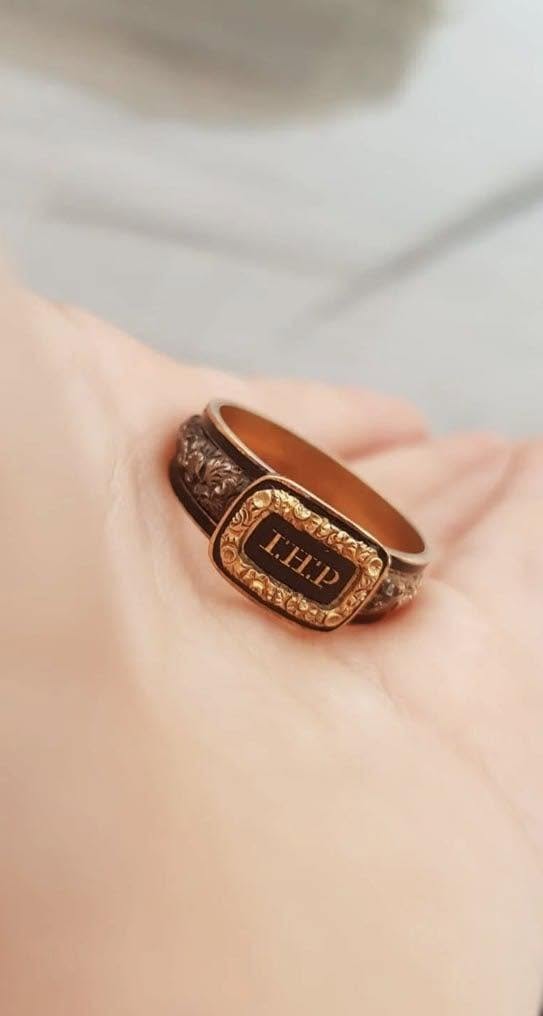
This Vintage Treasure Holds a Deep Story when the object in question is a Georgian mourning ring. At first glance, such a ring may look like a small piece of antique jewelry decorated with dark enamel, gold lettering, a tiny gemstone, braided hair, or an engraved inscription. However, these details often carried deeply personal meaning.
Georgian mourning rings became closely associated with remembrance during the eighteenth and early nineteenth centuries. Families used them to honor people who had died, preserve memories, and sometimes communicate grief in a socially recognizable way. Because jewelry could remain close to the body, a ring offered something more intimate than a painted portrait or memorial plaque.
The Georgian era covered the reigns of Britain’s Kings George I through George IV, from 1714 to 1830. During that long period, mourning customs evolved considerably. Therefore, not every mourning ring looks the same. Some are simple gold bands with black enamel. Others feature inscriptions, urns, skulls, seed pearls, miniature portraits, or compartments containing hair.
This Vintage Treasure Holds a Deep Story because its value often comes from far more than metal or gemstones. Every inscription, symbol, and worn edge may preserve a connection between a living person and someone they refused to forget.
I first understood the emotional power of mourning jewelry after seeing an old ring tucked inside a small wooden box at an estate sale. The gold looked soft from years of wear, while a narrow black enamel band circled the outside. Inside, tiny engraved letters recorded a name and date. I had expected to see nothing more than an antique accessory, yet the inscription changed everything. Suddenly, the ring felt less like jewelry and more like a private message that had somehow survived generations. Since then, I have looked at old mourning rings differently. Their beauty matters, but the memories they were created to carry matter even more.
This Vintage Treasure Holds a Deep Story Through Georgian Mourning Traditions
Death occupied a more visible place in daily life during the Georgian period than it often does today. Families frequently experienced the loss of children, spouses, siblings, and parents at younger ages, so remembrance became woven into household customs.
Mourning Jewelry Turned Grief Into Something Tangible
Mourning jewelry allowed people to carry remembrance physically.
A person could wear a ring every day, touch it, read the inscription, and remember the individual whose name it carried. Consequently, the object created a private connection even when grief followed strict social customs.
Some mourning rings were commissioned directly by families after a death. Others were specified in wills.
A person might leave money for several rings so relatives, friends, or professional associates could receive memorial jewelry. Therefore, surviving examples sometimes appear in groups with identical inscriptions.
This Vintage Treasure Holds a Deep Story because mourning rings often connect directly to an individual rather than commemorating an abstract idea.
Many pieces include initials, names, dates of death, ages, or short phrases. These inscriptions can sometimes help identify the person memorialized.
Black enamel became especially common because black symbolized mourning. However, not every memorial ring relied entirely on black.
White enamel sometimes appeared in mourning jewelry, especially in pieces associated with an unmarried person or child. Seed pearls could symbolize tears or purity, while dark stones created a more somber appearance.
Hair also became an important memorial material.
Families sometimes placed braided or woven hair under glass, inside a small compartment, or beneath a crystal bezel. Because hair survives long after death, it offered a direct physical connection to the deceased.
For modern collectors, that detail can make mourning jewelry feel extraordinarily personal.
Georgian Society Developed a Rich Language of Symbols
Mourning rings often used symbols that nineteenth-century viewers understood immediately.
An urn represented death and remembrance. Weeping willow trees suggested grief. Skulls emphasized mortality. Crosses connected mourning with Christian faith.
Likewise, broken columns could represent a life cut short.
A serpent eating its own tail, known as an ouroboros, symbolized eternity. Therefore, jewelers sometimes used serpent-shaped bands to suggest endless memory or everlasting love.
Forget-me-not flowers communicated remembrance directly.
Miniature paintings could show mourners standing beside tombs or urns, while landscapes often included dark trees and classical monuments.
This Vintage Treasure Holds a Deep Story because those symbols formed a visual language.
Modern viewers may admire the decoration without understanding what each image communicated. However, Georgian wearers often recognized the symbolism immediately.
For example, a tiny urn beneath a willow tree was not random decoration. It created a complete visual message about mourning, loss, and memory.
Even the materials mattered.
Gold suggested permanence and value, while black enamel emphasized grief.
Jet and dark glass became associated with mourning in later periods as well, although specific materials and fashions changed over time.
Therefore, identifying an antique mourning ring requires looking at the entire design rather than one feature alone.
This Vintage Treasure Holds a Deep Story in Its Materials and Craftsmanship
Georgian jewelry often relied on hand craftsmanship. As a result, small irregularities, engraved lettering, handmade settings, and worn surfaces can reveal how a piece was created and used.
Gold, Enamel, Hair, and Gemstones All Carried Meaning
Gold served as one of the most common materials for Georgian mourning rings.
Its durability made it suitable for daily wear, while its value made the object feel worthy of remembrance.
Black enamel frequently covered parts of the band or surrounded engraved lettering. Jewelers sometimes placed pale gold letters against dark enamel so the name and date stood out clearly.
Hairwork added an especially intimate layer.
A jeweler might weave a lock of hair into a delicate pattern beneath glass. In other examples, hair formed part of the band itself.
Because the material came directly from the deceased, it transformed jewelry into a personal relic.
This Vintage Treasure Holds a Deep Story even when the ring appears plain.
A narrow gold band with a single inscription may carry more historical significance than an elaborate ring with precious stones.
However, gemstones also appeared.
Seed pearls became popular in sentimental jewelry and could represent tears. Diamonds sometimes accented rings made for wealthier families.
Garnets, amethysts, rock crystal, and other stones also appeared depending on period, fashion, and budget.
Miniature portraits added another level of detail. A skilled painter could create a tiny likeness on ivory, enamel, or another surface.
Therefore, a mourning ring might function simultaneously as jewelry, memorial, portrait, and family record.
Wear and Patina Can Reveal a Ring’s History
Antique jewelry rarely survives in perfect condition.
Enamel may chip. Gold may soften along edges. Engraved lettering can become faint. Glass covers may scratch.
These signs do not automatically reduce historical interest.
In fact, wear can show that somebody actually used the ring for years.
This Vintage Treasure Holds a Deep Story partly because human contact leaves evidence.
A smooth inner band may suggest frequent wear. Worn engraving can indicate that the ring passed through several generations.
However, damage and restoration complicate identification.
A ring may have received a replacement stone, resized band, repaired enamel, or later inscription.
Therefore, collectors should avoid assuming that every visible feature remains original.
Magnification can help reveal solder lines, replaced settings, inconsistent engraving, and other changes.
Hallmarks can also provide important clues.
British gold jewelry may carry maker’s marks, assay marks, date letters, or purity marks, although Georgian hallmarking practices differ from later standardized systems.
Not every mourning ring has clear marks.
Therefore, dating often requires combining several clues: construction, lettering style, enamel work, symbolism, metal type, and documented provenance.
An experienced antique jewelry specialist can help distinguish genuine Georgian work from later Victorian pieces or modern reproductions.
This Vintage Treasure Holds a Deep Story Because Mourning Jewelry Became a Family Record
Some mourning rings preserve surprisingly specific information. A name, age, and date can turn a small piece of jewelry into a historical document.
Inscriptions Can Connect a Ring to a Real Person
The inside or outside of a mourning ring may contain initials, full names, dates, or phrases such as “In Memory Of.”
Sometimes the inscription records an exact age at death.
That information can become extremely valuable for genealogical research.
For example, a family historian may compare the inscription with parish registers, cemetery records, probate documents, wills, or newspaper notices.
Suddenly, This Vintage Treasure Holds a Deep Story becomes more than a poetic idea.
The ring can point directly toward a documented individual.
Wills are especially useful because some people ordered mourning rings for specific relatives or friends.
A will might state that several people should receive rings of a certain monetary value.
Therefore, researchers can sometimes connect a surviving ring with a named circle of mourners.
Family letters may provide additional clues.
If a ring stayed within one household for generations, oral history can also help explain how it moved through the family.
However, oral traditions can change over time.
Therefore, written documentation provides stronger evidence when available.
Collectors should preserve any old boxes, handwritten notes, photographs, receipts, or family records found with the ring.
Even a small scrap of paper can become an important part of provenance.
Georgian Mourning Rings Differ From Later Victorian Mourning Jewelry
Many people use the phrase “mourning jewelry” broadly.
However, Georgian and Victorian examples can differ significantly.
Victorian mourning customs became especially elaborate after Queen Victoria mourned Prince Albert following his death in 1861.
Black clothing, jet jewelry, hairwork, lockets, brooches, and memorial pieces became deeply associated with Victorian culture.
However, mourning jewelry existed long before that moment.
This Vintage Treasure Holds a Deep Story because Georgian rings represent an earlier stage of that tradition.
Georgian pieces often feature classical imagery such as urns, tombs, and willow trees.
Late Georgian jewelry may also show increasingly sentimental designs.
Victorian examples can become more elaborate, larger, and more varied in form.
Therefore, a black antique ring should not automatically be labeled Georgian.
Construction techniques, inscription styles, hallmarks, materials, and design motifs all matter.
Likewise, not every piece containing hair is mourning jewelry.
Hair jewelry could celebrate friendship, romance, or family relationships during the nineteenth century.
Context determines meaning.
A ring containing hair alongside a death date strongly suggests mourning. However, hair alone does not prove it.
Understanding these distinctions helps collectors appreciate the object more accurately.
This Vintage Treasure Holds a Deep Story and Deserves Careful Preservation
Antique mourning rings require gentle handling because many contain fragile enamel, old adhesives, hairwork, glass, miniature paintings, or delicate stones.
Improper cleaning can permanently damage these materials.
How to Clean and Store Antique Mourning Jewelry
Avoid soaking an antique mourning ring unless a professional confirms that the materials can tolerate water.
Hair compartments, foil-backed gemstones, miniature portraits, and old adhesives can react poorly to moisture.
Likewise, do not use ultrasonic jewelry cleaners.
The vibration can loosen stones, damage enamel, or disturb fragile settings.
Instead, gently wipe exposed metal with a very soft, dry cloth.
If dirt remains around detailed areas, consult a conservator or antique jewelry specialist before using cleaning chemicals.
This Vintage Treasure Holds a Deep Story, so preserving original surfaces usually matters more than making the ring look new.
Patina can carry historical value.
Aggressive polishing may remove engraved details or alter the surface.
Storage also matters.
Keep the ring in a dry, stable environment away from extreme heat, humidity, and direct sunlight.
Store it separately from harder jewelry that could scratch enamel or glass.
A padded jewelry box works well.
For particularly fragile pieces, place the ring in an acid-free archival box with soft inert padding.
Avoid cotton fibers that can catch on delicate prongs.
If the ring contains a miniature or hair compartment, limit strong light exposure because pigments and organic materials can fade.
How to Evaluate a Mourning Ring Before Buying or Selling
Begin by examining the inscription.
Check whether names and dates appear consistent with the apparent age of the ring.
Then look at construction quality.
Handmade Georgian jewelry often shows subtle irregularities that differ from modern machine production.
However, age alone does not guarantee authenticity.
Later revival jewelry sometimes copied earlier styles, while modern reproductions can imitate black enamel and memorial inscriptions.
Therefore, provenance matters.
Ask whether the seller has family history, documentation, old photographs, previous appraisals, or records connecting the ring to an estate.
Next, examine hallmarks carefully.
A specialist can help interpret them accurately.
This Vintage Treasure Holds a Deep Story, but financial value depends on several factors.
These include age, maker, condition, metal purity, gemstones, rarity, inscription, provenance, historical connection, and overall quality.
A ring connected to a documented historical figure may carry substantially greater value than an anonymous example.
However, sentimental value can exceed market value.
For families, an inexpensive mourning band tied to a known ancestor may remain priceless.
Therefore, avoid altering or selling inherited jewelry without first documenting everything known about it.
Frequently Asked Questions
What exactly is a Georgian mourning ring?
A Georgian mourning ring is a memorial piece created during or around the Georgian period, generally associated with Britain between 1714 and 1830. These rings commemorated deceased individuals and often featured black enamel, inscriptions, hairwork, urns, pearls, gemstones, or symbolic imagery.
Why did mourning rings often use black enamel?
Black represented mourning and grief. Jewelers could also use black enamel as a contrasting background for gold lettering. Therefore, names, dates, and memorial phrases became easier to read. However, not every mourning ring used black, and some examples feature white enamel or other colors.
Does hair inside an antique ring always mean it is mourning jewelry?
No. Hair jewelry could represent mourning, friendship, romance, or family affection. A ring becomes more clearly associated with mourning when hair appears alongside a death date, memorial inscription, urn, skull, or another funerary symbol.
How can I tell whether a mourning ring is genuinely Georgian?
Look at construction, metalwork, engraving style, symbolism, hallmarks, enamel, stones, and provenance. However, accurate dating can be difficult because later jewelers copied Georgian styles. Therefore, consult an antique jewelry specialist when authenticity significantly affects value.
Should I polish an old Georgian mourning ring?
Usually, aggressive polishing is a poor idea. It can remove patina, soften engraving, damage enamel, or disturb fragile components. Gently remove loose dust with a soft cloth and consult a professional before deeper cleaning.
Conclusion
This Vintage Treasure Holds a Deep Story because Georgian mourning rings were designed to carry memory across time.
They transformed grief into something tangible.
A name engraved in gold, a lock of hair beneath glass, a black enamel border, or a tiny painted urn could keep a deceased loved one symbolically close long after burial.
These rings also reveal much about Georgian society.
They show how families expressed loss, how jewelers combined symbolism with craftsmanship, and how personal memory could become part of everyday dress.
At the same time, mourning rings function as historical documents.
Names, dates, ages, hallmarks, inscriptions, and family provenance can help researchers reconstruct real lives.
Therefore, an old ring found in a drawer or inherited through generations deserves careful attention before anyone alters, cleans, or sells it.
This Vintage Treasure Holds a Deep Story even when its monetary value remains modest.
Its worn edges may show decades of use. Its faded inscription may preserve the only surviving object linked to a particular person. Its hair compartment may contain a physical connection that has survived for two centuries.
That combination of intimacy and endurance explains why Georgian mourning jewelry continues to fascinate collectors today.
Handle these pieces gently. Preserve their accompanying documents. Avoid aggressive cleaning. Most importantly, read every inscription before judging the ring only by its appearance.
Sometimes the smallest antique in a jewelry box carries the largest story.
And when that antique was created specifically so someone would never be forgotten, its true meaning becomes far greater than gold, enamel, or gemstones alone.