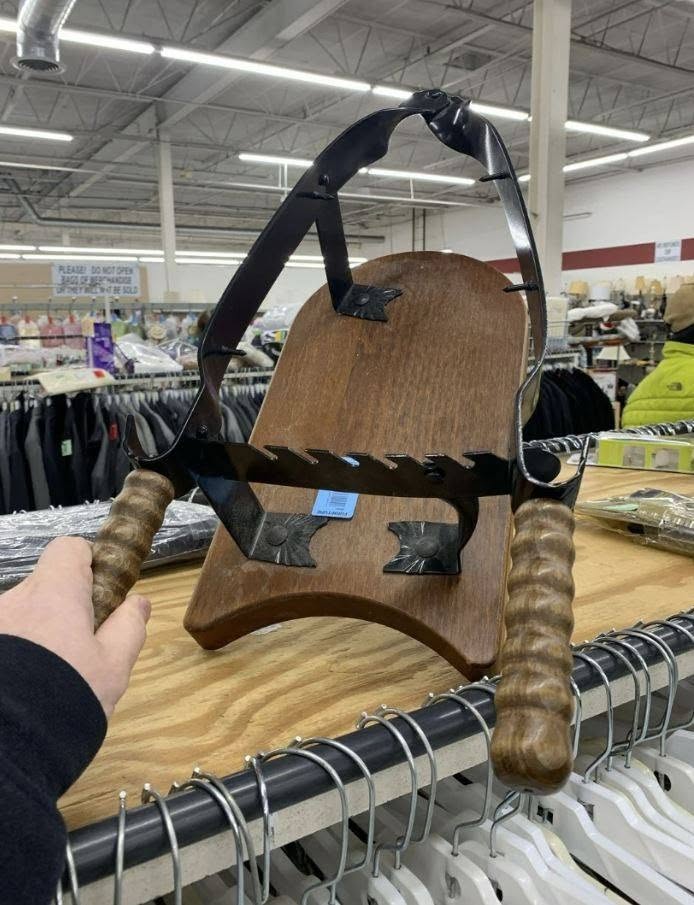
The Prosciutto Stand may look like a simple piece of kitchen equipment, yet its purpose reveals an entire culture of patient curing, careful slicing, and communal eating. Designed to secure a whole cured ham while it is carved, this sturdy holder transforms an awkward, heavy leg into something a skilled slicer can work with safely and precisely.
Across Italy and other parts of Europe, cured ham represents far more than a convenient appetizer. Salt, time, climate, and craftsmanship transform pork into a food that can take many months, and sometimes considerably longer, to mature. Once that process ends and the ham reaches the table, slicing becomes the final step.
That is where The Prosciutto Stand earns its place. A stable base and secure supports hold the leg firmly while a long, sharp knife produces thin slices. The stand does not create the flavor, yet it helps preserve the texture and presentation that make traditionally cured ham so distinctive.
I remember seeing a whole cured ham mounted on a wooden stand at a family gathering and wondering why anyone needed such a specialized object. Then the slicing began. Instead of cutting thick chunks, the person carving it moved the long knife slowly across the surface, producing translucent slices that folded softly onto the plate. Everyone gathered nearby, talking and reaching for slices as they appeared. Suddenly, the stand made sense. It was not decorative clutter. It turned carving into part of the meal itself, creating a small ritual where patience, conversation, and food all shared the same table.
Understanding The Prosciutto Stand and Its Purpose
Why a Whole Ham Needs a Specialized Holder
The Prosciutto Stand solves a surprisingly practical problem.
A whole cured ham is large, heavy, irregularly shaped, and difficult to hold with one hand while slicing with the other. Additionally, producing delicate slices requires controlled knife movements.
Trying to carve a rolling or shifting ham would make that process frustrating and potentially unsafe.
Therefore, a proper stand uses a broad base and one or more supports to stabilize the leg.
Many designs secure the narrow end near the hoof while supporting the heavier portion of the ham against the base. Clamps, collars, spikes, or adjustable fittings may keep everything firmly positioned.
Once secured, the ham sits at an angle that provides access to the cutting surface.
The slicer can then concentrate on making smooth strokes rather than preventing the ham from moving.
That stability becomes particularly important because traditional hand slicing typically uses a long, thin knife.
The Prosciutto Stand also helps the slicer rotate or reposition the ham as carving progresses.
Eventually, the exposed meat changes shape and the bone affects the direction of each cut. An adjustable stand makes those transitions easier.
Although wooden versions have a particularly traditional appearance, modern stands also use stainless steel and other durable materials.
Some combine a wooden base with metal hardware.
Others emphasize portability, easy cleaning, or adjustable positioning.
Whatever the material, the essential purpose remains unchanged: hold the ham securely enough for controlled carving.
It is a simple solution, yet good design makes a substantial difference.
Why Thin Slicing Matters
The Prosciutto Stand supports one of the most recognizable characteristics of prosciutto: extremely thin slicing.
Thickness changes the eating experience.
A thick piece of dry-cured ham can feel chewy and intensely salty. However, a properly thin slice feels more delicate. Fat softens quickly on the tongue, while the meat releases its savory flavor without overwhelming each bite.
That explains why experienced slicers aim for slices that appear almost translucent.
The knife needs to travel smoothly across the surface instead of chopping downward.
Meanwhile, the ham must remain stable.
The Prosciutto Stand provides that stable foundation.
Hand slicing also produces natural variation. Each slice may have a slightly different ratio of lean meat to fat, so successive bites can taste subtly different.
However, thinness should never come at the expense of safety.
A prosciutto knife needs to stay sharp because a dull blade encourages excessive pressure. More pressure can reduce control.
Therefore, the stand should rest on a firm, level work surface.
The ham should remain securely clamped.
Hands should stay away from the knife’s path.
Carving should always move in a controlled direction rather than becoming a contest for speed.
These details reveal why The Prosciutto Stand is more than a display rack.
Its shape directly supports the technique needed to serve a whole cured ham effectively.
The Tradition Behind The Prosciutto Stand
Salt, Pork, and the Art of Preservation
The Prosciutto Stand belongs to a culinary tradition that developed long before electric refrigeration.
For generations, people preserved meat through salting, drying, smoking, fermentation, and other methods. Salt became particularly valuable because it helped control moisture and made meat preservation possible under suitable conditions.
Italian prosciutto developed within this larger preservation tradition.
Different regions eventually established their own methods, rules, and recognizable products.
Prosciutto di Parma, for example, comes from the Parma area and follows protected production standards. Prosciutto di San Daniele comes from Friuli Venezia Giulia and follows its own protected tradition.
These names describe specific products rather than every cured ham made in Italy.
Nevertheless, they demonstrate how deeply location and production methods can shape food traditions.
Making dry-cured ham requires patience.
Producers prepare the fresh leg, apply salt according to the method being followed, and allow moisture to leave gradually. The ham then undergoes a lengthy maturation period under controlled conditions.
Time changes both texture and flavor.
Eventually, the fresh pork becomes firm, aromatic cured ham.
Only after all that work does The Prosciutto Stand enter the picture.
It represents the serving end of a much longer process.
That makes the object interesting from a historical perspective.
A stand does not preserve meat itself.
Instead, it reflects a culture in which families, restaurants, delicatessens, and producers traditionally handled whole cured legs rather than buying only pre-sliced packages.
The stand therefore connects production with presentation.
How a Practical Tool Became Part of the Table
The Prosciutto Stand also illustrates how ordinary kitchen equipment can acquire cultural meaning through repeated use.
Consider a wooden cutting board.
On its own, it is simply a surface.
However, a board used at countless family meals can become associated with particular people, celebrations, and recipes.
The same transformation can happen with a ham stand.
A sturdy stand might remain in a household for years.
It may appear during holidays, celebrations, or large gatherings.
Someone learns to secure the ham properly.
Another person learns how to carve it.
Eventually, younger family members understand the process simply because they have watched it happen repeatedly.
In that sense, The Prosciutto Stand can become part of culinary memory.
Still, romantic stories should not obscure its practical origins.
The stand exists because whole cured ham is difficult to carve without support.
Its cultural importance grew around that practical function.
Modern versions demonstrate how the design continues to evolve.
Some feature rotating hardware that lets the user change the ham’s position without removing it completely.
Others fold for storage.
Professional stands may prioritize heavy bases and rigid stainless-steel supports.
Decorative household versions often emphasize attractive wood.
Yet the best stand is not necessarily the most elaborate one.
It needs stability, strong hardware, enough room for the intended ham, and surfaces that can be cleaned properly.
Function comes first.
Tradition gives that function its character.
How to Use The Prosciutto Stand Properly
Securing and Preparing the Ham
Before slicing anything, place The Prosciutto Stand on a sturdy, level surface.
Do not use an unstable table.
Likewise, avoid positioning the stand close to the edge of a counter where accidental pressure could tip it.
Next, mount the ham according to the stand manufacturer’s design.
Different models secure the leg differently, so follow the instructions supplied with your stand.
Once mounted, test the ham gently.
It should not wobble significantly when you apply light pressure.
If it moves, tighten the appropriate fittings before picking up the knife.
Next comes preparation.
A whole cured ham usually has an exterior layer that protects the meat during maturation. You only need to expose the area you plan to slice.
Avoid stripping away far more protective material than necessary.
Once you expose the cutting surface, begin with controlled strokes.
Use a proper slicing knife with a long blade suited to cured ham.
Keep the knife sharp.
The Prosciutto Stand should hold the leg while your free hand stays safely away from the blade’s travel.
Try to maintain a relatively even cutting surface as you progress.
Deep gouges make later slicing more difficult and create thick, irregular pieces.
Instead, use long, smooth strokes.
The goal is thin slices rather than large chunks.
As you approach bones, the technique changes.
Never force the long blade blindly around hard bone.
Slow down and adjust your cutting direction.
A smaller knife may help separate meat carefully in tighter areas.
Safety always matters more than extracting one additional perfect slice.
Serving and Storing Prosciutto
Freshly sliced prosciutto usually tastes best when it is not refrigerator-cold.
Cool temperatures make fat firmer and can mute some aromas.
Therefore, slices often become more supple and expressive after sitting briefly at a comfortable serving temperature.
Arrange the slices loosely rather than compressing them into a dense pile.
This keeps them easy to separate.
Prosciutto pairs naturally with bread, cheese, fruit, and simple vegetables.
Melon remains a classic partner because its juicy sweetness contrasts with salty cured meat.
Fresh figs can provide a similar effect.
Meanwhile, mild cheeses and bread let the prosciutto remain the dominant flavor.
The Prosciutto Stand can also become part of the serving experience.
At a gathering, carving a few slices at a time keeps the presentation fresh and encourages conversation around the food.
However, proper storage remains important.
Follow the producer’s directions for the particular ham you purchase because storage recommendations can vary depending on whether the product remains whole, partially carved, vacuum-packed, or sliced.
Keep The Prosciutto Stand itself clean as well.
Remove food residue promptly.
Clean metal components according to the manufacturer’s directions.
Likewise, treat wooden bases appropriately rather than soaking them unnecessarily.
Before remounting food, make sure relevant surfaces are clean and completely dry.
A beautiful traditional presentation still requires modern food-safety habits.
Choosing and Caring for The Prosciutto Stand
What Makes a Good Stand
When selecting The Prosciutto Stand, stability should come before appearance.
A beautiful stand that slides across the counter or allows the ham to wobble defeats its main purpose.
Look for a wide, substantial base.
The hardware should feel rigid once tightened.
Additionally, clamps should accommodate the type and size of cured ham you expect to use.
Adjustability can provide another advantage.
A rotating or repositionable support allows you to change the cutting angle as the shape of the ham changes.
However, extra mechanisms also create additional areas that require cleaning.
Therefore, choose complexity only when it provides a feature you will actually use.
Material matters too.
Wood gives The Prosciutto Stand a warm, traditional appearance and looks particularly attractive when food becomes part of a table presentation.
Beech and other hardwoods commonly appear in kitchen equipment because they can provide a strong base.
Metal stands offer another option.
Stainless-steel components can provide excellent rigidity and straightforward maintenance when properly designed.
Many stands combine both materials.
Regardless of style, inspect the hardware periodically.
Loose screws, worn clamps, or damaged components can undermine stability.
Never continue slicing from a stand that no longer holds the ham securely.
A good stand should make carving feel predictable.
If you constantly need one hand to stop the ham from moving, something needs adjustment.
Cleaning and Preserving the Stand
The Prosciutto Stand comes into direct contact with food or sits immediately beside it, so cleanliness matters.
After slicing, remove visible meat and fat residue.
Follow the manufacturer’s instructions for disassembling removable hardware.
Wash food-contact metal components appropriately and dry them thoroughly.
Wood requires more careful treatment.
Do not automatically place a wooden base in a dishwasher.
High heat, detergent, and prolonged water exposure can warp or crack many wooden kitchen products.
Instead, follow the maker’s cleaning directions.
In many cases, prompt hand cleaning with minimal moisture followed by thorough drying works better.
Never leave food residue trapped around screws or clamps.
Fat can accumulate in narrow spaces and become difficult to remove later.
Therefore, occasional deeper cleaning may require removing detachable components.
The Prosciutto Stand should also remain completely dry during storage.
Moisture trapped against wood or metal encourages deterioration.
Store the stand somewhere clean and ventilated rather than placing it away while damp.
If a wooden component develops deep cracks or another food-contact surface becomes impossible to clean effectively, consider replacing the damaged piece.
Proper care allows a quality stand to serve for many years.
That longevity contributes to its traditional appeal.
Unlike disposable packaging, The Prosciutto Stand is meant to return to the table repeatedly.
Every use reinforces the same simple ritual: secure the ham, sharpen the knife, slice patiently, and share.
Frequently Asked Questions
What is The Prosciutto Stand used for?
The Prosciutto Stand securely holds a whole cured ham while someone slices it. Its base and clamps prevent the ham from rolling or shifting and make controlled, thin slicing easier.
What is a prosciutto holder called in Italian?
Several descriptions can appear depending on the product and context, including morsa per prosciutto, referring to a ham-holding clamp or stand. Italian sellers may also describe products as supports or stands for prosciutto.
Do I need The Prosciutto Stand for pre-sliced prosciutto?
No. The Prosciutto Stand serves whole cured legs. If you purchase prosciutto already sliced, you can simply store and serve it according to the package instructions.
Why should prosciutto be sliced so thin?
Thin slicing creates a more delicate texture and distributes the salty, savory meat and soft fat pleasantly across each bite. Thick slices can feel substantially chewier.
Can I use The Prosciutto Stand for other cured hams?
Many stands can hold different whole cured ham styles, including certain Spanish-style hams. However, dimensions and shapes differ, so check whether your stand supports the specific leg you plan to mount.
Conclusion
The Prosciutto Stand demonstrates how an uncomplicated kitchen object can tell a surprisingly rich food story.
At its most basic, the stand solves a mechanical problem.
A cured ham is heavy and irregular.
A slicing knife needs controlled movement.
Therefore, the ham needs secure support.
Yet generations of curing and serving whole hams have given The Prosciutto Stand a significance beyond simple convenience.
It marks the final stage of a process built around salt, time, skilled production, and patience.
Once the ham reaches the stand, months of maturation become something people can finally share at the table.
The stand also encourages a slower style of serving.
Instead of tearing open a package and placing uniform slices onto a plate, someone carves the ham gradually.
Each stroke exposes another layer.
Each slice differs slightly.
People gather, talk, taste, and wait for the next piece.
That experience explains why traditional food tools survive even when modern alternatives become faster.
Efficiency is not always the only goal.
Sometimes the process forms part of the pleasure.
The Prosciutto Stand represents exactly that idea.
Choose a sturdy model.
Secure the ham carefully.
Keep your knife sharp and your hands clear of its path.
Clean the stand thoroughly after use.
Then appreciate the object for what it does best: supporting one of the final, satisfying steps in a centuries-old tradition of curing, slicing, and sharing food.