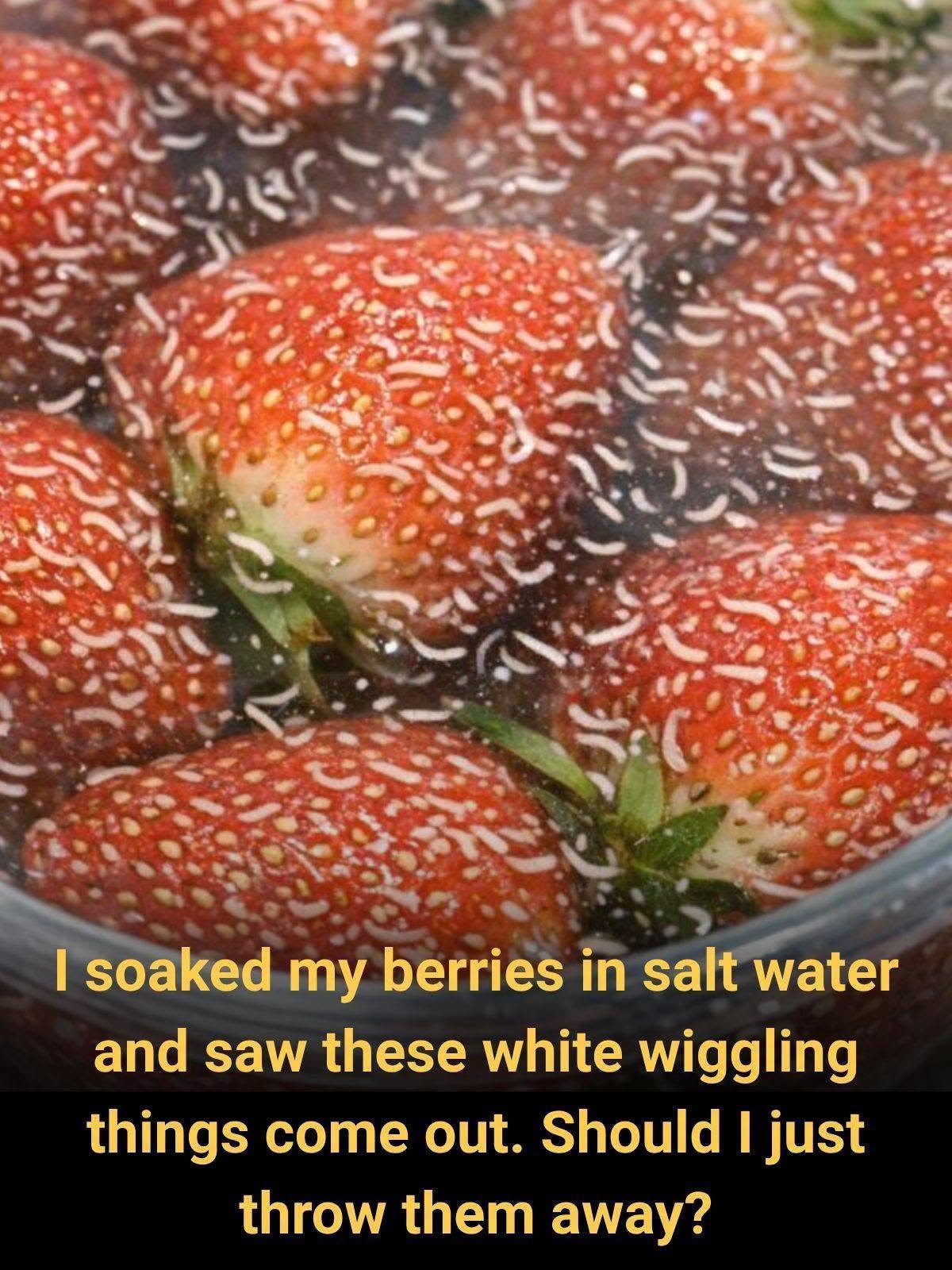
I Soaked My Strawberries in Salt Water and Saw White Worm-Like Things is the kind of experience that can make anyone hesitate before taking another bite. A bowl of fresh berries looks perfectly normal, then a salt-water soak appears to reveal tiny pale, wriggling organisms. Suddenly, a healthy snack can feel alarming.
However, the sight does not automatically mean the strawberries are filled with dangerous parasites.
Fresh strawberries grow outdoors and can come into contact with insects, soil, moisture, plant debris, and other natural material. Occasionally, tiny insects or larvae may be present on or in damaged fruit. At the same time, a magnified white speck in a viral video does not prove that every strawberry contains “worms.”
More importantly, salt water does not provide a reliable food-safety test. It cannot tell you whether fruit contains disease-causing bacteria, and seeing nothing after a soak does not prove that the berries are sterile.
Current food-safety guidance recommends a much simpler routine: inspect fresh produce, discard rotten pieces, rinse the fruit thoroughly under running water, and avoid using soap or detergent on produce. Washing can reduce bacteria on the surface, although it cannot eliminate every microorganism.
I once bought a beautiful container of strawberries and found one berry near the bottom with a soft spot and a tiny moving insect nearby. My first reaction was to throw out the entire container. Instead, I inspected every berry carefully, discarded the damaged fruit and the pieces touching it, then rinsed the remaining firm berries before eating them. The experience changed the way I handle berries. I no longer assume that one odd-looking piece means the whole package is unsafe, but I also do not ignore mold, leaking fruit, or obvious decay. A careful inspection usually gives a much clearer answer than a dramatic online trick.
What White Worm-Like Things on Strawberries Might Actually Be
Tiny Larvae Can Sometimes Be Associated With Ripe Fruit
If I Soaked My Strawberries in Salt Water and Saw White Worm-Like Things describes what happened in your kitchen, the first question is usually simple: what are those things?
Without seeing and identifying the organism directly, nobody can reliably determine the species from a description alone.
However, small insect larvae can sometimes occur in fruit.
Certain fruit flies lay eggs in ripe or damaged fruit, and very small larvae may develop inside the soft flesh. Because the larvae can be pale or nearly translucent, they may look like tiny white worms.
That does not make them human parasites.
Insects that develop in fruit generally have life cycles associated with plants and fruit rather than the human body. Therefore, seeing a small larva does not automatically mean the berry contains something capable of establishing an infection in a person.
In addition, strawberries have delicate skin.
They can crack, bruise, soften, and become damaged during growing, harvesting, transport, and storage. Those damaged areas can make the fruit more attractive to insects.
However, not every strawberry contains larvae.
The dramatic idea that all strawberries hide wriggling worms simply does not follow from seeing an occasional insect in one batch.
I Soaked My Strawberries in Salt Water and Saw White Worm-Like Things should therefore prompt inspection, not panic.
Look at the fruit closely.
Check for soft spots.
Notice whether any berries have obvious holes, leaking juice, severe bruising, or decay.
Then decide whether the fruit still looks fresh enough to wash and eat.
Not Every White Speck Is a Worm
The second possibility is much less dramatic.
Some white objects that appear in a bowl of soaked strawberries may not be living organisms at all.
Strawberries have textured surfaces covered with seeds, tiny hairs, plant tissue, and crevices where debris can collect.
Small fragments of the fruit itself may loosen during soaking.
Plant material can float.
Tiny particles can move when the water moves.
Likewise, air bubbles, reflections, and magnification can make ordinary debris appear surprisingly strange.
Viral videos create another problem.
They often show extreme close-ups without enough context to identify what the viewer is actually seeing.
A tiny object filmed with a phone’s macro setting can look enormous.
If water moves around the object, that movement can make a stationary particle seem alive.
Therefore, I Soaked My Strawberries in Salt Water and Saw White Worm-Like Things does not provide enough information by itself to identify the material.
You need actual observation.
Does the object move independently?
Does it bend or crawl?
Does it remain attached to the fruit?
Does it simply drift with the water?
Those details can help, although they still may not allow a certain identification.
The safest approach does not require identifying every tiny object.
Instead, focus on the condition of the berries.
Fresh, firm fruit without mold or decay can usually be handled by normal produce-washing practices.
By contrast, visibly rotten or moldy fruit should go into the trash rather than the sink.
That distinction matters much more for food safety than trying to diagnose every speck in a viral-looking bowl.
Does Salt Water Really Remove Bugs From Strawberries?
Salt Water Is Not a Reliable Safety Test
I Soaked My Strawberries in Salt Water and Saw White Worm-Like Things became a popular type of online experiment because the result looks convincing.
You place berries in water.
You add salt.
Then tiny objects appear.
The natural conclusion is that the salt “pulled worms out” of otherwise normal strawberries.
However, that conclusion goes too far.
A salt solution may disturb some small insects or organisms that are already present.
Soaking may also loosen debris.
Therefore, the process can make certain things easier to notice.
Still, salt water cannot tell you whether the berries contain harmful bacteria.
It cannot prove that the fruit is free from viruses.
Likewise, it cannot guarantee that every insect has been removed.
Food-safety guidance does not recommend salt-water soaking as a substitute for washing produce under running water.
Instead, current guidance recommends rinsing fresh fruits and vegetables thoroughly under running water and gently rubbing the surface. It also advises against washing produce with soap, detergent, or commercial produce wash.
Another important point often gets lost online.
Washing reduces surface contamination, but it does not sterilize produce.
Official guidance specifically notes that washing can reduce bacteria without eliminating all of it.
Therefore, seeing nothing after a salt-water soak does not prove safety.
Likewise, seeing one insect does not prove the fruit is dangerously contaminated.
I Soaked My Strawberries in Salt Water and Saw White Worm-Like Things should not become a home laboratory test.
Use appearance, freshness, storage, and proper washing instead.
Vinegar, Soap, and Bleach Are Not Necessary
Once people worry about insects or germs, they often search for a stronger cleaning method.
That can lead to vinegar baths, soap, detergent, bleach, or other household substances.
However, stronger does not always mean safer.
Current guidance recommends plain running water for fresh produce and specifically advises against soap, detergent, and household cleaning solutions on fruits and vegetables. Produce can absorb residues, and those products are not designed to be eaten.
Therefore, do not respond to I Soaked My Strawberries in Salt Water and Saw White Worm-Like Things by reaching for dish soap.
Instead, place the strawberries in a clean colander.
Run cool water over them.
Gently move and rub the berries so water reaches different surfaces.
Then dry them with a clean paper towel or clean cloth.
Drying can also help reduce some surface bacteria after rinsing.
Vinegar gets more complicated.
Some people use diluted vinegar to help reduce surface microorganisms or slow spoilage.
However, a vinegar soak should not be treated as sterilization.
It cannot guarantee that pathogens are gone.
Likewise, it does not make spoiled strawberries safe again.
If a berry smells bad, leaks, collapses into mush, or carries mold, washing does not reverse decomposition.
The practical rule remains simple.
Inspect first.
Rinse properly.
Dry thoroughly.
Refrigerate.
Discard what is clearly spoiled.
That routine provides much more reliable everyday protection than dramatic soaking experiments.
Should You Throw Strawberries Away After Seeing Larvae or Mold?
One Tiny Insect Does Not Always Mean the Whole Box Is Ruined
I Soaked My Strawberries in Salt Water and Saw White Worm-Like Things can create an immediate urge to throw everything away.
However, the condition of the fruit matters.
If you notice one small insect on an otherwise firm, fresh-looking berry, that finding alone does not automatically prove that every strawberry in the container is unsafe.
Inspect the entire package.
Remove berries that look badly bruised, decomposed, leaking, or rotten.
If one piece looks questionable, discard it.
Then inspect berries that touched it.
Food-safety guidance recommends cutting away damaged or bruised areas on produce and throwing away produce that looks rotten.
However, strawberries are soft fruit.
That matters when mold appears.
Mold can grow beneath the visible surface of soft, high-moisture foods.
Therefore, you should not simply scrape mold off a strawberry and eat the remainder.
Guidance for moldy fruit recommends discarding moldy pieces and any fruit directly touching them, then carefully examining the remaining fruit. If the rest shows no mold and is not overly mushy, wash it thoroughly before eating.
This approach offers a sensible middle ground.
You do not need to throw out a full package automatically because one berry went bad.
However, you should not ignore mold either.
Check neighboring fruit closely.
Mold spreads quickly among soft fruits and vegetables, especially when they sit together in a moist container.
Therefore, I Soaked My Strawberries in Salt Water and Saw White Worm-Like Things becomes a much easier situation to manage when you separate insects from spoilage.
One is unpleasant.
The other may signal a stronger reason to discard affected fruit.
Mold, Slime, Odor, and Decay Matter More Than the Salt-Water Trick
When deciding whether to keep or discard strawberries, focus on visible quality.
Mold provides one of the clearest warning signs.
Fuzzy white, gray, green, or blue growth indicates spoilage.
Soft fruit should generally be discarded when mold appears because contamination can extend below the surface.
Sliminess also matters.
Fresh strawberries should feel firm to moderately soft, depending on ripeness.
They should not feel slick, mushy, or wet from decomposition.
Likewise, leaking berries deserve attention.
Juice leaking from crushed or decomposing fruit can spread moisture through the container and speed deterioration.
An unpleasant fermented or rotten odor provides another warning.
Fresh strawberries should smell fruity and fresh.
If the package smells sour, alcoholic, or badly fermented, inspect it carefully and discard spoiled fruit.
I Soaked My Strawberries in Salt Water and Saw White Worm-Like Things becomes much less concerning when the berries remain fresh, firm, and mold-free.
By contrast, a package full of soft, moldy fruit belongs in the trash regardless of whether salt water reveals anything.
This distinction also helps reduce food waste.
You do not need to discard perfectly good berries because an online video made you nervous.
At the same time, you should not try to rescue obviously spoiled fruit because you dislike wasting food.
Food safety works best when you respond to actual signs of spoilage rather than fear.
How to Wash, Store, and Eat Strawberries Safely
Rinse Under Running Water Shortly Before Eating
I Soaked My Strawberries in Salt Water and Saw White Worm-Like Things often leads people to overcomplicate strawberry washing.
The routine can stay simple.
First, wash your hands.
Then inspect the berries and remove any visibly rotten or moldy fruit.
Place the strawberries under cool running water.
Gently rub and turn them so the water reaches the surfaces.
Then dry them with a clean towel or paper towel.
Current produce guidance recommends thorough rinsing under running water before eating or preparing fresh fruits and vegetables. It also recommends drying the produce afterward.
Avoid soap.
Avoid detergent.
Avoid bleach.
Those products belong on dishes and surfaces, not on strawberries.
Timing matters too.
Strawberries spoil quickly when excess moisture remains on them.
Therefore, washing just before eating often works better than washing the entire package days in advance.
If you do wash them early, dry them very thoroughly before refrigeration.
Keep strawberries cold because berries deteriorate faster at warm temperatures.
General produce guidance recommends keeping perishable produce refrigerated at 40°F or below.
You should also check the container every day or two.
Remove berries that begin to mold or collapse before they affect neighboring fruit.
These habits matter more than whether you perform a salt-water soak.
Know When Symptoms After Eating Need Medical Attention
If you already ate strawberries before noticing a tiny insect, there is usually no reason to assume you now have a parasitic infection.
Finding an insect associated with fruit does not automatically mean that organism can live inside the human body.
However, foodborne illness can occur after eating contaminated produce, just as it can occur after eating other contaminated foods.
Common symptoms can include diarrhea, stomach cramps, nausea, vomiting, and fever.
Most mild stomach illnesses improve without major treatment.
However, some symptoms deserve medical attention.
Current guidance recommends seeking care for bloody diarrhea, diarrhea lasting longer than three days, fever above 102°F, vomiting so frequent that you cannot keep liquids down, or signs of dehydration such as reduced urination, dry mouth, or dizziness when standing.
Pregnant people and others at higher risk from foodborne illness should also take significant symptoms seriously.
Therefore, I Soaked My Strawberries in Salt Water and Saw White Worm-Like Things should not cause panic if you already ate a berry.
Instead, pay attention to how you feel.
If you remain well, you do not need to assume something harmful happened.
If severe symptoms develop, seek appropriate medical care rather than trying home “detox” remedies.
The same practical approach applies before eating.
Choose good-quality fruit.
Refrigerate it.
Discard obvious spoilage.
Wash it under running water.
Then enjoy it without turning every tiny natural imperfection into a health emergency.
Frequently Asked Questions
I Soaked My Strawberries in Salt Water and Saw White Worm-Like Things. Should I throw the whole container away?
Not automatically. Inspect the berries carefully. Discard any that are moldy, rotten, leaking, severely damaged, or overly mushy. If only one berry is affected, remove it and inspect berries that touched it. Remaining firm, mold-free fruit can be rinsed thoroughly before eating.
Are the white things definitely parasites?
No. Without identifying the organism directly, you cannot know exactly what it is. Some may be small insect larvae, while others may be plant debris or other material. Fruit-associated insect larvae are not automatically human parasites.
Does salt water make all hidden bugs leave strawberries?
No. Salt water may disturb some organisms, but it is not a reliable test for contamination and does not guarantee removal of insects or pathogens.
What is the safest way to wash strawberries?
Rinse them thoroughly under cool running water while gently rubbing and turning the fruit. Then dry them with a clean towel or paper towel. Do not use soap, detergent, or bleach.
What should I do if I already ate strawberries and feel sick?
Monitor your symptoms and stay hydrated. Seek medical care for severe signs such as bloody diarrhea, diarrhea lasting more than three days, fever above 102°F, repeated vomiting that prevents you from keeping liquids down, or signs of dehydration.
Conclusion
I Soaked My Strawberries in Salt Water and Saw White Worm-Like Things sounds alarming, especially when you have just watched tiny pale objects move through the water.
However, the sight does not prove that strawberries are dangerous or filled with human parasites.
Fresh fruit comes from an outdoor agricultural environment.
Therefore, an occasional insect, larva, or bit of debris can appear.
Salt water may make some material easier to notice, but it does not provide a reliable food-safety test.
The better approach focuses on the condition of the fruit.
Inspect strawberries carefully.
Discard berries that are rotten, moldy, slimy, leaking, or severely damaged.
If one moldy berry appears, remove it and any fruit directly touching it, then inspect the rest closely.
For fresh berries, wash them thoroughly under running water before eating.
Do not use soap, detergent, or bleach.
Then dry the fruit with a clean towel and refrigerate it appropriately.
Most importantly, do not let dramatic close-up videos convince you that ordinary strawberries hide a medical threat.
I Soaked My Strawberries in Salt Water and Saw White Worm-Like Things should lead to careful inspection, not panic.
If the berries look fresh, wash them properly.
If they show real signs of spoilage, throw the affected fruit away.
And if you have already eaten strawberries and feel fine, you generally do not need to assume that seeing an insect later means something dangerous happened.
Simple food handling remains the strongest routine: inspect, rinse, dry, refrigerate, and discard obvious spoilage.