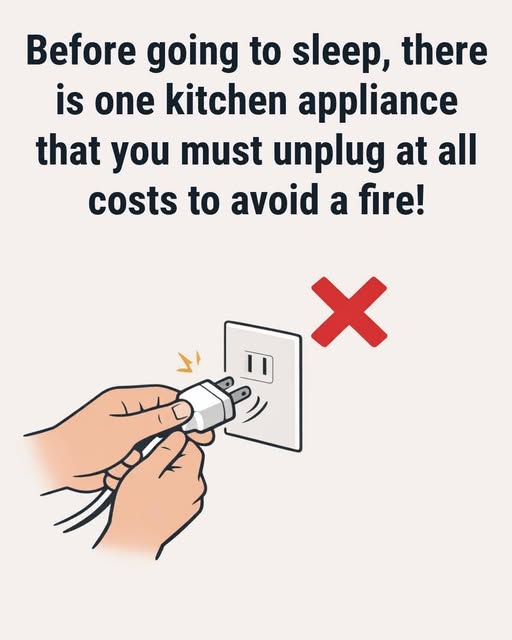
Why You Should Always Unplug Your Air Fryer at Night comes down to a simple household safety principle: when a small countertop appliance is not in use, disconnecting it from electrical power removes one potential source of an electrical fault. The U.S. Fire Administration specifically advises consumers to unplug small appliances when they are not being used. (U.S. Fire Administration)
That does not mean every plugged-in air fryer is secretly overheating overnight. Most properly functioning appliances remain uneventful while connected to power. However, air fryers combine high-wattage electrical components, heating elements, internal wiring, electronics, grease, and repeated exposure to high temperatures. If a component becomes damaged or defective, disconnecting the appliance after use can provide an additional layer of protection.
Real recalls show why appliance condition matters. The U.S. Consumer Product Safety Commission recalled about two million Cosori air fryers in 2023 because a wire connection could overheat and create fire and burn hazards. In 2024, Best Buy recalled certain Insignia air fryers and air fryer ovens after reports that included overheating, melting, and fires. (U.S. Consumer Product Safety Commission)
Therefore, unplugging your air fryer after it cools takes only a few seconds, yet it fits into a much broader approach to electrical and kitchen safety.
I developed the habit after walking into the kitchen one evening and noticing that an appliance plug felt warmer than I expected. Nothing had caught fire, and the appliance still worked, but the experience changed my routine. Instead of assuming the off button disconnected everything inside, I started unplugging countertop appliances after they cooled. I also began checking cords, outlets, and plugs for discoloration or damage. The routine takes almost no time. More importantly, it reminds me to look at the appliance rather than automatically trusting it forever simply because it worked correctly yesterday.
Why You Should Always Unplug Your Air Fryer at Night
Unplugging Removes Power From an Appliance You Are Not Using
The clearest reason behind Why You Should Always Unplug Your Air Fryer at Night has nothing to do with panic. It comes from basic electrical safety.
When you remove the plug from the wall outlet, electrical power can no longer travel through the appliance’s cord and internal circuits from that outlet.
That creates a clear distinction between “off” and “disconnected.”
Depending on the design, an appliance’s off button may stop cooking while parts of its electronic control system remain connected to mains power. Digital displays, touch controls, communication modules, or other electronics may remain energized in certain models.
However, consumers should avoid a common exaggeration.
A small amount of standby electricity does not automatically create a fire. Modern electronics routinely remain connected to power without incident.
The concern involves the possibility of a defect.
Damaged wiring, a failing connection, a faulty electronic component, liquid intrusion, or a recalled part can change the risk profile of an appliance.
The U.S. Fire Administration gives straightforward advice for small appliances: unplug them when you are not using them. It also advises replacing appliances with cracked, damaged, or loose cords. (U.S. Fire Administration)
Therefore, the nighttime habit makes practical sense.
After dinner, allow the air fryer to cool. Clean it when appropriate. Then, disconnect it from the outlet.
You eliminate unnecessary electrical connection during the many hours when nobody needs the appliance.
Why You Should Always Unplug Your Air Fryer at Night also applies beyond nighttime. If you finish making breakfast and do not expect to use the appliance again that day, you can unplug it then.
The clock does not create the safety benefit.
Being finished with the appliance does.
Air Fryers Have Experienced Genuine Overheating Recalls
Why You Should Always Unplug Your Air Fryer at Night becomes easier to understand when you look at documented product recalls rather than frightening social-media stories.
In February 2023, the U.S. Consumer Product Safety Commission announced a recall involving approximately two million Cosori air fryers sold in the United States. According to the commission, a wire connection inside affected units could overheat and create a fire and burn hazard. (U.S. Consumer Product Safety Commission)
That recall did not mean every air fryer was dangerous.
It meant specific models contained a documented defect serious enough to justify stopping their use and replacing them.
Another major recall followed in March 2024.
Best Buy recalled certain Insignia air fryers and air fryer ovens after receiving reports involving overheating, melting, and glass shattering. The CPSC said six reports involved air fryers catching fire. (U.S. Consumer Product Safety Commission)
Earlier recalls involved other brands and models as well. For example, the CPSC recalled certain Secura air fryers in 2023 because a wire connection could overheat and create fire and burn hazards. (U.S. Consumer Product Safety Commission)
These cases offer an important lesson.
Do not assume that a countertop appliance remains safe indefinitely just because you have used it hundreds of times.
Check recalls periodically.
Know your model number.
Inspect the cord.
Pay attention to unusual heat, smells, sounds, or behavior.
Most importantly, stop using an appliance immediately if a recall applies to your exact model.
Unplugging a recalled product does not make it safe to continue cooking with it.
Why You Should Always Unplug Your Air Fryer at Night represents one preventive habit, while recall awareness represents another.
Together, they create a more sensible safety routine than relying on either one alone.
Warning Signs You Should Never Ignore
Hot Plugs, Melting Smells, and Damaged Cords Need Attention
Why You Should Always Unplug Your Air Fryer at Night becomes especially important when an appliance starts behaving differently.
A plug that becomes unusually hot deserves investigation.
So does a cord with cracked insulation, exposed wiring, burn marks, or melted areas.
The U.S. Fire Administration specifically advises replacing a small appliance when its cord becomes cracked, damaged, or loose. (U.S. Fire Administration)
Do not cover cord damage with ordinary tape and continue using the appliance.
Likewise, do not ignore a wall outlet that becomes discolored, loose, or hot.
A damaged outlet can create an electrical hazard independently of the appliance.
Burning or melting odors also require immediate attention.
Some new appliances may release temporary manufacturing odors during initial use, but a persistent electrical or melting-plastic smell is different. Cosori’s own 2026 safety guidance advises unplugging an air fryer and allowing it to cool when users notice smoke unrelated to food, a strong burning or melting smell, or visible warping. (COSORI)
If this happens, stop cooking.
Turn the unit off.
Unplug it if you can do so safely.
Then, let it cool away from combustible materials.
Do not repeatedly restart it simply to see whether the smell returns.
Instead, check the manual, manufacturer support information, and current recall notices.
Why You Should Always Unplug Your Air Fryer at Night should become an automatic routine, but warning signs require more than routine unplugging.
They require you to stop using the appliance until you understand the problem.
A device that smells like burning plastic does not become safe simply because you unplugged it overnight and plugged it back in the next morning.
Smoke or Unusual Heat Is Not Something to “Monitor”
Some appliance problems begin subtly.
Perhaps the air fryer suddenly sounds different.
Maybe the display flickers.
You may notice smoke near the back rather than inside the food basket.
Or perhaps the exterior casing becomes far hotter than usual.
Do not normalize these changes.
Why You Should Always Unplug Your Air Fryer at Night includes learning the difference between ordinary cooking heat and abnormal behavior.
Air fryers intentionally generate high heat inside their cooking chambers. Therefore, warm exterior surfaces can be normal depending on the model.
However, melting, warping, sparking, electrical odors, smoke that does not come from food, or unexpectedly hot electrical connections are warning signs.
If flames appear, prioritize personal safety.
Do not throw water onto an electrical appliance fire.
If a fire is small and you have an appropriate extinguisher and know how to use it, a multipurpose extinguisher that includes Class C capability can address fires involving energized electrical equipment. The U.S. Fire Administration identifies Class C extinguishers for electrical equipment and notes that many home extinguishers carry combined A-B-C ratings. (U.S. Fire Administration)
However, never put yourself in danger to save an appliance.
If the fire grows, smoke spreads rapidly, or you cannot safely control the situation, leave the home and call emergency services.
Also, remember that smoke alarms remain essential.
Unplugging countertop appliances cannot replace working smoke alarms or a household fire-escape plan.
The best approach uses layers of protection.
Use the appliance correctly.
Keep it clean.
Watch it while cooking.
Disconnect it afterward.
Maintain functioning smoke alarms.
Then, respond immediately when something looks or smells wrong.
How to Use an Air Fryer More Safely Every Day
Keep Heat and Airflow Away From Combustible Materials
Why You Should Always Unplug Your Air Fryer at Night addresses electrical connection, but safe placement while cooking matters just as much.
Air fryers move very hot air rapidly around food.
They also release hot exhaust through ventilation openings.
Therefore, do not crowd the appliance against walls, curtains, paper products, plastic containers, or other items that heat could damage.
Follow the clearance requirements in your specific manufacturer’s manual.
Different models use different ventilation designs, so one universal distance cannot replace the instructions supplied with your appliance.
Also, avoid operating an air fryer underneath something that could trap its exhaust unless the manufacturer approves the arrangement.
A clear countertop gives the appliance room to release heat.
Likewise, place it on a stable, heat-resistant surface.
Do not put the appliance on a bed, upholstered furniture, unstable tray, or other inappropriate surface.
Why You Should Always Unplug Your Air Fryer at Night also includes keeping the surrounding area free from combustible clutter after use.
Paper towels, recipe cards, plastic bags, and food packaging can easily accumulate near countertop appliances.
Give the unit space.
During cooking, stay reasonably nearby.
The U.S. Fire Administration emphasizes that unattended equipment represents a major contributor to home cooking fires and advises people to watch what they are cooking. (U.S. Fire Administration)
An air fryer has a timer and automatic controls, but those features should not become an excuse to leave the house while it cooks.
A timer can stop normal operation.
It cannot necessarily protect against every electrical or mechanical failure.
Therefore, treat the air fryer as active cooking equipment whenever it runs.
Clean Grease and Food Debris Regularly
An air fryer can accumulate grease surprisingly quickly.
Fat can drip into the basket or drawer.
Bread crumbs can collect beneath food.
Sauces can splatter onto surfaces.
Over time, these residues may smoke during later cooking cycles.
Therefore, cleaning represents an important part of Why You Should Always Unplug Your Air Fryer at Night.
First, unplug the appliance and let it cool completely before cleaning.
Then, remove the basket, crisper plate, or other washable components according to your owner’s manual.
Clean grease before it becomes a thick baked-on layer.
Cosori’s maintenance guidance recommends soaking removable basket components when needed and cleaning food residue with gentle tools rather than damaging surfaces. (COSORI)
However, never immerse the main electrical body of the air fryer in water unless the manufacturer explicitly designed it for that purpose.
Likewise, do not pour water into ventilation slots or electrical openings.
Pay special attention to food that creates heavy grease.
Bacon, chicken skin, sausages, and other fatty foods can leave substantial residue.
If your model provides specific instructions for cooking high-fat foods, follow them.
Also, inspect the heating area periodically once the appliance has cooled.
A buildup of food or grease near heating components may contribute to smoke or unpleasant odors.
Why You Should Always Unplug Your Air Fryer at Night becomes even more useful here because unplugging before cleaning protects you from accidentally activating controls while your hands are inside removable components.
Clean appliance.
Clear vents.
Intact cord.
Stable outlet.
Those simple checks can prevent many avoidable problems.
Build a Safer Nighttime Kitchen Routine
Unplug the Air Fryer After It Has Finished Cooling
Why You Should Always Unplug Your Air Fryer at Night works best as part of a repeatable routine.
After cooking, remove the food.
Turn the air fryer off normally.
Allow the appliance to cool according to its manufacturer’s directions.
Then, unplug it by gripping the plug itself rather than yanking the cord.
Pulling repeatedly on the cable can strain the connection between the plug and cord.
Next, check the cooking area.
Did grease spill beneath the appliance?
Did food packaging end up against the exhaust area?
Does the plug or outlet look discolored?
Did you notice any unusual odor during cooking?
These observations take seconds.
However, they help you recognize changes before they become serious.
Once the appliance cools, clean removable components as necessary.
Then, leave the cord positioned where it will not become crushed, kinked, or exposed to hot surfaces.
Why You Should Always Unplug Your Air Fryer at Night does not require disconnecting it while it is actively running or frantically pulling the plug the moment a timer reaches zero.
Instead, the habit means leaving the unit disconnected during long periods when nobody plans to use it.
The U.S. Fire Administration’s broader recommendation to unplug small appliances when not in use supports exactly this kind of routine. (U.S. Fire Administration)
The same principle can apply to other small countertop appliances when their manufacturers allow it.
Toasters, kettles, waffle makers, and similar devices do not need to remain energized around the clock simply because they normally sit on the counter.
However, always follow product-specific instructions.
Some devices may have clocks or programmed functions that reset when disconnected.
Safety guidance from the manufacturer should take priority over convenience.
Check Recalls, Outlets, and Your Model’s Manual
Unplugging cannot compensate for a defective appliance that you continue using.
Therefore, Why You Should Always Unplug Your Air Fryer at Night should include a second habit: identify exactly which air fryer you own.
Find the model number.
Record it somewhere accessible.
Then, check the U.S. Consumer Product Safety Commission recall database periodically, especially if you hear news about an air fryer recall.
The CPSC maintains current product recall information, and recalled appliances may require replacement, refunds, or immediate discontinuation of use depending on the specific notice. (U.S. Consumer Product Safety Commission)
Do not assume a recall applies to an entire brand.
Model numbers, manufacturing dates, sizes, and other details determine whether a particular unit falls within a recall.
Also, inspect the wall outlet.
The plug should fit securely.
If it slips easily, crackles, sparks, becomes unusually hot, or shows discoloration, stop using that outlet and have it evaluated by a qualified electrician.
Avoid overloading the same electrical circuit with multiple high-power cooking appliances at once.
Air fryers, electric kettles, toaster ovens, and microwaves can each draw substantial current while operating.
Your owner’s manual may include specific circuit or outlet requirements.
Follow them.
Finally, keep the manual rather than throwing it away with the packaging.
It contains model-specific clearances, cleaning instructions, electrical ratings, and warnings that generic internet advice cannot replace.
Why You Should Always Unplug Your Air Fryer at Night represents a strong general habit.
However, the safest household combines that habit with correct operation, recall awareness, regular inspection, and immediate action when equipment develops a problem.
Frequently Asked Questions
Why You Should Always Unplug Your Air Fryer at Night?
The U.S. Fire Administration advises consumers to unplug small appliances when they are not in use. Disconnecting an unused air fryer removes electrical power from the appliance and provides an additional layer of protection against possible electrical faults. (U.S. Fire Administration)
Can an air fryer catch fire even if it normally works properly?
Any electrical appliance can develop a fault, although that does not mean fires are common during normal use. The CPSC has documented air fryer recalls involving overheating and fire hazards, including major Cosori and Insignia recalls. (U.S. Consumer Product Safety Commission)
Does an air fryer still use electricity when it is turned off?
Some electronic air fryers may keep certain control electronics energized while plugged in, depending on their design. However, standby electricity by itself does not mean a fire will occur. Unplugging simply removes the power connection when you do not need the appliance.
What should I do if my air fryer smells like burning plastic?
Stop using it. Turn it off and unplug it when safe to do so. Allow it to cool, then inspect it for damage and check the model for recalls or manufacturer guidance. Cosori advises unplugging an air fryer if users notice smoke unrelated to food, a strong burning or melting smell, or visible warping. (COSORI)
Should I keep using a recalled air fryer if I unplug it every night?
No. If your exact model appears in a recall that tells consumers to stop using it, follow the recall instructions. Nightly unplugging does not repair a defective component or make continued cooking safe. (U.S. Consumer Product Safety Commission)
Conclusion
Why You Should Always Unplug Your Air Fryer at Night is not about assuming that every countertop appliance is moments away from catching fire.
It is about removing an unnecessary electrical connection when you have finished using a high-heat appliance.
The U.S. Fire Administration recommends unplugging small appliances when they are not in use. That simple guidance provides a strong foundation for the habit. (U.S. Fire Administration)
Real product recalls also demonstrate that air fryer electrical failures can happen.
The CPSC recalled approximately two million Cosori air fryers in 2023 because an internal wire connection could overheat. In 2024, certain Insignia air fryers and air fryer ovens were recalled after reports involving overheating, melting, and fires. (U.S. Consumer Product Safety Commission)
Those recalls should not make you afraid of every air fryer.
Instead, they should encourage sensible habits.
Keep your appliance clean.
Give it appropriate ventilation.
Never ignore damaged cords, overheating plugs, sparks, warping, or burning smells.
Stay nearby while cooking.
Check recalls periodically.
Follow the manufacturer’s instructions.
Then, once you have finished using the appliance and it has safely cooled, unplug it.
Why You Should Always Unplug Your Air Fryer at Night becomes even more valuable when it forms part of a complete kitchen routine rather than a single isolated rule.
Look around before going to bed.
Make sure cooking appliances have turned off.
Disconnect small appliances that do not need power.
Remove combustible clutter from hot surfaces.
Confirm that nothing smells unusual.
And maintain working smoke alarms throughout your home.
No single habit can guarantee that a house fire will never happen.
However, prevention often comes from stacking small decisions together.
Unplugging an unused air fryer is one of those decisions.
It costs nothing.
It takes seconds.
And once it becomes part of your routine, you barely have to think about it.