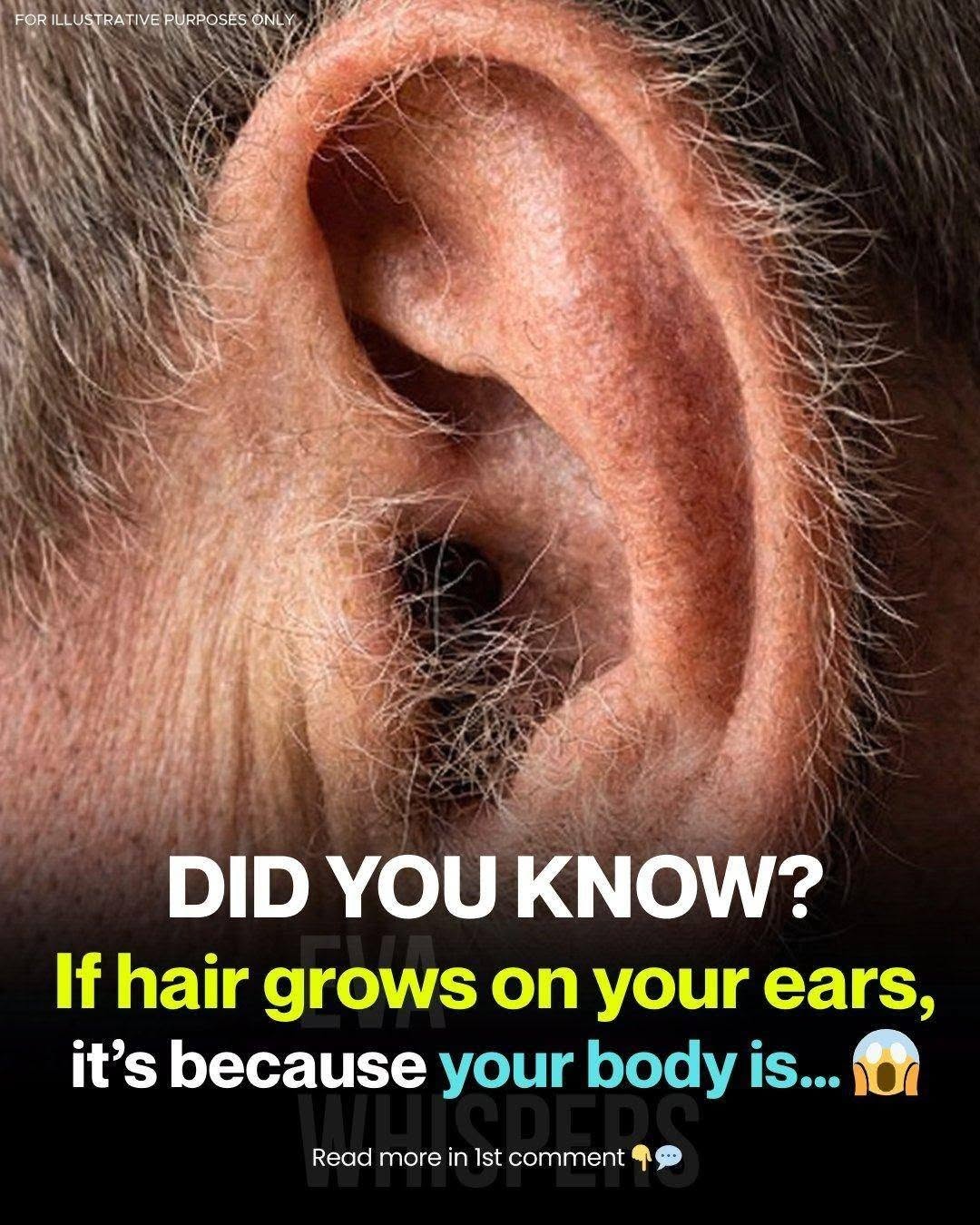
What Your Ear Hair Says About Your Health can sound more dramatic than the science supports. You notice several coarse hairs along the outer ear or near the entrance to the ear canal, and suddenly an ordinary grooming issue feels like a possible warning sign.
For most adults, visible ear hair reflects normal differences in hair growth, genetics, hormones, and aging rather than hidden disease. Excessive hair growth beyond what doctors expect for a person’s age, sex, and background can fall under the medical term hypertrichosis, but a few increasingly noticeable ear hairs do not automatically meet that definition.
You may also encounter an especially alarming claim online: hairy ears supposedly predict heart disease. Researchers have investigated possible associations between ear-canal hair and coronary artery disease for decades. However, association does not make ear hair a diagnostic test, and older studies have produced findings that require substantial caution because age, genetics, ancestry, and other cardiovascular risk factors can overlap.
Therefore, the useful question is not whether one stray hair reveals your cardiovascular future. Instead, it is whether a sudden or unusual change in body hair appears alongside other symptoms that deserve attention.
I remember noticing a few surprisingly coarse hairs around an older relative’s ears during a family haircut. Someone jokingly announced that they must mean his heart was in trouble because they had seen the claim online. For a moment, what should have been a routine grooming observation created genuine anxiety. Once we looked more carefully at the evidence, the picture became much less frightening. Ear hair commonly changes with age, while actual cardiovascular assessment depends on established factors such as blood pressure, cholesterol, diabetes, smoking, and medical history. He trimmed the hairs, kept his regular checkup, and stopped treating the mirror like a diagnostic machine.
Why Ear Hair Becomes More Noticeable
Hair Follicles Change Throughout Life
Understanding What Your Ear Hair Says About Your Health starts with understanding ordinary hair biology.
Almost everyone has fine hair around the external ear. However, hair follicles do not behave identically throughout life. Some produce very fine, lightly pigmented hairs, while others produce darker and thicker terminal hairs.
Hair also moves through growth and resting cycles rather than growing continuously at the same rate. Individual follicles can occupy different stages at the same time.
Consequently, several hairs can suddenly become noticeable even though the underlying change developed gradually.
Age frequently changes hair patterns as well. Someone may lose density on the scalp while simultaneously noticing coarser hair elsewhere. Hormonal changes influence some of these patterns, although the biology is more complicated than the popular claim that “testosterone rises and ear hair appears.”
In fact, androgen-related hair responses depend partly on how individual follicles respond to hormonal signals. Genetics also influence hair characteristics. Male-pattern scalp hair loss, for example, reflects an interaction between androgens and genetic predisposition, illustrating how strongly follicle behavior can depend on both factors.
Therefore, What Your Ear Hair Says About Your Health usually begins with a very ordinary explanation: follicles change, and different areas of the body respond differently over time.
Genetics Can Matter More Than You Think
Look at relatives, and you may notice remarkably similar hair patterns.
One family may develop thick eyebrows and visible ear hair relatively early. Another may have very little visible body hair even in later adulthood.
That variation does not automatically indicate different levels of health.
Dermatologists define hypertrichosis according to hair growth that exceeds what clinicians expect for a person’s age, sex, and racial or ethnic background. That definition itself recognizes how widely normal hair patterns vary between people.
Therefore, comparing yourself with a random photograph online rarely tells you much.
The location also matters. Hair around the outer ear differs from hair growing unusually across large areas of the body. Likewise, a few coarse hairs that have developed gradually differ from rapidly increasing hair growth accompanied by other physical changes.
Women may notice changing facial or body hair patterns with hormonal transitions, including menopause. Dermatologists note that menopause can bring more facial hair alongside scalp thinning as hormone levels change.
So, when considering What Your Ear Hair Says About Your Health, family patterns and gradual aging often provide a much more plausible explanation than a hidden disease.
Does Ear Hair Really Predict Heart Disease?
Where the Heart-Disease Claim Came From
The idea that What Your Ear Hair Says About Your Health includes a direct warning about coronary artery disease did not appear from nowhere.
Researchers have published studies examining ear-canal hair and other visible ear characteristics as possible markers of coronary disease. An article published in the New England Journal of Medicine in 1984 discussed ear-canal hair and earlobe creases as possible predictors, while a 1989 study also examined relationships between ear-canal hair, earlobe creases, age, and coronary artery disease.
More recent research has continued exploring ear characteristics. For example, a 2020 study investigated hair growth on the ear and an earlobe groove among Iranian patients with suspected coronary disease. Importantly, the authors themselves noted uncertainty in previous research and the influence of racial characteristics and genetic tendencies.
Those details matter.
If two traits both become more common with increasing age, they can appear statistically connected even when one does not directly cause the other.
Moreover, cardiovascular disease depends on numerous established factors.
Therefore, seeing several coarse hairs on an ear does not tell you whether an artery contains plaque.
It also does not tell you whether you need medication, cardiac imaging, or emergency treatment.
In practical terms, What Your Ear Hair Says About Your Health does not include a reliable home heart test.
What Actually Matters for Cardiovascular Risk
Rather than inspecting ear hair, assess cardiovascular health through evidence-based risk factors and routine healthcare.
Blood pressure matters.
Cholesterol matters.
Smoking matters.
Diabetes matters.
Family history, age, physical activity, weight, kidney disease, and other medical factors can also contribute to overall risk.
A clinician can combine relevant information instead of interpreting a single physical feature in isolation.
That distinction becomes particularly important when social-media posts present ear hair as an “early warning sign.”
Even research that identifies an association cannot automatically establish that the feature independently predicts disease in an individual.
For example, older age can increase both visible ear hair and cardiovascular risk. Genetics and population differences can also complicate apparent relationships, something researchers examining ear characteristics have specifically acknowledged.
Consequently, do not schedule an emergency cardiac evaluation because a barber notices several new ear hairs.
At the same time, do not ignore genuine cardiovascular care simply because you have no ear hair.
If you have chest pressure, difficulty breathing, fainting, or other potentially serious symptoms, seek appropriate medical attention based on those symptoms rather than anything happening around the ears.
What Your Ear Hair Says About Your Health ultimately says much less about your arteries than a proper medical evaluation does.
When Changes in Ear Hair Deserve Attention
Sudden Widespread Hair Growth Is Different
Most gradual ear-hair growth remains harmless. However, What Your Ear Hair Says About Your Health becomes a more useful question when the change occurs suddenly or affects much more than your ears.
Doctors use the term hypertrichosis for excessive hair growth that exceeds what they expect for someone’s age, sex, and ethnic background. It can occur in one localized area or involve much larger parts of the body.
Hypertrichosis can also be congenital or acquired later in life.
Acquired excessive hair growth has several possible causes, so a dramatic change warrants evaluation rather than self-diagnosis.
The important distinction involves scale and timing.
One or two coarse hairs that become noticeable over several years look very different medically from extensive new hair growth developing over weeks or months.
Likewise, a woman who develops substantial new androgen-pattern facial or body hair together with menstrual changes or other signs of hormonal disturbance deserves different evaluation from an older man trimming a few ear hairs.
Dermatology guidance distinguishes hypertrichosis from hirsutism, the latter referring to excessive terminal hair in women in androgen-dependent areas.
Therefore, examine the complete pattern rather than the ear alone.
Look at the Skin Around the Hair Too
Sometimes the most useful information has nothing to do with the hair shaft.
Pay attention to the surrounding skin.
A sore, persistent lump, repeatedly bleeding spot, unusual pigment change, infected follicle, or nonhealing lesion deserves medical evaluation regardless of whether hair grows from the area.
Hair removal itself can occasionally irritate follicles. DermNet notes that folliculitis can occur after shaving, waxing, electrolysis, or plucking.
Therefore, an inflamed bump after aggressive grooming may represent irritation rather than a mysterious internal health signal.
However, persistent changes should not receive endless home treatment without assessment.
The same principle applies inside the ear.
Pain, drainage, hearing changes, swelling, or a sensation of blockage may result from wax, infection, skin disease, or another ear problem. Visible hair does not explain those symptoms automatically.
So, What Your Ear Hair Says About Your Health should never become a reason to overlook more meaningful signs.
If the hair itself looks ordinary but the ear hurts, focus on the pain.
If the skin changes, focus on the skin.
If hearing declines, discuss the hearing change.
A symptom-based approach provides much more useful information than assuming every change around the ear comes from aging.
Removing Ear Hair Safely
Trimming Is Usually the Simplest Option
If your only concern involves appearance, What Your Ear Hair Says About Your Health may matter less than how to manage it safely.
You do not medically need to remove normal ear hair.
However, you may prefer trimming it for cosmetic reasons.
A small electric trimmer specifically designed for external ear or facial hair offers a practical approach. Keep the device around the visible outer portion of the ear and follow the manufacturer’s instructions.
Do not push cutting equipment deeply into the ear canal.
The deeper ear canal contains delicate skin, and the eardrum lies farther inside. Aggressive grooming creates unnecessary opportunities for cuts and irritation.
Small grooming scissors can work around clearly visible external hairs, but use caution and adequate lighting.
Plucking deserves more consideration.
While removing one obvious external hair may seem simple, repeated plucking can irritate hair follicles. Folliculitis can follow hair-removal methods such as plucking, shaving, or waxing.
Therefore, trimming often offers a gentler solution when many hairs bother you.
Never use flame, chemical depilatories not intended for the area, or sharp improvised objects inside the ear.
The cosmetic benefit does not justify injuring sensitive tissue.
Ear Hair Has a Normal Purpose
Hair itself is not an enemy.
Fine hairs around the ear opening exist as part of the skin’s normal protective environment. Meanwhile, earwax and the ear canal’s natural structure also help trap particles and support protection of the canal.
Therefore, the goal should not involve stripping every visible hair from deep inside the ear.
Instead, limit cosmetic grooming to what you can see and safely reach externally.
If hair combines with wax to create a sensation of blockage, do not insert tweezers, cotton swabs, pins, or scissors deeper into the canal.
A healthcare professional can examine the ear and safely address impacted material when necessary.
The same caution applies if you use hearing aids or other devices that enter the ear canal. Persistent discomfort, feedback, obstruction, or skin irritation may deserve professional assessment rather than increasingly aggressive grooming.
Ultimately, What Your Ear Hair Says About Your Health usually comes down to ordinary human variation.
You can trim it if you dislike how it looks.
You can leave it alone if it does not bother you.
Neither decision changes your masculinity, femininity, cleanliness, or overall health.
Frequently Asked Questions
Is ear hair normal as you get older?
Yes. Visible ear hair can become more noticeable with age, particularly in men, although individual patterns vary substantially. Genetics and differences in follicle behavior influence how much hair someone develops.
Does ear hair mean I have heart disease?
No. Some older and smaller studies have reported associations between ear-canal hair and coronary artery disease, but ear hair does not function as a diagnostic test for heart disease. Age, genetics, ancestry, and other factors can complicate such associations.
Does high testosterone cause ear hair?
Androgens influence several patterns of terminal hair growth, but visible ear hair does not provide a direct measurement of testosterone levels. Genetics, follicle sensitivity, age, and other biological factors can also contribute.
Is it safe to pluck ear hair?
Plucking visible external hairs can irritate follicles, and hair removal can contribute to folliculitis in some people. Trimming visible external hairs generally provides a less aggressive option. Avoid inserting tweezers or other tools deep into the ear canal.
When should unusual hair growth be checked by a doctor?
Seek medical advice when hair growth becomes sudden, extensive, or dramatically different from your previous pattern, particularly when additional hormonal, skin, or systemic symptoms appear. Hypertrichosis can be localized or generalized and may develop later in life for several reasons.
Conclusion
What Your Ear Hair Says About Your Health is usually much less alarming than viral health posts suggest.
A few wiry hairs around the ears commonly reflect normal variation in hair follicles, genetics, and aging. They do not automatically mean that testosterone levels have become abnormal, and they certainly do not provide a diagnosis of coronary artery disease.
Scientists have investigated links between ear-canal hair and heart disease for decades. However, those studies do not justify using ear hair as a cardiovascular screening test. Age, genetics, population differences, and established cardiovascular risk factors make the real picture far more complicated.
Instead, evaluate heart health through the things that actually matter clinically: regular medical care and assessment of established risk factors.
Likewise, focus on patterns when hair changes.
Gradual development of several coarse ear hairs generally differs from sudden, widespread excessive hair growth. The latter can justify medical evaluation, particularly when other symptoms accompany it.
If appearance bothers you, trim visible external hairs carefully and avoid digging, cutting, or applying harsh products inside the ear canal.
Ultimately, What Your Ear Hair Says About Your Health is often simply that human hair changes throughout life.
Sometimes a hair is a health clue.
Most of the time, an ear hair is just an ear hair.