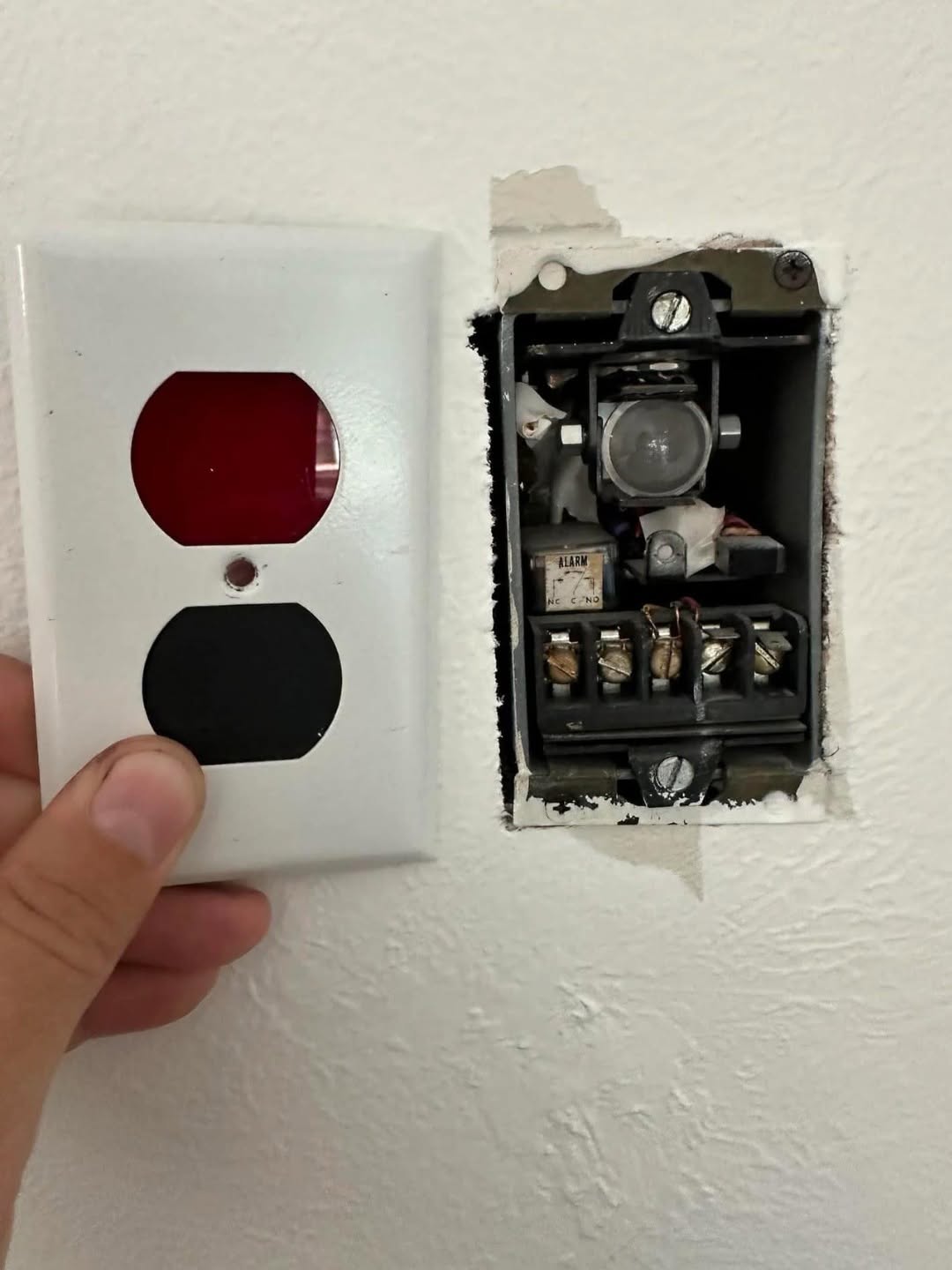
What Was the Detect-O-Ray? It was a photoelectric switch sold in the 1940s that used a beam of light and a photoelectric cell to trigger an electrical response when something interrupted that beam. Although modern posts often describe it as an early home-security system, surviving period descriptions show that its purpose was broader: it could activate buzzers, bells, lights, and other low-voltage devices, while later uses included customer-announcement systems, counting applications, and intrusion detection.
The Detect-O-Ray emerged during an era when “electric eye” technology fascinated both engineers and consumers. The Detect-O-Ray Company traces to Chicago around 1940, and an artifact preserved by the Made-in-Chicago Museum dates the device to the 1940s. A 1944 F.A.O. Schwarz catalog even marketed one version as a sophisticated workshop gadget, complete with a buzzer and reflector.
However, several viral descriptions exaggerate or simplify how the system worked. The documented model did not necessarily use two identical units facing one another, and available period evidence describes a lamp sending light toward a reflecting mirror, which returned the beam to the receiving photoelectric cell in the main housing.
I first became interested in devices like this after seeing an old dark metal fixture that looked more like forgotten electrical hardware than anything useful. At first glance, it seemed impossible that such a simple box could perform a job we now associate with sophisticated sensors. Yet that is exactly what made it fascinating. Once I learned that light itself could act as the trigger, the design suddenly felt remarkably modern. It reminded me that many ideas we call “smart” today began decades earlier with switches, relays, lenses, and careful engineering. Old technology can look crude, but sometimes the idea behind it remains surprisingly elegant.
How the Detect-O-Ray Actually Worked
A Beam of Light Acted Like an Invisible Switch
To understand What Was the Detect-O-Ray?, start with its central idea: the device used light to control an electrical circuit.
A 1944 catalog description characterized the Detect-O-Ray as an automatic electric switch. The unit projected a beam across a space toward a reflecting mirror. The reflected light then returned to a lens and photoelectric cell inside the Detect-O-Ray housing. When a moving object interrupted that beam, the device could energize an electrical output connected to a buzzer, light, or another suitable device.
That setup differed from a mechanical tripwire.
Nothing needed to touch a switch. Likewise, a person did not need to step on a floor plate or open a physical contact.
Instead, breaking the light path created the event.
This principle made the Detect-O-Ray useful for many applications. A person passing through a doorway could trigger a buzzer. An object moving along a production line could activate a signal. Meanwhile, someone entering a protected area could set off an alarm.
The system relied on photoelectric sensing, a technology already developing rapidly before World War II. The museum account notes that photocells had reached consumer products during the 1930s and already supported industrial and transportation applications before the Detect-O-Ray entered the market.
Therefore, the device did not invent photoelectric sensing itself.
Instead, it packaged the principle into a practical commercial product that ordinary businesses, hobbyists, and homeowners could use.
It Was Not Simply Two Matching Infrared Sensors
Modern descriptions sometimes present the Detect-O-Ray as though it worked exactly like a contemporary paired infrared beam detector.
Available historical evidence paints a different picture.
The 1944 description cited by the Made-in-Chicago Museum says the cabinet cast a barely visible light beam toward a reflecting mirror. The mirror then returned the beam to the unit. The museum’s technical reconstruction likewise describes an incandescent lamp, reflector, lens, and photoelectric cell working together.
Therefore, the best-documented configuration did not require two powered boxes directly facing one another.
That distinction matters.
When people ask What Was the Detect-O-Ray?, it can be tempting to explain it by comparing it directly with today’s infrared garage-door sensors. The comparison helps conceptually, because both systems detect interruptions in a light path. However, the hardware arrangement and optical technology could differ substantially.
Likewise, claims that the original Detect-O-Ray always used infrared light should be treated cautiously. The period description calls the projected beam “hardly visible,” while the museum reconstruction describes an incandescent lamp. That evidence does not establish that every Detect-O-Ray used a modern infrared LED-style emitter.
So, the safest description remains simple.
The Detect-O-Ray used photoelectric sensing and a directed light beam. When something interrupted the beam, the circuit responded.
That idea feels familiar today, even though the components belonged firmly to the electromechanical age.
Where the Detect-O-Ray Came From
Chicago Engineering in the Early 1940s
The Detect-O-Ray appears to have entered the market around 1940.
According to the Made-in-Chicago Museum’s research, Chicago engineer Clifford E. Ives trademarked the Detect-O-Ray name around that time. Ives had already worked on a wide range of mechanical and electrical inventions, and his engineering business operated under the name Ives Engineering Laboratories.
For a period, the Detect-O-Ray name existed alongside another related product called the Announc-O-Ray.
By 1942, advertisements identified the Detect-O-Ray Company as a separate business and promoted the device as a plug-in photoelectric control with adjustable sensitivity and options for different lighting conditions. An outdoor weatherproof housing was also advertised.
The company’s addresses changed over time.
Early material placed it at locations in Chicago, while later business records associated the product with other addresses. A 1955 electrical-industry directory still listed “DETECT-O-RAY” and associated it with the Detjen Corporation in Pleasant Valley, New York, suggesting the name or product continued circulating well after its early Chicago period.
The exact corporate history remains incomplete.
Even the museum account notes uncertainties about ownership, manufacturing, and the roles of individuals associated with the business. Therefore, claims about a single continuous company history should remain cautious.
Still, one point remains clear: the device belongs to the early commercial era of photoelectric automation.
That alone makes What Was the Detect-O-Ray? a fascinating question for anyone interested in vintage technology.
A Surprisingly Expensive Piece of Consumer Technology
The Detect-O-Ray was not a cheap novelty.
A 1944 F.A.O. Schwarz catalog offered a unit for $31.50. The listing described a metal cabinet measuring roughly 6.5 by 5 by 5 inches, supplied with a buzzer and mirror and designed for 110-volt, 60-cycle AC power.
For the time, that represented a significant purchase.
The surprising part comes from where the catalog placed it.
F.A.O. Schwarz marketed the device as something suitable for a boy’s workshop, demonstrating how science, electronics, and mechanical experimentation appealed strongly to the hobby market during that era.
At the same time, the product clearly had practical adult uses.
The same basic mechanism could detect a passerby, activate an annunciator, trigger a bell, or provide a simple form of perimeter detection.
That versatility probably helped the product survive beyond novelty status.
The Detect-O-Ray also illustrates how early automation often blurred the lines between industrial equipment, household technology, and hobby electronics.
Today, we divide products into neat categories such as smart-home sensors, retail door chimes, industrial counters, and security alarms.
In the 1940s, one adaptable photoelectric switch could potentially perform several of those functions.
Therefore, calling it only a “security device” understates what it actually did.
What People Used the Detect-O-Ray For
Security Was One Use, but Not the Only One
Modern articles frequently frame What Was the Detect-O-Ray? as the story of an early burglar alarm.
That description contains some truth.
The museum’s historical account notes that a properly configured Detect-O-Ray could alert a homeowner when a person or animal crossed its beam. It could therefore act as an intrusion detector when connected to a buzzer, bell, or other alerting device.
However, the product supported much more.
Its intermittent mode could function as a customer-announcement system. For example, someone entering a shop could cross the beam and trigger a sound, effectively creating an early automatic door-entry alert.
The same principle could also support counting tasks.
If objects passed through the beam one at a time, the electrical output could feed compatible equipment that registered those interruptions.
Industry already used related photocell systems before the Detect-O-Ray appeared. Photoelectric devices monitored cars, machines, and manufacturing processes, showing how rapidly the “electric eye” concept expanded beyond laboratories.
Therefore, the Detect-O-Ray fits into a broader history of automation.
It represents a period when engineers learned to replace direct human observation with sensors.
That may sound ordinary now.
However, during the 1930s and 1940s, giving an electrical device the ability to “notice” when something crossed a space felt dramatically futuristic.
Its Limitations Were Very Real
The Detect-O-Ray was clever, but it was not magic.
Light-based systems of that era could suffer from several practical weaknesses.
The museum’s analysis notes that ambient light could interfere with detection. In addition, incandescent bulbs could lose intensity or fail altogether. Accurate alignment between the light path, mirror, lens, and receiver also mattered.
Therefore, reliability depended on installation and maintenance.
A mirror could shift.
A bulb could age.
Dust could affect optics.
Meanwhile, changes in surrounding light could alter sensor behavior.
Modern photoelectric sensors solve many of these problems with improved emitters, receivers, modulation techniques, digital electronics, and self-monitoring circuitry.
Nevertheless, the fundamental idea remains recognizable.
Send light toward a detector.
Monitor that light.
React when something interrupts it.
This continuity makes the Detect-O-Ray historically interesting.
It did not predict every detail of today’s sensors, but it embodied the same broader concept: use an invisible or barely noticeable physical signal to detect movement without direct mechanical contact.
Why the Detect-O-Ray Still Matters Today
It Shows That “Smart” Automation Predates the Internet
The most interesting answer to What Was the Detect-O-Ray? may not involve security at all.
Instead, the device demonstrates how long engineers have pursued automated environments.
The Detect-O-Ray did not use Wi-Fi.
It had no app, processor, cloud account, or digital camera.
Yet it could detect an event in the physical world and automatically trigger another action.
That basic pattern sits at the center of modern automation.
A contemporary system might detect motion and send a push notification.
The Detect-O-Ray detected a broken beam and supplied current to another circuit.
Different technology, same logic.
This historical perspective also helps correct the idea that smart-home concepts suddenly appeared with smartphones.
Automatic lighting, photocells, timed switches, electric eyes, door annunciators, and alarm circuits existed decades earlier.
The Detect-O-Ray simply represents one particularly memorable example.
Furthermore, contemporary photoelectric switches still rely on the broad idea of using light to sense objects or environmental changes. The museum notes that descendants of this technology remain common in applications such as automatic doors, lighting controls, and security equipment.
So, while the hardware changed dramatically, the design principle endured.
What to Do If You Find One Today
If you discover old electrical hardware that you suspect might be a Detect-O-Ray, avoid immediately powering it.
Period descriptions show that some Detect-O-Ray units operated from 110-volt AC mains power. Old wiring, insulation, capacitors, and other components can deteriorate over decades.
Therefore, treat an unidentified vintage electrical device cautiously.
Do not assume it remains safe simply because it looks intact.
Likewise, avoid connecting it directly to modern household power unless someone qualified has inspected it.
If the device remains installed in a wall or connected to old wiring, a licensed electrician can determine whether it remains energized and how to disconnect it safely.
Collectors may also want to preserve original components, labels, mirrors, lenses, and wiring arrangements because they help document how the system worked.
However, preservation does not require operating the original electrical circuitry.
A nonworking unit can still serve as an interesting artifact.
You could photograph it, document its location, preserve identification plates, and research its manufacturer before altering anything.
That approach respects both the historical value and the practical risks of old electrical equipment.
Frequently Asked Questions
What Was the Detect-O-Ray originally designed to do?
The Detect-O-Ray functioned as an automatic photoelectric switch. It projected a light beam toward a reflector and reacted when an object interrupted the beam. The electrical output could activate buzzers, bells, lights, or other compatible equipment.
Was the Detect-O-Ray an early burglar alarm?
It could serve as one, but that was only one application. Historical descriptions also support shop-entry alerts, automatic switching, and counting or detection tasks.
Did the Detect-O-Ray use infrared light?
The available period description calls the beam barely visible, while surviving technical accounts describe an incandescent lamp and photoelectric cell. That evidence does not justify claiming that all original Detect-O-Ray units used modern-style infrared emitters.
Did Detect-O-Ray systems always use two units facing each other?
The best-documented 1940s configuration used one main cabinet and a reflecting mirror. The unit sent light to the mirror, which reflected it back toward the photoelectric receiver. Therefore, the popular description of two identical powered units facing each other does not fit the surviving period documentation for that model.
Can an original Detect-O-Ray still work?
Possibly, but powering vintage electrical equipment without inspection can create electrical and fire risks. Some period Detect-O-Ray units used 110-volt AC power, so a qualified electrician or experienced vintage-electronics specialist should inspect an original unit before anyone attempts to operate it.
Conclusion
What Was the Detect-O-Ray? It was a clever 1940s photoelectric switch that used a controlled beam of light to detect an interruption and trigger an electrical response.
Although modern retellings often call it the ancestor of today’s motion sensors, that comparison works best as a broad analogy rather than a precise technical description.
Historical evidence shows a device built around a lamp, reflector, lens, photoelectric cell, and switching circuitry. A 1944 version could activate bells or lights when someone or something crossed its beam, while other configurations supported customer-announcement and counting functions.
It also belonged to a larger technological movement.
By the time the Detect-O-Ray appeared around 1940, engineers had already begun using photocells for automatic detection in industrial and transportation settings. The Detect-O-Ray helped bring that same idea into a compact commercial product.
More than eight decades later, the principle still feels familiar.
Modern sensors may use infrared LEDs, microcontrollers, wireless radios, and smartphone notifications, but the underlying goal remains remarkably similar: detect a physical change and respond automatically.
That makes the Detect-O-Ray more than unusual old hardware.
It offers a small but revealing glimpse into the long history of automation, sensing, and the human desire to make technology respond to the world around us.