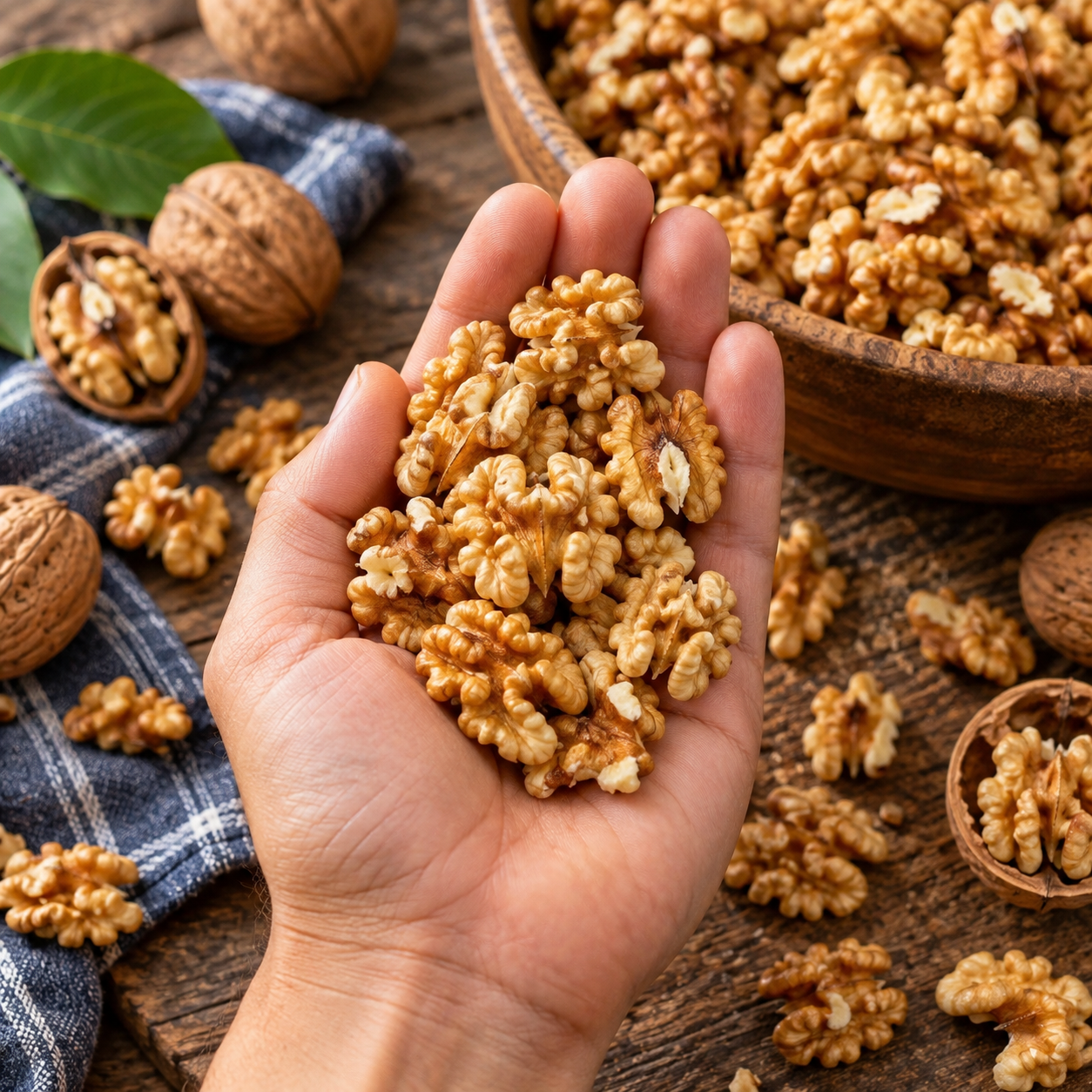
The Power of the Walnut: 5 Science-Backed Health Benefits becomes much more interesting once you look beyond the walnut’s famous brain-like shape. Walnuts pack unsaturated fats, plant protein, fiber, minerals, polyphenols, and alpha-linolenic acid, commonly called ALA, into a remarkably small package.
Unlike many foods surrounded by exaggerated health claims, walnuts have received considerable attention in controlled nutrition studies. Research has explored their effects on cholesterol, gut bacteria, body weight, cognitive health, and several cardiovascular risk markers. However, the evidence does not support treating walnuts as a cure or expecting one daily handful to prevent disease.
I started paying more attention to walnuts after realizing how easy they were to add to ordinary meals. A small handful worked in oatmeal, yogurt, salads, and even simple snacks without requiring a new recipe or complicated routine. What surprised me most was how satisfying they felt despite the modest portion. At the same time, I learned that more does not automatically mean better. Walnuts contain plenty of calories, so they make the most sense when they replace less nutritious snacks or some saturated-fat-rich foods instead of simply getting added on top of everything else.
So, what does research actually tell us? The Power of the Walnut: 5 Science-Backed Health Benefits lies primarily in how walnuts can contribute to an overall healthy dietary pattern rather than in any single miraculous effect.
Why Walnuts Stand Out Nutritionally
1. Walnuts Can Support a Heart-Healthy Eating Pattern
One of the strongest areas of walnut research involves cardiovascular health, particularly blood lipids. Walnuts contain predominantly unsaturated fats, including polyunsaturated fatty acids, rather than the large amounts of saturated fat found in some other foods.
A systematic review and meta-analysis of randomized controlled trials found that walnut intake was associated with reductions in total cholesterol, LDL cholesterol, and triglycerides, although it did not significantly change HDL cholesterol. The researchers also noted variability among the included studies, which matters when interpreting the size of the effect.
Another controlled feeding study provides a useful example of what can happen under carefully managed conditions. Participants ate 42 grams of walnuts per day during the walnut phase, and researchers observed lower LDL cholesterol compared with the control period. The study also detected changes in gut bacteria and microbial metabolites.
Still, walnuts do not cancel out an otherwise unhealthy diet. Heart health depends on the entire eating pattern, physical activity, smoking status, blood pressure, cholesterol, diabetes, genetics, and many other factors. Therefore, think of walnuts as one useful food within a larger cardiovascular strategy rather than as a treatment.
2. Walnuts Provide a Notable Plant Source of Omega-3 Fat
Walnuts stand apart from many commonly eaten nuts because they provide alpha-linolenic acid, or ALA. ALA is an essential omega-3 fatty acid, which means the body needs to obtain it through food.
That characteristic explains why discussions about The Power of the Walnut: 5 Science-Backed Health Benefits frequently focus on omega-3s. However, ALA should not be confused with EPA and DHA, the long-chain omega-3 fatty acids commonly associated with oily fish. The human body can convert some ALA into longer-chain omega-3s, but that conversion remains limited.
Fortunately, walnuts provide much more than ALA. They also contain protein, fiber, magnesium, copper, manganese, and numerous plant compounds. Therefore, their nutritional value comes from the whole food rather than one isolated nutrient.
This distinction matters because people often search for a single “superfood” compound. In reality, diets work through combinations of foods and nutrients. Adding walnuts to oatmeal while also eating fruits, vegetables, legumes, whole grains, and other nutrient-dense foods makes far more sense than relying on walnuts alone.
What Walnuts May Do for the Brain and Gut
3. Walnuts May Support Brain Health, but the Evidence Needs Context
The shape of a walnut makes the “brain food” nickname memorable, but appearance has nothing to do with its biological effects. Researchers became interested in walnuts because of their fatty acids, polyphenols, and other compounds that could potentially influence processes related to brain health.
The large Walnuts and Healthy Aging, or WAHA, randomized trial offers particularly useful evidence. Researchers assigned 708 cognitively healthy adults ages 63 to 79 to either a walnut-enriched diet or a control diet and followed them for two years. The walnut group consumed roughly 30 to 60 grams per day.
Importantly, the overall trial did not show a significant difference in global cognitive decline between the walnut and control groups. Post hoc analyses suggested possible benefits in a subgroup from the Barcelona study site, but researchers described those results as encouraging yet inconclusive.
Therefore, saying that walnuts have been proven to improve memory in everyone would overstate the evidence. A more accurate conclusion is that walnuts contain nutrients compatible with a healthy dietary pattern, while researchers continue studying whether regular consumption offers specific cognitive benefits in certain populations.
4. Walnuts Can Influence the Gut Microbiome
The digestive system provides another fascinating area of walnut research. Food does not simply provide nutrients for human cells. It also interacts with the enormous community of microorganisms living in the digestive tract.
In one randomized controlled feeding study, adults consumed 42 grams of walnuts daily for three weeks. Researchers observed changes in the relative abundance of several bacterial groups as well as reductions in certain secondary bile acids. LDL cholesterol was also lower after the walnut period.
Another randomized crossover trial involving healthy adults found that eating 43 grams of walnuts daily for eight weeks significantly affected gut microbiome composition and diversity. Researchers observed increases in some bacterial groups associated with potentially beneficial metabolic activity. However, they also emphasized the need for further research into the long-term significance of these changes.
More recent exploratory research has continued investigating how walnut consumption may alter microbial gene expression and metabolism. Those findings offer interesting possible mechanisms connecting walnuts, the microbiome, and cardiovascular health, but the researchers specifically noted that replication remains necessary.
How Walnuts Fit Into Weight and Metabolic Health
5. Walnuts Can Be Filling Without Automatically Causing Weight Gain
Walnuts contain a substantial number of calories because fat provides more energy per gram than protein or carbohydrates. That fact sometimes leads people who want to manage their weight to avoid nuts completely.
Research paints a more nuanced picture. A systematic review and meta-analysis of 27 randomized trials found that walnut interventions did not significantly increase overall body weight, BMI, waist circumference, or fat mass. However, the researchers also found no clear overall evidence that walnuts themselves produce meaningful weight loss.
A newer 2025 meta-analysis reported a very small average reduction in body weight and an improvement in HOMA-IR, a marker related to insulin resistance. However, it found no significant changes in fasting blood sugar, HbA1c, insulin, or BMI. The authors called for additional well-designed trials to confirm the findings.
Therefore, walnuts should not be marketed as a weight-loss shortcut. Their real advantage comes from how they can fit into a satisfying diet. Their combination of fat, protein, and fiber can make a modest serving feel substantial, particularly when walnuts replace cookies, chips, or other less nutrient-dense snacks.
Portion Size Matters More Than Fear of Fat
Avoiding walnuts solely because they contain fat misses an important nutritional distinction. Most of their fat is unsaturated, and healthy dietary patterns can include unsaturated fats while still supporting weight management.
However, portions still matter. Eating a measured serving works differently from repeatedly grabbing walnuts from a large container without noticing how much you consume. Because nuts pack substantial energy into a small volume, portions can grow quickly.
A practical serving is about 1 ounce, or 28 grams. Depending on size, that generally works out to roughly 14 walnut halves. Some clinical trials have used larger daily amounts, often around 30 to 60 grams, but those amounts formed part of structured research diets where researchers accounted for the additional calories.
For everyday eating, a small handful offers a simple starting point. You can also sprinkle chopped walnuts over food instead of eating them separately. That approach spreads their flavor and texture throughout a meal while keeping the portion easy to manage.
How Many Walnuts Should You Eat and How to Use Them
A Small Daily Serving Is Enough for Most People
The question behind The Power of the Walnut: 5 Science-Backed Health Benefits is often surprisingly practical: how many walnuts should you actually eat?
You do not need enormous amounts. About 1 ounce, or 28 grams, represents a convenient standard serving. Clinical studies frequently use larger quantities, but that does not mean everyone needs to copy a research protocol to enjoy walnuts as part of a healthy diet.
More importantly, consider what the walnuts replace. Adding 200 calories of walnuts to a diet without changing anything else has a different effect from replacing a pastry, candy bar, or another snack with them. Food substitutions often matter more than simply adding supposedly healthy foods.
People with specific calorie or nutrition goals can adjust the serving accordingly. Likewise, anyone following a medically prescribed diet should consider individual guidance rather than assuming one portion works universally.
Simple Ways to Add Walnuts Without Overdoing Them
Walnuts require almost no preparation. Add a tablespoon or two of chopped walnuts to oatmeal, overnight oats, yogurt, or whole-grain cereal. Their crunch can make a simple breakfast more satisfying without requiring extra sugar.
At lunch, walnuts work well in salads with leafy greens, vegetables, fruit, or beans. They can also add texture to grain bowls. Meanwhile, a small portion paired with fresh fruit makes an easy snack.
For dinner, chopped walnuts can add texture to vegetable dishes, whole grains, or certain sauces. You can also use them in baking, although desserts containing walnuts remain desserts and should not automatically receive a health halo simply because nuts appear in the ingredient list.
Choose plain or lightly seasoned walnuts when you want the simplest option. Products covered in large amounts of sugar, candy coatings, or excessive salt can change the nutritional picture considerably.
Finally, store walnuts properly. Their high unsaturated-fat content makes them susceptible to developing off flavors over time. Keep them sealed, and consider refrigeration or freezing for longer storage, particularly after opening a large package.
Frequently Asked Questions
How many walnuts should I eat per day?
About 1 ounce, or 28 grams, makes a practical serving for many adults. That equals roughly a small handful or around 14 walnut halves, depending on their size. Research studies sometimes use larger portions, but you do not need to reproduce clinical trial quantities to include walnuts in a balanced diet.
Do walnuts really improve memory?
Research has not established that walnuts improve memory in everyone. The two-year WAHA randomized trial found no significant overall improvement in global cognition among healthy older adults, although exploratory subgroup results suggested potential benefits that require further study.
Are walnuts good for cholesterol?
Evidence from randomized trials suggests that including walnuts in the diet can modestly improve certain blood lipids, particularly LDL and total cholesterol. However, individual results vary, and walnuts should complement rather than replace medical treatment for high cholesterol.
Will eating walnuts make me gain weight?
Not necessarily. A meta-analysis of randomized trials found that walnut consumption did not significantly increase body weight, BMI, waist circumference, or fat mass overall. However, walnuts still contain substantial calories, so portion size and the rest of your diet matter.
Who should avoid walnuts?
Anyone with a walnut or tree-nut allergy should avoid walnuts and follow professional allergy guidance. People who have difficulty chewing or swallowing may also need modified textures. Additionally, anyone following a specialized medical diet can ask a healthcare professional or registered dietitian how walnuts fit into their individual needs.
Conclusion
The Power of the Walnut: 5 Science-Backed Health Benefits comes from a combination of nutrients rather than one magical ingredient. Walnuts provide unsaturated fats, plant-based ALA omega-3 fatty acid, fiber, protein, minerals, and a variety of plant compounds.
The strongest research supports their usefulness as part of a heart-healthy dietary pattern. Randomized trials and meta-analyses suggest that walnut consumption can modestly reduce LDL and total cholesterol, while controlled studies also show measurable effects on the gut microbiome.
Brain-health research remains interesting but less definitive. Contrary to some popular summaries, the large WAHA trial did not find a significant overall cognitive benefit after two years. Researchers did identify possible benefits in certain subgroups, but those findings need further investigation.
Likewise, walnuts do not function as a weight-loss food in the usual sense. Research suggests that regularly including them does not necessarily cause weight gain, despite their calorie density. Still, portion size and food substitution remain important.
For most people who can safely eat nuts, a small handful offers an easy way to include walnuts in everyday meals. Add them to oatmeal, yogurt, salads, fruit, or other nutrient-dense foods, and consider what they replace rather than simply adding unlimited portions.
Ultimately, walnuts deserve their reputation as a nutritious food without needing exaggerated promises. They cannot guarantee a sharper memory, prevent heart disease, or produce automatic weight loss. However, as part of a varied and balanced eating pattern, they offer a convenient combination of nutrients backed by a growing body of research.