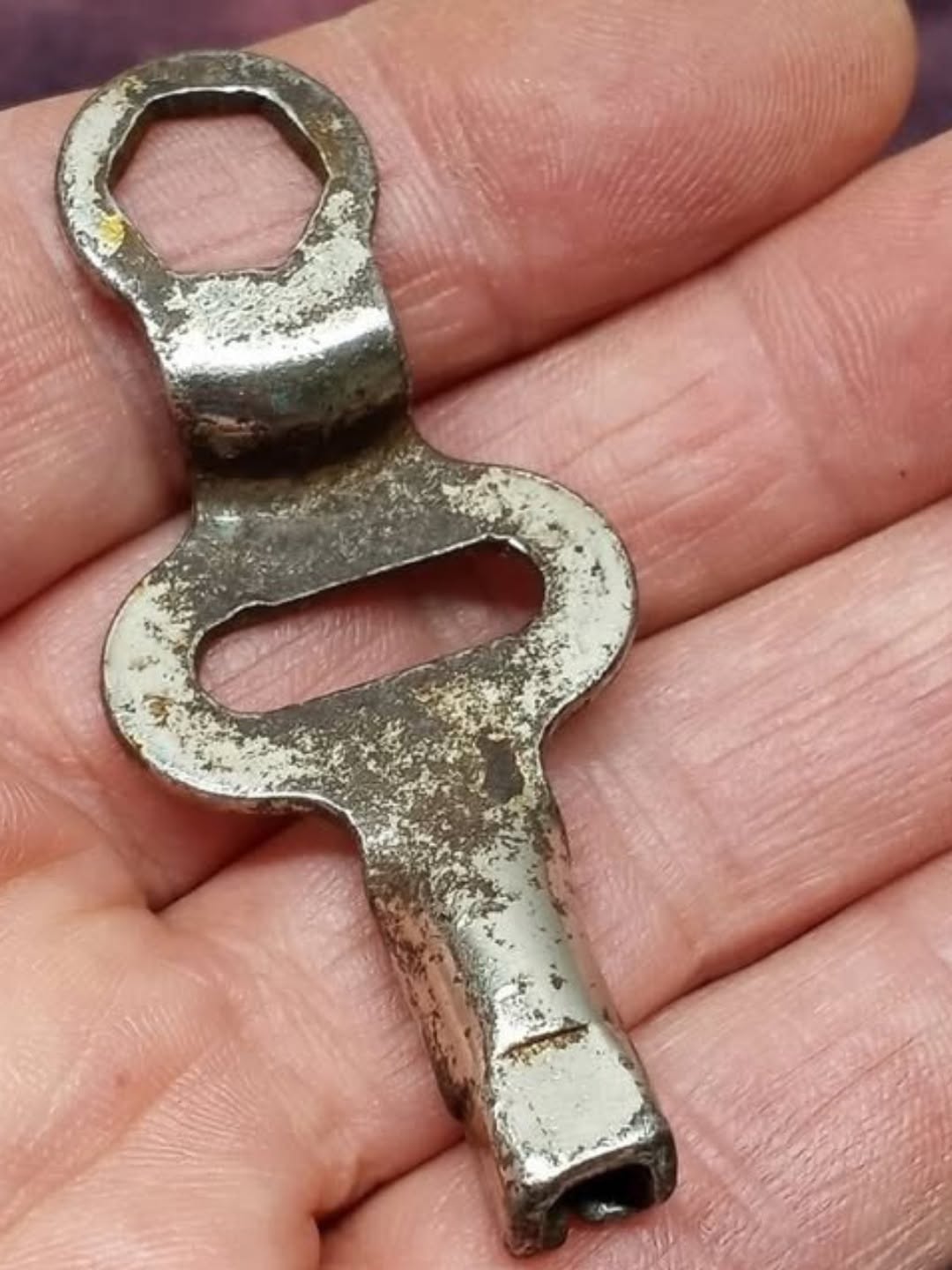
The Little Key That Held a Thousand Adventures may look mysterious today. Small, oddly shaped, and usually made of metal, it can resemble a miniature wrench, an old bottle opener, or a forgotten piece of hardware.
Yet generations of children knew exactly what it was.
It was a roller skate key.
For anyone who grew up with adjustable clamp-on roller skates, that tiny tool could determine whether the afternoon began with wheels rattling down the sidewalk or ended before the first lap around the block. The key tightened the clamps that held metal skates against ordinary shoes, and on some models it also helped adjust the skate’s length. Museum collections preserve surviving examples of these skates with their original keys, including a 1925 pair in the Smithsonian’s National Museum of American History.
Unlike today’s skates, many older clamp-on designs did not arrive as one permanently fitted boot-and-skate unit. They attached directly to shoes. That meant children could adjust the metal frames to fit different footwear and growing feet. The Strong National Museum of Play notes that many manufacturers developed clamp-on skates that could fit over ordinary shoes, making the adjustable design an important chapter in roller-skating history.
The Little Key That Held a Thousand Adventures was therefore much more than a curious accessory. It was the tool that made the whole system work.
I first understood the meaning of an old skate key after finding one in a box of family keepsakes. At first, nobody younger in the room knew what it was. Then an older relative smiled immediately and described tightening metal skates onto shoes before racing down the sidewalk with neighborhood friends. She remembered carrying the key on a string so it would not disappear halfway through the afternoon. Suddenly, the little piece of metal no longer looked like random hardware. It represented scraped knees, summer evenings, hand-me-down skates, neighborhood races, and the freedom of being told to come home when the streetlights came on.
The Little Key That Held a Thousand Adventures Had One Essential Job
It Tightened Clamp-On Roller Skates to Ordinary Shoes
The Little Key That Held a Thousand Adventures existed because classic metal roller skates worked very differently from most modern recreational skates.
Many older designs used metal platforms that sat beneath the wearer’s ordinary shoes. Clamps at the front gripped the shoe, while a leather ankle strap helped secure the skate. Waterloo Museum describes its historic Sunshine roller skates as metal skates that fit over shoes, with a special key functioning like a miniature wrench to tighten the front clamps.
That tiny wrench mattered.
Without enough tension, the skate could shift against the shoe. Therefore, the rider needed to tighten the clamps securely before taking off.
The Smithsonian preserves a 1925 pair of metal clamp-on roller skates with leather ankle straps and a skate key still attached to the strap of the right skate. The original owner used them while growing up in the Bronx.
That surviving object makes the relationship between skate and key beautifully clear.
The key was not decorative.
It was not a toy by itself.
Instead, it formed part of the equipment needed to prepare the skates for use.
Historical examples also show why children often kept the key close. Losing it could make adjustment difficult just when the skates needed tightening.
The McLeod County Historical Society describes an old metal roller skate key used both to change skate length and tighten toe clamps. Its collection record also notes that skaters sometimes wore the key on a string around the neck.
So, The Little Key That Held a Thousand Adventures often traveled with the child who owned the skates.
That practical habit eventually became part of the nostalgia surrounding the object.
Some Keys Also Adjusted the Skate Length
The Little Key That Held a Thousand Adventures did more than clamp some skates to shoes.
Adjustable metal skates could accommodate different foot sizes by allowing the frame to slide longer or shorter. Waterloo Museum explains that its Sunshine skates could fit different shoes by sliding the two sections apart, while the special skate key tightened the front clamps.
Other historical skate keys handled both adjustments.
The McLeod County Historical Society identifies its example specifically as a tool used to change skate length and tighten the toe clamps.
That adjustability offered an obvious advantage for growing children.
A pair of skates did not necessarily become useless the moment someone’s shoes changed size. Instead, the metal frame could be repositioned within its adjustment range.
Families could also pass adjustable skates among siblings when the design accommodated their shoe sizes.
The result was a piece of recreational equipment that felt almost mechanical compared with modern skates.
Before rolling away, the child might need to position the frame, tighten the toe clamps, fasten the ankle straps, and check the fit.
Then came the real test.
Stand up.
Balance.
Push away.
Hope everything stayed tight.
The Little Key That Held a Thousand Adventures became part of that ritual.
Modern products often hide their adjustments behind buckles, molded boots, ratchets, or quick-release mechanisms. The older clamp-on skate exposed its machinery.
You could see the nuts.
You could see the clamps.
You could feel the frame move when you adjusted it.
And you needed the little metal key to bring everything together.
That physical involvement may help explain why people remember the tool so fondly decades later.
It was not simply something that came in the box.
You actually used it.
Roller Skating Looked Very Different Before Modern Skate Boots
Clamp-On Skates Were Once a Familiar Way to Roll
The Little Key That Held a Thousand Adventures belongs to a much longer history of roller skating.
The Strong National Museum of Play notes that roller-skate development changed dramatically after New York businessman James Plimpton developed a four-wheel skate capable of turning more effectively in 1863. Roller skating expanded afterward, and numerous companies eventually produced clamp-on models designed to fit ordinary shoes.
By the late 19th century, roller rinks had already become popular forms of recreation in many communities.
Clamp-on skates offered a practical approach.
Instead of purchasing a dedicated skating boot, users attached the wheels to shoes they already wore.
That design probably looks unusual to anyone accustomed to modern quad skates or inline skates.
Imagine placing a rigid metal platform underneath your everyday shoe.
At the front, metal clamps grip the sole.
A strap secures the skate higher on the foot or ankle.
Below everything sit hard wheels that announce nearly every crack in the pavement.
It was not subtle.
Yet children made those skates fly.
The Smithsonian’s 1925 example demonstrates that clamp-on skates with keys formed part of childhood recreation at least a century ago.
The Little Key That Held a Thousand Adventures therefore connects directly with a period when outdoor play required more mechanical involvement than many modern toys do.
A loose skate required adjustment.
A growing foot required adjustment.
Passing the skates to another child often required adjustment.
The key made those changes possible.
Consequently, losing it could transform an exciting afternoon into a search through pockets, drawers, sidewalks, and grass.
The Skate Key Became Part of Childhood Memory
The Little Key That Held a Thousand Adventures carries an emotional weight much larger than its physical size.
Museum records offer clues about why.
The McLeod County Historical Society notes that the key could be worn around the neck on a string. That detail may sound trivial until you imagine a child preparing for a full afternoon outdoors.
The key needed to remain accessible.
If a clamp loosened, the rider needed it.
If another child borrowed the skates, the fit might need changing.
If the frame slipped out of adjustment, the key became essential again.
Therefore, children had good reason to keep it physically attached to themselves or the skates.
The Smithsonian’s 1925 pair preserves the key attached directly to a skate strap, offering another example of keeping the tool close to the equipment.
Over time, that practical little key became inseparable from the larger experience.
It recalls rough pavement.
Metal wheels.
Leather straps.
Shoes squeezed tightly between clamps.
Neighborhood sidewalks.
Driveways that suddenly became racetracks.
The terrifying thrill of a downhill slope.
And perhaps the universal childhood question: “Can I stay out a little longer?”
Objects become nostalgic because they collect memories around them.
The Little Key That Held a Thousand Adventures may have cost very little compared with the skates themselves.
Still, it unlocked the activity.
Without it, a poorly adjusted pair of clamp-on skates could not do what the child wanted them to do.
That made the key feel far more important than its size suggested.
Why the Roller Skate Key Looks So Mysterious Today
Its Shape Came From Function, Not Decoration
The Little Key That Held a Thousand Adventures can confuse modern observers because it does not necessarily resemble a familiar house key.
Instead, many skate keys resemble small stamped-metal tools.
They may have openings, slots, or wrench-like ends designed to fit the skate’s adjustment hardware.
Waterloo Museum explicitly describes its skate key as a miniature wrench used to tighten the front clamps.
Meanwhile, the McLeod County Historical Society describes another metal skate key used both for adjusting skate length and tightening the toe clamps.
Therefore, different skates could require keys shaped to interact with their particular adjustment mechanisms.
That explains why someone finding one loose in a drawer today might guess that it belongs to machinery, a can opener, a bottle, or some obscure household device.
Its shape provides almost no obvious clue once the roller skates disappear.
Put it beside a pair of vintage clamp-on skates, however, and the mystery disappears.
Suddenly, every opening and edge has a purpose.
The key reaches hardware that fingers cannot grip efficiently.
Then turning the key translates hand pressure into mechanical adjustment.
It is wonderfully simple engineering.
No batteries.
No screen.
No app.
No charging cable.
Just metal turning metal.
The Little Key That Held a Thousand Adventures belonged to an era when children sometimes needed basic mechanical familiarity simply to use their toys.
That experience could feel frustrating when something loosened.
However, it also taught cause and effect.
If the skate shifted, tighten it.
If the frame was too short, adjust it.
If the clamp pin needed more pressure, reach for the key.
Vintage Skate Keys Survive Even After Their Skates Disappear
The Little Key That Held a Thousand Adventures has outlived many of the skates it originally served.
That is one reason people still encounter mysterious examples in old jewelry boxes, sewing drawers, garage tins, and family keepsake collections.
Small metal objects survive easily.
They occupy almost no space.
Someone may remove the skates during a household cleanout but keep the key because it seems unusual.
Another person may save one intentionally because it represents childhood.
Museum collections preserve the objects for similar historical reasons.
The Smithsonian’s clamp-on skates and key document childhood recreation in the Bronx in 1925. The McLeod County Historical Society separately catalogs a metal key and explains precisely how it adjusted old skates. Waterloo Museum also preserves adjustable metal skates and their special tightening key as part of local history.
Together, those objects show how everyday tools can become historical artifacts once technology changes.
Nobody necessarily thought of a skate key as a museum piece when children were using it on sidewalks.
It was simply something they needed.
That transformation happens with many familiar objects.
Technology moves forward.
The everyday item disappears.
Then one generation recognizes it instantly while another asks, “What is this thing?”
That question keeps The Little Key That Held a Thousand Adventures alive.
What the Roller Skate Key Still Teaches Us
Simple Toys Once Required Patience and Responsibility
The Little Key That Held a Thousand Adventures offers more than nostalgia.
It also reminds us how much children’s recreation changes alongside technology.
Old clamp-on skates demanded preparation.
You could not always put them on and immediately race away.
The frame had to fit.
The clamps needed tightening.
The ankle straps needed fastening.
Then you needed enough balance to control rigid metal skates beneath ordinary shoes.
Historic examples show just how mechanical these devices were. Waterloo Museum describes sliding metal sections for size adjustment, front clamps tightened with a key, and leather ankle straps securing the skate.
That does not mean older toys were automatically better.
Modern skates often provide better comfort, materials, wheels, and purpose-built footwear.
However, old clamp-on skates created a particular relationship between child and equipment.
Children had to understand whether the skate felt loose.
They needed to carry the adjustment tool.
They had to stop and fix problems instead of expecting the equipment to correct itself.
That little bit of responsibility became part of the adventure.
The Little Key That Held a Thousand Adventures could therefore represent independence as much as recreation.
You learned to adjust your own skates.
You learned how tight felt tight enough.
You learned that ignoring a wobbling clamp was a bad idea.
Then, once everything worked, you were free.
Sometimes an Ordinary Object Becomes a Time Machine
The Little Key That Held a Thousand Adventures demonstrates the unusual power of familiar objects.
A photograph can preserve what something looked like.
A story can preserve what happened.
However, holding the physical object can trigger a different kind of memory.
The weight feels familiar.
The shape fits the hand.
Suddenly, details return.
A childhood street.
A front porch.
The sound of metal wheels.
The friend who always skated fastest.
The hill everyone knew was too steep but tried anyway.
The relief of finally mastering a turn without falling.
Museums preserve historical skate keys because they help document how people actually lived and played. The Smithsonian, Waterloo Museum, and other historical collections treat clamp-on skates and their keys as artifacts of recreation and everyday life.
Yet families preserve them for another reason.
Memory.
The Little Key That Held a Thousand Adventures might remind one person of an older sibling teaching them to skate.
Another remembers a parent kneeling on the sidewalk and tightening the clamps.
Someone else remembers wearing the key around their neck because losing it meant trouble.
That emotional history cannot fit into a museum catalog.
Still, it forms part of the object’s meaning.
A roller skate key was designed to turn a piece of hardware.
In memory, however, it turns something much bigger.
It opens a door to a version of childhood built from pavement, freedom, neighborhood friendships, and the satisfying clatter of four wheels beneath each foot.
Frequently Asked Questions
What is The Little Key That Held a Thousand Adventures?
The Little Key That Held a Thousand Adventures is a nostalgic name for the roller skate key used with vintage adjustable clamp-on roller skates. Historical examples show that the key tightened the front toe clamps, while some keys could also help adjust the skate’s length.
How did an old roller skate key work?
The user fitted the appropriate end of the key onto the skate’s adjustment hardware and turned it to tighten or loosen the mechanism. Waterloo Museum describes the key as a miniature wrench used to tighten front clamps, while McLeod County Historical Society records show that some keys also adjusted skate length.
Did children really wear roller skate keys around their necks?
Yes, at least some did. The McLeod County Historical Society specifically records that a skater could wear the key on a string around the neck. The Smithsonian also preserves a 1925 pair with the key attached directly to one skate’s strap.
How did vintage clamp-on roller skates attach to shoes?
Many designs used metal front clamps that gripped ordinary shoes along with leather ankle straps. The skates could also include sliding sections that allowed the frame length to be adjusted. Waterloo Museum documents precisely this arrangement on its historic Sunshine roller skates.
When were clamp-on roller skates used?
Clamp-on roller skates have a long history. The Strong National Museum of Play notes that numerous manufacturers developed clamp-on designs after roller skating expanded in the 19th century, while the Smithsonian preserves a complete clamp-on pair from 1925. They remained familiar childhood equipment for later generations as well.
Conclusion
The Little Key That Held a Thousand Adventures does not look important when it sits alone.
It is small.
It is simple.
And without its original skates nearby, it can look like a tool whose purpose has been completely forgotten.
Yet the roller skate key played an essential role in the era of adjustable clamp-on skates.
It tightened the metal clamps that held skates to ordinary shoes. On some models, it also helped adjust the frame to fit different foot sizes. Museum collections still preserve keys alongside the skates they served, including a 1925 pair in the Smithsonian and historic examples documented by Waterloo Museum and the McLeod County Historical Society.
For generations of children, however, the key represented much more.
It meant the skates were ready.
It meant the sidewalk was waiting.
It meant friends were outside.
It meant another race around the block before dinner.
That is how an ordinary metal wrench became The Little Key That Held a Thousand Adventures.
Today, modern skate designs have largely removed the need for this peculiar little tool. Yet discovering one can still unlock an entire world of memories.
If you recognize it immediately, you may remember exactly what it felt like to tighten those clamps and push away.
If you have never seen one before, now you know why such a tiny piece of metal mattered so much.
It did not merely adjust a pair of skates.
For the children who carried it, it adjusted the fit just tightly enough to let an adventure begin.