Few kitchen arguments have survived as many generations as the great mayonnaise debate. Nearly everyone has encountered it at some point. You visit a parent, grandparent, aunt, or family friend and notice something alarming sitting on the kitchen counter: an open jar of mayonnaise.
Immediately, questions start racing through your mind.
How long has that been there?
Is it still safe?
Shouldn’t mayonnaise be refrigerated?
Yet the owner of the jar seems completely unconcerned.
Perhaps you’ve heard the classic response:
“I’ve been doing this for forty years and nobody has ever gotten sick.”
Or maybe:
“My mother did it this way, and her mother did too.”
These confident declarations often leave people torn between family tradition and modern food safety advice. After all, if someone has stored mayonnaise on the counter for decades without obvious consequences, can it really be that dangerous?
The answer is more complicated than many people realize.
While mayonnaise is surprisingly resilient in some ways, it also has limitations that should not be ignored. Understanding what makes mayonnaise unique can help explain why this debate continues today and why food safety experts continue to recommend refrigeration after opening.
Let’s explore the science, myths, risks, and practical guidelines surrounding one of the most misunderstood condiments in the kitchen.
Why Mayonnaise Creates So Much Confusion
Unlike milk, meat, or fresh seafood, mayonnaise doesn’t immediately seem perishable.
It looks stable.
It smells acidic.
It contains ingredients that appear shelf-friendly.
Most importantly, unopened jars sit safely on grocery store shelves for months.
This leads many people to wonder:
If mayonnaise can survive for months at room temperature in a store, why does it suddenly become unsafe once opened?
The answer lies in understanding both how commercial mayonnaise is made and what changes after the seal is broken.
What Exactly Is Mayonnaise?
Mayonnaise is an emulsion—a mixture of ingredients that normally would not stay combined.
The basic ingredients include:
- Oil
- Egg yolks
- Vinegar or lemon juice
- Salt
- Seasonings
The oil and water-based ingredients are blended into a stable structure that creates the thick, creamy texture we recognize.
Commercial manufacturers carefully control this process.
More importantly, they formulate mayonnaise with enough acidity to make it highly resistant to harmful bacterial growth.
This is where many misconceptions begin.
The Science Behind Mayonnaise’s Acidity
Commercial mayonnaise is surprisingly acidic.
Most store-bought brands maintain a pH between 3.6 and 4.0.
For comparison:
- Pure water has a pH of 7.
- Tomatoes typically range from 4.3 to 4.9.
- Vinegar usually falls around 2 to 3.
This acidic environment makes life difficult for many dangerous bacteria.
In fact, researchers have found that pathogens such as Salmonella struggle to survive in properly formulated commercial mayonnaise.
This is one reason mayonnaise gained a reputation for being safer than people expected.
Ironically, mayonnaise is often blamed for food poisoning outbreaks when other ingredients are actually responsible.
The Surprising Truth About Picnic Food Poisoning
For decades, mayonnaise carried a reputation as the villain behind summer food poisoning.
Potato salad was frequently blamed.
Macaroni salad was often suspected.
Egg salad became notorious.
Yet food scientists eventually discovered something interesting.
The mayonnaise itself was rarely the problem.
Instead, the real culprits were often:
- Cooked potatoes
- Hard-boiled eggs
- Chicken
- Tuna
- Contaminated utensils
When mixed into mayonnaise-based salads and left at unsafe temperatures, these ingredients provided ideal conditions for bacterial growth.
The mayonnaise was guilty by association.
The USDA’s Two-Hour Rule
Despite mayonnaise’s acidic protection, food safety organizations remain clear about storage recommendations.
The general guideline is straightforward:
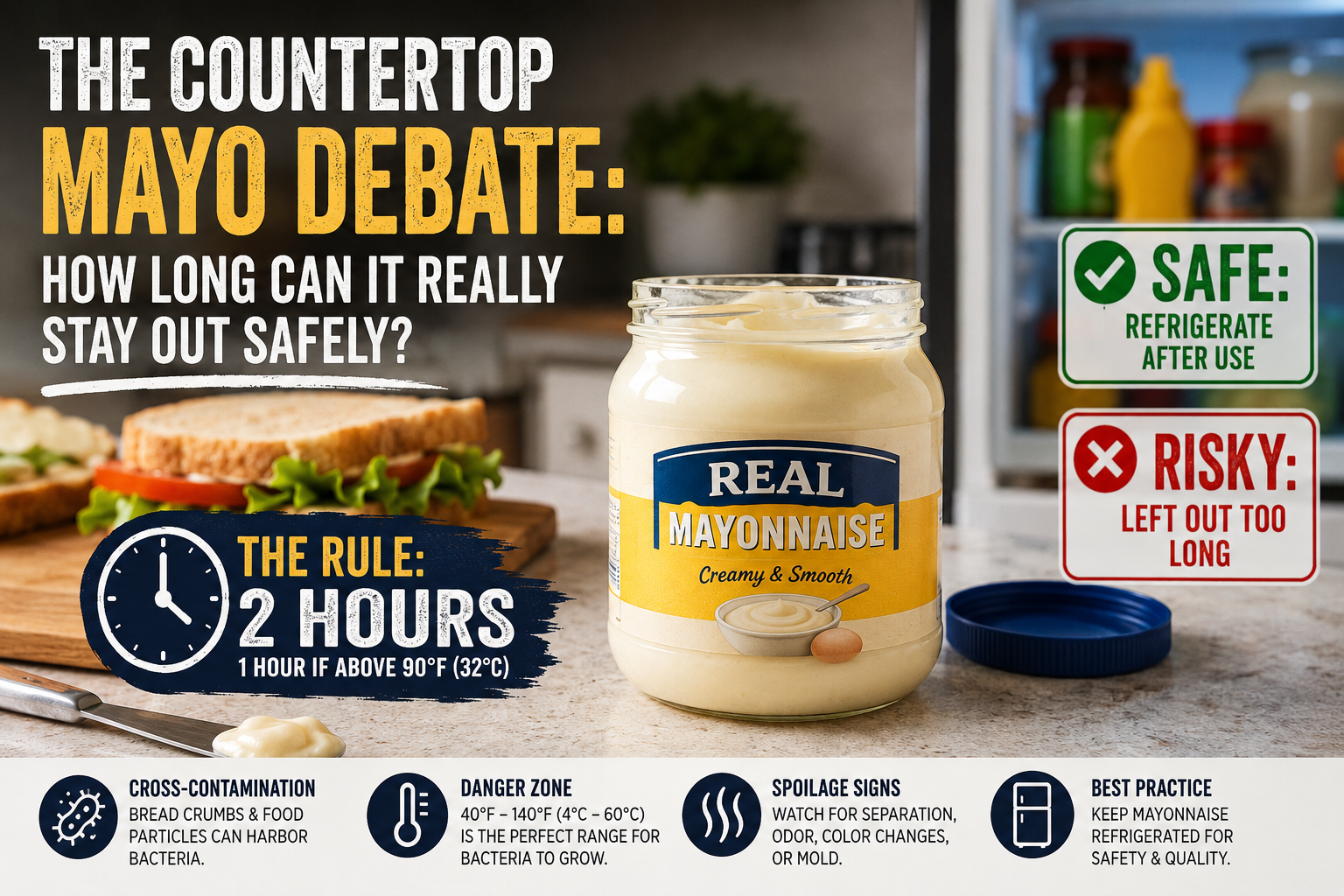
An opened jar of mayonnaise should not remain unrefrigerated for more than two hours.
If temperatures exceed 90°F (32°C), that limit drops to one hour.
These recommendations come from food safety agencies that study bacterial growth patterns under real-world conditions.
The purpose isn’t to suggest that mayonnaise instantly becomes dangerous after two hours.
Instead, the rule provides a safety margin designed to minimize risk.
Why Opening the Jar Changes Everything
When a mayonnaise jar is sealed at the factory, it exists in a controlled environment.
The contents remain protected from:
- Airborne contaminants
- Food particles
- Human contact
- Moisture fluctuations
Once opened, everything changes.
Each time the lid comes off, new opportunities for contamination emerge.
The mayonnaise itself may still be acidic enough to discourage many bacteria.
However, the things introduced into the jar can create entirely different conditions.
The Hidden Threat of Cross-Contamination
Cross-contamination is the true reason opened mayonnaise belongs in the refrigerator.
Consider a common scenario.
Someone spreads mayonnaise onto a sandwich.
The knife touches bread.
Then the same knife returns to the jar.
Tiny bread crumbs enter the mayonnaise.
Perhaps traces of turkey, ham, lettuce, or cheese come along as well.
The contamination may be invisible.
But it exists.
These food particles often possess a more neutral pH than mayonnaise.
Unlike the acidic condiment surrounding them, these particles can become miniature habitats where bacteria survive and multiply.
Repeated use introduces more contaminants.
Over time, risk increases.
Why Grandma Never Got Sick
Many people point to relatives who stored mayonnaise on the counter for years without apparent problems.
This observation is often accurate.
Several factors help explain why.
Luck
Food safety involves probabilities.
Not every unsafe practice leads to illness.
Sometimes people simply get lucky.
Frequent Consumption
If mayonnaise is used rapidly, there may be insufficient time for significant bacterial growth.
Cool Kitchen Temperatures
Older homes often remained cooler than modern kitchens during certain seasons.
Lower temperatures slow bacterial activity.
Limited Contamination
Some households naturally introduce fewer contaminants due to careful handling.
The absence of illness does not necessarily prove the practice is safe.
It simply means conditions never aligned to create a noticeable problem.
Temperature: The Critical Factor
Food safety experts frequently discuss the “Danger Zone.”
This refers to temperatures between 40°F and 140°F (4°C to 60°C).
Within this range, bacteria reproduce rapidly.
A refrigerator keeps mayonnaise below this danger zone.
A countertop does not.
Even moderate room temperatures allow microorganisms to multiply much faster than they would under refrigeration.
This is especially important during:
- Summer months
- Heat waves
- Homes without air conditioning
- Warm kitchen environments
The warmer the room, the faster deterioration occurs.
Oxidation: The Overlooked Problem
Bacteria aren’t the only concern.
Oxidation also affects mayonnaise quality.
When exposed to oxygen and heat, oils gradually begin breaking down.
This process creates:
- Off flavors
- Unpleasant odors
- Color changes
- Texture changes
Although oxidation isn’t always dangerous, it significantly reduces quality.
The mayonnaise may become unpleasant long before it becomes hazardous.
Signs Your Mayonnaise Has Gone Bad
Many people wonder whether spoiled mayonnaise announces itself clearly.
Sometimes it does.
Warning signs include:
Separation
Fresh mayonnaise remains smooth and uniform.
If oil separates from the mixture, the emulsion has broken down.
Color Changes
Healthy mayonnaise appears creamy white or slightly ivory.
Yellowing, browning, or graying suggests deterioration.
Strange Odors
Fresh mayonnaise smells mildly tangy.
Spoiled mayonnaise may smell:
- Sour
- Chemical-like
- Musty
- Rancid
Mold Growth
Any visible mold means immediate disposal.
Never attempt to scrape mold away and save the remaining contents.
Texture Changes
Lumps, unusual thickness, or watery consistency can signal spoilage.
Homemade Mayonnaise: An Entirely Different Story
Homemade mayonnaise deserves special attention.
Unlike commercial products, homemade versions often contain:
- Raw egg yolks
- Less acidity
- No preservatives
- Variable recipes
Because of these differences, homemade mayonnaise spoils much faster.
Food safety experts generally recommend:
- Refrigerating immediately
- Using within a few days
- Never leaving it unrefrigerated for extended periods
Homemade mayonnaise carries substantially greater risk than store-bought varieties.
Common Myths About Mayonnaise
Myth 1: Mayonnaise Causes Food Poisoning Easily
Reality: Mayonnaise itself is often more resistant than many ingredients mixed with it.
Myth 2: The Smell Test Is Always Reliable
Reality: Dangerous bacteria do not always produce noticeable odors.
Myth 3: Refrigeration Is Optional
Reality: Manufacturers recommend refrigeration after opening for a reason.
Myth 4: Acid Makes It Completely Safe
Reality: Acidity helps but does not eliminate all risks.
Myth 5: If It Looks Fine, It Is Fine
Reality: Harmful microorganisms are invisible.
How Long Does Refrigerated Mayonnaise Last?
Once opened and refrigerated, commercial mayonnaise remains usable surprisingly long.
Most manufacturers recommend consuming within two months after opening for best quality.
Many jars remain safe beyond this timeframe if stored properly.
However, flavor and texture gradually decline over time.
Always check:
- Expiration dates
- Appearance
- Smell
- Texture
When in doubt, throw it out.
Best Practices for Safe Mayonnaise Storage
Following a few simple habits dramatically reduces risk.
Use Clean Utensils
Never double-dip knives or spoons.
Close the Lid Promptly
Reduce exposure to air and contaminants.
Refrigerate Immediately
Return the jar to the refrigerator after use.
Avoid Temperature Cycling
Repeated warming and cooling accelerate deterioration.
Keep It Clean
Wipe the rim regularly to prevent residue buildup.
Monitor Expiration Dates
Replace older jars before quality declines significantly.
What About Restaurant Mayonnaise?
Restaurants often appear to leave mayonnaise-containing products out longer than recommended.
However, commercial food service operations typically use:
- Temperature-controlled stations
- Strict monitoring procedures
- Frequent replacement schedules
- Specialized formulations
Professional practices differ substantially from leaving an open jar on a household countertop for days.
The Bottom Line
The mayonnaise debate persists because both sides contain a kernel of truth.
Traditionalists are correct that commercial mayonnaise is more resilient than many people realize.
Its acidity offers significant protection against harmful bacteria.
However, food safety experts are equally correct.
Once opened, mayonnaise becomes vulnerable to contamination, oxidation, and temperature-related deterioration.
The safest approach remains simple:
Store unopened mayonnaise in the pantry.
Store opened mayonnaise in the refrigerator.
Use clean utensils.
Discard jars showing signs of spoilage.
And if you discover an open jar sitting on the counter for several days, it’s wise to replace it.
Mayonnaise may be surprisingly durable, but it isn’t invincible.
In the end, the refrigerator provides a level of protection that far outweighs the few seconds required to return the jar after making a sandwich.
Sometimes the simplest food safety habits are also the smartest ones.