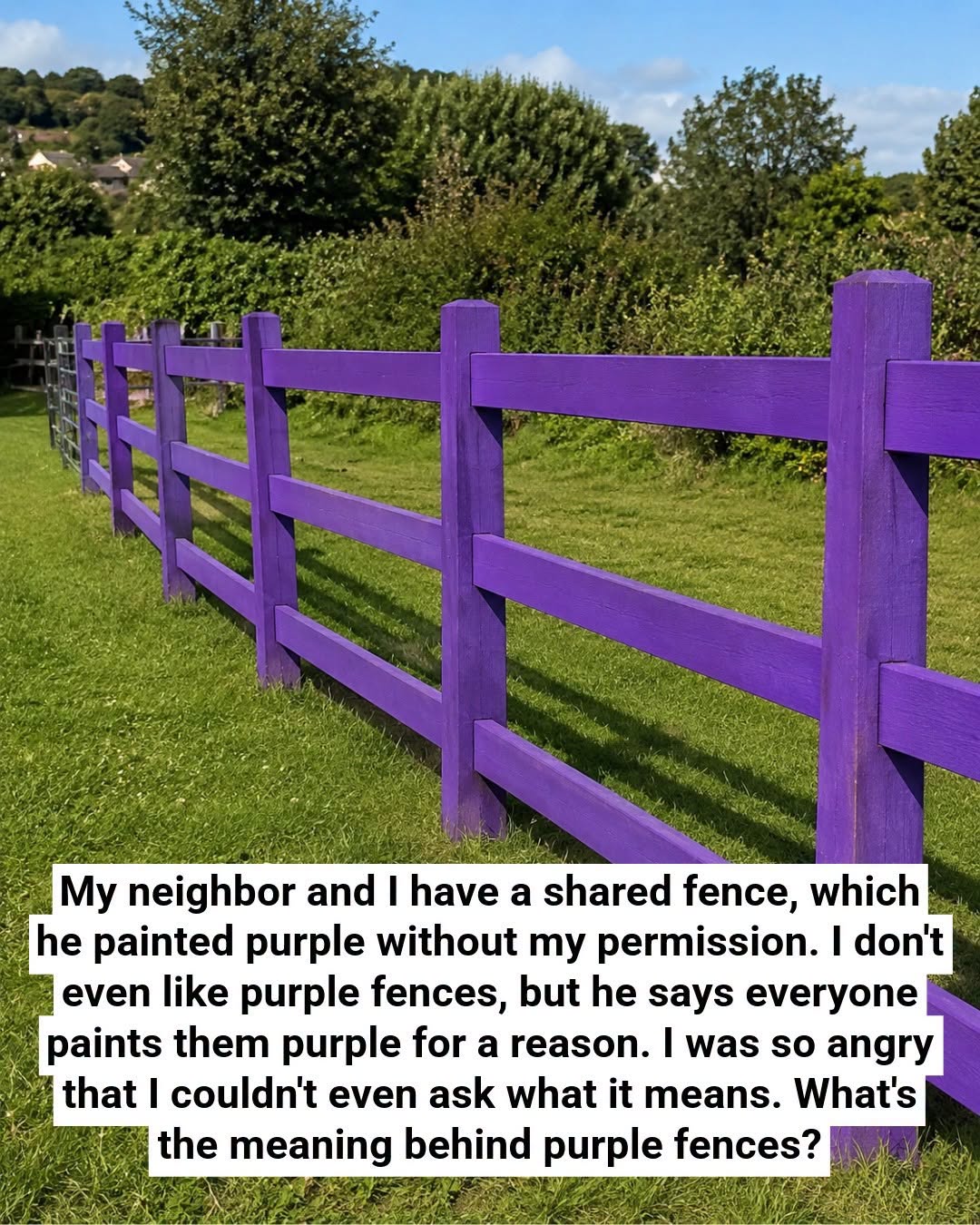
If You Spot a Painted Purple Fence, tree, or fence post while hiking, hunting, fishing, or exploring rural land, do not assume someone simply made an unusual decorating choice. In several U.S. states, properly placed purple paint marks can serve as legal notice that private property is posted against trespassing. Texas law, for example, expressly recognizes qualifying purple marks on trees or posts as a form of notice, while Missouri law also allows property owners or lessees to post land using specified purple marks.
However, one important detail often disappears from viral explanations: purple paint laws are not identical nationwide. The exact color, placement requirements, spacing, property types, and legal consequences depend on the jurisdiction. Therefore, a random purple object does not automatically carry the same legal meaning everywhere in the United States.
Still, when you encounter deliberate purple vertical markings along the apparent boundary of rural property, the safest practical response is simple: do not continue onto the land unless you know you have permission.
Purple paint provides landowners with a durable alternative to signs that can deteriorate, disappear, or require repeated replacement. More importantly, it gives hikers, hunters, and other visitors a boundary signal they should take seriously.
I first learned about purple property markings during a countryside drive when several fence posts along a wooded field carried nearly identical vertical purple stripes. At first, I assumed the landowner simply liked the color. A local explained that the marks served as property notices under state trespassing rules. What surprised me most was not the unusual color but how easy it would have been to walk past without recognizing its significance. Since then, I have treated repeated paint markings near rural boundaries as a reason to stop, check local rules, and respect the apparent property line rather than assuming an unmarked trail gives me permission to continue.
What Purple Paint on a Fence or Tree Can Mean
Purple Paint May Serve as Legal Trespass Notice
The most important thing to understand about If You Spot a Painted Purple Fence is that some states legally recognize purple paint as a way of giving notice against entry onto private property.
Texas provides a clear example. Section 30.05 of the Texas Penal Code recognizes identifying purple paint marks on trees or posts as one method through which a property owner can provide notice that entry is forbidden. The statute does not treat any random splash of purple paint as sufficient. Instead, the markings must satisfy detailed requirements concerning size, height, visibility, and spacing.
Missouri uses a similar concept. Its statutes allow an owner or lessee to post real property against trespassers by applying identifying purple marks to trees or posts around the posted area. Missouri also specifies characteristics such as the length and height of the marks and how far apart they may appear.
This system gives property owners an alternative to repeatedly installing conventional “No Trespassing” signs.
However, do not assume every state follows the same system.
Legislative materials from Washington, for example, have discussed other states that use paint markings and noted that Oregon, Idaho, and Montana used orange in the context discussed there. That example demonstrates why travelers should never assume a particular paint color has one universal legal meaning throughout the country.
Therefore, treat deliberate boundary paint conservatively while recognizing that actual legal rules remain state-specific.
A Purple Fence Is Not Always the Same as a Purple Boundary Mark
Online explanations often say, “A purple fence means no trespassing.”
That statement oversimplifies the law.
In jurisdictions such as Texas and Missouri, statutes focus on qualifying marks placed on trees or posts rather than declaring that every object painted purple automatically creates legally sufficient notice.
For example, Texas requires the purple marks to form vertical lines at least eight inches long and at least one inch wide. The bottom of the mark must sit at least three feet but no more than five feet above the ground. The markings also must remain readily visible to people approaching the property.
Consequently, someone who paints an entire garden fence purple for decorative reasons has not necessarily created the same legal notice that a statute describes.
Context matters.
Repeated vertical marks along trees or posts beside an apparent property boundary strongly suggest deliberate posting. Meanwhile, one purple mailbox, planter, barn door, or decorative fence section may mean nothing related to trespassing.
Still, you do not need to conduct a legal analysis in the woods before respecting an apparent boundary.
When the markings repeat at regular intervals and clearly follow private property, assume the landowner intends to communicate a restriction.
That approach protects both you and the landowner.
Why Landowners Use Purple Paint Instead of Signs
Paint Can Be Durable and Highly Visible
When If You Spot a Painted Purple Fence becomes relevant, you may wonder why the owner did not simply hang a written sign.
Paint has several practical advantages.
A painted mark attaches directly to an existing tree or post. Therefore, it cannot blow away like lightweight signage, and someone cannot remove it as easily as a sign attached with nails, screws, or wire.
Paint also allows a landowner to repeat notices across a long rural boundary without installing dozens of separate signboards.
Texas illustrates how deliberately the system can work. The state’s rules require qualifying purple markings to remain visible to anyone approaching the property. Texas also sets maximum spacing at 100 feet on forest land and 1,000 feet on land that does not qualify as forest land.
Missouri similarly requires readily visible markings and imposes spacing requirements in its statute.
These details show that purple paint laws do not rely merely on the color itself.
The overall pattern creates notice.
For hikers and hunters, that distinction helps identify markings intentionally placed for boundary communication.
A single splash might result from maintenance or another activity.
Repeated standardized marks usually deserve much greater attention.
Purple Is Not the Nationwide Universal Boundary Color
One popular explanation claims lawmakers chose purple because it never appears in nature or because every other bright color already had another official purpose.
That explanation sounds plausible, but it should not be presented as a universal legal fact without jurisdiction-specific evidence.
What we can establish clearly is that states have adopted different paint-based approaches.
Washington legislative material discussing notice against trespass observed that Oregon, Idaho, and Montana used orange paint in the comparable systems referenced at that time.
Texas and Missouri, meanwhile, expressly recognize purple under their respective statutes.
Therefore, no traveler should memorize “purple always means this everywhere” and stop there.
Instead, remember the more useful rule:
When you encounter deliberately repeated paint marks along a rural property line, treat them as potentially meaningful boundary notices and follow local law.
If you frequently hike, hunt, camp, or fish in a particular state, checking that state’s trespassing and land-access rules before your trip makes more sense than trying to interpret unfamiliar markings after you arrive.
Private land can sit directly beside public trails, forests, waterways, or hunting areas. As a result, a landscape that looks open does not automatically provide public access.
What to Do When You Encounter Purple Marks
Stop Before Crossing the Apparent Boundary
If If You Spot a Painted Purple Fence describes what is directly ahead of you, the safest immediate decision is to remain on the side where you already have lawful access.
Do not climb the fence.
Do not squeeze through an opening.
Do not assume the rule applies only to hunters.
Do not decide that crossing “for just five minutes” cannot matter.
Texas criminal-trespass law recognizes several forms of notice, including qualifying purple paint marks. Entering or remaining on another person’s property without effective consent after receiving legally recognized notice can create criminal consequences under the circumstances covered by the statute.
Likewise, Missouri specifically authorizes qualifying purple markings as a method of posting property against trespassers.
Therefore, the practical response should not involve testing whether the property owner actually enforces the boundary.
Turn back or follow a route that you know remains open to the public.
If you believe a public trail continues across the marked area, verify the route through an authoritative map, park agency, land-management authority, or property owner rather than assuming.
GPS apps can help with navigation, but they can also contain outdated or user-generated information.
A painted property notice visible in the real world deserves attention.
Don’t Remove, Alter, or Paint Over Boundary Markings
Finding a boundary marker inconvenient does not give you permission to change it.
Do not scrape off purple paint, cover it with another color, remove the marked post, or modify signage associated with the property.
Likewise, do not create your own purple boundary marks on property you do not own simply because you have learned what the color can mean.
Legal posting requirements belong to property owners or other people authorized under applicable law. Missouri’s statute, for example, specifically describes the owner or lessee posting real property through qualifying purple marks.
If you believe someone has incorrectly marked public property, report the situation to the relevant land-management agency instead of changing the markings yourself.
The same approach applies when you suspect a boundary dispute.
Land ownership can become complicated, particularly around forests, easements, hunting leases, agricultural property, and parcels crossed by trails.
A visitor standing beside a fence usually lacks enough information to settle that disagreement.
Respect the boundary first.
Verify the situation second.
That sequence prevents a simple navigation problem from becoming a confrontation.
The Biggest Myths About Purple Paint Laws
Myth: Purple Paint Means the Same Thing in Every State
The biggest misconception surrounding If You Spot a Painted Purple Fence is that purple represents a universal American property law.
It does not.
Texas expressly recognizes properly placed purple marks within its criminal-trespass notice rules. Missouri also authorizes purple marks for posting property. However, other jurisdictions may use different colors, different standards, signs, fencing, verbal notice, or other legal mechanisms.
Even within states that recognize purple paint, the technical rules differ.
Texas, for example, specifies an eight-inch minimum vertical line, one-inch minimum width, a particular height range, and different maximum spacing for forest and nonforest land.
Missouri’s statute also sets measurement, height, visibility, and spacing requirements, but its wording does not simply duplicate Texas law.
Therefore, an article that gives one set of measurements and presents them as nationwide rules creates a misleading impression.
Local law controls.
That fact matters especially for travelers who cross state lines for hunting, hiking, fishing, camping, or off-road recreation.
Before entering unfamiliar rural land, learn the access rules for that location.
Myth: No Sign Means You Can Enter
Another dangerous misconception says private land becomes fair game when you cannot find a traditional “No Trespassing” sign.
That assumption can create legal trouble.
In Texas, qualifying purple paint constitutes one statutorily recognized type of notice under the criminal-trespass law. Traditional signs represent only one way an entrant may receive notice.
Therefore, searching for a printed sign while ignoring painted marks misses the entire purpose of a purple-paint system.
More broadly, the absence of a sign does not automatically establish a right to enter private property.
Property access rules depend on local law, ownership, permission, easements, public rights of way, and other circumstances.
If you cannot determine whether land is public or private, do not treat uncertainty as permission.
Instead, stay on clearly designated public routes until you can verify access.
That approach offers another advantage: it reduces the chance of accidentally entering agricultural operations, active hunting land, livestock areas, or other spaces where unexpected visitors can create safety problems.
Respecting boundaries does not require knowing every detail of property law.
It requires recognizing when the landscape tells you to stop.
Frequently Asked Questions
Does purple paint always mean no trespassing?
No. Several states recognize purple paint as a method of posting private property, but the rule is not universal nationwide. Texas and Missouri expressly recognize qualifying purple markings, while other states can use different systems or colors.
What does purple paint mean in Texas?
Texas law recognizes properly placed purple paint marks on trees or posts as a form of notice for criminal-trespass purposes. The marks must meet statutory requirements concerning dimensions, height, visibility, and spacing.
How big must purple marks be in Texas?
Texas requires vertical purple lines at least eight inches long and at least one inch wide. Their lower edge must sit between three and five feet above the ground, and spacing requirements depend on whether the property is forest land.
Does an entire purple-painted fence automatically mean no trespassing?
Not necessarily. Laws such as Texas’s describe qualifying purple marks on trees or posts rather than declaring that every purple-painted object legally means no trespassing. However, repeated purple boundary markings should still prompt you to stop and verify access before continuing.
What should I do if I see purple marks while hiking?
Remain on the side where you know you have legal access. Do not cross an apparent private-property boundary unless you have permission or reliable confirmation that your route remains public. Because paint-posting laws vary by jurisdiction, check applicable state and local rules when necessary.
Conclusion
If You Spot a Painted Purple Fence, repeated purple marks on trees, or purple stripes on fence posts, do not dismiss them as random decoration.
In states such as Texas and Missouri, properly placed purple paint can carry genuine legal significance as notice against trespassing.
However, the viral version of this rule usually goes too far.
Purple does not function as one universal property code across all 50 states. Different jurisdictions use different colors and legal standards, and even states that recognize purple paint can impose different rules concerning dimensions, height, spacing, visibility, and property type.
Therefore, remember the principle rather than a misleading nationwide formula.
Deliberate paint markings along a rural boundary deserve respect.
If the marks appear to communicate a private-property restriction, stop before crossing. Check your map, verify the applicable law, or obtain permission from the landowner.
Do not remove or alter the markings.
Most importantly, never assume that an apparently open field, forest, trail, or fence gap means the public has permission to enter.
The purple stripe may look surprisingly simple.
In the places where the law recognizes it, that simplicity is exactly the point: the landowner has already given you a message.
When you recognize it, respect it.