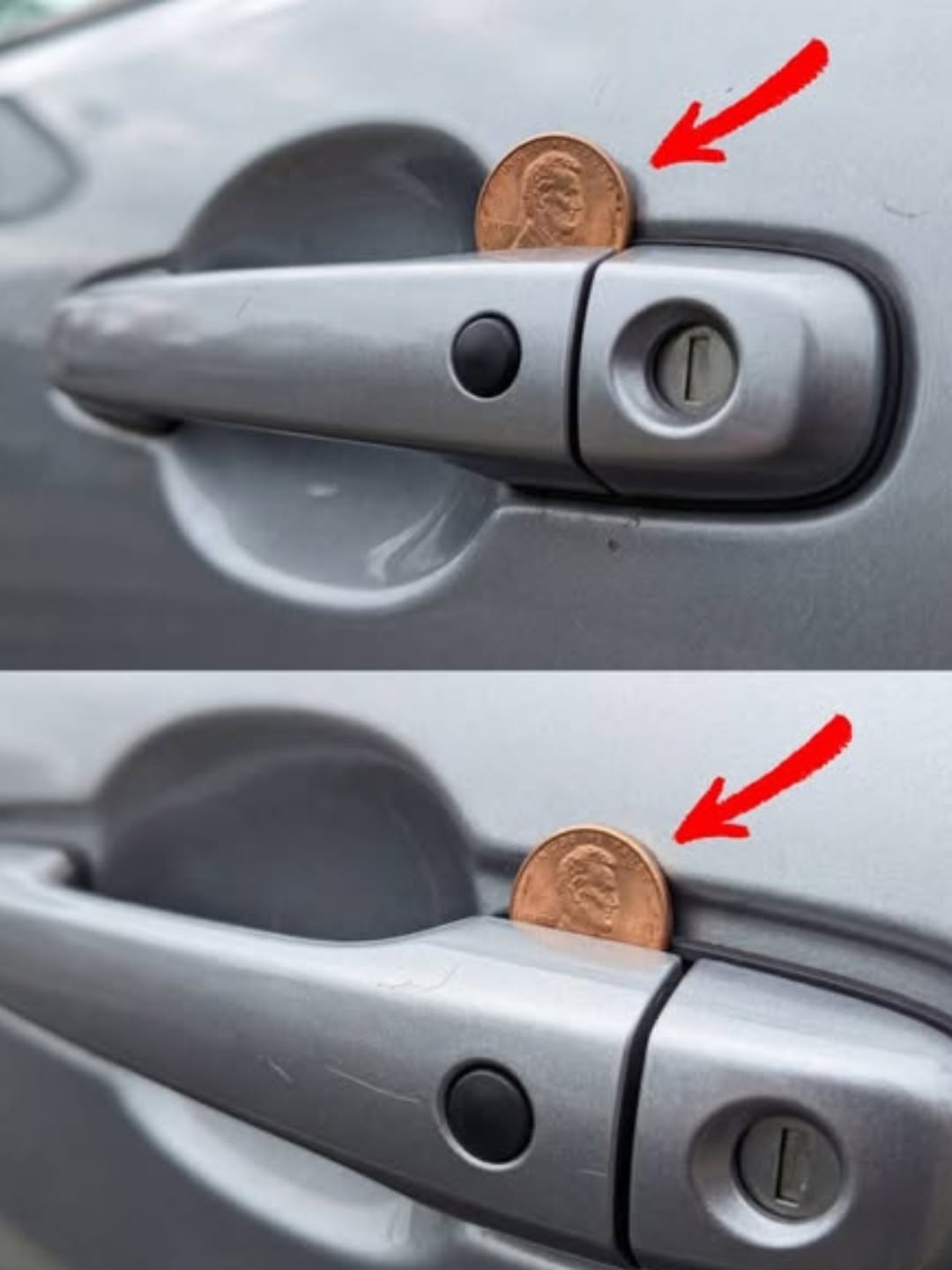
If You See a Penny in Your Car Door Handle, you may immediately remember one of those alarming social media warnings about thieves, secret signals, or a clever trick that supposedly leaves your vehicle unlocked.
The story sounds believable because it combines an ordinary object with a threat that feels difficult to detect. According to the viral claim, someone wedges a penny or another coin into a car’s exterior door handle. Then, when the owner locks the vehicle, the coin supposedly prevents the door from locking properly. The thief later returns and simply opens the door.
However, there is an important problem with that story: investigators and automotive experts have found no credible evidence of a widespread theft method involving pennies jammed into car door handles. Snopes investigated versions of the warning and found no documented rash of thefts caused by the supposed coin trick.
Still, finding an unexplained object attached to your vehicle deserves reasonable attention. You do not need to panic, but you should inspect your surroundings, verify that your vehicle locks normally, remove the object safely, and report genuinely suspicious behavior when appropriate.
I once returned to a parking lot and noticed a coin sitting strangely close to my passenger-side door handle. I had already seen frightening online warnings, so my imagination immediately jumped to the worst explanation. Instead of rushing away or assuming someone had targeted the car, I checked the surrounding area, looked for damage, removed the coin, and tested every door. Everything worked normally. Nothing else happened. That moment reminded me how easily viral stories can turn something unexplained into something sinister. Since then, I have followed a simpler rule: stay observant, check the vehicle carefully, but do not let an unsupported internet rumor create unnecessary fear.
If You See a Penny in Your Car Door Handle, Understand the Viral Claim First
How the Supposed Penny Trick Is Said to Work
The popular warning usually follows the same script.
Someone secretly places a penny, nickel, or another small coin into the exterior door handle on the passenger side of a parked vehicle. According to the story, the car owner later presses the lock button on the key fob and walks away.
The coin supposedly interferes with the handle mechanism. Therefore, the viral story claims that one door remains unlocked even though the driver believes every door has locked.
Then, once the owner leaves, a thief supposedly returns, opens the compromised door, and steals valuables or attempts to steal the vehicle.
Some versions add another dramatic detail. They claim criminals deliberately use the passenger-side handle because the driver will not notice the coin while approaching the driver’s door.
Other versions claim a penny acts as a secret marker. Supposedly, one criminal places the coin while another returns later to identify a target.
Still other posts turn the scenario into a distraction scheme. They warn that a thief waits nearby while the driver investigates the strange coin.
These explanations spread easily because each one sounds just plausible enough to create anxiety.
However, repetition does not make a story true.
Fact-checking investigations have traced versions of the claim for years without finding evidence that criminals commonly use coins in door handles as a reliable method for defeating vehicle locks. Automotive experts cited during those investigations also questioned whether the proposed mechanism would actually prevent the locking system from functioning as described.
Therefore, If You See a Penny in Your Car Door Handle, you should separate two questions.
First, does the coin prove that someone intends to steal your vehicle?
No credible evidence establishes that conclusion.
Second, should you still look around and check your car?
Absolutely.
Caution makes sense even when panic does not.
Why the Story Sounds More Convincing Than It Is
The penny warning survives because it takes advantage of several things people already understand.
Car theft happens.
Thieves sometimes look for easy opportunities.
People also know that small mechanical problems can cause doors, windows, and locks to behave unpredictably.
Therefore, placing those ideas together creates a convincing story.
However, real vehicle-theft prevention guidance focuses on much more ordinary risks.
The FBI recommends parking in well-lit areas, closing and locking windows and doors, hiding valuables from view, and avoiding leaving keys inside the vehicle. Likewise, the National Insurance Crime Bureau advises drivers to lock their doors, take their keys or key fobs, avoid leaving an unattended vehicle running, and choose visible, well-lit parking areas.
Notice what those recommendations emphasize.
They focus on controlling access to the vehicle rather than searching every handle for pennies.
That does not prove that nobody has ever placed a coin near a vehicle for suspicious reasons. Almost any object could theoretically be used in an isolated crime or prank.
Instead, it shows why If You See a Penny in Your Car Door Handle should not automatically become evidence of an organized theft technique.
Furthermore, online warnings often grow more dramatic as people repost them. One version says a coin affects the lock. Another adds an accomplice. Then another claims criminals track victims afterward.
Eventually, the story can sound like a highly organized operation even though the original evidence remains weak.
A better approach uses observable facts.
Is the handle damaged?
Does the door lock?
Is someone watching the vehicle?
Did you find other signs of tampering?
Does your dashboard show a warning?
Those questions provide more useful information than a frightening social media post.
What to Do If You Find a Penny in Your Car Door Handle
Check Your Surroundings Before Focusing on the Coin
If You See a Penny in Your Car Door Handle, avoid becoming so focused on the object that you stop paying attention to everything around you.
First, take a quick look at your surroundings.
You do not need to assume that everyone nearby represents a threat. However, notice whether anyone appears to be watching your vehicle unusually closely, following you, interfering with nearby cars, or behaving in a way that genuinely concerns you.
If the area feels unsafe, you do not need to stand beside the car investigating.
Instead, move toward a populated, well-lit location. If you believe someone poses an immediate threat, contact emergency services.
However, if nothing else looks suspicious, examine the coin without turning the situation into an emergency.
Check whether someone simply placed it loosely near the handle.
Then inspect the surrounding paint, trim, lock cylinder, window, and handle for visible damage.
You may also check the ground nearby. A coin can end up in strange places for completely ordinary reasons.
Next, remove the penny if you can do so without forcing or damaging the handle.
Modern U.S. cents use a copper-plated zinc construction, so the coin itself is simply a small, lightweight object rather than a specialized device.
After removing it, test the handle normally.
Do not yank it repeatedly or push another object into the mechanism.
If the handle appears damaged or jammed, consult your vehicle manual or a qualified technician instead of forcing it.
Most importantly, remain proportionate in your response.
A loose penny alone does not establish criminal intent.
Nevertheless, unusual physical damage, broken glass, disturbed trim, damaged locks, or evidence that someone entered the vehicle changes the situation.
Those signs deserve closer attention.
Lock the Car and Physically Verify the Doors
After removing the object, test your vehicle’s locks.
Press the lock button on your key fob as you normally would.
Then listen for the expected confirmation sound or watch for the usual light signal if your vehicle provides one.
Next, physically check the doors.
Pull gently on each exterior handle while keeping the key far enough away that a proximity-entry system will not automatically unlock the vehicle.
This step matters because drivers sometimes assume their vehicle locked simply because they pressed a button.
Automakers can use different keyless-entry and walk-away locking systems. In some vehicles, certain conditions can prevent automatic locking from operating as expected. Manufacturer service information, for example, has warned drivers to verify that doors and liftgates are actually locked rather than relying entirely on automatic locking behavior.
Therefore, If You See a Penny in Your Car Door Handle, physical verification provides a straightforward answer to the most important immediate question.
Is the door actually locked?
If every door locks and unlocks normally, you have strong practical evidence that the coin did not disable your locking system.
However, if one door refuses to lock, do not automatically blame the penny.
A failing actuator, damaged handle, electrical problem, weak battery, sensor issue, or another mechanical fault could cause the problem.
Instead, secure the vehicle somewhere appropriate and have the system inspected.
Also remove visible valuables before leaving the car.
The FBI and NICB consistently recommend keeping valuables hidden, closing windows, locking doors, and taking your keys with you because those simple habits reduce opportunities for theft.
Those steps protect you regardless of how the penny arrived.
How to Tell a Viral Warning From a Real Vehicle-Theft Risk
Look for Evidence Instead of Dramatic Language
If You See a Penny in Your Car Door Handle, one of the most useful things you can do happens before you even reach the parking lot: learn how to recognize weak online claims.
Viral crime warnings often use urgent language.
They may tell you to “share immediately,” warn that “police don’t want you to know,” or claim that a new trick has suddenly appeared everywhere.
However, genuine public-safety guidance usually looks different.
Reliable agencies explain a risk, offer practical prevention steps, and identify actions people can take without creating panic.
For example, current NICB guidance emphasizes locking doors, rolling up windows, removing keys, parking in well-lit places, and keeping valuables out of sight. The FBI offers similar recommendations for preventing motor vehicle theft.
Meanwhile, fact-checkers examining the penny-in-the-handle warning have found no evidence supporting claims of a widespread theft technique.
Therefore, ask a few basic questions whenever you encounter a frightening warning.
Does the claim identify a police department?
Does that department actually publish the warning?
Does the post cite documented incidents?
Do automotive professionals confirm that the supposed trick can work?
Can you find the warning from a credible public-safety organization rather than only from reposted social media graphics?
These questions can quickly separate useful safety information from recycled internet folklore.
Furthermore, avoid assuming that photographs prove the entire accompanying story.
A photograph may genuinely show a penny beside a door handle.
However, the image alone cannot tell you who placed the coin there or why.
Context matters.
Focus on Theft Risks That Authorities Actually Warn About
Real vehicle theft deserves attention even though the penny story lacks strong evidence.
The FBI maintains dedicated information on motor vehicle theft and recommends practical precautions, including locking every door and window, keeping valuables out of sight, and parking in well-lit locations.
Similarly, NICB recommends taking the keys or key fob with you, never leaving a running vehicle unattended, and using additional immobilizing or tracking devices when appropriate.
These recommendations work because they address opportunities that thieves can actually exploit.
An unlocked door provides access.
Visible valuables provide motivation.
Keys left inside can make theft easier.
An unattended running vehicle can create an obvious opportunity.
Therefore, If You See a Penny in Your Car Door Handle, use the moment as a reminder to check the basics rather than assuming you discovered a sophisticated criminal code.
Remove the coin.
Verify the locks.
Look inside the vehicle.
Check whether anything appears missing or disturbed.
Then take sensible precautions.
If you discover evidence of an actual break-in or theft, contact law enforcement and your insurer promptly. NICB specifically recommends quick reporting after a vehicle theft because faster reporting can improve the chance of recovery.
Furthermore, if you notice suspicious behavior involving several vehicles in a parking area, notify property security or local authorities.
You do not need to investigate other people’s cars yourself.
The important point remains simple: real-world prevention works better than fear.
How to Protect Your Vehicle Without Becoming Paranoid
Build Simple Security Habits Every Time You Park
If You See a Penny in Your Car Door Handle, the experience may make you more aware of vehicle security.
That can become useful if you turn the concern into consistent habits.
Start by locking your vehicle every time you leave it.
Next, roll the windows up completely.
Take your keys and key fob with you.
Moreover, avoid leaving handbags, electronics, shopping bags, wallets, or other desirable items where someone can easily see them through a window.
The FBI describes thefts from automobiles as crimes in which visible valuables can create an opportunity, while both the FBI and NICB recommend securing belongings out of sight.
Whenever practical, park in a visible, well-lit location.
Also avoid leaving the engine running while you step into a store, even for a short period. NICB repeatedly identifies unattended running vehicles and keys left behind as avoidable risks.
For additional protection, some owners may choose an alarm, immobilizer, steering-wheel locking device, tracking system, or another security tool. NICB includes immobilizing and tracking devices among options owners can consider for additional vehicle protection.
However, security does not require constant suspicion.
You do not need to inspect every parked vehicle nearby.
You do not need to assume a stranger walking through a parking lot has targeted you.
Instead, establish a routine.
Park.
Remove valuables.
Close the windows.
Take the keys.
Lock the doors.
Physically verify the lock when something seems unusual.
Then continue with your day.
Those habits provide more dependable protection than memorizing every alarming story circulating online.
Know When You Should Contact Police or Security
A penny alone usually does not justify treating the situation as an emergency. The available fact-checking evidence does not support the idea that finding one in a car handle automatically proves a theft attempt.
However, additional circumstances may give you a legitimate reason to seek assistance.
For example, contact property security or local law enforcement if you find clear signs that someone has tried to enter your vehicle.
Those signs might include broken glass, a damaged lock, forced trim, missing property, or obvious interior disturbance.
Likewise, seek help if you observe someone actively tampering with vehicles.
If you believe you face immediate danger, move to safety and contact emergency services.
However, avoid confronting a suspicious person yourself.
If your vehicle has actually disappeared, report the theft to law enforcement and your insurer as quickly as possible. NICB specifically recommends prompt reporting.
If nothing else appears wrong, you can document the unusual object with a photograph before removing it.
Then check the vehicle and its locks.
This response gives you useful information without escalating an unexplained event into a crisis.
Ultimately, If You See a Penny in Your Car Door Handle, your goal should involve awareness rather than fear.
A strange object deserves a moment of attention.
It does not deserve control over the rest of your day.
Frequently Asked Questions
Does a penny in a car door handle mean thieves marked my vehicle?
There is no reliable evidence that a penny in a door handle serves as a widespread criminal marking system. Fact-checking investigations into viral versions of this story found no documented pattern supporting that claim. Still, check your surroundings and vehicle if something appears unusual.
Can a penny stop a modern car door from locking?
The widely shared claim says a coin can interfere with a handle and leave a door unlocked. However, automotive experts cited in investigations of the rumor questioned whether the trick works as described, and investigators found no rash of thefts tied to it. Verify your own doors physically if you have concerns.
What should I do first if I find a penny in my car handle?
Look around, move somewhere safer if the situation feels threatening, remove the penny without forcing the mechanism, inspect the door for damage, lock the vehicle, and verify the doors. If you find signs of actual tampering or theft, contact the appropriate authorities.
Should I call police just because I found a penny?
A penny by itself does not establish that a crime occurred. However, you should contact law enforcement or security if you see someone tampering with vehicles, discover damage or missing property, or believe you face an immediate safety threat. If your car has actually been stolen, report it promptly.
What are the best ways to prevent vehicle theft?
Lock your doors and windows, remove your keys, avoid leaving a vehicle running unattended, keep valuables hidden, and park in well-lit locations whenever possible. Both the FBI and NICB consistently recommend these measures.
Conclusion
If You See a Penny in Your Car Door Handle, you do not need to assume that a sophisticated thief has selected your vehicle.
The famous penny-in-the-handle story has circulated for years, yet fact-checking investigations have not uncovered evidence of a widespread theft method in which criminals use coins to prevent car doors from locking.
Nevertheless, finding something unusual on your vehicle gives you a good reason to pay attention.
Check your surroundings.
Remove the object carefully.
Inspect the handle and nearby areas for damage.
Lock the vehicle.
Then physically verify the doors.
If you notice genuine signs of tampering, missing belongings, or suspicious activity, contact security or law enforcement as appropriate.
Most importantly, focus your energy on prevention methods supported by established public-safety guidance. Lock doors and windows, take your keys, hide valuables, avoid leaving the vehicle running unattended, and choose well-lit parking areas whenever possible.
The penny itself may turn out to mean absolutely nothing.
Your awareness, however, still matters.
If You See a Penny in Your Car Door Handle, stay observant without assuming the worst. A calm inspection and a few sensible security checks provide far more protection than letting a frightening viral rumor decide what happened.