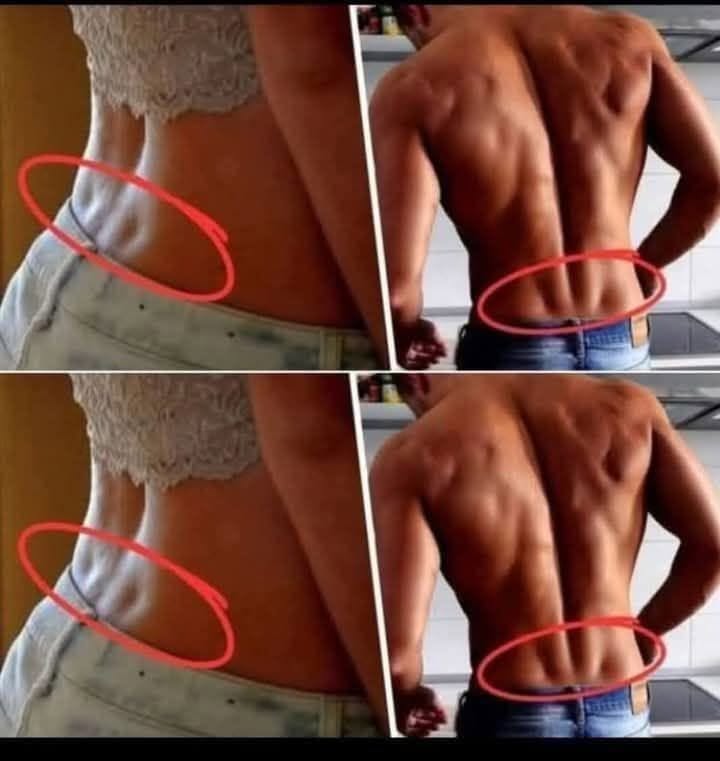
If You Have These Two “Dimples” on Your Lower Back, you are probably looking at a completely normal anatomical feature commonly called dimples of Venus. These small, usually symmetrical indentations sit on either side of the lower back near the upper part of the pelvis.
They can be subtle or sharply defined. Some people notice them only when they lose weight, build muscle, change posture, or happen to see their back from a different angle. Others have had obvious lower-back dimples for as long as they can remember.
Anatomically, these depressions correspond closely with the posterior superior iliac spines, or PSIS, which are bony landmarks at the back of the pelvis. Medical literature describes dimples of Venus, also called fossae lumbales laterales, as symmetrical lower-back indentations associated with these landmarks.
Despite countless internet claims, they do not prove that someone has exceptional circulation, fertility, sexual health, athletic ability, or a perfectly toned body. For most people, they simply reflect normal differences in pelvic anatomy and the tissues covering it.
I remember noticing these two small depressions in the mirror years ago and wondering why they looked so perfectly matched. I had never paid attention to them before, so naturally I started wondering whether exercise had created them or whether they meant something about my weight. Eventually, I learned that they correspond to ordinary landmarks at the back of the pelvis and that many people naturally have them. What surprised me most was how much folklore surrounded such a simple feature. Since then, I have viewed them differently: not as a health score or beauty requirement, but as one of the many harmless variations that make bodies look different.
What Those Two Lower-Back Dimples Actually Are
They Sit Over Important Pelvic Landmarks
If You Have These Two “Dimples” on Your Lower Back, look at where they sit.
Typically, one appears on each side of the lower spine, slightly above the crease between the buttocks. Beneath those depressions lie bony landmarks known as the posterior superior iliac spines.
The PSIS forms part of the ilium, one of the major bones of the pelvis. An anatomy reference from the National Library of Medicine notes that the PSIS marks the posterior edge of the iliac crest and can appear externally as the lower-back depressions commonly called dimples of Venus.
Researchers also use these dimples as visible surface landmarks when studying pelvic and spinal anatomy. A 2022 anatomical study describes dimples of Venus as symmetrical depressions above the gluteal cleft associated with the PSIS.
So, despite their romantic name, the basic explanation involves ordinary anatomy.
Your pelvis has bony projections.
Your skin and connective tissues lie over them.
The way those tissues attach and contour can create visible depressions.
Consequently, some people have two clearly defined dimples, while other people have barely noticeable ones.
Neither appearance is inherently healthier.
Likewise, you do not need lower-back dimples for your pelvis, spine, or muscles to function normally.
If You Have These Two “Dimples” on Your Lower Back, they therefore tell you much more about the shape of your anatomy than about your overall health.
Connective Tissue Helps Create the Indentation
Why does the skin dip inward instead of simply lying flat over the pelvis?
Research discussing the fossae lumbales laterales describes a short ligament extending between the PSIS region and the skin as part of the anatomical explanation for the indentation.
That connective-tissue relationship helps anchor the skin more closely to the underlying structures.
As a result, the surrounding tissue may sit slightly higher while the attached area pulls inward.
The effect resembles other natural body contours created by relationships between bone, muscle, fat, fascia, ligaments, and skin.
This explains another common question: why can one person’s dimples look much deeper than another person’s?
Body composition can affect visibility.
So can the distribution of subcutaneous fat.
Muscle development and posture can change how light and shadows fall across the lower back.
Individual pelvic anatomy also varies.
Therefore, If You Have These Two “Dimples” on Your Lower Back, their appearance may become stronger or weaker over time even though the underlying landmarks remain.
That does not mean the dimples themselves suddenly appeared because you became healthier.
They may simply have become easier to see.
Likewise, gaining weight may make them less visible without changing the structure beneath them.
This distinction becomes important because social media often turns ordinary anatomy into a body goal.
In reality, no one needs visible Venus dimples to have an attractive, strong, or healthy lower back.
Are Venus Dimples Genetic, and Can Exercise Create Them?
Genetics and Anatomy Probably Influence Their Appearance
If You Have These Two “Dimples” on Your Lower Back, you may wonder whether other family members have them.
Medical literature commonly describes dimples of Venus as a hereditary or anatomical characteristic. One peer-reviewed study describes the feature as considered hereditary and links the surface indentations to the PSIS and associated soft tissues.
However, that does not mean a simple single gene determines whether you will have obvious dimples.
Many visible body characteristics develop through combinations of skeletal anatomy, connective tissue, fat distribution, muscle, and inherited traits.
Therefore, family resemblance makes sense without requiring a simple “dimple gene.”
You might inherit a pelvic structure that makes the landmarks prominent.
You might also inherit body-fat distribution or connective-tissue characteristics that make the indentations easier to see.
Meanwhile, siblings can look completely different.
If You Have These Two “Dimples” on Your Lower Back while a brother or sister does not, nothing unusual has happened.
Normal anatomical variation explains enormous differences between relatives.
The same principle applies across sexes.
Although the traditional name refers to Venus, people of any sex can have these depressions.
You may sometimes hear the term “Apollo dimples” used informally for similar lower-back indentations in men.
However, anatomy remains anatomy regardless of the mythological nickname.
The two depressions still correspond to the same general pelvic region.
Therefore, their presence does not tell you anything reliable about masculinity, femininity, reproductive ability, or attractiveness.
Exercise Can Reveal Them, but It Cannot Guarantee Them
A popular fitness claim says that enough lower-back or glute exercises will create Venus dimples.
That oversimplifies the anatomy.
Exercise can strengthen the muscles around your hips, glutes, abdomen, and lower back. It can also change body composition over time.
Consequently, existing dimples may become more noticeable if surrounding definition increases or the amount of tissue covering the area changes.
However, exercise cannot reposition your PSIS landmarks or manufacture a specific connective-tissue attachment that your body does not naturally have.
So, If You Have These Two “Dimples” on Your Lower Back, training may change how visible they look.
If you do not have visible dimples, performing hundreds of squats, bridges, or back extensions does not guarantee that two indentations will appear.
Fortunately, their absence says nothing negative about fitness.
Someone can have powerful glutes, excellent mobility, strong abdominal muscles, and healthy body composition without visible Venus dimples.
Meanwhile, another person who rarely exercises may have deep lower-back dimples simply because of anatomy.
That is why treating them as a fitness achievement becomes misleading.
Exercise for strength, mobility, cardiovascular health, balance, function, and enjoyment.
Do not chase one tiny anatomical feature as proof that your body has reached an ideal condition.
If the dimples become more visible as your body changes, consider that an aesthetic variation rather than a medical achievement.
What Venus Dimples Do Not Tell You About Your Health
They Are Not Proof of Better Circulation or Fertility
If You Have These Two “Dimples” on Your Lower Back, you may have encountered some surprisingly bold claims online.
One popular story says Venus dimples indicate excellent circulation.
Another says people who have them experience better sexual function.
Others connect them with fertility, hormonal health, or physical endurance.
These claims lack a solid anatomical basis.
The dimples primarily mark relationships among the skin, soft tissue, and bony landmarks at the back of the pelvis. Research has examined their relationship with spinopelvic measurements, but that is very different from proving that people with dimples have superior circulation, fertility, or sexual function. A 2023 study found associations between the presence of Venus dimples and certain pelvic and facet-joint angles, demonstrating that the feature can relate to anatomical geometry rather than supernatural health advantages.
Therefore, If You Have These Two “Dimples” on Your Lower Back, enjoy them if you like how they look.
Just do not treat them as a diagnostic test.
They cannot tell you whether your blood pressure is healthy.
They cannot measure cardiovascular fitness.
They cannot confirm reproductive health.
They cannot diagnose hormonal balance.
Likewise, not having them does not indicate poor circulation or another deficiency.
Bodies contain countless visual characteristics that have little direct relationship with health.
Ear shape provides one example.
So do attached or detached earlobes.
Likewise, differences in knuckle appearance or natural waist contour do not automatically reveal internal health.
Venus dimples belong largely in that category: visible anatomy rather than a wellness score.
They Are Not the Same Thing as Every Dimple Near the Tailbone
This distinction matters.
If You Have These Two “Dimples” on Your Lower Back symmetrically on either side of the spine, you are describing something quite different from a single midline pit directly above the crease between the buttocks.
A sacral dimple usually refers to a congenital indentation near the sacrum, most often discussed in babies. Cleveland Clinic notes that most sacral dimples in infants are harmless, although some unusual features can prompt further evaluation for an underlying spinal condition.
Clinical guidance similarly distinguishes ordinary low sacral dimples from atypical ones that may need investigation.
Another condition, pilonidal sinus disease, can create a pit or opening near the top of the crease between the buttocks. MedlinePlus describes a pilonidal dimple as a pit or sinus in the sacral area that can develop an infected cyst-like structure.
That does not describe typical bilateral Venus dimples.
The location and appearance differ.
Two shallow, symmetrical lower-back depressions that have always been present usually fit the classic Venus-dimple pattern.
A single opening in the midline that becomes painful, swollen, red, or begins draining needs a different interpretation.
Therefore, the word “dimple” alone does not tell you what structure you are seeing.
Location, symmetry, symptoms, and whether it represents an actual opening in the skin all matter.
When a Lower-Back Dimple Deserves Medical Attention
Normal Venus Dimples Usually Need Nothing Done
If You Have These Two “Dimples” on Your Lower Back and they are symmetrical, painless, and simply part of your normal appearance, you generally do not need to do anything about them.
You do not need special stretching.
You do not need massage.
You do not need supplements.
You do not need to strengthen them.
And you certainly do not need to “fix” them.
They are anatomical depressions rather than injuries.
Because they lie near the sacroiliac region, people sometimes assume pain near a Venus dimple means the dimple caused it.
However, the visible indentation itself does not automatically explain lower-back pain.
The PSIS serves as a useful surface landmark for clinicians assessing the sacroiliac region, and tenderness near that area can occur with musculoskeletal problems. An NCBI anatomy reference notes that tenderness in the region can occur with conditions involving the sacroiliac joint.
Therefore, If You Have These Two “Dimples” on Your Lower Back and also develop pain, focus on the pain as a separate symptom rather than assuming the dimples became unhealthy.
Many problems can cause lower-back discomfort.
Muscle strain, prolonged sitting, activity changes, joint problems, and numerous other conditions may contribute.
If persistent pain limits movement, interferes with sleep, follows significant trauma, or accompanies neurological symptoms, appropriate medical assessment makes sense.
The dimples themselves usually require no treatment.
Pain, Swelling, Drainage, or a New Skin Opening Changes the Picture
A classic Venus dimple should not behave like an inflamed skin lesion.
Therefore, seek medical advice if an indentation or pit near the tailbone becomes red, hot, swollen, increasingly painful, or begins draining pus or blood.
Those symptoms may fit a different condition, such as an infected pilonidal sinus.
MedlinePlus describes pilonidal sinus disease as an inflammatory condition involving hair follicles along the crease between the buttocks. An infected area can form a painful cyst or abscess.
That condition has nothing to do with whether someone possesses attractive or prominent Venus dimples.
Likewise, a lower-back indentation present in a newborn deserves pediatric interpretation rather than comparison with an adult Venus dimple. Most infant sacral dimples are harmless, but clinicians consider features such as location and associated skin findings when deciding whether evaluation is needed.
For adults, the most useful distinction remains straightforward.
If You Have These Two “Dimples” on Your Lower Back and they have always looked like two shallow, matching depressions, they most likely represent ordinary anatomy.
If instead you notice a new lump, painful opening, swelling, drainage, redness, or another significant skin change near the tailbone, do not dismiss it as a Venus dimple.
Have the actual symptom evaluated.
Frequently Asked Questions
If You Have These Two “Dimples” on Your Lower Back, what are they called?
They are commonly called dimples of Venus or Venus dimples. The anatomical term fossae lumbales laterales also appears in medical literature. They typically form as symmetrical depressions over the posterior superior iliac spine region of the pelvis.
Does having Venus dimples mean you are healthy or fit?
No. Their presence largely reflects anatomy and soft-tissue contours. Although lower body fat or greater muscle definition can make existing dimples easier to see, the dimples themselves do not prove superior fitness, circulation, fertility, or overall health.
Can exercise give you Venus dimples?
Exercise can change muscle definition and body composition, which may make naturally occurring dimples more noticeable. However, it cannot guarantee them because the underlying pelvic anatomy and connective-tissue relationships differ among individuals.
Do men have lower-back Venus dimples too?
Yes. People of any sex can have symmetrical dimples over the PSIS region. Some popular sources call similar indentations in men “Apollo dimples,” but they correspond to the same general anatomical landmarks.
When should a lower-back dimple concern me?
Two ordinary, symmetrical, painless Venus dimples generally do not require treatment. However, a painful midline pit or opening with redness, swelling, warmth, bleeding, or drainage may represent something different, such as pilonidal sinus disease, and deserves medical evaluation.
Conclusion
If You Have These Two “Dimples” on Your Lower Back, the explanation is usually far simpler than the myths surrounding them.
They are commonly called Venus dimples.
They sit over the posterior superior iliac spine region, where the back of the pelvis creates identifiable surface landmarks. Medical research describes the dimples as symmetrical lower-back indentations associated with the PSIS and nearby connective tissue.
Some people have obvious ones.
Others have faint ones.
Many people do not visibly have them at all.
Every one of those variations can be normal.
Their visibility may change with body composition, posture, age, or muscle definition. However, exercise cannot guarantee them, and their presence does not prove that someone has better circulation, greater fertility, superior athletic ability, or any other special health advantage.
Most importantly, distinguish Venus dimples from other types of depressions or openings near the tailbone.
Two shallow, symmetrical indentations are different from a single midline sacral pit or an inflamed pilonidal sinus. A painful area with swelling, redness, warmth, or drainage warrants medical attention rather than an assumption that it is simply another body dimple.
So, If You Have These Two “Dimples” on Your Lower Back, you probably do not need to change anything.
They are not a hidden medical test.
They are not something you earned through perfect exercise.
And they are not something anyone needs in order to have an attractive or healthy body.
They are simply one of the many small anatomical variations that make human bodies interesting.