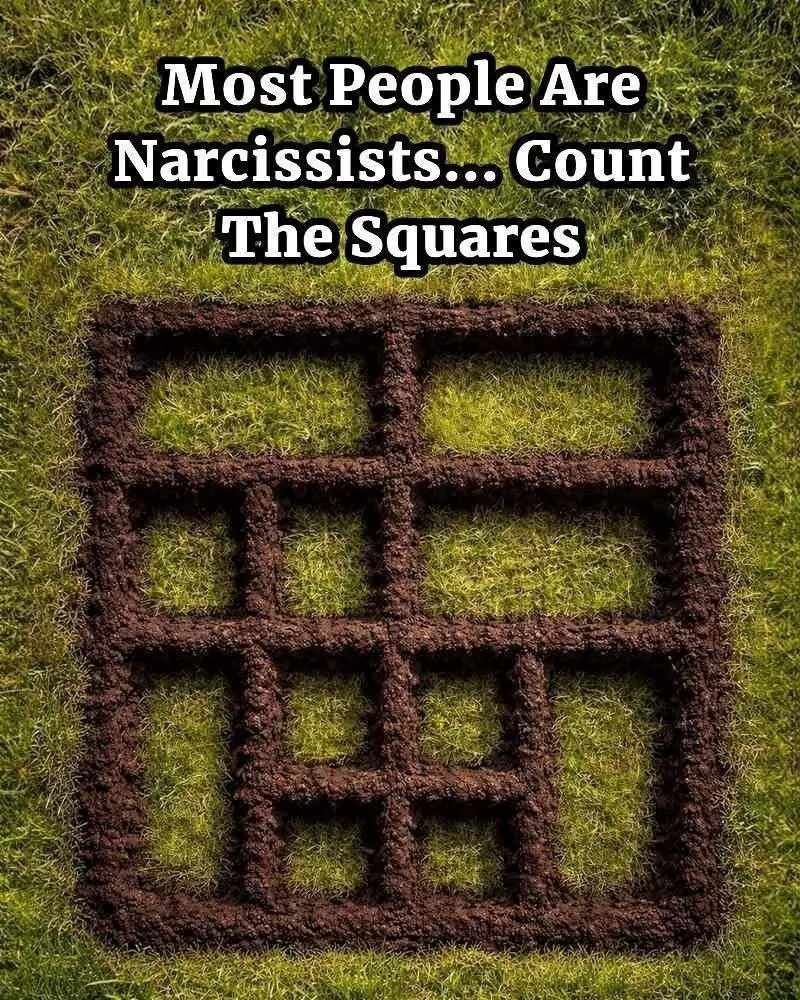
At first glance, the image looks simple. A collection of lines forms a pattern of boxes, and the challenge appears straightforward: count the squares. Yet within seconds, most people discover the puzzle is far more complicated than expected.
Some viewers quickly settle on an answer. Others stare at the image for several minutes, tracing lines with their eyes, searching for hidden shapes they may have missed. A few become frustrated and give up entirely.
What makes this visual puzzle so fascinating is that it tests more than observation skills. It quietly reveals how people approach uncertainty, problem-solving, patience, and even self-confidence.
While social media often exaggerates claims by saying puzzles like this “prove narcissism” or uncover hidden personality traits, the real value lies in something much more interesting: the way our minds process information.
Why Visual Puzzles Fascinate The Human Brain
Humans naturally enjoy finding patterns.
From childhood, the brain constantly searches for structure, meaning, and order in the world. That instinct helps us:
- recognize faces
- learn language
- navigate environments
- solve problems
- make predictions
A puzzle built around hidden squares taps directly into this pattern-recognition system.
The Brain Loves Fast Answers
The moment most people see the image, the brain immediately tries to simplify it.
Instead of carefully examining every possible square, the mind often jumps toward the most obvious shapes first.
This happens because the brain prefers efficiency.
Fast conclusions conserve mental energy.
However, quick thinking sometimes sacrifices accuracy.
Why People Miss Hidden Squares
Visual puzzles rely on a psychological tendency called perceptual grouping.
The brain naturally organizes visual information into recognizable chunks instead of analyzing every detail individually.
As a result:
- large shapes may be overlooked
- overlapping squares become invisible
- embedded patterns get ignored
- assumptions replace careful observation
The puzzle becomes less about eyesight and more about attention.
The Trap Of Immediate Confidence
One of the most interesting parts of these puzzles is how quickly people become certain of their answers.
Someone may glance at the image for three seconds and confidently announce a number.
Another person may carefully recount several times and still feel uncertain.
This difference reveals important thinking habits.
Why Fast Certainty Feels Rewarding
Confidence often feels emotionally satisfying.
People naturally associate decisiveness with intelligence.
In many situations, responding quickly creates the impression of competence.
However, visual puzzles expose an important truth:
Speed and accuracy are not always the same thing.
Overconfidence In Everyday Life
The same mental shortcut used during puzzles often appears in real-world decisions.
People sometimes:
- rely heavily on first impressions
- stop searching once they find an answer
- resist reconsidering their beliefs
- ignore missing information
Psychologists sometimes call this cognitive closure.
The brain prefers certainty, even when uncertainty would lead to better understanding.
The Value Of Slowing Down
People who perform best on puzzles usually approach them differently.
Instead of rushing, they pause.
They:
- question their first answer
- double-check assumptions
- explore alternative possibilities
- remain comfortable with uncertainty
This mindset reflects curiosity rather than ego.
Why Curiosity Improves Problem Solving
Curious thinkers are more willing to admit they may have missed something.
That openness allows them to:
- notice hidden details
- adapt more easily
- revise mistakes
- learn faster
In life, this same flexibility often improves communication, relationships, learning, and decision-making.
Curiosity creates room for growth.
The Psychology Behind Puzzle Solving
Visual puzzles reveal several fascinating mental processes happening in real time.
Selective Attention
The brain filters information constantly.
Selective attention helps people focus on important details while ignoring distractions.
Unfortunately, puzzles intentionally exploit this system.
The mind focuses on obvious shapes while filtering out hidden configurations.
Cognitive Biases
Several common biases appear during puzzles.
Confirmation Bias
Once people believe they found the correct answer, they often stop looking for contradictory evidence.
Anchoring Bias
The first number someone considers heavily influences later guesses.
Mental Shortcuts
The brain uses shortcuts called heuristics to simplify difficult tasks.
These shortcuts save time but increase mistakes.
Why These Puzzles Go Viral Online
Square-counting puzzles spread rapidly across social media because they trigger several emotional responses at once.
People feel:
- challenged
- competitive
- curious
- surprised
- eager to prove themselves
The Social Appeal Of “Hidden Intelligence” Tests
Many viral posts claim:
- “Only geniuses can solve this.”
- “Most people fail this challenge.”
- “Your answer reveals your personality.”
These statements attract attention because humans naturally enjoy measuring themselves against others.
Even when the claims are exaggerated, the emotional hook works extremely well.
Does The Puzzle Actually Reveal Personality?
Not in a scientific way.
A square puzzle cannot diagnose narcissism, intelligence, or emotional traits.
However, it may reflect certain thinking tendencies.
Possible Thinking Styles Revealed
People who rush may value decisiveness.
People who carefully analyze may value accuracy.
People who enjoy the challenge may naturally lean toward curiosity and persistence.
But none of these traits alone define a person’s personality.
Human behavior is far more complex than a single internet puzzle.
A Step-By-Step Way To Count Squares Correctly
Most people miss squares because they look randomly instead of systematically.
A structured method improves accuracy dramatically.
Step 1: Count Small Squares First
Begin with the smallest visible squares.
These are easiest to identify and create a foundation for the larger shapes.
Step 2: Search For Medium Squares
Next, combine neighboring smaller squares into larger units.
Many hidden squares emerge at this stage.
Step 3: Identify Large Outer Squares
Some puzzles include massive squares formed by nearly the entire structure.
These are frequently overlooked because the brain focuses on smaller details.
Step 4: Look For Overlapping Shapes
The most difficult part involves identifying overlapping or partially hidden squares.
This stage requires patience and visual flexibility.
What The Puzzle Teaches Beyond Counting
Although the puzzle seems trivial, it mirrors important life skills.
Patience Matters
Many mistakes happen because people dislike slowing down.
Careful observation often produces better outcomes than impulsive reactions.
Flexibility Improves Understanding
People who remain open to changing their answer usually discover more information.
Being willing to reconsider assumptions is a strength, not a weakness.
Attention To Detail Changes Outcomes
Small details frequently determine success.
In work, relationships, finances, and learning, overlooked details can create major consequences.
Why The Human Mind Loves Hidden Patterns
Humans evolved to detect patterns quickly.
This ability once helped our ancestors survive by recognizing:
- danger
- weather changes
- food sources
- facial expressions
Today, the same instinct drives fascination with puzzles, riddles, and optical illusions.
The brain experiences satisfaction when hidden patterns suddenly become clear.
Psychologists sometimes call this the “aha moment.”
That feeling releases dopamine, the brain’s reward chemical.
The Difference Between Intelligence And Thoughtfulness
Internet puzzles often imply that fast answers equal intelligence.
Real problem-solving is usually more nuanced.
Highly effective thinkers often:
- pause before deciding
- tolerate uncertainty
- gather more evidence
- reconsider assumptions
- remain mentally flexible
Thoughtfulness sometimes matters more than speed.
Why Some People Become Frustrated
Visual puzzles can trigger frustration because they challenge confidence.
People expect the answer to appear quickly.
When it doesn’t, the brain experiences discomfort.
The Emotional Side Of Being Wrong
Humans naturally dislike uncertainty and mistakes.
Some people become defensive when their answer changes.
Others enjoy the process of discovery.
This difference often shapes how people approach challenges in daily life as well.
Using Puzzles To Strengthen Your Brain
While puzzles cannot magically increase IQ, they may strengthen several cognitive skills.
Potential Mental Benefits
Regular puzzle-solving may help improve:
- concentration
- pattern recognition
- visual processing
- memory
- patience
- problem-solving skills
They also encourage mental engagement, which supports long-term cognitive health.
A Reminder About Viral Psychology Claims
Many social media posts attach dramatic psychological labels to simple behaviors.
Claims like:
- “Most people are narcissists”
- “Only geniuses solve this”
- “Your answer reveals your true personality”
are usually exaggerated for attention.
Real psychology is far more careful and evidence-based.
A puzzle may reflect thinking habits, but it cannot define someone’s character.
Final Thoughts
“How many squares can you spot?” may look like a simple internet distraction, but it reveals something genuinely interesting about human thinking.
Some people rush toward certainty. Some pause and analyze. Some enjoy the challenge. Others become frustrated by ambiguity.
The puzzle itself matters less than the mindset brought to it.
In many ways, life works the same way.
Important decisions often require:
- patience
- attention to detail
- flexibility
- humility
- curiosity
The people who see the most are not always the fastest.
They are usually the ones willing to slow down long enough to look again.
And sometimes, the hidden answers appear only after we stop assuming we already know what we’re seeing.