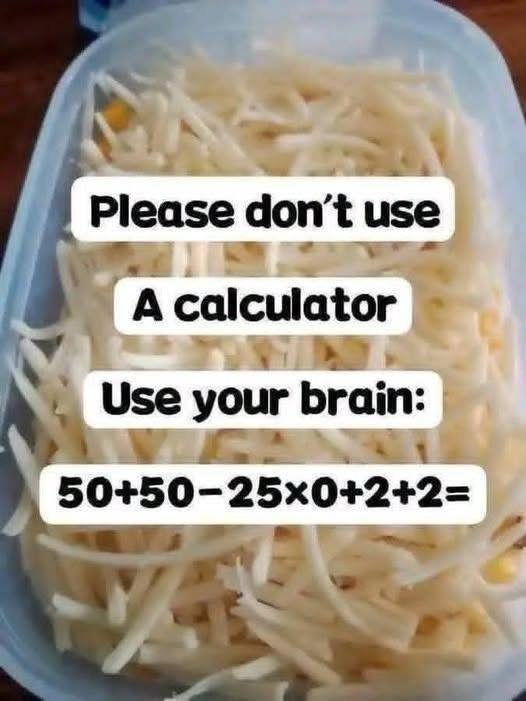
50 + 50 − 25 × 0 + 2 + 2 = ?
At first glance, this math problem seems almost too easy.
Most people look at it for only a second or two before confidently announcing an answer. Some say the solution is 104. Others insist it’s 4. A surprising number of people become involved in lengthy online debates defending their calculations.
So who’s right?
The answer may seem obvious once you know it, but this viral puzzle has fooled thousands of people because it exploits one of the most common mistakes in mathematics: ignoring the order of operations.
The equation looks simple enough to solve mentally, yet that’s exactly what causes many people to make a critical error.
Before reading further, take another look:
50 + 50 − 25 × 0 + 2 + 2 = ?
What answer did you get?
If you arrived at 104, congratulations.
If you got 4, don’t feel bad. You’re in very good company.
Let’s explore why so many people get this puzzle wrong and what it teaches us about how our brains process information.
Why This Puzzle Confuses So Many People
The problem isn’t difficult mathematics.
There are no fractions, exponents, square roots, or advanced algebraic concepts.
Instead, the challenge lies in how our brains naturally want to solve the equation.
Humans are pattern-seeking creatures. When we read words, we move from left to right. When we read sentences, we process information in sequence. Because of this habit, many people instinctively approach mathematical expressions the same way.
They begin at the left side and work straight across.
That approach seems logical.
Unfortunately, mathematics follows a different set of rules.
The Most Common Wrong Answer
Many people calculate the problem like this:
50 + 50 = 100
100 − 25 = 75
75 × 0 = 0
0 + 2 = 2
2 + 2 = 4
Final answer: 4
The calculation appears reasonable.
Every step seems correct.
Yet the answer is wrong.
The mistake occurs because multiplication was performed after subtraction rather than before it.
This seemingly tiny oversight completely changes the outcome.
Understanding the Order of Operations
Mathematics relies on universal conventions that ensure everyone arrives at the same answer when solving an expression.
Without these rules, equations could have multiple answers depending on the order in which people performed calculations.
To avoid confusion, mathematicians use the Order of Operations.
Most students learn this concept through the acronym PEMDAS:
P – Parentheses
E – Exponents
M – Multiplication
D – Division
A – Addition
S – Subtraction
In some countries, students learn BODMAS instead:
B – Brackets
O – Orders
D – Division
M – Multiplication
A – Addition
S – Subtraction
Both systems teach the same principle.
Certain operations must be completed before others.
Solving the Puzzle Correctly
Let’s follow the proper order.
The expression is:
50 + 50 − 25 × 0 + 2 + 2
Step 1: Perform Multiplication First
The multiplication portion is:
25 × 0
Any number multiplied by zero equals zero.
Therefore:
25 × 0 = 0
The equation now becomes:
50 + 50 − 0 + 2 + 2
Step 2: Solve Remaining Operations Left to Right
Now only addition and subtraction remain.
Since addition and subtraction share equal priority, work from left to right.
50 + 50 = 100
100 − 0 = 100
100 + 2 = 102
102 + 2 = 104
Final Answer
104
🎯 Correct Answer: 104
Why Multiplying by Zero Tricks People
Part of the puzzle’s effectiveness comes from the presence of zero.
Most people know that multiplying any number by zero results in zero.
However, many subconsciously treat the equation as though the multiplication occurs after the subtraction.
Their brain sees:
75 × 0
and immediately reduces everything to zero.
The trap works because the multiplication operation visually appears later in the expression, encouraging people to process it at the wrong moment.
Why These Puzzles Go Viral
Mathematical puzzles spread rapidly online because they create instant disagreement.
Unlike many topics, math feels objective.
People become extremely confident in their answers.
When someone else produces a different result, debate begins immediately.
Social media algorithms love engagement.
A simple equation that generates hundreds of comments is almost guaranteed to spread.
These puzzles exploit several psychological tendencies:
Confidence Bias
Many people trust their first instinct without checking their work.
Speed Over Accuracy
The easier a problem looks, the less carefully people analyze it.
Familiarity Illusion
Because the numbers are simple, people assume the solution must also be simple.
Emotional Investment
Once someone publicly commits to an answer, they often defend it vigorously.
The Calculator Debate
One reason these puzzles generate confusion is that different calculators sometimes appear to give different results.
This depends on the type of calculator being used.
Basic Calculators
Many simple calculators process entries sequentially.
If buttons are pressed one after another, the calculator may effectively calculate left to right.
This can sometimes produce unexpected results.
Scientific Calculators
Scientific calculators automatically follow the order of operations.
When entered correctly, they produce the mathematically accepted answer:
104
Smartphone Calculators
Most smartphone calculators switch to scientific mode when rotated horizontally and will correctly evaluate the expression.
Real-World Importance of Order of Operations
Some people dismiss puzzles like this as trivial.
However, the principles behind them have enormous practical importance.
Engineers use these rules when designing bridges.
Scientists use them when calculating experiments.
Programmers use them when writing software.
Financial analysts use them when modeling investments.
Without a standardized order of operations, complex calculations would become unreliable.
Imagine if different engineers interpreted formulas differently when building airplanes or skyscrapers.
Consistency is essential.
Other Famous Viral Math Puzzles
This isn’t the first equation to divide the internet.
Several famous examples have generated worldwide debate.
8 ÷ 2(2 + 2)
Some people answer 1.
Others answer 16.
The disagreement usually stems from misunderstandings about multiplication and division precedence.
6 ÷ 2(1 + 2)
Another classic puzzle that generates heated arguments despite having a standard solution.
1 + 2 × 3 + 4 × 5
Many people rush and answer incorrectly because they ignore multiplication priority.
These puzzles remind us that mathematical rules matter even when the numbers seem simple.
Why Adults Forget These Rules
Many adults haven’t used formal arithmetic rules in years.
Daily life often involves:
- Estimations
- Mental shortcuts
- Calculator use
- Approximate calculations
As a result, concepts learned in school can fade over time.
That doesn’t mean someone is bad at math.
It simply means the brain prioritizes information it uses regularly.
When confronted with a puzzle like this, people often rely on intuition rather than formal procedure.
That’s exactly what the puzzle is designed to exploit.
A Simple Trick to Avoid Mistakes
Whenever you encounter a mathematical expression:
- Look for parentheses first.
- Identify multiplication and division.
- Complete those operations before addition and subtraction.
- Then work left to right.
Slowing down by just a few seconds dramatically improves accuracy.
Frequently Asked Questions
Why isn’t the answer 4?
Because multiplication must be performed before subtraction according to the order of operations.
Does multiplication always come before addition?
Yes, unless parentheses indicate otherwise.
What if the equation had parentheses?
Parentheses change everything because they must be solved first.
Is PEMDAS universal?
Yes. Different countries may use slightly different acronyms, but the underlying rules remain the same.
Why do smart people get this wrong?
Because the mistake isn’t about intelligence. It’s about rushing and relying on instinct instead of procedure.
Final Thoughts
The beauty of this puzzle isn’t the arithmetic.
It’s the lesson hidden inside it.
Many mistakes in life happen not because something is difficult, but because it appears easy.
Our brains love shortcuts.
Most of the time, those shortcuts help us move efficiently through the world.
Occasionally, however, they lead us astray.
This simple equation reminds us of the value of slowing down, checking our assumptions, and trusting proven rules over first impressions.
So the next time you see a viral math puzzle online, resist the urge to answer immediately.
Pause.
Look carefully.
Follow the process.
Because in mathematics—and often in life—the right answer usually belongs to the person willing to slow down long enough to find it.
And in this case, that answer is:
104.