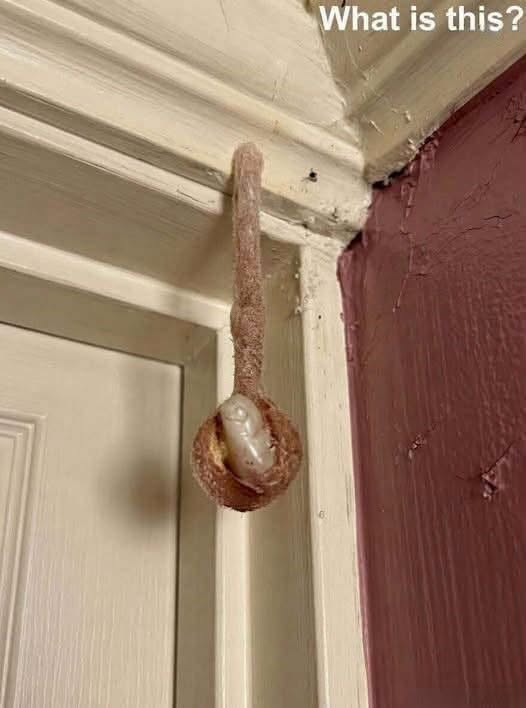
You check into a hotel, put down your luggage, and notice something unusual near the ceiling, window, curtain rail, or air-conditioning unit: a small structure made from dried mud.
It might resemble a cluster of narrow tubes, a lumpy patch of clay, or a tiny mud sculpture stuck firmly to the wall.
One possible explanation is a mud dauber nest.
Mud daubers are solitary wasps known for constructing nests from mud. Their unusual architecture can be fascinating—but finding a nest inside a hotel room still deserves attention.
Here’s how to recognize one and what to do next.
What Is a Mud Dauber?
“Mud dauber” is a general name used for several types of solitary wasps that build nests using mud.
Unlike many familiar social wasps, mud daubers generally don’t live together in large colonies with hundreds or thousands of workers.
Instead, a female typically works alone.
She collects small amounts of wet mud, carries them to a protected location, and gradually constructs individual chambers for her offspring.
That’s why their nests can look so different from the papery nests people usually associate with wasps.
What Does a Mud Dauber Nest Look Like?
The appearance depends on the species.
Some nests resemble long organ-pipe-like tubes arranged beside one another.
Others look like irregular rounded clumps of dried mud.
You may find them attached to:
- Walls
- Ceilings
- Window frames
- Roof overhangs
- Garages
- Sheds
- Porches
- Protected corners
Indoors, a quiet corner near a window or another opening may provide the sheltered location a wasp is looking for.
Why Would One Build a Nest in a Hotel Room?
A hotel room obviously isn’t the intended habitat.
But insects don’t recognize buildings as hotels, houses, or offices. They respond to environmental conditions.
A sheltered corner may provide protection from rain and wind. If a window, vent, balcony door, or another opening provides access, a mud dauber may occasionally enter and select the location for nesting.
An older nest might also remain attached to a surface long after the wasp that constructed it has disappeared.
Are Mud Daubers Dangerous?
Mud daubers are wasps and are capable of stinging, but they’re generally considered less aggressive around people than many social wasps.
They aren’t normally defending a large communal colony in the same way some yellowjackets and other social wasps do.
However, “less aggressive” does not mean you should handle one.
Any wasp may potentially sting if trapped, squeezed, stepped on, or otherwise threatened.
People with known serious allergies to insect stings should be particularly cautious.
What’s Inside the Mud Chambers?
This is one of the most interesting parts of mud-dauber biology.
The female builds individual chambers and provisions them with prey—often spiders, depending on the species—to provide food for her developing young.
She lays an egg in the chamber and seals it.
The immature wasp develops inside before eventually emerging.
Small round openings in an old nest can sometimes indicate that adult insects have already emerged.
Should You Touch the Nest?
If you’re staying in a hotel, don’t try to remove it yourself.
You don’t know whether the nest is active, what species created it, or whether another insect is using an abandoned nest.
There’s also no reason to climb onto hotel furniture or improvise a way to reach something near the ceiling.
Instead, take a photograph from a safe distance and contact hotel staff.
What to Do If You Find One in Your Hotel Room
The safest approach is straightforward.
1. Keep your distance.
Don’t poke, break, spray, or handle the structure.
2. Look for insect activity from a safe location.
You don’t need to approach the nest to investigate it.
3. Take a photograph.
A clear picture can help hotel staff or a pest-management professional identify the structure.
4. Contact the front desk.
Tell them you’ve discovered what appears to be an insect nest inside the room.
5. Ask them to inspect it.
Hotel maintenance or pest-management staff can determine whether it’s active and remove it appropriately if necessary.
If insects are actively flying around the room or you don’t feel comfortable remaining there, requesting another room is reasonable.
Don’t Stand on Furniture to Get a Better Look
It might be tempting to grab a chair and inspect the nest closely.
That’s unnecessary and potentially dangerous.
A fall from unstable hotel furniture is likely a greater immediate hazard than observing a small nest from across the room.
Use your phone’s camera zoom instead.
What If the Nest Looks Empty?
Even an apparently abandoned nest is best left to hotel staff.
Small holes may suggest that insects have emerged, but visual appearance alone doesn’t always tell you whether every chamber is empty.
Old mud nests may also sometimes be reused or occupied by other insects.
Hotel staff can remove the structure and inspect the surrounding area for possible entry points.
Mud Daubers Can Actually Be Beneficial Outdoors
Although finding a nest in your bedroom isn’t ideal, mud daubers have an ecological role.
Many prey on spiders and other arthropods, helping regulate their populations naturally.
Outdoors, when a nest isn’t creating a safety or structural problem, it may not always need to be removed.
Inside a hotel room, however, the situation is different. Guests shouldn’t have to share their sleeping space with an active wasp nest.
Mud Dauber or Something Else?
Not every mud structure on a building was created by a mud dauber.
Other insects can construct nests or shelters from mud, and identification from appearance alone isn’t always reliable.
That’s another reason photographs are useful.
If identification matters, a local pest professional or entomologist can provide a more reliable answer than simply guessing from the shape.
How Hotels Can Prevent Them
Prevention usually involves limiting access to suitable indoor nesting locations.
That can include:
- Repairing damaged window screens
- Sealing appropriate cracks and gaps
- Checking openings around doors and windows
- Inspecting balconies and sheltered exterior areas
- Removing abandoned nests when appropriate
- Investigating repeated insect activity
Regular inspection is particularly useful in warm climates where insects may remain active for much of the year.
The Bottom Line
A strange mud structure on a hotel wall may look alarming, but it could simply be the work of a solitary mud-building wasp.
Mud daubers are remarkable builders and are generally less defensive around humans than many social wasps. Still, a hotel-room nest isn’t something guests should investigate or remove themselves.
Keep your distance, take a photo, notify hotel staff, and allow them to inspect it safely.
It’s an interesting glimpse into insect architecture—but one that’s better appreciated without getting too close.