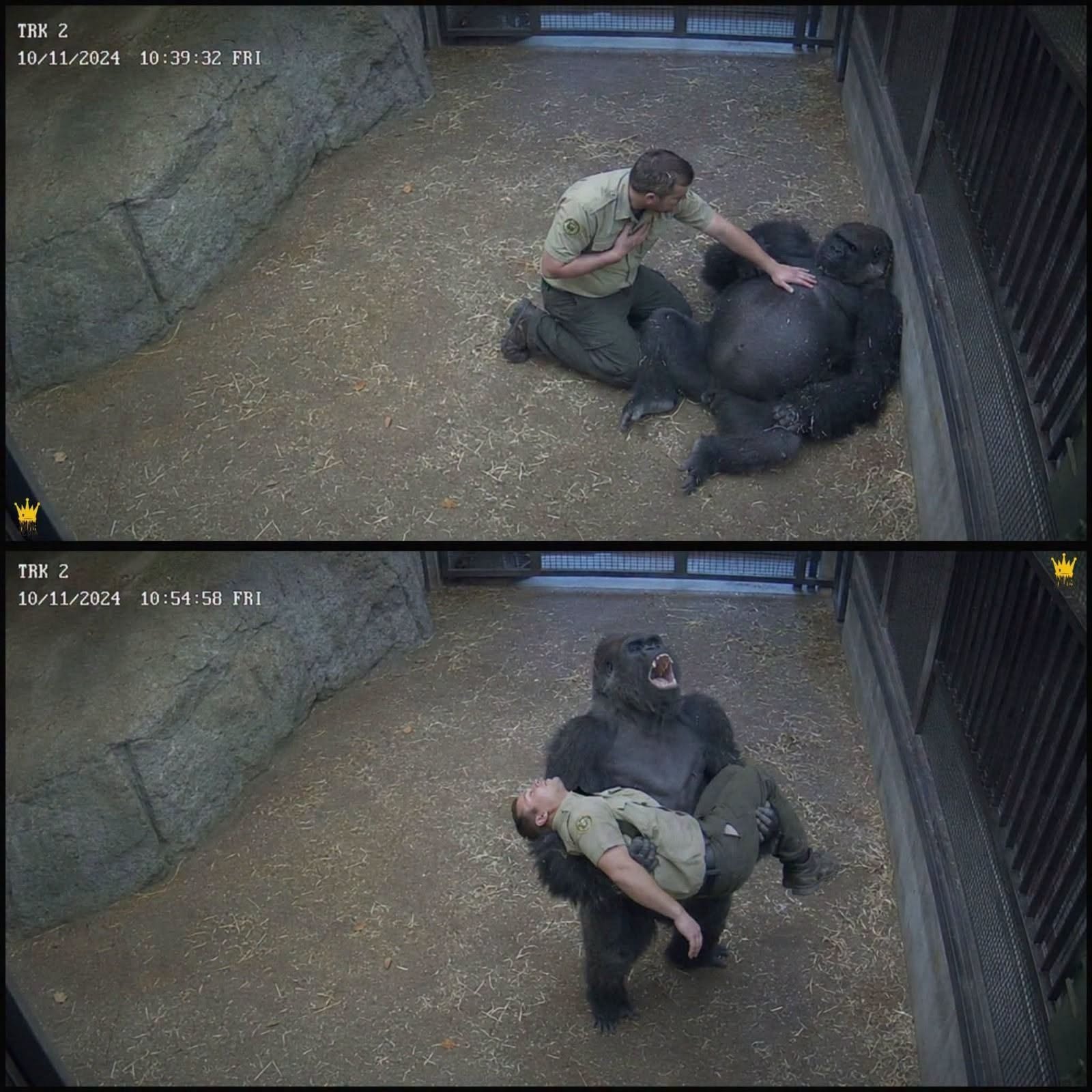
A dramatic story spreading across social media describes a gorilla coming to the aid of a longtime caretaker who collapsed inside an enclosure. According to the account, the animal nudged the unconscious man, carried him toward an entrance, and cried loudly until sanctuary employees arrived.
The story contains nearly everything that makes a post go viral: a medical emergency, an intelligent animal, a trusted human relationship, and a last-second rescue. It also carries an emotionally satisfying message about loyalty and compassion across species.
However, the available version leaves out the basic details needed to confirm that the event occurred. It does not identify the sanctuary, the country, the gorilla, the caretaker’s full name, the responding emergency service, or any official source. Searches mainly locate social-media posts repeating the same narrative rather than independent reporting or a statement from an animal-care institution.
That does not prove every element is false. It does mean readers should not present the story as verified news.
The account can still open worthwhile conversations about great-ape intelligence, the relationships animals form with caregivers, safe sanctuary practices, and the danger of dismissing possible heart-attack symptoms.
The Viral Account and What It Claims
A caretaker reportedly ignored warning signs
The story identifies the caretaker only as Julius. It says that he experienced chest discomfort and numbness in one arm earlier in the day but blamed the sensations on spicy food.
He allegedly continued working and entered the gorilla’s enclosure for a familiar interaction. According to the account, he knelt beside the animal and began rubbing its abdomen, a routine the pair had supposedly shared many times.
Moments later, he collapsed.
The gorilla then approached, nudged him, and appeared to check for a response. When Julius remained motionless, the animal reportedly moved him toward the enclosure entrance before producing loud vocalizations that attracted staff members.
Employees allegedly entered, removed Julius safely, and called emergency services. Doctors then reportedly determined that he had suffered a serious heart attack.
These details appear repeatedly in social-media versions of the story. Yet the posts do not point to an original sanctuary announcement, named witness, hospital statement, security video, or established news report.
The missing information matters
A credible report about such an extraordinary rescue would normally include several verifiable details:
- The sanctuary’s name and location
- The species and identity of the gorilla
- The caretaker’s full name or an official reason for withholding it
- A statement from the institution
- The date and approximate time of the incident
- The responding emergency service
- Confirmation from doctors or family
- Original security footage or credited photographs
The circulating account provides none of these.
Instead, it uses phrases such as “a local sanctuary,” “according to the account,” and “doctors later confirmed.” Those statements sound authoritative but cannot be checked without named sources.
When a story makes a remarkable claim but omits every detail that would allow verification, readers should approach it cautiously.
Why the Story Feels Believable
Great apes display complex social behavior
Gorillas are highly social primates capable of forming long-term relationships, recognizing familiar individuals, responding to social cues, and learning through repeated interactions.
Research on animal care and human–animal relationships indicates that nonhuman primates can respond differently to familiar caregivers and may show reduced stress during calm, positive interactions.
Broader animal-behavior research also supports the idea that mammals can show forms of emotional sensitivity and caregiving behavior. Scientists continue to debate how closely these behaviors correspond to human concepts such as empathy, intention, and moral concern.
Therefore, it is not inherently impossible that a gorilla might react strongly when a familiar person suddenly becomes unresponsive.
What remains unsupported is the exact sequence described in the viral post: deliberately lifting the caretaker, carrying him to an access point, and summoning human assistance with an apparent understanding of the emergency.
Humans naturally interpret animal behavior through relationships
When an animal stays near an injured person, vocalizes, nudges a body, or seeks attention, observers often interpret the behavior through familiar human ideas such as loyalty, grief, protection, or rescue.
Those interpretations may sometimes capture part of what the animal experiences. However, they can also overstate intention.
A gorilla might react because:
- A familiar routine suddenly stopped
- The caretaker’s posture looked unusual
- The animal became distressed
- It sought attention from nearby staff
- It responded to unfamiliar sounds or smells
- It had learned that vocalizing brings human attention
None of those explanations would make the behavior meaningless. They simply show why scientists avoid assigning a precise human motive without careful observation.
The difference between “the gorilla reacted to distress” and “the gorilla understood a heart attack and organized a rescue” is significant.
Could a Gorilla Physically Carry a Human?
Gorillas possess enormous strength
Adult gorillas have powerful arms, shoulders, and upper bodies adapted for climbing, movement, foraging, and social behavior.
A gorilla could physically move or drag an unconscious adult under certain circumstances. However, viral claims about gorilla strength often rely on exaggerated comparisons that lack reliable measurement.
More importantly, physical ability does not prove that a reported rescue occurred.
The question is not merely whether a gorilla could move a caretaker. The question is whether this particular animal did so, in this particular location, for the reason described.
Without footage or institutional confirmation, that remains unknown.
Direct-contact practices require strict safeguards
Modern professional care for great apes generally emphasizes protected contact, barriers, trained staff, and carefully controlled procedures because even a calm animal can cause severe injury unintentionally.
The story portrays a caretaker kneeling inside an enclosure and rubbing a gorilla’s belly. That detail may raise questions about the sanctuary’s operating practices, depending on the institution, species, and physical setup.
Some sanctuaries care for animals under unusual historical arrangements, but direct contact with a full-grown gorilla would involve substantial risk.
A credible institutional report would likely explain how the interaction occurred safely and how staff entered after the collapse.
The source offers no such context.
The Medical Warning Inside the Story Is Real
Chest discomfort and arm symptoms demand attention
Although the animal-rescue element remains unverified, the account includes symptoms that should never be casually dismissed.
Heart-attack warning signs can include:
- Pressure, squeezing, fullness, or pain in the chest
- Discomfort in one or both arms
- Pain in the back, neck, jaw, or stomach
- Shortness of breath
- Cold sweat
- Nausea
- Lightheadedness
- Unusual weakness or fatigue
The American Heart Association advises treating these symptoms as an emergency, especially when chest discomfort lasts more than a few minutes or returns after temporarily easing.
Numbness alone can also have causes unrelated to the heart, including nerve compression or stroke. However, numbness combined with chest pain or other sudden symptoms requires urgent assessment.
People should not assume that chest discomfort comes from spicy food, indigestion, anxiety, or muscle strain without medical evaluation.
Calling emergency services quickly can limit damage
A heart attack occurs when blood flow to part of the heart muscle becomes blocked. The longer the blockage continues, the more tissue may suffer permanent damage.
The CDC advises calling emergency services immediately when someone develops possible heart-attack symptoms. Emergency personnel can begin assessment and treatment during transport, while the hospital can rapidly perform tests and restore blood flow when necessary.
Driving oneself to a hospital may create additional danger if the person loses consciousness or develops cardiac arrest on the way.
When symptoms suggest a heart attack:
- Call the local emergency number immediately.
- Keep the person seated or lying safely.
- Follow instructions from the dispatcher.
- Do not give food or drink unless instructed.
- Begin CPR and use an automated external defibrillator if the person becomes unresponsive and stops breathing normally, provided someone present has the ability to act.
Do not wait to see whether symptoms disappear.
New chest pain at rest is especially concerning
Unstable angina can cause sudden or worsening chest discomfort, often while a person rests. It can signal that the heart is not receiving enough blood and may precede a heart attack.
The American Heart Association classifies new, persistent, or worsening chest discomfort as an emergency that requires immediate help.
A person may feel tempted to complete a shift, finish a task, or avoid causing concern. That delay can become dangerous.
No workplace duty, animal-care routine, meeting, or journey should take priority over unexplained chest pain with arm, jaw, back, or breathing symptoms.
Why Viral Animal-Rescue Stories Spread So Quickly
They offer a satisfying emotional arc
The story follows a powerful structure:
- A human cares for an animal over many years.
- The human suddenly becomes vulnerable.
- The animal recognizes the crisis.
- The care is returned.
- A life is saved.
This creates a strong sense of emotional justice.
Readers want to believe that kindness returns to those who give it. The story suggests that trust crosses species boundaries and that animals remember how humans treat them.
That message can feel true even when the specific incident lacks evidence.
The details sound cinematic
Several details make the account especially memorable:
- The ignored chest pain
- The daily belly-rub ritual
- The sudden collapse
- The gorilla’s concerned nudging
- The careful lifting of the caretaker
- The urgent cries
- The security video shown afterward
Each detail strengthens the emotional picture.
However, the same level of narrative neatness can signal embellishment. Real emergencies often unfold chaotically and leave incomplete or conflicting accounts.
A polished story with no verifiable names may have been written for engagement rather than reporting.
Repetition can create false credibility
When readers see the same claim on Facebook, Instagram, YouTube, and multiple blogs, they may assume several sources confirmed it.
In reality, every version may trace back to the same unsourced caption.
Search results for this story mainly show posts repeating almost identical language. They do not provide independent interviews, official documentation, or original reporting.
Repetition proves that a story is popular. It does not prove that it is accurate.
How to Check a Viral Animal Story
Search for the original institution
Begin by identifying the zoo, sanctuary, rehabilitation center, or wildlife agency involved.
A legitimate organization may publish:
- A press release
- A social-media statement
- A staff update
- The animal’s name
- The caretaker’s condition
- Footage from the incident
- Clarification of safety procedures
When the post refuses to name the institution, verification becomes nearly impossible.
Look for local reporting
An emergency involving a gorilla and a human caretaker would likely attract local journalists.
Search for:
- The location
- The caretaker’s name
- The sanctuary’s name
- The date
- Emergency-service reports
- Interviews with staff or family
An absence of mainstream coverage does not always prove a story false, especially in remote locations. Yet total absence becomes more significant when the event allegedly involved security footage, doctors, staff members, visitors, and a major medical rescue.
Separate observation from interpretation
Even authentic footage may not prove every claim made about it.
A video might show a gorilla vocalizing beside a motionless person. It might not prove that the animal understood the medical problem, intentionally requested help, or carried the person for rescue.
Useful wording distinguishes the visible behavior from the interpretation:
Supported by footage:
“The gorilla remained near the caretaker and vocalized.”
Interpretation:
“The gorilla understood the heart attack and called for help.”
The second statement requires more evidence.
Check whether the images match the story
Viral posts frequently use unrelated photographs or generated illustrations.
A reverse-image search may reveal that the picture comes from:
- A different sanctuary
- An old documentary
- A stock-photo collection
- A fictional video
- Another animal rescue
- An artificial-image generator
A powerful image can make a weak story feel credible, so visual verification matters.
What Science Says About Human–Primate Bonds
Familiar caregivers can become socially important
Animals in managed care often learn individual voices, routines, gestures, and expectations.
Calm, consistent interactions may help reduce stress and support cooperation during feeding, medical checks, transport, or enrichment activities. Research into zoo-animal training emphasizes structured, trust-based methods rather than force.
A gorilla may respond differently to a familiar caretaker than to an unfamiliar person because the caretaker predicts safety, food, enrichment, or positive interaction.
That bond can be meaningful without being identical to a human friendship.
Care must not become unsafe anthropomorphism
Strong emotional bonds can tempt people to treat wild animals like domestic pets.
Gorillas remain powerful, complex wild animals even when they know and trust individual humans.
Respectful care requires:
- Secure barriers
- Professional training
- Veterinary oversight
- Enrichment
- Species-appropriate social structures
- Emergency procedures
- Minimal unnecessary direct contact
Calling a gorilla “gentle” does not remove the need for safety systems.
A moving rescue story should not encourage untrained people to approach, touch, feed, or enter spaces with great apes.
A More Responsible Way to Tell the Story
Keep the emotional message without presenting fiction as fact
The source story can inspire compassion without claiming certainty.
A responsible summary would say:
A viral social-media account claims that a gorilla attracted help after a familiar caretaker collapsed. However, the story does not identify the sanctuary or provide independent confirmation. While great apes can form complex social relationships and respond to distress, the specific rescue remains unverified.
That wording preserves what people find compelling while protecting readers from misinformation.
Use the account as a health reminder
The strongest practical lesson does not depend on whether the gorilla rescue happened.
Chest pain accompanied by arm discomfort, shortness of breath, sweating, nausea, or lightheadedness can indicate a heart attack. Immediate emergency care matters.
A responsible article can therefore use the viral story to encourage readers to recognize warning signs without pretending that an unverifiable narrative has become established news.
Frequently Asked Questions
Did a gorilla named in the story save its caretaker?
The available posts do not identify the gorilla, sanctuary, location, or original source. The event cannot currently be verified through credible independent reporting.
Is the caretaker Julius a real, identified person?
The story uses only the first name Julius. No confirmed biography, employer, interview, or medical statement accompanies the viral account.
Can gorillas recognize when a familiar human is distressed?
Gorillas can recognize familiar individuals and respond to unusual behavior or social cues. However, interpreting a response as a deliberate medical rescue requires stronger evidence than the source provides.
Could a gorilla move an unconscious adult?
A gorilla is physically capable of moving a human. That does not establish that the reported event occurred.
Are chest pain and arm numbness always signs of a heart attack?
No. They can have other causes. Nevertheless, chest discomfort with arm symptoms, breathlessness, sweating, nausea, or lightheadedness should be treated as a possible heart attack and evaluated immediately.
Should someone drive to the hospital during possible heart-attack symptoms?
Calling emergency services is generally safer because trained personnel can begin care and respond if the person deteriorates during transport.
Conclusion
The story of a gorilla rescuing a beloved caretaker is emotionally powerful. It reflects ideas that many people want to believe: animals remember kindness, trust creates loyalty, and care can return at the moment it is needed most.
Yet emotional appeal does not replace verification.
The circulating account does not name the sanctuary, location, gorilla, witnesses, hospital, or emergency responders. Searches mainly reveal social-media posts copying the same unsourced narrative. Until an identifiable institution or credible report confirms the event, it should remain labeled as an unverified viral story.
The health warning, however, deserves immediate attention. Chest pain with arm discomfort, shortness of breath, nausea, sweating, or lightheadedness may signal a heart attack. Do not blame those symptoms on food or wait for them to pass. Call emergency services promptly.
The best way to respect both animals and readers is to combine wonder with evidence. Great apes already possess enough intelligence, social complexity, and emotional significance to inspire us. Their real behavior does not need an invented rescue to become extraordinary.
More Handmade Haven
- Your Brain Is Still Young If You Can Spot the Man in a Hat in This Vintage Puzzle
- COVID-19 Vaccines and Long-Term Safety: What We Know in 2026
- Tick-Borne Illnesses: Warning Signs, Safe Tick Removal, and Practical Ways to Protect Your Family
- Only People with an IQ of 140 Can Find the 5 Differences: Can You Spot Them All?