
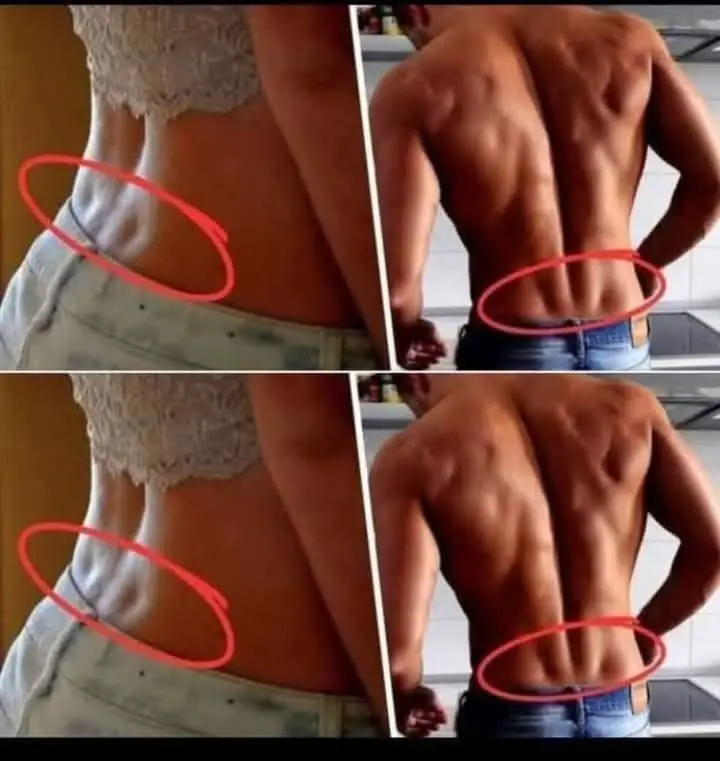
Those small, symmetrical indentations on the lower back—often highlighted in images like the one above—have captured attention for generations. Commonly called “dimples of Venus” in women and sometimes “dimples of Apollo” in men, these subtle features are often seen as attractive. However, beyond aesthetics, many people wonder: Do they actually mean something about your health or body?
The short answer is simple: in most cases, they are completely normal. But let’s take a deeper, science-based look at what they are, why they appear, and when—rarely—they might deserve attention.
What Are Lower Back Dimples?
Lower back dimples are small indentations located just above the buttocks, on either side of the spine. Medically, they correspond to the posterior superior iliac spine (PSIS)—a bony point where ligaments connect skin to deeper structures.
These dimples form when:
- The skin attaches more tightly to underlying ligaments
- There is a certain distribution of body fat
- Genetics influence body structure
They are not muscles, and you can’t create them through exercise alone. Instead, they are a natural anatomical feature.
Why Do Some People Have Them?
1. Genetics Play the Biggest Role
If your parents or family members have these dimples, you’re more likely to have them too. They are largely inherited traits.
2. Body Composition Matters
People with lower body fat tend to show these dimples more clearly. That’s why they often appear more visible in lean individuals.
3. Bone Structure and Ligaments
The position of your pelvic bones and how ligaments attach to your skin influence whether dimples form.
Are These Dimples a Sign of Good Health?
You may have heard claims that these dimples indicate:
- Better circulation
- Higher fertility
- Greater physical fitness
In reality, there is no strong scientific evidence supporting these ideas.
However, there is a small grain of truth behind some claims:
- Because these dimples are often more visible in lean individuals, they can sometimes be associated with lower body fat.
- Lower body fat can be linked to fitness—but the dimples themselves are not a health marker.
Bottom line: They are not a medical indicator of health—just a natural variation.
When They Are Completely Normal
For the vast majority of people, these dimples are harmless. They are considered normal if they:
- Are symmetrical (appear on both sides)
- Have been present since adolescence or early adulthood
- Are painless
- Show no changes over time
- Have normal skin (no swelling, redness, or unusual features)
If your dimples meet these criteria, there is nothing to worry about. They are simply part of your body’s structure.
When Should You Pay Attention?
Although rare, certain features may suggest the need for medical evaluation—especially in infants.
In Babies or Young Children
Doctors may look more closely if a dimple:
- Is deep or unusually large
- Appears off-center
- Is located higher up on the back
- Has hair growth, skin discoloration, or a lump nearby
These features can sometimes be linked to conditions like:
- Spina bifida occulta
- Tethered cord syndrome
- Dermal sinus tracts
However, it’s important to stress:
👉 These concerns apply mostly to newborns, not adults.
What About Adults?
In adults, lower back dimples are almost always harmless.
You should only consider medical advice if you notice:
- Sudden changes in shape or size
- Pain or tenderness in the area
- Numbness or tingling in the legs
- Changes in bladder or bowel control
These symptoms are unrelated to the dimples themselves but could indicate another condition that needs evaluation.
Do Lower Back Dimples Affect Physical Performance?
No—these dimples do not:
- Improve strength
- Enhance flexibility
- Affect posture
They are purely structural and have no impact on physical ability.
Can You Get Dimples Through Exercise?
This is a common misconception.
You cannot create true dimples if you don’t already have the anatomical structure for them.
However, you can make them more visible by:
- Reducing body fat
- Strengthening core and lower back muscles
Even then, visibility depends mostly on genetics.
Cultural and Aesthetic Perspectives
Throughout history, these dimples have been associated with beauty and symmetry.
- In classical art, they were often emphasized as a sign of grace
- In modern culture, they are sometimes considered attractive
- Fitness models often highlight them due to low body fat
But remember: beauty standards vary, and these dimples are simply one of many natural body variations.
Myths vs. Facts
Myth: They mean you’re healthier
Fact: No scientific proof supports this.
Myth: Only fit people have them
Fact: They are genetic, not fitness-based.
Myth: You can train your body to get them
Fact: You can’t create them without the underlying structure.
Myth: They indicate better sexual health
Fact: This is a myth with no medical basis.
How to Tell the Difference Between Normal and Concerning
| Feature | Normal Dimples | Concerning Signs |
|---|---|---|
| Symmetry | Yes | No |
| Pain | None | Present |
| Skin | Smooth | Swelling, redness, hair tuft |
| Onset | Since youth | New or changing |
| Location | Lower back | Higher or unusual |
If your dimples fall in the “normal” column, there’s nothing to worry about.
Psychological Impact: Why People Notice Them
Interestingly, these dimples draw attention because:
- They highlight the curve of the lower back
- They create visual symmetry
- They are relatively uncommon
This makes people more curious about them—even though they’re medically insignificant.
A Balanced Perspective
It’s easy to overanalyze small physical features, especially with so much information online. But in reality:
- Most body variations are completely normal
- Not every visible trait has a deeper meaning
- Simplicity often explains what looks mysterious
Lower back dimples are a perfect example of this.
Final Thoughts
Those two small indentations on your lower back may look intriguing, but in most cases, they’re simply a natural part of your anatomy—nothing more, nothing less.
They don’t define your health, your fitness, or your body’s capabilities. They are just one of many subtle ways the human body varies from person to person.
If they’ve been there for years and haven’t changed, you can consider them completely harmless.