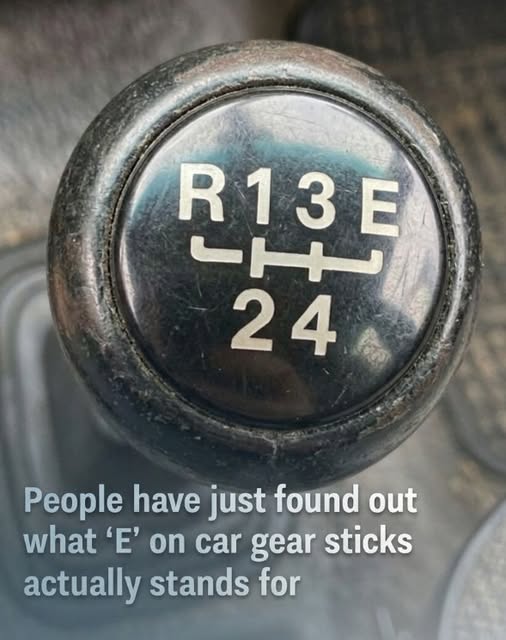
If you’ve ever climbed into an older car and noticed an “E” on the gear selector, you’re definitely not alone in wondering what it means. Many younger drivers have never seen it before because modern vehicles rarely use this label anymore.
At first glance, the “E” can look mysterious. Some people think it means:
- Emergency
- Extra gear
- Electric mode
- Engine brake
But in most older vehicles, the “E” actually stood for one simple thing:
“E” Means Economy
The “E” represented Economy Mode — a fuel-saving transmission setting designed to help drivers improve gas mileage during normal driving.
Manufacturers introduced this feature decades ago when fuel efficiency became a major concern, especially during periods of rising gas prices and stricter fuel economy standards.
Instead of focusing on fast acceleration or sporty driving, Economy mode prioritized smoother shifting and lower fuel consumption.
Why Older Cars Used Economy Mode
Back in the 1970s, 1980s, and 1990s, automakers began experimenting with different transmission settings to give drivers more control over how their vehicles behaved.
Fuel prices fluctuated heavily during these decades, and many drivers wanted ways to:
- Save gasoline
- Reduce engine strain
- Improve highway efficiency
- Make daily commuting cheaper
Economy mode became one of the solutions.
It allowed automatic transmissions to shift differently depending on the driver’s needs.
How “E” Mode Actually Worked
When the transmission was placed in “E” mode, the vehicle would usually:
- Shift gears earlier
- Keep engine RPM lower
- Reduce aggressive acceleration
- Prioritize smoother driving
- Use less fuel whenever possible
This often made the vehicle feel:
- Softer
- Calmer
- Less responsive
- More fuel-efficient
The difference wasn’t dramatic, but many drivers noticed improved gas mileage during highway or city commuting.
What Drivers Felt While Using “E” Mode
Economy mode changed how the transmission behaved.
The Car Would Usually:
- Accelerate more gently
- Delay high RPM revving
- Shift into higher gears sooner
- Feel less “sporty”
For some drivers, this felt smooth and comfortable.
For others, it felt slightly sluggish.
That was intentional.
The transmission computer — or mechanical system in older cars — was trying to conserve fuel rather than maximize performance.
Common Transmission Labels in Older Cars
Many older automatic vehicles included multiple drive modes.
Common labels included:
| Label | Meaning |
|---|---|
| E | Economy |
| S | Sport |
| P | Park |
| R | Reverse |
| N | Neutral |
| D | Drive |
| L | Low gear |
Some luxury cars also included:
- W for Winter
- M for Manual
- PWR for Power mode
Each setting changed how the transmission responded.
Economy Mode vs Sport Mode
Many vehicles offered both Economy and Sport settings.
The difference was mainly in transmission behavior.
Economy Mode
Focused on:
- Fuel savings
- Earlier shifting
- Lower RPM
- Smoother driving
Sport Mode
Focused on:
- Faster acceleration
- Higher RPM
- Delayed shifting
- Stronger throttle response
Sport mode usually felt more powerful, but it consumed more fuel.
Why Modern Cars Rarely Use “E”
Today, most vehicles manage fuel efficiency automatically.
Modern transmissions use:
- Advanced computers
- Sensors
- Adaptive shifting systems
- Driving behavior analysis
Instead of manually selecting “Economy,” the car often adjusts itself in real time.
Some modern vehicles now use:
- ECO buttons
- Drive mode selectors
- Fuel-saving software systems
But the concept is basically the same.
Did “E” Mode Actually Save Fuel?
Yes — though the savings varied.
Economy mode could improve fuel efficiency by:
- Reducing engine strain
- Preventing unnecessary high RPM driving
- Encouraging smoother acceleration
However, actual fuel savings depended heavily on:
- Driving habits
- Traffic conditions
- Vehicle weight
- Engine size
- Road terrain
Aggressive driving could still cancel out the benefits.
Which Cars Commonly Had “E” Mode?
Many older vehicles from:
- Mercedes-Benz
- BMW
- Toyota
- Volvo
- Honda
- Nissan
- Volkswagen
Used some form of Economy transmission setting.
Luxury sedans especially loved offering multiple driving modes.
Why Some Drivers Preferred Economy Mode
Drivers often used “E” mode for:
- Long highway trips
- Daily commuting
- Fuel savings
- Smoother rides
- Winter driving conditions
Some people simply preferred the softer feel of the transmission.
Others barely noticed the difference.
Why Some Drivers Hated It
Not everyone loved Economy mode.
Common complaints included:
- Slower acceleration
- Delayed response
- Weak passing power
- “Lazy” feeling transmission
Drivers who enjoyed performance often switched immediately back to:
- Sport
- Power
- Standard drive settings
Economy Mode and Engine RPM
One major goal of Economy mode was lowering RPM.
RPM stands for:
Revolutions Per Minute
Lower RPM generally means:
- Less fuel burned
- Less engine stress
- Quieter operation
Economy mode tried to keep RPM lower whenever possible.
Could “E” Mode Damage the Car?
No.
Economy mode was designed by the manufacturer for normal use.
Using it would not:
- Hurt the engine
- Damage the transmission
- Wear out components faster
In fact, smoother shifting sometimes reduced wear slightly.
Why Younger Drivers Are Confused by It Today
Modern cars have changed dramatically.
Many newer drivers:
- Never learned manual transmissions
- Rarely see older gear selectors
- Use fully computerized vehicles
- Drive cars with touchscreen controls instead of shift labels
That makes old-school labels like “E” feel mysterious today.
Other Strange Symbols Found on Older Cars
Older vehicles often included labels that confuse modern drivers.
Examples include:
- OD (Overdrive)
- Choke controls
- Carburetor adjustments
- Manual idle settings
- Cruise buttons with unusual icons
Cars were far more mechanical and less automated than today.
Did Manual Cars Have “E” Mode?
Not usually.
Economy mode mainly appeared on:
- Automatic transmissions
- Semi-automatic systems
- Luxury automatic vehicles
Manual drivers controlled fuel economy themselves through:
- Gear choice
- RPM management
- Driving habits
What Is Overdrive?
Some people confuse “E” with Overdrive.
They are not identical.
Overdrive:
- Reduces engine RPM at high speeds
- Improves highway fuel economy
- Functions as an extra cruising gear
Economy mode affects overall shift behavior throughout driving.
The Evolution of Fuel-Saving Technology
Economy mode was an early attempt at smarter fuel management.
Today’s vehicles now use:
- Hybrid systems
- Cylinder deactivation
- Start-stop technology
- Computerized fuel mapping
- Continuously variable transmissions (CVTs)
Modern fuel efficiency systems are much more advanced than the old “E” selector.
Why Older Cars Still Fascinate Drivers
Many people enjoy discovering forgotten features in classic vehicles because they reveal how automotive technology evolved over time.
Simple labels like:
- E
- OD
- Sport
- Power
Represent entire eras of engineering philosophy.
Older cars relied more on driver involvement, while modern cars automate nearly everything.
Common Internet Myths About the “E”
Social media often spreads incorrect explanations.
Myth: “E” Means Emergency
False.
Myth: “E” Unlocks Extra Power
False.
Myth: “E” Is for Electric Driving
False in older gas vehicles.
In most cases, it simply meant:
Economy Mode
Why Drivers Sometimes Miss Older Features
Some drivers actually miss older transmission modes because they offered:
- More direct control
- Simpler systems
- Mechanical feel
- Custom driving behavior
Modern systems often operate invisibly behind the scenes.
Frequently Asked Questions
Does every “E” always mean Economy?
Usually, but not universally. Vehicle manuals always provide the most accurate explanation.
Can Economy mode improve gas mileage significantly?
It may help modestly, especially during steady driving.
Is Economy mode slower?
Usually yes, because it prioritizes efficiency over acceleration.
Do modern cars still have Economy mode?
Yes, though it may appear as:
- ECO
- Eco Drive
- Fuel Saver Mode
Can you leave Economy mode on all the time?
Generally yes.
Final Thoughts
The mysterious “E” on older car gear selectors isn’t nearly as complicated as the internet sometimes makes it seem.
In most vehicles, it simply stood for:
Economy Mode
It was designed to:
- Save fuel
- Lower engine RPM
- Create smoother driving
- Reduce aggressive shifting
While modern cars now handle fuel efficiency automatically, the old “E” represents an interesting chapter in automotive history — a time when drivers had more visible control over how their cars behaved.
Sometimes the simplest features become the most fascinating once they disappear
More Home Remedies
- Wrinkled Fingers After Water Exposure: What Your Skin May Be Telling You
- Skin Rash With Breathing Trouble? It Could Be a Life-Threatening Allergic Reaction
- I Thought It Was a Piece of Trash on the Bathroom Floor—Until It Moved
- If You Are Getting White Pimples on Your Lips or Intimate Area, Here’s What They Could Mean