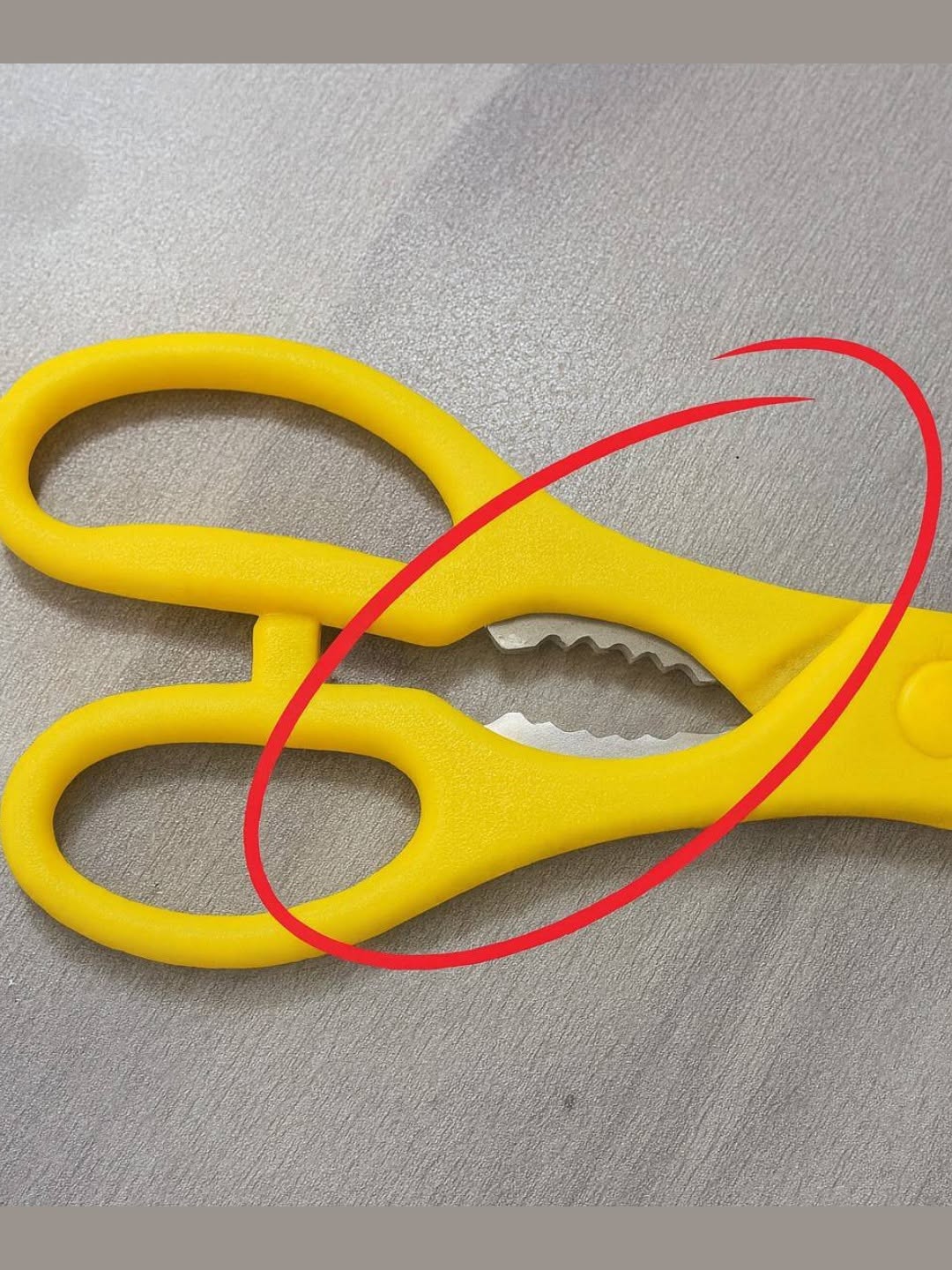
What’s That Strange Toothy Part on Kitchen Scissors For? If you have ever looked closely at a sturdy pair of kitchen shears, you may have noticed a ridged, tooth-like opening between the handles. It looks too deliberate to be decorative, yet many people use the scissors for years without touching it.
That little section can serve several purposes, depending on the exact design of your shears. On some models, manufacturers build it as a nutcracker or gripping surface. On others, the handle area includes a screw-cap opener, bottle opener, lid lifter, or even an integrated bone-breaking feature. ZWILLING, for example, describes multi-purpose shears that include a ridged nut-cracking opening as well as separate functions for screw caps, lids, and bottles. Its MIYABI kitchen shears also include an integrated bone breaker.
So, that odd little feature really can turn a simple pair of scissors into a compact kitchen multi-tool.
I first noticed the ridged section while washing an old pair of kitchen shears that had been sitting in my drawer for years. I had used them for opening packages, trimming herbs, cutting parchment, and occasionally tackling chicken. Yet I had never stopped to wonder why the handles had a strange toothed opening near the pivot. One afternoon, I tried gripping a stubborn twist cap with it and immediately understood the design. The ridges held the cap more securely than my fingers could. Since then, I have looked at kitchen scissors differently. Sometimes the smartest tool in the drawer hides in the part nobody thinks to use.
What’s That Strange Toothy Part on Kitchen Scissors For?
It Is Usually a Built-In Gripping or Cracking Tool
What’s That Strange Toothy Part on Kitchen Scissors For? On many heavy-duty kitchen shears, those ridges create a high-grip area that becomes useful when the handles move toward each other.
Rather than cutting with the blades, you place an appropriate object between the ridged sections and apply gentle pressure through the handles.
On certain multi-purpose shears, manufacturers specifically identify this opening as a nutcracker. ZWILLING describes the ridged opening on one of its multi-purpose shears as a feature that provides a secure grip for cracking nut shells.
That design makes practical sense.
Smooth metal or plastic can slide against a rounded walnut or hazelnut shell. However, small ridges increase grip and help hold the object in place as you squeeze.
Still, not every pair of kitchen scissors uses the same design.
Some models combine several different openings and notches around the handles. Therefore, one toothed section may serve as a nutcracker while another part opens bottles or grips screw caps.
Other heavy-duty designs may include a bone-breaking feature designed specifically for poultry preparation. MIYABI, for example, lists an integrated bone breaker on its kitchen shears while separately describing screw-cap and bottle-cap opening functions.
Because manufacturers build different combinations into different models, What’s That Strange Toothy Part on Kitchen Scissors For cannot have one universal answer for every pair.
The most accurate answer is this: it usually serves as a gripping, cracking, or twisting aid, but the intended job depends on the particular shears.
The Handles Can Hide More Than One Tool
Kitchen shears often look simple at first glance.
However, manufacturers frequently build extra functions into areas that would otherwise remain unused.
For example, ZWILLING describes multi-purpose shears with built-in twist-cap openers, cap lifters, and lid openers. The company also notes that some models can crack nuts.
Another ZWILLING model integrates a screw-cap opener, bottle opener, and lid opener directly into the handle.
Therefore, when you ask What’s That Strange Toothy Part on Kitchen Scissors For, it helps to examine the entire handle rather than focusing on only one notch.
You may discover several shapes.
A curved serrated opening may grip a twist cap.
A deeply ridged central section may crack nuts.
A hooked metal edge may lift a bottle cap.
Another reinforced area may provide extra leverage for poultry work.
These features allow one sturdy tool to perform several small kitchen jobs without requiring separate gadgets.
That does not mean every scissor can safely perform every task.
A lightweight pair designed for herbs and packaging may not tolerate the same pressure as forged multi-purpose shears.
Likewise, ordinary office scissors should never become improvised nutcrackers simply because their handles resemble the feature.
Instead, look at the construction.
Heavy stainless-steel shears with reinforced handles and manufacturer-described multi-purpose functions can handle more demanding jobs than lightweight household scissors.
When possible, check the manufacturer’s product information before applying substantial pressure.
Clever Ways to Use the Toothy Section
Crack Nuts and Grip Twist Caps
One of the most useful answers to What’s That Strange Toothy Part on Kitchen Scissors For involves nuts.
Place a suitable nut inside the ridged opening, then close the handles gradually. The ridges help keep the shell from slipping while the handles provide mechanical leverage.
You should use controlled pressure rather than squeezing as hard as possible.
A sudden crush can shatter a shell into small pieces. Therefore, slow pressure gives you more control.
ZWILLING specifically describes the ridged opening on its multi-purpose shears as a nutcracker that provides secure grip for nut shells.
Depending on the size and design, the same general gripping concept can also help with certain screw caps.
ZWILLING lists built-in screw-cap opening functions on several of its multi-purpose kitchen shears.
To use that type of feature, position the cap inside the designated gripping area and apply enough pressure to hold it firmly.
Then twist.
The ridges can create additional traction when a wet or smooth cap feels difficult to turn by hand.
However, avoid excessive force.
Glass bottles and containers can break if you squeeze too hard or use a feature that the manufacturer did not intend for that purpose.
Likewise, make sure your fingers stay clear of the blades while you grip or rotate an object.
What’s That Strange Toothy Part on Kitchen Scissors For becomes much easier to understand once you see it as a traction tool.
Instead of cutting, the feature lets your hand pressure travel through the handles and into a small gripping surface.
That simple mechanism can make a stubborn shell or cap surprisingly manageable.
Open Bottles and Lift Tight Lids—If Your Model Supports It
Some kitchen shears include separate metal contours near the handles that work as bottle openers or lid lifters.
ZWILLING states that its multi-purpose shears can include a bottle opener, screw-cap opener, and lid lifter, while another model specifically lists a jar-lid lifting function.
Therefore, the odd shapes around your handles may serve different jobs.
For a traditional capped bottle, the opener portion usually catches underneath the cap edge while the handles provide leverage.
A lid-lifting feature works differently.
Rather than twisting the entire lid, it can help break the seal or lift an edge enough to reduce resistance.
However, you should never assume that the serrated toothy opening itself performs all these functions.
Sometimes the bottle opener sits beside it.
Sometimes the screw-cap grip surrounds another portion of the handle.
That distinction matters because applying force in the wrong place can damage the shears or the container.
So, What’s That Strange Toothy Part on Kitchen Scissors For on your exact pair?
Look closely for clues.
If the opening forms opposing ridges that close together, it likely serves a gripping or cracking function.
If you see a hooked metal projection, that may serve as a cap lifter.
If you see a broad rounded opening with gripping teeth, that may help with twist caps.
The manufacturer’s instructions provide the best confirmation.
This variety also explains why people often disagree about the feature online.
Two people may own kitchen scissors that look almost identical but have different handle tools.
One person’s “nutcracker” may genuinely be another model’s cap grip.
The best approach involves identifying the tool based on its design and the manufacturer’s description rather than assuming every notch performs the same job.
Can the Toothy Part Really Help With Poultry?
Some Heavy-Duty Shears Include Bone-Breaking Features
What’s That Strange Toothy Part on Kitchen Scissors For when the shears look especially heavy and sturdy?
On some poultry-oriented models, it can be connected to gripping or breaking small poultry bones.
MIYABI describes one of its kitchen shears as having an integrated bone breaker. The same product also includes micro-serrated blades and cap-opening features, showing how several specialized functions can coexist on one pair of shears.
Meanwhile, ZWILLING explains that poultry shears are specifically designed for portioning chicken, duck, and turkey and can separate softer bones that an ordinary knife may not handle as conveniently.
However, this does not mean you should place any large bone inside an unidentified toothed notch and squeeze.
The feature needs sufficient strength.
The handles need proper reinforcement.
The material needs to withstand concentrated pressure.
Therefore, only use a bone-breaking function if your shears are designed and described for that job.
Even then, focus on appropriate poultry preparation rather than extremely hard bones.
A heavy beef bone, for example, belongs in a completely different category from small poultry joints.
Trying to overpower a tool can cause it to slip, deform, or break.
What’s That Strange Toothy Part on Kitchen Scissors For may include bone-related work on some models, but manufacturer instructions should determine whether your particular tool supports it.
The Blades and the Handle Feature Do Different Jobs
Kitchen scissors often combine cutting and gripping technology in one compact tool.
The blades perform the cutting.
Meanwhile, the toothy handle area provides leverage, traction, or cracking pressure.
High-quality kitchen shears may also use micro-serrated blades. ZWILLING explains that micro-serration helps grip material while cutting, particularly thicker or more difficult foods and materials.
That blade serration differs from the larger ridged feature between the handles.
The distinction can become confusing because both areas have “teeth.”
However, they serve separate mechanical purposes.
The small blade serrations help stop slippery food or packaging from sliding away from the cutting edge.
The larger handle ridges may help grip an object that you want to twist or crack.
Therefore, What’s That Strange Toothy Part on Kitchen Scissors For depends partly on where the teeth actually appear.
If they run along a cutting blade, they probably improve cutting grip.
If they appear in a reinforced opening between the handles, they likely serve a secondary gripping function.
Understanding that difference can make kitchen shears much more useful.
Instead of seeing them as oversized scissors, you start to recognize them as a collection of small mechanical tools arranged around one central pivot.
Still, use the blades and the gripping feature deliberately.
Keep your fingers away from sharp edges.
Work on a stable surface.
Apply gradual rather than sudden pressure.
Most importantly, never force the tool beyond the job its construction can handle.
How to Use and Care for Multi-Purpose Kitchen Shears
Use the Right Feature Instead of Forcing the Tool
Now that you know What’s That Strange Toothy Part on Kitchen Scissors For, the next step involves using it properly.
Start by identifying your particular scissors.
Look for a brand or model name printed on the blade.
Then examine the handle area.
You may find one or several integrated features.
If you want to crack a nut, use the ridged opening designed to hold the shell rather than placing the nut between the cutting blades.
If your scissors include a screw-cap grip, center the cap securely before applying gentle pressure.
Likewise, use a dedicated bottle-opening edge rather than trying to pry a cap with the tip of a cutting blade.
These small choices make the tool safer and help protect its cutting edges.
Also keep your grip dry whenever possible.
Kitchen work often involves moisture, oil, and slippery foods. ZWILLING specifically notes that kitchen-shear handles should provide good grip because hands frequently become wet during cooking.
Therefore, if your hands or the tool feel greasy, stop and dry them before applying leverage.
Do not use the shears as pliers for hardware, wire, screws, or other non-kitchen jobs unless the manufacturer explicitly supports those tasks.
You can damage the cutting alignment or pivot.
What’s That Strange Toothy Part on Kitchen Scissors For does not mean the scissors have become an unlimited substitute for every tool in the house.
Instead, think of the feature as a useful extension of the kitchen jobs the shears were already built to perform.
Clean the Hidden Gripper Carefully
The toothy section also creates one cleaning challenge.
Small grooves can trap food particles, shell fragments, oil, or moisture.
Therefore, clean that area thoroughly after use, especially if it touches raw poultry.
Some kitchen shears separate into two pieces for easier cleaning, although designs vary.
If yours comes apart, follow the manufacturer’s instructions when separating and reassembling it.
Otherwise, open the shears enough to expose the gripping surfaces and wash carefully.
ZWILLING recommends hand washing its kitchen scissors with a soft cloth and drying them promptly to help maintain performance and prevent surface corrosion.
That guidance offers a useful general reminder even if your own manufacturer provides different instructions.
Do not assume every stainless-steel shear belongs in the dishwasher.
Instead, check the care information for your model.
After cleaning, dry the blades, pivot, handle edges, and toothed opening thoroughly.
You can also check the pivot periodically.
A loose pivot can affect cutting performance, while accumulated residue can make the scissors feel stiff.
Sharp blades also matter.
ZWILLING notes that kitchen scissors may eventually require sharpening if cutting performance declines.
Still, the handle tool itself needs more cleaning than sharpening.
Once you start using the hidden gripping section, you may wonder why you ignored it for so long.
It occupies almost no extra storage space, yet it can perform jobs that would otherwise require another tool.
Frequently Asked Questions
What’s That Strange Toothy Part on Kitchen Scissors For?
It usually serves as a gripping, cracking, or twisting feature. On some kitchen shears, manufacturers identify a ridged opening as a nutcracker. Other models include built-in screw-cap openers, lid lifters, bottle openers, or bone-breaking features. The exact purpose depends on the model.
Can I use the ridged part of kitchen scissors to crack nuts?
Yes, if your manufacturer designed that feature as a nutcracker. ZWILLING specifically describes a ridged opening on one multi-purpose shear as a nutcracker that creates a secure grip on nut shells. Apply pressure gradually rather than crushing the shell aggressively.
Can kitchen scissors open jars?
Some multi-purpose kitchen shears include screw-cap grips or lid-lifting features that can help with certain containers. ZWILLING lists screw-cap openers and lid-opening features on several models. However, not every pair includes these functions, so check your model before applying force.
Is the toothy part meant to break bones?
Sometimes. Certain heavy-duty shears include integrated bone-breaking features, and poultry shears can be designed for separating softer poultry bones. However, do not assume every ridged opening can handle bones. Use it only if the manufacturer identifies that purpose.
Can kitchen shears go in the dishwasher?
That depends on the manufacturer. ZWILLING recommends hand washing its kitchen shears with a soft cloth and drying them promptly to maintain performance and reduce the chance of surface rust. Always follow the care instructions for your particular pair.
Conclusion
What’s That Strange Toothy Part on Kitchen Scissors For? It is not simply decoration, and it is not necessarily a leftover piece of manufacturing.
On many multi-purpose kitchen shears, that ridged section provides extra grip for tasks such as cracking nuts or holding twist caps. Other nearby handle features may lift bottle caps, loosen lids, or perform additional jobs. Some heavy-duty models even incorporate bone-breaking functions for poultry preparation.
However, the exact function varies between manufacturers and models.
Therefore, inspect your scissors before trying every trick you see online.
A reinforced ridged opening may be a nutcracker.
A curved gripping section may handle screw caps.
A hooked edge may open bottles.
A specialized heavy-duty design may help with poultry bones.
Once you identify the intended feature, use gradual pressure and keep your hands away from the blades.
Then clean the grooves carefully afterward.
What’s That Strange Toothy Part on Kitchen Scissors For ultimately reveals something clever about good kitchen design: manufacturers can turn an otherwise unused section of a familiar tool into something genuinely useful.
The next time a jar lid refuses to cooperate or a nut shell fights back, look at your kitchen scissors before reaching for another gadget.
That strange little row of teeth may have been waiting to help all along.