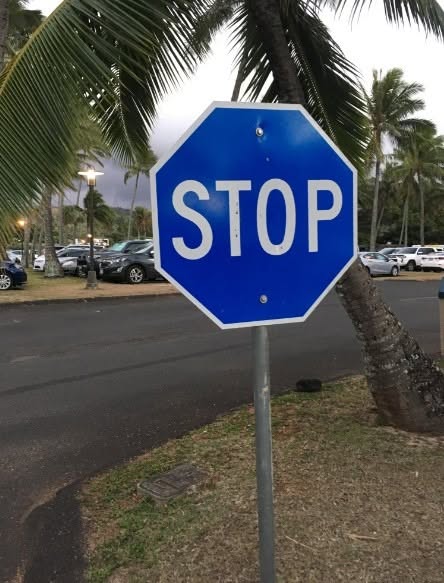
What Does a Blue Stop Sign Mean? The Truth Behind This Unusual Road Sign becomes a surprisingly important question the first time you see a familiar octagonal STOP sign painted an unfamiliar shade of blue.
You may be driving through a private neighborhood, apartment complex, parking area, college campus, industrial property, or gated community when it suddenly appears. The shape says STOP. The letters say STOP. Yet the color looks completely wrong.
So, what should you do?
In the United States, an official STOP sign follows a standardized design: an octagonal shape with a white legend and border on a red background. The Federal Highway Administration’s current Manual on Uniform Traffic Control Devices, or MUTCD, establishes that standard. Therefore, a blue octagonal sign displaying STOP is not the standard federal STOP sign design.
However, that does not mean you should simply drive through it. A blue stop sign often appears on private property where an owner or manager wants drivers to stop. Because state and local laws differ, its legal enforceability can depend on where it stands, who controls the roadway, and whether that roadway falls under traffic-control requirements.
A few years ago, I noticed a blue stop sign while visiting a large private residential community. I slowed down because the shape looked familiar, but the color made me wonder whether it was decorative. Another driver stopped normally, so I did the same. Later, I learned that the community used colored signs to distinguish privately maintained roads from nearby public streets. That small encounter stayed with me because it showed how much drivers rely on familiar colors without realizing it. More importantly, it taught me a useful rule: when a sign clearly communicates caution, treating it cautiously makes far more sense than testing whether it carries legal authority.
What Does a Blue Stop Sign Mean on Private Property?
It Usually Communicates an Intended Stop
What Does a Blue Stop Sign Mean when you encounter one in a private development? In practical terms, the property owner usually wants drivers to stop at that location before continuing.
You may see such signs in gated communities, apartment complexes, office parks, warehouses, privately controlled roads, resort properties, parking facilities, or other areas that maintain their own traffic-control systems.
The octagonal shape matters because American drivers immediately associate it with stopping. Therefore, even when someone changes the color, the sign still communicates a recognizable instruction.
However, the color change creates an important distinction.
Under the federal MUTCD standard, a STOP sign uses a white word and border against a red background. FHWA specifically assigns this distinctive color and shape because STOP signs communicate a critical right-of-way requirement. Consequently, a blue version does not match the standard R1-1 STOP sign.
That distinction explains why you generally should not expect legitimate public-road authorities to replace ordinary red STOP signs with blue ones simply for decoration.
Nevertheless, private property can create more complicated situations.
A private owner may install a nonstandard sign to manage vehicle movement inside a property. For example, a condominium association might want vehicles to stop where an internal driveway crosses a pedestrian path. Similarly, a business might install one near a loading area.
So, What Does a Blue Stop Sign Mean for your immediate driving decision?
Treat it as a clear warning that someone expects traffic to stop. Slow down, make sure pedestrians and vehicles have cleared your path, and proceed cautiously.
Trying to determine its exact legal enforceability while moving through the intersection provides no safety advantage.
Private Does Not Always Mean Traffic Rules Disappear
One common misunderstanding says that anything located on private property falls completely outside ordinary traffic standards.
The reality can be more complicated.
FHWA states that owners of private roads open to public travel rely on MUTCD standards, while responsibility for devices on those roads can fall to the owner. In addition, state or local governments may impose approval or compliance requirements in certain situations.
Therefore, the words “private road” do not automatically answer every legal question.
The exact rules can depend on state law, municipal ordinances, agreements with law enforcement, public access, road classification, and the type of property involved.
Parking areas create another distinction. Historically, MUTCD applicability has treated parking areas and their driving aisles differently from roads open to public travel. As a result, you should not assume that every sign inside every parking lot carries exactly the same statutory authority as a government-installed traffic sign on a public street.
Still, safety does not depend solely on whether a police officer could issue a ticket for ignoring one particular sign.
If an octagonal blue sign tells you to stop before entering a cross-traffic area, blindly driving through it could still create a collision risk. Moreover, your conduct after a crash could become relevant to insurance claims, property rules, or other legal questions depending on the circumstances.
Therefore, What Does a Blue Stop Sign Mean in the safest practical sense?
It means you have reached a point where stopping and checking your surroundings represents the sensible choice, even though the sign itself does not match the standard public-road STOP sign design.
Why Official Stop Signs Are Red Instead of Blue
Standardization Helps Drivers React Quickly
Traffic signs need consistency because drivers frequently make decisions in seconds.
A driver approaching an intersection should not have to study a sign and wonder whether purple means stop today while orange means stop somewhere else.
Instead, standardized shapes, colors, symbols, and placement make important messages easier to recognize.
The MUTCD exists specifically to promote uniform traffic-control practices throughout the United States. FHWA describes it as the national standard governing traffic-control devices and emphasizes uniformity as a way to support safe and efficient travel.
For STOP signs, the design is especially distinctive.
The sign has eight sides.
It uses a red background.
It displays STOP in white letters.
It also uses a white border.
That combination gives drivers multiple recognition cues. Even if bad weather, distance, glare, or another vehicle partly obscures the word, the sign’s octagonal silhouette still provides a strong clue.
Therefore, asking What Does a Blue Stop Sign Mean also reveals why changing standardized colors can cause confusion.
A blue STOP sign may still look understandable because its shape and text remain familiar. However, the unfamiliar color forces the driver to spend an extra moment interpreting it.
On a private property traveling at low speed, that confusion may create only a minor inconvenience. On a busy public roadway, however, consistent design becomes much more important.
That is why official traffic-control systems follow established standards rather than allowing each community to choose its favorite color.
Blue Already Has Other Uses in Traffic Sign Systems
Blue itself does not mean “stop” within the familiar U.S. traffic-sign system.
Instead, blue commonly appears in informational and road-user-service contexts. Previous and current MUTCD frameworks use blue in several guide and information applications, while the current manual also reserves certain colors, including light blue, for possible future federal uses.
Drivers often associate blue signs with services or information rather than immediate regulatory commands.
For example, motorists may encounter blue signs connected with traveler services, facilities, or certain informational purposes.
That makes a blue octagonal STOP sign unusual for two reasons.
First, it combines the highly recognizable STOP shape with an unexpected color.
Second, that color already appears elsewhere in roadway communication for different purposes.
Consequently, What Does a Blue Stop Sign Mean cannot be answered simply by saying, “Blue has a universal traffic meaning.”
It does not.
Instead, you need to examine the entire sign and its setting.
If the sign has eight sides and clearly says STOP, the property owner almost certainly intends a stopping instruction. However, the nonstandard color tells you that you are not looking at the conventional R1-1 STOP sign recognized under the federal design standard.
This difference also explains why homemade traffic signs can create problems.
Good traffic control depends on drivers understanding instructions immediately. Therefore, private owners who need actual STOP control on roads subject to applicable standards benefit from using the familiar standardized design rather than inventing variations.
What Should You Do When You See a Blue Stop Sign?
Stop First and Sort Out the Details Later
What Does a Blue Stop Sign Mean when it suddenly appears in front of your vehicle?
From a practical safety perspective, the easiest response is simple: stop.
You already recognize what the shape and word communicate. Therefore, you lose very little by making a complete stop, checking for pedestrians, bicycles, vehicles, and other hazards, and continuing when the path becomes clear.
By contrast, assuming the sign “doesn’t count” and proceeding without checking creates unnecessary risk.
Imagine that you enter a private apartment complex and approach a blue STOP sign beside a crosswalk. A child steps toward the road while another vehicle approaches from your right.
In that situation, debating the sign’s regulatory status misses the point.
The intersection still contains hazards.
Likewise, private communities may establish rules for residents, employees, tenants, visitors, or contractors. Ignoring posted instructions could potentially create consequences under private agreements even when ordinary public-road enforcement does not apply in exactly the same way.
Therefore, the safest answer to What Does a Blue Stop Sign Mean does not require you to become a traffic lawyer before pressing the brake pedal.
Stop.
Observe.
Proceed carefully.
Afterward, if the sign’s status matters for a citation, accident, property dispute, or other legal question, check the applicable state and local law or obtain qualified legal guidance.
This distinction matters because traffic laws vary among jurisdictions. You should never rely on the sign’s color alone to determine whether law enforcement can act.
Look at Location, Shape, Wording, and Context
Context can tell you a great deal about an unusual road sign.
First, determine where you are.
If you are traveling on an ordinary public street and suddenly encounter a blue octagonal STOP sign, that situation deserves attention because the sign does not match the standard federal STOP design.
However, if you have entered a private subdivision, industrial complex, resort, or controlled parking property, a privately installed sign becomes more plausible.
Next, examine the shape.
An eight-sided sign strongly signals STOP because the octagonal shape carries an unusually specific association.
Then read the wording.
If it clearly displays STOP, the intended instruction leaves little mystery even though the color looks unusual.
Finally, observe surrounding traffic markings.
Are there stop lines on the pavement? Does another approach have a similar sign? Is there a pedestrian crossing? Do other drivers stop? Does a gate, guard station, or property entrance indicate private control?
Together, those details help answer What Does a Blue Stop Sign Mean in that particular location.
However, never let curiosity distract you from driving.
You do not need to photograph the sign, search your phone, or inspect property records while behind the wheel.
Instead, respond conservatively and continue safely.
If the sign appears dangerously misleading on a public roadway, you can report it to the relevant road authority after you park safely.
Likewise, if a private-property sign has faded, fallen, or become confusing, property management may appreciate knowing about the problem.
Common Myths About Blue Stop Signs
A Blue Stop Sign Does Not Create a Secret Traffic Rule
Unusual signs naturally inspire unusual explanations.
Some people assume a blue STOP sign belongs to police, emergency services, wealthy neighborhoods, or special government districts.
Others believe blue means stopping is optional.
Neither assumption provides a reliable rule.
What Does a Blue Stop Sign Mean? In most situations, the simplest explanation works best: someone responsible for a private area installed a nonstandard sign to tell drivers to stop.
The blue color itself does not magically create a nationwide alternate STOP category.
The current federal STOP standard remains the red octagonal sign with white wording and border.
Similarly, blue does not automatically tell you whether police can issue a citation.
Legal authority depends on more than pigment.
Location matters.
Road classification matters.
State and local statutes matter.
The ownership and public accessibility of the road can matter.
Therefore, two visually similar blue STOP signs in two different states or properties might exist under different legal circumstances.
Another myth suggests that drivers may ignore anything nonstandard.
That approach makes little sense from a safety standpoint.
Suppose someone installs a nonstandard warning beside a private driveway because large trucks routinely cross it. Even if the sign lacks formal regulatory status, the hazard remains real.
Traffic safety requires drivers to respond to conditions around them rather than treating every trip as an exercise in technical loopholes.
Red Still Means the Official Standard
What Does a Blue Stop Sign Mean compared with a traditional red one?
The most important distinction involves standardization.
When you see a properly installed red octagonal STOP sign on a public roadway, you are looking at one of the most recognizable regulatory devices in American transportation.
FHWA’s standards assign that sign a specific appearance so drivers encounter consistent communication across different jurisdictions.
A blue version lacks that standardized STOP-sign color scheme.
Therefore, seeing one should make you think “nonstandard,” not “new national traffic law.”
At the same time, nonstandard does not mean meaningless.
A private property owner may have installed it intentionally.
An older development may use unusual signage.
A decorative community design may have influenced its appearance.
Alternatively, someone may simply have chosen the wrong sign.
Whatever the reason, your immediate task remains safe driving.
Treat the STOP message seriously, particularly when vehicles, pedestrians, gates, driveways, or intersecting paths create potential conflicts.
Then continue once you can do so safely.
That approach avoids both extremes: blindly assuming every blue sign has identical legal force and recklessly assuming an unfamiliar color gives you permission to ignore a clear safety instruction.
Frequently Asked Questions
What Does a Blue Stop Sign Mean in the United States?
A blue octagonal sign reading STOP generally communicates that the property owner wants drivers to stop, but it does not match the federally standardized STOP sign design. The official MUTCD design uses a red background with white lettering and border. Blue versions most commonly make sense in private or otherwise nonstandard traffic-control settings.
Is a blue stop sign legally enforceable?
The answer depends on location and applicable law. State statutes, local ordinances, road ownership, public access, and other factors can affect enforcement. Therefore, you cannot reliably determine enforceability from color alone. On private roads open to public travel, owners can also have responsibilities involving traffic-control devices.
Should I stop at a blue stop sign?
Yes, stopping represents the safest practical response when an octagonal sign clearly instructs you to STOP. Even if its legal status differs from a standard public-road sign, cross traffic, pedestrians, property rules, or other hazards may still make stopping necessary for safe driving.
Why would someone install a blue stop sign?
Property owners sometimes use customized signs for aesthetic, organizational, or internal traffic-management reasons. A private neighborhood, commercial property, campus, or similar location may choose a different color. However, where formal MUTCD requirements apply, standardized traffic-control designs matter.
Are official U.S. stop signs ever blue?
The standard STOP sign specified by the current MUTCD is not blue. It is an octagon with a white legend and border on a red background. Therefore, a blue STOP sign should not be confused with the standard R1-1 sign simply because it uses the same word or shape.
Conclusion
What Does a Blue Stop Sign Mean? The Truth Behind This Unusual Road Sign comes down to an important distinction between intended meaning and standardized legal design.
A blue octagonal sign displaying STOP clearly communicates an intended stopping instruction. Therefore, when you encounter one, the safest response is to stop, check your surroundings, and proceed carefully.
However, blue is not the standard color for an official U.S. STOP sign.
The Federal Highway Administration’s MUTCD specifies the familiar red octagon with white lettering and a white border. That consistency helps drivers recognize critical instructions quickly wherever they travel.
So, What Does a Blue Stop Sign Mean when you find one in a neighborhood or private development?
Usually, it signals a privately installed or otherwise nonstandard attempt to control traffic. Its precise legal enforceability depends on the location and applicable state or local law rather than the blue color itself.
Most importantly, do not confuse “nonstandard” with “safe to ignore.”
The few seconds required to stop and look cost almost nothing. Driving through an intersection because you hope an unusual sign does not count can cost much more.
When the shape says STOP, the word says STOP, and the surrounding conditions call for caution, stopping remains the sensible choice.
Red may be the official standard, but safe driving never depends on winning an argument with a sign.