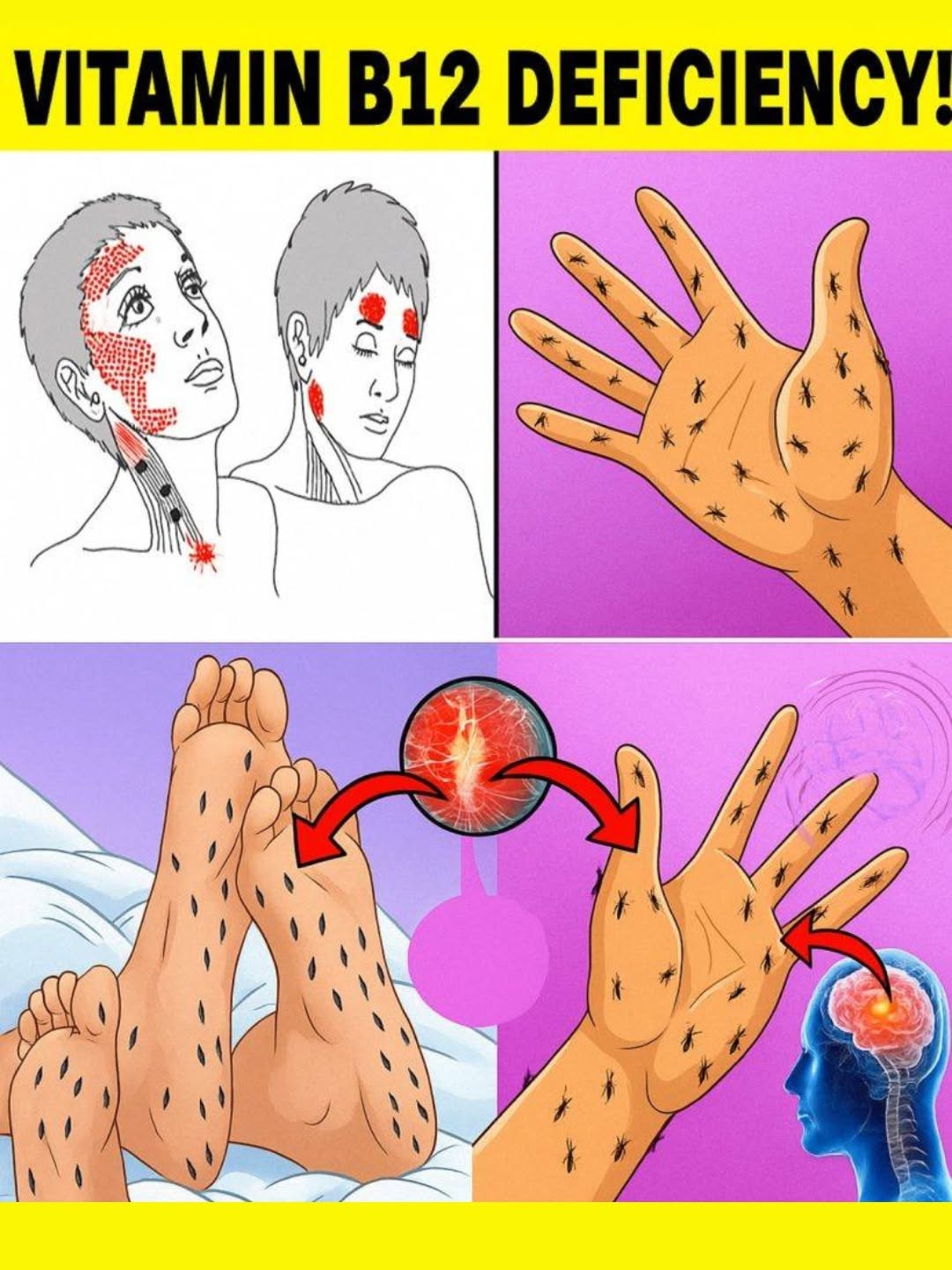
Vitamin B12 Deficiency Symptoms That Should Never Be Ignored can begin so gradually that many people mistake them for stress, poor sleep, aging, or simply having a difficult week. Persistent fatigue may come first. Then you might notice tingling in your feet, weakness, balance problems, a sore tongue, or difficulty concentrating.
Because vitamin B12 supports normal red blood cell formation and neurological function, deficiency can affect both the blood and nervous system. Importantly, neurological symptoms can occur even without anemia, so a normal-looking blood count does not automatically rule out a B12 problem.
Vitamin B12 deficiency also becomes more common in certain groups. Older adults, people with gastrointestinal disorders or previous gastrointestinal surgery, people with pernicious anemia, and people who follow vegan or some vegetarian diets face higher risks. Long-term use of medications such as metformin and acid-suppressing medicines can also interfere with B12 status.
The condition deserves attention because prolonged deficiency can damage nerves, and some neurological problems may not fully reverse when treatment comes too late. Fortunately, clinicians can diagnose deficiency with appropriate testing and treat it according to the underlying cause.
I first became interested in vitamin B12 after someone close to me spent months blaming constant fatigue and tingling feet on getting older. The symptoms developed slowly, so nothing initially seemed dramatic enough to investigate. Eventually, the combination of exhaustion, unsteady walking, and persistent pins and needles prompted a medical appointment. Blood testing revealed a B12 problem that required treatment. What stayed with me was how ordinary each symptom seemed when considered separately. Together, however, they formed a pattern worth noticing. Since then, I have learned not to treat unexplained neurological changes or persistent fatigue as an inevitable part of aging without considering other possible causes.
Why Vitamin B12 Deficiency Symptoms Can Be Easy to Miss
B12 Deficiency Often Develops Slowly
Vitamin B12 Deficiency Symptoms That Should Never Be Ignored do not always arrive suddenly.
The body stores a relatively large supply of vitamin B12 compared with the amount it needs each day. NIH’s Office of Dietary Supplements states that the body can store roughly 1 to 5 milligrams of B12, which helps explain why symptoms may take several years to appear after absorption or dietary problems begin.
That slow progression creates a problem.
If fatigue develops over months, you may adapt to it.
If your memory feels slightly less sharp, you may blame stress.
If your feet occasionally tingle, you may assume you sat in an awkward position.
However, symptoms can gradually accumulate as the deficiency becomes more significant.
MedlinePlus lists fatigue, low energy, lightheadedness, pale skin, shortness of breath, appetite changes, and a swollen red tongue among possible symptoms of vitamin B12 deficiency anemia. Longer-standing deficiency can also cause numbness, tingling, loss of balance, concentration problems, confusion, and other neurological changes.
Because these symptoms occur in many other conditions, symptoms alone cannot confirm B12 deficiency.
NICE specifically warns that unexplained fatigue and other features associated with B12 deficiency can also occur with many different health problems. Therefore, clinicians should consider the full clinical picture rather than diagnosing deficiency from one symptom.
Still, a persistent combination deserves attention.
For example, fatigue plus numb feet and balance problems provides more reason to seek evaluation than an isolated tired afternoon.
Vitamin B12 Deficiency Symptoms That Should Never Be Ignored become especially meaningful when they persist, progress, or appear in someone with known risk factors.
You Can Have Neurological Symptoms Without Anemia
One of the most important facts about Vitamin B12 Deficiency Symptoms That Should Never Be Ignored involves anemia.
Many people assume B12 deficiency always causes obvious anemia first.
That assumption can create false reassurance.
NIH states that neurological symptoms such as numbness and tingling can occur without anemia. NICE similarly recommends that clinicians not rule out B12 deficiency simply because anemia or enlarged red blood cells are absent.
That matters because nerve involvement can become serious.
The nervous system requires vitamin B12 for normal function, and prolonged deficiency can damage nerves. NHS guidance warns that neurological complications can sometimes become irreversible.
Therefore, persistent pins and needles, numbness, unexplained balance changes, or progressive weakness should not be dismissed just because someone says their routine blood count looked normal.
However, these symptoms can also signal conditions unrelated to B12.
Diabetes, nerve compression, thyroid disease, neurological disorders, medication effects, spinal problems, and many other conditions can cause similar complaints.
That is exactly why testing matters.
A clinician may check a complete blood count and serum B12 level. When results remain uncertain, methylmalonic acid testing can help clarify B12 status in appropriate cases. NIH describes serum methylmalonic acid as a sensitive marker, although kidney function and age can affect the result.
The goal should not involve guessing from symptoms.
Instead, recognize the warning pattern and get the right evaluation.
Eight Vitamin B12 Deficiency Symptoms Worth Taking Seriously
Fatigue, Weakness, Breathlessness, and Pale Skin
The first group of Vitamin B12 Deficiency Symptoms That Should Never Be Ignored often resembles ordinary exhaustion.
1. Persistent fatigue or unusually low energy. Vitamin B12 deficiency can interfere with normal red blood cell production and contribute to megaloblastic anemia. As a result, people may experience persistent tiredness, weakness, or reduced stamina. NIH and MedlinePlus both list fatigue among recognized deficiency symptoms.
Occasional tiredness after a bad night’s sleep is common.
However, unexplained fatigue that persists despite adequate rest deserves a closer look, particularly when other symptoms appear.
2. Weakness or lightheadedness. MedlinePlus lists lack of energy and lightheadedness during standing or exertion among possible symptoms.
Again, those symptoms do not prove B12 deficiency. Dehydration, low blood pressure, anemia from other causes, heart conditions, and numerous other issues can produce similar experiences.
3. Shortness of breath or palpitations. Vitamin B12 deficiency can contribute to anemia, and both shortness of breath and palpitations can accompany that process. NIH specifically includes palpitations among possible effects, while MedlinePlus lists exertional shortness of breath.
New or severe chest symptoms need appropriate medical assessment rather than self-treatment with vitamins.
4. Pale skin. Pallor can accompany anemia associated with B12 deficiency. NIH and MedlinePlus both identify pale skin among possible signs.
However, skin tone varies enormously, so pallor works best as one clue rather than a diagnostic test.
Taken together, these four symptoms can reflect reduced oxygen-carrying capacity when anemia develops.
Yet Vitamin B12 Deficiency Symptoms That Should Never Be Ignored do not stop with the blood.
The neurological signs often deserve even more attention.
Tingling, Balance Problems, Cognitive Changes, and a Sore Tongue
5. Numbness or pins and needles. Persistent tingling in the hands or feet ranks among the most characteristic neurological symptoms associated with prolonged B12 deficiency. NIH, NHS, and MedlinePlus all identify numbness or tingling as possible manifestations.
If tingling keeps returning or gradually spreads, seek medical evaluation rather than assuming circulation alone caused it.
6. Balance or coordination problems. NHS lists problems with balance and coordination among neurological symptoms of B12 deficiency, while MedlinePlus notes loss of balance.
A new change in walking deserves attention because falling risk can increase.
Sudden severe balance loss, especially with facial weakness, speech difficulty, or one-sided weakness, can indicate a medical emergency such as stroke and should not be attributed to B12 deficiency without urgent assessment.
7. Memory, concentration, or mood changes. Vitamin B12 deficiency can affect cognition and mental health. NIH lists dementia among possible severe manifestations, while NHS includes depression, anxiety, confusion, and dementia among neurological or psychological symptoms. NICE also recognizes an association with mental health symptoms.
However, B12 supplements do not function as a general memory enhancer when deficiency does not exist. NIH notes that randomized trials have not shown consistent cognitive improvement from B12 supplementation in older adults without a demonstrated deficiency-related need.
8. A swollen, red, or sore tongue. Glossitis can occur with vitamin B12 deficiency. NIH lists glossitis among recognized effects, while MedlinePlus describes a swollen red tongue and, in some cases, bleeding gums.
These eight Vitamin B12 Deficiency Symptoms That Should Never Be Ignored become especially important when several occur together.
Who Faces a Higher Risk of Vitamin B12 Deficiency?
Age, Diet, and Digestive Conditions Can Affect B12 Status
Vitamin B12 Deficiency Symptoms That Should Never Be Ignored deserve particular attention in people who have recognized risk factors.
Older adults make up one important group.
NIH reports that prevalence estimates vary greatly depending on the definition and test used. Using different criteria, studies have found B12 deficiency in roughly 3% to 43% of community-dwelling older adults. More recent U.S. NHANES data using a stricter serum cutoff estimated deficiency in about 3.7% of adults age 60 and older, while approximately 12.3% fell below a broader insufficiency threshold.
That range also shows why viral claims such as “one in five adults over 50 is deficient” need context.
Different laboratory cutoffs produce very different prevalence estimates.
Diet matters too.
Vitamin B12 occurs naturally primarily in foods of animal origin, including fish, meat, poultry, eggs, and dairy products. Fortified foods can also provide it.
Therefore, people following vegan diets need a reliable B12 source through fortified foods or supplementation. Vegetarians can also face increased risk depending on how much dairy, eggs, or fortified food they consume.
However, dietary intake tells only part of the story.
Someone can eat plenty of B12 and still develop deficiency if the digestive system cannot absorb it effectively.
Celiac disease, some gastrointestinal disorders, pernicious anemia, and certain stomach or intestinal surgeries can interfere with absorption.
That means simply eating more meat will not correct every B12 deficiency.
The underlying cause determines the right treatment.
Pernicious Anemia and Certain Medications Can Increase Risk
Pernicious anemia represents one important cause of clinically significant B12 deficiency.
The condition interferes with intrinsic factor, a protein the body needs to absorb B12 efficiently. Without adequate absorption, a person can become deficient even while consuming enough vitamin B12.
Previous stomach or small-intestinal surgery can create similar problems by reducing the body’s ability to release or absorb the vitamin. Weight-loss procedures that alter gastrointestinal anatomy can therefore increase risk.
Medications also deserve attention.
NIH identifies long-term use of metformin as a potential contributor to reduced B12 status. Acid-suppressing medications, including proton pump inhibitors, can also reduce absorption of B12 from food by lowering stomach acid.
MedlinePlus similarly lists long-term metformin use and prolonged use of certain heartburn medicines among possible contributors.
However, do not stop prescribed medications because you read about this interaction.
Instead, discuss your risk with the clinician who prescribed them.
Depending on your medical history and symptoms, a healthcare professional may decide that B12 testing makes sense.
Vitamin B12 Deficiency Symptoms That Should Never Be Ignored also deserve attention after major gastrointestinal surgery or when chronic digestive symptoms accompany fatigue or neurological changes.
Finally, nitrous oxide exposure can interfere with vitamin B12 function. MedlinePlus lists nitrous oxide misuse among potential contributors to B12 deficiency-related problems.
The broader lesson remains straightforward.
A deficiency can result from inadequate intake, poor absorption, medication effects, or other medical circumstances.
Therefore, successful treatment begins with finding the cause.
Testing and Treating Vitamin B12 Deficiency
Blood Tests Can Confirm What Symptoms Alone Cannot
Vitamin B12 Deficiency Symptoms That Should Never Be Ignored should prompt evaluation, not self-diagnosis.
Symptoms overlap heavily with many other disorders.
A clinician may begin with a health history, physical examination, medication review, complete blood count, and serum vitamin B12 measurement. MedlinePlus lists CBC, serum B12, methylmalonic acid, homocysteine, and certain antibody tests among investigations that may help diagnose B12 deficiency and determine its cause.
Testing can become especially important when neurological symptoms appear.
NIH explains that serum B12 values in an intermediate range may require methylmalonic acid testing to help clarify whether a functional deficiency exists.
However, laboratory interpretation is not completely straightforward.
Kidney problems and older age can raise methylmalonic acid independently of B12 deficiency, while homocysteine lacks specificity because folate status and kidney function can also affect it.
Therefore, clinicians interpret results alongside symptoms and risk factors.
NICE also emphasizes that B12 deficiency should not be ruled out solely because someone lacks anemia or macrocytosis.
This point becomes especially important when numbness, balance problems, or other neurological changes appear.
If your symptoms have developed gradually, write down when you first noticed them.
Mention dietary changes.
Tell your clinician about gastrointestinal surgery or digestive disorders.
Bring a complete medication list.
These details can help determine why the deficiency developed and what type of treatment makes sense.
Treatment Depends on the Cause
Vitamin B12 deficiency is treatable, but the right approach depends on why it happened.
MedlinePlus notes that people who develop deficiency because of a restrictive vegetarian diet may respond to oral B12 supplementation. Meanwhile, people with conditions that impair absorption may require injections, sometimes on an ongoing basis. High-dose oral treatment can also work in some circumstances.
NIH likewise reports that injectable B12 traditionally treats deficiency when malabsorption creates a barrier, although evidence suggests high-dose oral therapy can normalize B12 levels in some people.
Therefore, do not assume that everyone with low B12 needs the same supplement, dose, or treatment schedule.
Likewise, avoid using high-dose supplements as a substitute for finding the cause.
A person with pernicious anemia has a different problem from someone whose diet contains very little B12.
Someone taking long-term metformin may require a different management plan from someone who has undergone gastric surgery.
Follow-up also matters.
NICE recommends identifying the cause where possible and monitoring whether treatment works appropriately.
The greatest reason to take Vitamin B12 Deficiency Symptoms That Should Never Be Ignored seriously involves nerve damage.
NIH emphasizes that early diagnosis and intervention matter because prolonged neurological effects can become irreversible.
Therefore, persistent tingling, numbness, weakness, balance changes, or cognitive symptoms deserve timely medical evaluation rather than months of experimenting with supplements alone.
Frequently Asked Questions
What are the most important Vitamin B12 Deficiency Symptoms That Should Never Be Ignored?
Persistent fatigue, numbness or tingling, balance problems, weakness, shortness of breath, pale skin, cognitive changes, and a sore or swollen tongue all warrant attention, particularly when several occur together. Symptoms do not confirm B12 deficiency on their own, so appropriate testing matters.
Can vitamin B12 deficiency cause tingling in the hands and feet?
Yes. Neurological changes can include numbness and tingling in the hands or feet. Importantly, these symptoms can occur even when anemia is absent. Persistent tingling should receive medical evaluation because many other neurological conditions can cause the same symptom.
Can low B12 affect memory and mood?
Yes. B12 deficiency can accompany concentration problems, confusion, memory impairment, depression, anxiety, and, in severe cases, dementia-like symptoms. However, these symptoms have many possible causes, and taking B12 does not automatically improve memory in people who are not deficient.
Who should consider getting tested for vitamin B12 deficiency?
People with compatible symptoms or important risk factors should discuss testing with a healthcare professional. Higher-risk groups include older adults, vegans and some vegetarians, people with pernicious anemia or gastrointestinal disease, people who have undergone certain gastrointestinal surgeries, and people using medications such as metformin or long-term acid suppressants.
Can nerve damage from vitamin B12 deficiency become permanent?
It can. NHS and NIH sources warn that neurological complications from prolonged B12 deficiency may sometimes become irreversible. That makes timely assessment especially important when persistent numbness, tingling, balance changes, or other neurological symptoms develop.
Conclusion
Vitamin B12 Deficiency Symptoms That Should Never Be Ignored often look deceptively ordinary at first.
You may feel exhausted.
Your hands or feet may tingle.
Your balance may feel slightly less reliable.
You may struggle to concentrate or notice an unusually sore tongue.
Individually, those symptoms can have dozens of explanations. However, a persistent combination can provide an important reason to discuss vitamin B12 testing with a healthcare professional.
Vitamin B12 deficiency can affect red blood cells and the nervous system. Moreover, neurological symptoms can develop even without anemia, which means waiting for obvious anemia can delay recognition.
Risk also varies.
Older adults, people who eat little or no animal-derived food without reliable fortified sources or supplements, people with pernicious anemia, people with certain gastrointestinal diseases or surgeries, and people taking some long-term medications may face increased risk.
Fortunately, clinicians can test for B12 deficiency and choose treatment based on its cause. Oral supplements work well in some circumstances, while injections or other approaches may make more sense when absorption problems exist.
Do not automatically blame ongoing fatigue, numbness, tingling, or balance problems on aging.
At the same time, do not assume B12 deficiency causes every neurological symptom.
Sudden one-sided weakness, new difficulty speaking, severe chest pain, major breathing difficulty, or an abrupt severe neurological change requires urgent medical assessment rather than waiting for a vitamin test.
Vitamin B12 Deficiency Symptoms That Should Never Be Ignored deserve attention because early recognition can prevent a treatable nutritional or absorption problem from progressing into more serious complications.
When symptoms persist, getting an accurate diagnosis provides far more value than guessing.