Traditional Greek Salad is a fresh, colorful Mediterranean dish that combines juicy tomatoes, crisp cucumbers, green bell peppers, red onions, Kalamata olives, and creamy feta cheese with a simple olive oil and oregano dressing. This classic salad delivers bold flavors, satisfying textures, and wholesome ingredients in every bite.
Known in Greece as horiatiki, or village salad, this beloved dish celebrates fresh vegetables and quality ingredients. Unlike many American-style Greek salads, the traditional version doesn’t include lettuce. Instead, it relies on ripe tomatoes, crunchy cucumbers, salty olives, and generous slices of feta cheese.
Best of all, you can prepare this easy Greek salad in about 15 minutes. It requires no cooking, uses everyday ingredients, and pairs beautifully with grilled meats, seafood, warm pita bread, and other Mediterranean favorites.
I first fell in love with a salad like this during a summer gathering when someone brought a large bowl filled with colorful vegetables and a thick slice of feta on top. I expected a simple side dish, but the combination of juicy tomatoes, tangy olives, fresh cucumber, and fragrant oregano surprised me. The dressing tasted light yet flavorful, and every ingredient stood out. Since then, I’ve enjoyed making this salad whenever tomatoes reach their peak sweetness. It reminds me that fresh ingredients often need very little preparation to create something memorable, especially when good olive oil and creamy feta bring everything together.
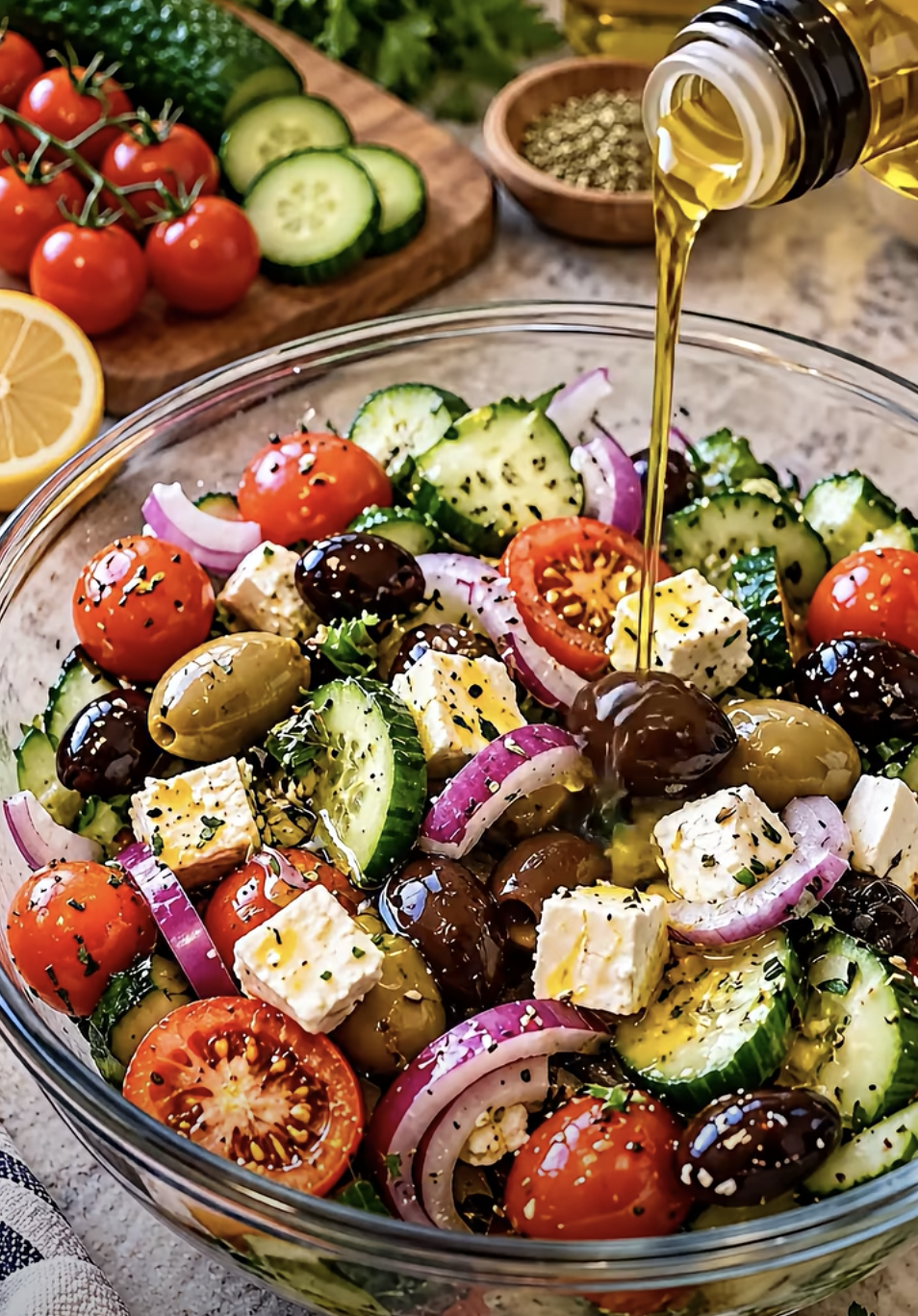
Traditional Greek Salad – Fresh, Authentic Mediterranean Recipe
Ingredients
Equipment
Method
- Wash the tomatoes, cucumber, and green bell pepper under cool running water. Pat dry with a clean kitchen towel.
- Cut the tomatoes into generous wedges and slice the cucumber into thick half-moons.
- Remove the seeds from the green bell pepper and slice into thin strips. Peel and thinly slice the red onion.
- Place tomatoes, cucumber, green bell pepper, and red onion into a large serving bowl. Add Kalamata olives and optional drained capers. Toss gently.
- Whisk extra virgin olive oil, red wine vinegar, dried oregano, sea salt, and freshly ground black pepper in a small bowl until combined.
- Pour the dressing over the prepared vegetables. Toss gently until evenly coated.
- Place the thick feta cheese slices or block on top of the dressed vegetables.
- Sprinkle with a little extra oregano and drizzle lightly with additional olive oil if desired. Serve immediately at room temperature or slightly chilled.
Notes
Why Traditional Greek Salad Is So Delicious
The Fresh Mediterranean Ingredients Make All the Difference
Traditional Greek Salad stands out because it highlights the natural flavors of fresh vegetables rather than hiding them under a heavy dressing.
Ripe tomatoes provide sweetness, acidity, and plenty of juicy flavor. Meanwhile, cucumbers add a refreshing crunch that balances the softer tomatoes.
Green bell peppers contribute a slightly grassy, crisp flavor, while red onions add a pleasant sharpness.
Kalamata olives bring a salty, fruity richness that gives the salad its distinctive Mediterranean character.
Finally, feta cheese adds a creamy, tangy contrast that complements the vegetables beautifully.
Each ingredient contributes something important.
The tomatoes create juiciness, the cucumbers and peppers provide crunch, and the olives add depth. The feta cheese brings everything together with its rich, savory flavor.
Another reason this salad tastes so satisfying is its simplicity.
Instead of using a complicated dressing, traditional recipes rely on extra virgin olive oil, oregano, and sometimes red wine vinegar.
These ingredients enhance the vegetables without overpowering them.
For the best flavor, choose ripe, seasonal produce and good-quality feta cheese.
Because this salad contains relatively few ingredients, freshness makes a noticeable difference.
A Healthy, Quick, and Versatile Side Dish
Traditional Greek Salad offers several practical advantages that make it perfect for everyday meals.
First, you can prepare it in approximately 15 minutes without turning on the stove or oven.
Second, it uses ingredients that you can easily find in most grocery stores.
Third, it fits naturally into a Mediterranean-style eating pattern that emphasizes vegetables, olive oil, and minimally processed foods.
This salad provides fiber from fresh vegetables and unsaturated fats from olive oil and olives.
Feta cheese also contributes protein and calcium, although it adds sodium.
Additionally, the combination of vegetables, cheese, and olive oil makes the salad flavorful and satisfying.
You can serve it alongside:
- Grilled chicken or chicken souvlaki
- Baked salmon or grilled shrimp
- Lamb kebabs or grilled steak
- Warm pita bread and hummus
- Roasted vegetables and Mediterranean rice
- Falafel or other vegetarian dishes
The salad also works beautifully as part of a summer lunch or a larger mezze-style spread.
Because it contains no lettuce, the vegetables maintain their structure better than delicate leafy greens.
However, for the freshest texture, add the dressing shortly before serving.
Essential Ingredients for an Authentic Traditional Greek Salad
Choosing Tomatoes, Cucumbers, Peppers, and Olives
The secret to a memorable Traditional Greek Salad begins with selecting excellent vegetables.
Tomatoes form the foundation of the dish, so choose ripe, juicy varieties with a sweet aroma.
Medium vine-ripened tomatoes work beautifully. However, you can also use ripe heirloom tomatoes for additional color and flavor.
Cut the tomatoes into generous wedges rather than tiny cubes.
Larger pieces retain their texture and release delicious juices that blend with the olive oil dressing.
For the cucumber, choose a firm, fresh variety.
English cucumbers offer thin skins and fewer seeds, making them convenient for this recipe.
Alternatively, use a regular cucumber and peel some or all of the skin if it tastes bitter.
Slice the cucumber into thick half-moons to maintain a satisfying crunch.
Green bell pepper adds the characteristic flavor that distinguishes traditional Greek salad from many other tomato and cucumber salads.
Remove the seeds and slice the pepper into thin strips.
Red onion contributes sharpness and color.
If you prefer a milder onion flavor, soak the slices in cold water for about 10 minutes, then drain thoroughly.
For the olives, choose authentic Kalamata olives whenever possible.
Their deep purple color, meaty texture, and fruity flavor complement the feta and tomatoes.
Capers are optional, but they add another salty, tangy element.
Selecting Feta Cheese and Making the Olive Oil Dressing
Feta cheese plays a central role in Traditional Greek Salad.
For an authentic flavor, choose Greek feta made from sheep’s milk or a combination of sheep’s and goat’s milk.
Traditional Greek feta has a pleasantly tangy flavor and a creamy yet slightly crumbly texture.
Whenever possible, buy feta in a block rather than purchasing pre-crumbled cheese.
Block feta generally offers a better texture and makes the classic presentation easier.
Place a thick slice of feta directly on top of the vegetables instead of mixing small crumbles throughout the salad.
This creates the familiar Greek village salad appearance.
The dressing requires only a few ingredients.
Extra virgin olive oil provides richness and a smooth, fruity flavor.
Red wine vinegar adds brightness, while dried oregano contributes a fragrant Mediterranean aroma.
Sea salt enhances the vegetables, and freshly ground black pepper adds gentle warmth.
Whisk the ingredients together until combined.
However, don’t worry if the dressing separates slightly. Olive oil and vinegar naturally separate without an emulsifier.
Simply whisk again before pouring it over the vegetables.
For the most authentic approach, you can drizzle the olive oil and vinegar directly over the salad and sprinkle the oregano on top.
Either method creates a delicious result.
How to Make Traditional Greek Salad Step by Step
Preparing and Cutting the Fresh Vegetables
Making Traditional Greek Salad requires very little preparation, but the way you cut the vegetables influences the finished texture.
Start by washing the tomatoes, cucumber, and green bell pepper under cool running water.
Dry them gently with a clean kitchen towel.
Next, cut the tomatoes into medium-sized wedges.
Avoid chopping them too finely because larger wedges create the juicy, rustic texture associated with Greek village salad.
Slice the cucumber lengthwise, then cut it into thick half-moons.
If you use a small cucumber, you can cut it into thick rounds instead.
Remove the stem and seeds from the green bell pepper.
Then slice the pepper into thin strips.
Peel the red onion and slice it into thin half-moons.
For a milder flavor, soak the onion slices briefly in cold water before adding them to the salad.
Next, drain the Kalamata olives.
If your olives contain pits, remove them before serving or clearly inform guests that the olives still have pits.
Finally, drain the capers if you plan to include them.
Place the tomatoes, cucumber, bell pepper, and red onion into a large serving bowl.
Add the olives and optional capers.
Gently toss the vegetables to distribute everything evenly.
Avoid vigorous mixing because it can crush the tomatoes and release too much liquid.
Mixing the Dressing and Assembling the Salad
Once you prepare the vegetables, the remaining steps take only a few minutes.
In a small bowl, combine extra virgin olive oil, red wine vinegar, dried oregano, sea salt, and freshly ground black pepper.
Whisk until the ingredients blend together.
Taste the dressing and adjust the seasoning if necessary.
Remember that feta cheese, olives, and capers already contain salt, so you may need less additional salt than expected.
Pour the dressing over the prepared vegetables.
Next, gently toss everything until the dressing lightly coats the tomatoes, cucumber, peppers, and onions.
Allow the vegetables to sit for approximately five minutes if you want their juices to mingle with the dressing.
Then place the feta cheese on top.
You can use one large block or several thick slices.
Sprinkle a little additional dried oregano over the feta.
For a beautiful finishing touch, drizzle a small amount of extra virgin olive oil over the cheese.
Serve the Traditional Greek Salad immediately at room temperature or slightly chilled.
Room-temperature tomatoes often deliver a fuller flavor than very cold tomatoes.
If you prepared the ingredients in advance, let the salad sit outside the refrigerator briefly before serving, while keeping food safety in mind.
Pair it with warm pita bread to soak up the flavorful tomato juices and olive oil dressing.
Expert Tips, Variations, and Storage Ideas
Simple Tips for the Best Greek Salad Every Time
A few thoughtful details can elevate Traditional Greek Salad from good to exceptional.
First, use the ripest tomatoes you can find.
Because tomatoes provide much of the salad’s flavor and moisture, their quality makes a major difference.
Second, avoid cutting the vegetables into very small pieces.
Traditional Greek salad has a rustic appearance, with generous tomato wedges and thick cucumber slices.
Larger pieces also help the vegetables retain their crisp texture.
Third, choose high-quality extra virgin olive oil.
A fruity, flavorful olive oil complements the fresh vegetables and enhances the entire dish.
Fourth, use block feta instead of pre-crumbled feta.
The thick slice creates a beautiful presentation and delivers a richer texture.
Another helpful tip involves the red onion.
If the onion tastes especially sharp, soak the slices in cold water for 10 minutes before adding them to the bowl.
This softens the intensity without removing the onion’s pleasant crunch.
Finally, avoid overdressing the salad.
You want enough olive oil and vinegar to enhance the vegetables, but not so much that the ingredients swim in dressing.
Taste before adding extra salt, especially when using salty feta, olives, and capers.
Delicious Variations and Proper Storage
Although Traditional Greek Salad follows a simple formula, you can make small adjustments to suit your preferences.
For a milder salad, reduce the amount of red onion.
If you prefer extra tanginess, add a little more red wine vinegar.
For a stronger herbal flavor, sprinkle additional dried oregano over the feta before serving.
You can also add extra cucumber for more crunch or use a combination of colorful ripe tomatoes.
However, if you want to maintain the traditional Greek village salad style, skip lettuce and heavy creamy dressings.
Some modern variations include chickpeas, grilled chicken, or quinoa.
These additions can create a more substantial meal, although they move the dish away from its traditional form.
For storage, place leftover salad in an airtight container and refrigerate promptly.
Enjoy it within one to two days for the best texture.
The tomatoes will release additional liquid over time, and the cucumbers may gradually soften.
Therefore, this salad tastes best shortly after preparation.
If you want to prepare it ahead of time, chop the vegetables and store them separately from the dressing and feta.
Then combine everything shortly before serving.
Avoid freezing Greek salad because thawing damages the texture of the fresh vegetables.
Ingredients
Servings: 4 | Prep time: 15 minutes | Cook time: 0 minutes | Total time: 15 minutes
For the Salad
- 4 medium ripe tomatoes, cut into wedges
- 1 large cucumber, sliced into thick half-moons
- 1 green bell pepper, thinly sliced
- ½ medium red onion, thinly sliced
- ¾ cup Kalamata olives
- 7 ounces (200 g) feta cheese, cut into thick slices or kept as a large block
- 1 tablespoon capers, drained (optional)
For the Dressing
- ¼ cup extra virgin olive oil
- 1 tablespoon red wine vinegar
- 1 teaspoon dried oregano
- ½ teaspoon sea salt, or to taste
- ¼ teaspoon freshly ground black pepper
Instructions
1. Wash the vegetables. Rinse the tomatoes, cucumber, and green bell pepper under cool running water. Pat dry with a clean kitchen towel.
2. Cut the tomatoes and cucumber. Slice the tomatoes into generous wedges. Cut the cucumber into thick half-moons.
3. Prepare the pepper and onion. Remove the seeds from the green bell pepper and slice it into thin strips. Peel and thinly slice the red onion.
4. Assemble the vegetables. Place the tomatoes, cucumber, bell pepper, and red onion in a large serving bowl. Add the Kalamata olives and optional capers.
5. Prepare the dressing. In a small bowl, whisk together extra virgin olive oil, red wine vinegar, dried oregano, sea salt, and black pepper.
6. Dress the salad. Pour the dressing over the vegetables and gently toss until everything has an even coating.
7. Add the feta cheese. Place the feta block or thick feta slices on top of the salad.
8. Finish and serve. Sprinkle with a little extra oregano and drizzle lightly with additional olive oil if desired. Serve immediately at room temperature or slightly chilled.
Frequently Asked Questions
1. What makes Traditional Greek Salad different from regular Greek salad?
Traditional Greek Salad, also known as horiatiki, typically contains tomatoes, cucumbers, green bell peppers, red onions, Kalamata olives, feta cheese, oregano, and olive oil.
Unlike many American-style Greek salads, it doesn’t contain lettuce.
The vegetables have a rustic, chunky appearance, and the feta usually sits on top in a thick slice or block.
Traditional versions also avoid creamy bottled dressings.
Instead, olive oil, oregano, and sometimes vinegar provide the main seasoning.
2. Can I make Traditional Greek Salad ahead of time?
Yes, but the salad tastes best when you assemble it shortly before serving.
You can wash and cut the vegetables several hours in advance.
Store them in airtight containers in the refrigerator.
Keep the dressing and feta separate until you’re ready to serve.
Then combine the vegetables, add the dressing, and finish with the feta.
This approach helps maintain the fresh, crisp texture.
3. What type of feta cheese works best for Greek salad?
Authentic Greek feta made from sheep’s milk or a combination of sheep’s and goat’s milk works especially well.
It offers a tangy flavor and a creamy, slightly crumbly texture.
Choose feta that comes in a block, preferably packed in brine.
Block feta maintains its moisture and creates the classic Greek salad presentation.
Avoid pre-crumbled feta when possible because it can taste drier.
4. Is Traditional Greek Salad healthy?
Traditional Greek Salad can be a nutritious addition to a balanced diet.
It contains fresh vegetables that provide fiber, vitamins, and antioxidants.
Extra virgin olive oil supplies mostly monounsaturated fats, while feta contributes protein and calcium.
However, feta cheese, Kalamata olives, and capers can contain significant amounts of sodium.
If you’re watching your sodium intake, reduce the added salt or use smaller portions of the salty ingredients.
5. What can I serve with Traditional Greek Salad?
Traditional Greek Salad pairs beautifully with many Mediterranean-inspired dishes.
Popular options include grilled chicken, lamb kebabs, baked fish, grilled shrimp, and warm pita bread.
You can also serve it with hummus, roasted potatoes, falafel, or rice dishes.
For a light summer meal, enjoy a generous portion with crusty bread.
The bread tastes especially delicious when you use it to soak up the tomato juices and olive oil dressing at the bottom of the bowl.
Conclusion
Traditional Greek Salad proves that fresh ingredients and simple preparation can create an incredibly flavorful dish.
Juicy tomatoes, crunchy cucumbers, crisp green peppers, red onions, Kalamata olives, and creamy feta cheese combine beautifully with extra virgin olive oil and fragrant oregano.
With just 15 minutes of preparation and no cooking required, this classic Mediterranean salad makes a convenient addition to everyday lunches, summer dinners, and special gatherings.
Its vibrant colors, refreshing texture, and balanced flavors make it a wonderful side dish for grilled meats, seafood, and vegetarian meals.
Whether you’re exploring Mediterranean cuisine or simply looking for an easy way to enjoy more fresh vegetables, Traditional Greek Salad delivers delicious results with very little effort.