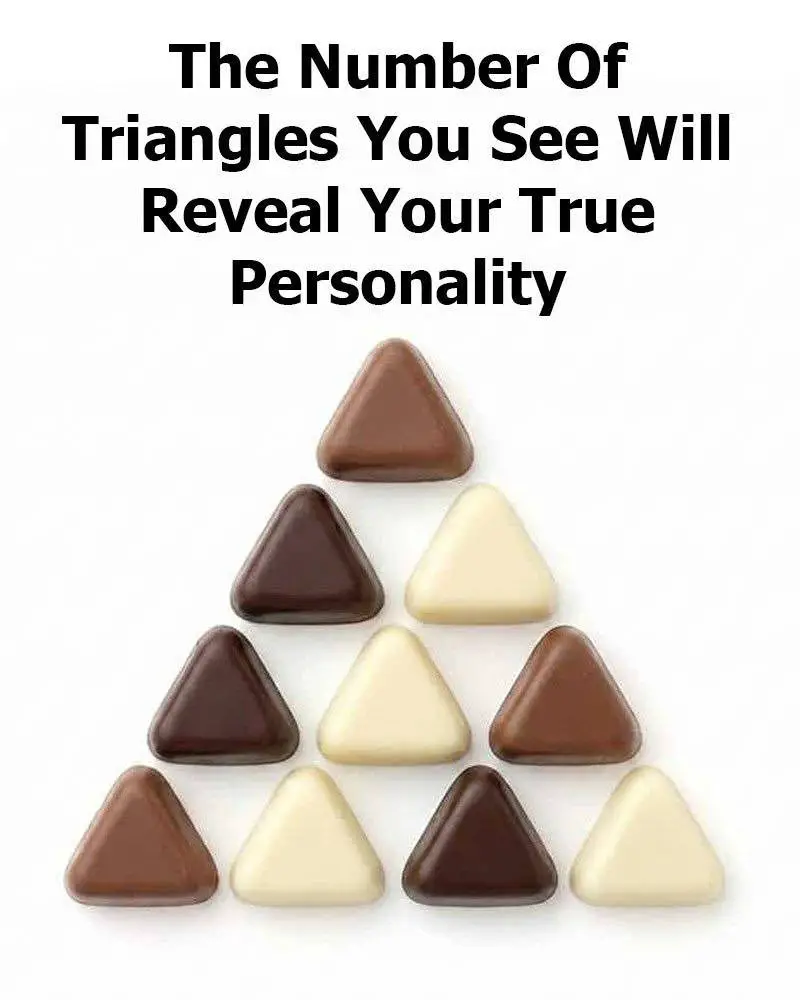
At first glance, the image looks incredibly simple. A few chocolate-colored triangles stacked neatly into a larger triangular shape. Easy enough, right?
But then something strange happens.
You begin counting.
One triangle becomes three. Three become seven. Suddenly you notice hidden shapes tucked between the obvious ones. Larger triangles emerge from smaller ones. Your eyes move back and forth across the image as your brain tries to organize what it sees.
Before long, you realize this isn’t just a counting game anymore.
It’s a fascinating little experiment in perception.
Visual puzzles like this have become wildly popular online because they trigger something deep inside the human brain: our instinct to search for patterns, organize information, and make meaning out of what we see. Some people glance at the image and instantly settle on a number. Others spend several minutes analyzing every angle, convinced there must be more triangles hiding in plain sight.
And that difference says something interesting about how we process the world around us.
The image above asks a playful question:
“How many triangles do you see?”
But the more interesting question may actually be:
“How does your mind approach the challenge?”
🔍 Why Triangle Puzzles Fascinate Us
Human brains are wired to recognize shapes and patterns quickly. It’s part of survival instinct. Long before modern life existed, our ancestors needed to identify danger, movement, shelter, and pathways in seconds.
Today, that same pattern-recognition ability shows up in puzzles like this.
When you look at the triangle arrangement, your brain immediately starts sorting information:
- Which shapes count?
- Which lines belong together?
- Are hidden triangles included?
- Should overlapping shapes count?
Different people answer those questions differently without even realizing it.
That’s why one person confidently says “10,” while another insists there are “24.”
Neither person is necessarily wrong. They’re simply perceiving the image through a different cognitive lens.
🧠 What Your First Count Might Say About You
While this puzzle is meant for fun and reflection rather than scientific diagnosis, the way you approach it can reveal interesting tendencies about your thinking style.
If You Saw a Smaller Number First
You likely focus on the obvious and immediate shapes.
This often suggests:
- Fast decision-making
- Confidence in first impressions
- Practical thinking
- Efficiency over overanalysis
You probably prefer clarity and action over endless deliberation.
In everyday life, this can make you decisive, productive, and straightforward. However, you may occasionally overlook subtle details hiding beneath the surface.
If You Saw a Medium Number
You probably examined the image more carefully before answering.
This can suggest:
- Attention to detail
- Patience
- Curiosity
- Analytical thinking
You enjoy solving problems methodically rather than rushing.
People with this style often excel in situations requiring focus, observation, and careful reasoning.
If You Saw a Very Large Number
You likely searched deeply for hidden combinations and overlapping shapes.
This may reflect:
- Systems thinking
- High pattern recognition
- Deep analysis
- Creative problem-solving
You naturally look beyond the obvious and enjoy uncovering complexity.
The downside? Sometimes your brain may overcomplicate simple situations because it constantly searches for deeper layers.
🔺 The Psychology Behind Visual Puzzles
These puzzles work because they activate several fascinating psychological processes.
1. Pattern Recognition
Your brain automatically groups lines and shapes together to create order.
Some people prioritize simple structures. Others instinctively search for hidden combinations.
2. Selective Attention
Once you lock onto a certain number of triangles, your brain tends to focus on evidence supporting that count.
Psychologists call this confirmation bias.
You literally begin seeing what you expect to see.
3. The “Aha!” Effect
Every time you discover a hidden triangle, your brain experiences a tiny dopamine reward.
That little burst of satisfaction is why visual puzzles feel strangely addictive.
📐 Is There Actually a Correct Answer?
Mathematically, triangle puzzles can become surprisingly complicated depending on:
- Whether inverted triangles count
- Whether overlapping shapes count
- Whether partial outlines count
- How deeply the subdivisions are analyzed
Many online triangle puzzles spark arguments because people define “triangle” differently during counting.
That ambiguity is intentional.
The uncertainty keeps the puzzle engaging.
🌟 Why People Love Personality Puzzles
Even though these quizzes are not scientific personality assessments, millions of people enjoy them because they encourage self-reflection.
They feel personal.
They spark conversation.
They invite curiosity.
And most importantly, they reveal how differently people interpret the exact same image.
That alone is fascinating.
Two intelligent people can stare at identical shapes and walk away with completely different conclusions.
That’s true not only for puzzles — but for life itself.
💡 What This Puzzle Really Teaches
The real lesson isn’t about triangles.
It’s about perspective.
Some people rush toward answers.
Others slow down and investigate.
Some trust instinct.
Others trust analysis.
Neither approach is automatically better. Different situations require different strengths.
Quick thinkers move the world forward.
Careful observers prevent mistakes.
Systems thinkers discover hidden connections.
Creative analyzers uncover possibilities others never notice.
The world needs all of them.
🧩 A Simple Reflection Exercise
Instead of asking:
“How many triangles are there?”
Try asking yourself:
“How did I approach the challenge?”
Did you:
- Answer immediately?
- Double-check your count?
- Feel frustrated?
- Enjoy the process?
- Keep searching for hidden shapes?
Your reaction may reveal more about your thinking style than the actual number ever could.
⚠️ Important Reality Check
Despite the dramatic title, this puzzle cannot truly determine:
- Intelligence
- Emotional depth
- Relationship compatibility
- Career potential
- Mental health
- Personality type
Real personality assessment requires much deeper psychological evaluation.
This image is entertainment — thoughtful entertainment — but still entertainment.
And that’s perfectly okay.
Sometimes fun little puzzles help us reflect on ourselves in surprisingly meaningful ways.
🌈 Final Thoughts
The number of triangles you see does not define who you are.
But the way you search for them might reveal something interesting about how your mind works.
Maybe you’re someone who trusts first impressions.
Maybe you’re naturally analytical.
Maybe you love uncovering hidden layers others miss.
Whatever your approach, the puzzle reminds us of something important:
People do not all see the world the same way.
And that difference is not a flaw.
It’s what makes human thinking so fascinating.
So whether you counted 10 triangles or 30, don’t worry too much about getting the “right” answer.
The real value comes from the curiosity, conversation, and reflection the puzzle creates.
And honestly?