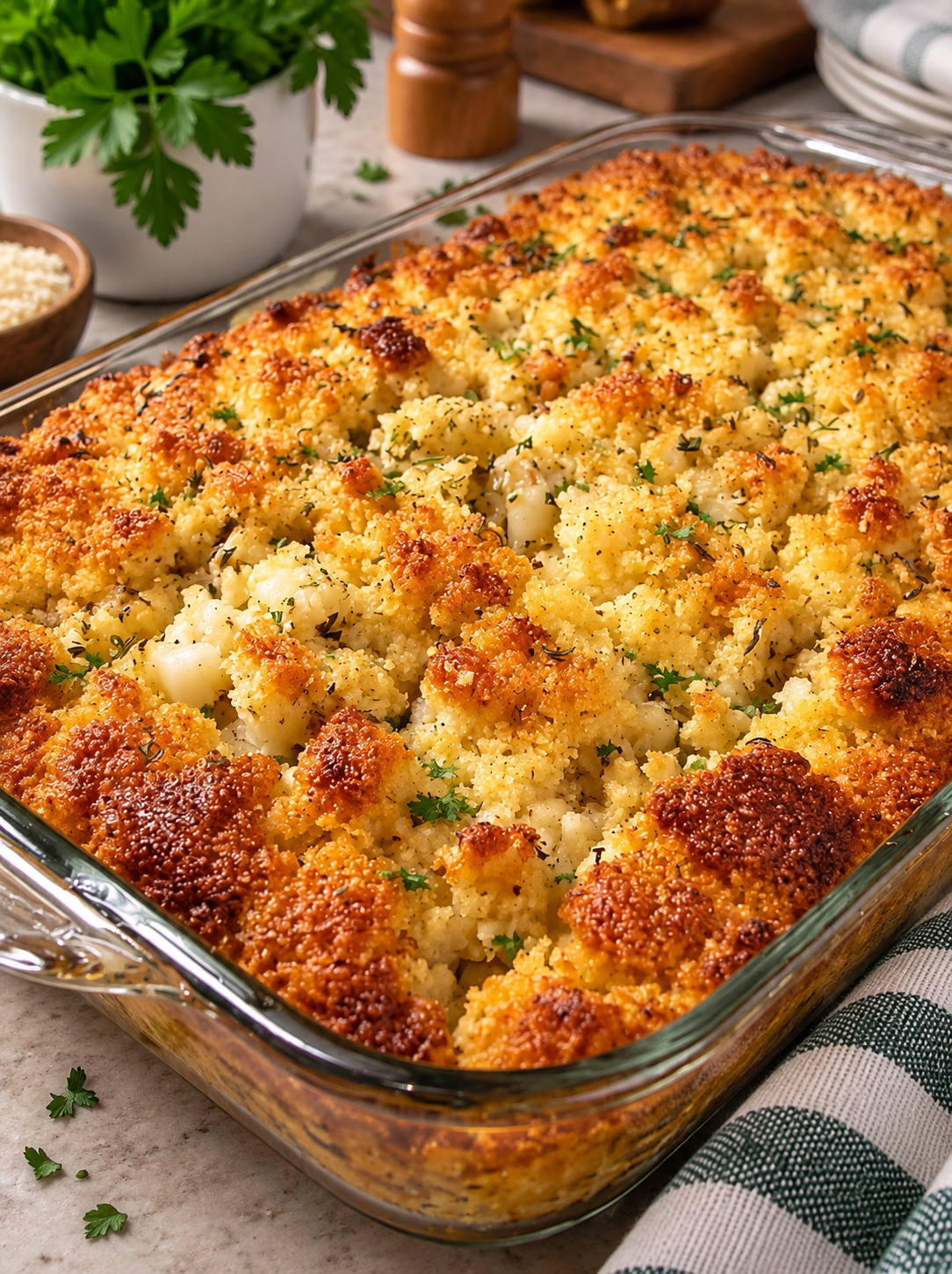
Southern Cornbread Dressing brings classic comfort to the table with tender crumbled cornbread, buttery onions and celery, fragrant sage, thyme, rich broth, and eggs that hold everything together. The center stays moist and soft, while the top develops lightly golden edges that make every serving especially satisfying.
This Southern Cornbread Dressing works beautifully for Thanksgiving, Christmas, Sunday dinner, and any gathering where you want a traditional side dish that feeds a crowd. Unlike bread-based stuffing, this version begins with crumbled cornbread. Therefore, it has a distinct texture and a warm corn flavor that pairs naturally with turkey, chicken, gravy, green beans, mashed potatoes, and other familiar sides.
The most important part of the recipe involves moisture. Cornbread absorbs broth quickly, so the mixture should look very moist before it enters the oven. However, it should not look soupy. When you add the broth gradually, you can easily control the final texture.
I remember making a pan of dressing for a family dinner after realizing how much the small details mattered. I had always assumed you could simply crumble cornbread, add broth, and bake it. Instead, slowly cooking the onion and celery in butter made the whole kitchen smell savory before the casserole even reached the oven. I also learned not to rush the broth. Once the crumbled cornbread became moist but still held its shape, I knew the texture was right. The finished dressing came out tender in the middle, lightly crisp around the edges, and full of sage and buttery flavor. Since then, I have always trusted the mixture more than a fixed amount of broth.
Why Southern Cornbread Dressing Has the Best Classic Texture
Day-Old Cornbread Creates a Tender, Moist Center
The foundation of Southern Cornbread Dressing is cornbread, and slightly dried cornbread gives the best results.
Fresh cornbread contains plenty of moisture. Therefore, it can become overly soft when you add several cups of broth. Day-old cornbread, on the other hand, absorbs seasoned liquid while still keeping some structure.
You can prepare the cornbread one or two days ahead.
For a simple homemade version, combine 1 1/2 cups yellow cornmeal, 1/2 cup all-purpose flour, 1 tablespoon baking powder, and 1/2 teaspoon salt.
In another bowl, whisk together 1 cup buttermilk, 1 large egg, and 1/4 cup melted butter.
Then pour the wet ingredients into the dry ingredients.
Stir only until the batter comes together.
Avoid overmixing because too much stirring can make the cornbread dense.
Transfer the batter to a greased 9-inch square pan.
Bake at 400°F for about 20 to 25 minutes, or until the top looks golden and a toothpick inserted into the center comes out clean.
Let the cornbread cool completely.
Then leave it uncovered for several hours or overnight.
Once dry enough, crumble about 8 cups into a large mixing bowl.
A mixture of fine crumbs and slightly larger pieces works well.
The smaller crumbs absorb broth and help bind the Southern Cornbread Dressing. Meanwhile, the larger pieces give the finished casserole more texture.
If you already have a favorite unsweetened or lightly sweetened cornbread recipe, you can use it instead. You can also use a convenient boxed mix when needed.
Butter, Onion, Celery, and Herbs Build Savory Flavor
While cornbread creates the structure, the vegetables and herbs give Southern Cornbread Dressing its classic savory flavor.
Melt 6 tablespoons butter in a large skillet over medium heat.
Then add 1 finely chopped medium yellow onion and 3 finely chopped celery stalks.
Cook the vegetables for about 7 to 10 minutes.
Stir occasionally.
During this time, the onion should turn translucent and the celery should soften.
Do not rush this step.
Slowly cooking the vegetables in butter gives them time to release their flavor. As a result, the finished dressing tastes deeper and more balanced.
Once the vegetables soften, add them to the crumbled cornbread.
Then sprinkle in 1 teaspoon dried sage, 1 teaspoon dried thyme, and 1/2 teaspoon black pepper.
If you enjoy fresh parsley, add a small handful of chopped leaves.
Sage gives Southern Cornbread Dressing its familiar holiday flavor. However, sage tastes strong, so the measured amount creates a good starting point.
Thyme adds another savory herbal layer without overpowering the cornbread.
At this point, gently toss the mixture so the vegetables and herbs spread throughout the crumbs.
You should see small pieces of celery and onion in every part of the bowl.
That even distribution matters because it keeps one serving from tasting plain while another tastes heavily seasoned.
You can add more herbs if you prefer, but start modestly. Broth and gravy will also add flavor later.
How to Make Southern Cornbread Dressing Step by Step
Add the Broth Slowly for the Right Consistency
After combining the cornbread, vegetables, and herbs, begin adding the broth.
You will need about 3 to 4 cups chicken or turkey broth.
Start with approximately 3 cups.
Pour the broth gradually over the cornbread while gently stirring.
Do not pour all 4 cups into the bowl at once.
Different batches of cornbread absorb different amounts of liquid. Therefore, a fixed amount does not always produce the same texture.
Day-old cornbread may need more broth.
Meanwhile, fresher cornbread may need less.
The mixture for Southern Cornbread Dressing should look very moist before baking.
When you scoop it with a spoon, it should hold together loosely.
However, you should not see a pool of broth at the bottom of the bowl.
If the mixture still looks dry or crumbly after 3 cups, add more broth a little at a time.
Stir gently after each addition.
Then give the cornbread a moment to absorb the liquid before deciding whether it needs more.
This gradual method helps prevent both dry and mushy dressing.
Once the moisture looks right, beat 2 large eggs in a small bowl.
Pour them into the dressing mixture.
Stir until the eggs distribute evenly.
The eggs help bind the cornbread as it bakes. Consequently, the casserole becomes tender but scoopable instead of falling apart completely.
Season with salt to taste.
However, remember that prepared chicken or turkey broth may already contain plenty of sodium.
Therefore, taste carefully before adding much additional salt.
Bake Until Set With Lightly Golden Edges
Once your Southern Cornbread Dressing mixture reaches the right consistency, prepare a 9-by-13-inch baking dish.
Lightly grease the dish with butter or cooking spray.
Then spoon the mixture into the pan.
Spread it evenly from corner to corner.
Use the back of a spoon or spatula to smooth the surface gently.
Do not pack the dressing down tightly.
A lighter touch helps preserve a tender texture.
If you want extra richness, place a few small pieces of butter over the top.
Lower the oven temperature to 375°F.
Then bake the Southern Cornbread Dressing uncovered for about 40 to 50 minutes.
The center should become set.
Meanwhile, the top should turn lightly golden, especially around the edges.
Avoid baking much longer than necessary.
Overbaking removes moisture and can turn a tender dressing into a dry casserole.
Check the center around the 40-minute mark.
It should no longer appear wet or loose.
However, it should still look moist.
Once the dressing reaches that point, remove it from the oven.
Let it rest for about 10 minutes.
This resting period helps the interior settle and makes serving easier.
The edges may become slightly firmer during the rest, while the center remains soft.
Serve Southern Cornbread Dressing warm.
Turkey or chicken gravy makes a classic finishing touch, especially during holiday meals.
How to Keep Southern Cornbread Dressing Moist and Flavorful
Watch the Broth Instead of Following One Exact Amount
The easiest way to ruin Southern Cornbread Dressing is to focus only on a measured amount of broth instead of watching the texture.
Cornbread behaves differently depending on its age, recipe, and moisture level.
Therefore, one batch may absorb 3 cups comfortably while another needs nearly 4 cups.
Start conservatively.
Then continue adding broth until the mixture becomes thoroughly moistened.
Before baking, the dressing should look wetter than the finished casserole.
That detail surprises many beginners.
The oven will evaporate some liquid, while the cornbread continues absorbing broth.
Consequently, a mixture that already looks dry before baking will usually come out even drier.
At the same time, you should not make the mixture watery.
If broth collects in the bottom of the bowl, you may have added too much.
Another important tip involves baking time.
Take the Southern Cornbread Dressing out once the center sets and the surface becomes lightly golden.
Do not keep baking simply because you want a darker crust.
If you prefer more color, you can let the edges brown slightly, but protect the moist interior.
Freshly baked cornbread also needs special attention.
If you have no time to make the cornbread a day ahead, crumble it onto a baking sheet.
Then leave it uncovered for several hours.
Alternatively, place the crumbs briefly in a low oven to remove some excess moisture.
That extra drying time improves broth absorption and gives the finished dressing a better texture.
Customize the Dressing With Meat, Eggs, or Fresh Herbs
Traditional Southern Cornbread Dressing invites plenty of family variations.
For a heartier version, fold in shredded cooked chicken or turkey.
This addition works especially well when you have leftover roasted poultry.
You can also brown breakfast sausage.
Drain the excess fat.
Then stir the sausage into the cornbread mixture before baking.
The sausage adds richness and a savory flavor that pairs well with sage and thyme.
Some Southern families also add chopped hard-boiled eggs.
The eggs create another layer of texture and make the dressing feel especially traditional for certain holiday tables.
For Thanksgiving, turkey broth makes an excellent choice.
It reinforces the flavor of the holiday meal and pairs naturally with turkey gravy.
Chicken broth works equally well throughout the year.
Fresh herbs offer another easy variation.
Add chopped parsley for freshness.
Use a little fresh thyme for a brighter herbal note.
Rosemary can also work, although its flavor is stronger. Therefore, use it sparingly.
You can also add a little poultry seasoning if you enjoy a more pronounced holiday flavor.
When customizing Southern Cornbread Dressing, avoid adding too many competing flavors.
Cornbread, onion, celery, butter, sage, thyme, and broth should still form the main foundation.
Simple additions usually work better than a long list of ingredients.
That restraint helps the dressing stay familiar and comforting.
Serving, Make-Ahead, and Storage Tips for Southern Cornbread Dressing
Prepare It Ahead for Easier Holiday Cooking
Southern Cornbread Dressing works especially well for holiday meal planning because several steps can happen ahead of time.
First, bake the cornbread one or two days before you need the casserole.
Once cool, leave it uncovered long enough to dry slightly.
Then store it until you are ready to assemble the dressing.
You can also chop the onion and celery ahead.
Keep them refrigerated in a covered container.
When you are ready, sauté them in butter and continue with the recipe.
For even more convenience, assemble the entire Southern Cornbread Dressing one day before baking.
Spread the prepared mixture in the greased baking dish.
Then cover the dish tightly and refrigerate it.
Keep the unbaked dressing cold until you are ready to cook it.
Because a refrigerated casserole starts much colder than a freshly assembled one, it may need a little extra time in the oven.
Check the center rather than relying only on the clock.
The dressing should look set throughout and feel hot in the middle.
Preparing the dish ahead can make Thanksgiving or Christmas cooking significantly easier.
Instead of mixing everything while other dishes compete for counter space, you can simply move the casserole from the refrigerator to the oven at the appropriate time.
You can also bake the dressing earlier and reheat it before serving.
If you do, cover it loosely while reheating to help protect the moisture.
A splash of broth over individual portions can also revive dressing that feels a little dry.
Freeze Leftovers and Pair Them With Classic Sides
Southern Cornbread Dressing freezes well, which makes leftovers easy to save.
First, let baked dressing cool.
Then transfer portions to airtight freezer-safe containers or wrap them securely.
Smaller portions often reheat more evenly than one large frozen block.
When you want to serve the dressing again, thaw it in the refrigerator.
Then reheat it until hot throughout.
The texture may become slightly softer after freezing, but the savory flavor still works beautifully.
For refrigerated leftovers, store the dressing in a covered container.
Reheat only the portion you plan to serve.
A little broth or gravy can help restore moisture.
Southern Cornbread Dressing pairs especially well with roast turkey and baked chicken.
Turkey gravy or chicken gravy adds extra richness.
Mashed potatoes make another classic holiday companion.
For vegetables, try green beans, collard greens, roasted Brussels sprouts, or glazed carrots.
Cranberry sauce offers a bright, tangy contrast to the savory herbs.
Sweet potato casserole creates another traditional pairing.
Macaroni and cheese makes the meal even more comforting.
Finally, warm dinner rolls or biscuits help complete the table.
Although Southern Cornbread Dressing often appears during Thanksgiving and Christmas, you do not need to save it for one season.
Serve it with roast chicken for Sunday dinner.
Add shredded poultry for a heartier casserole.
Or make a smaller holiday-style meal whenever you want the familiar flavor of sage, buttery vegetables, cornbread, and gravy.
Frequently Asked Questions
Is Southern Cornbread Dressing the same as stuffing?
They are similar, but they are not exactly the same. Southern Cornbread Dressing traditionally uses crumbled cornbread and bakes in a separate casserole dish. Stuffing often uses bread cubes and may traditionally cook inside poultry.
Why did my Southern Cornbread Dressing turn out dry?
The mixture may not have contained enough broth, or the dressing may have baked too long. Before baking, the cornbread mixture should look very moist but not watery.
Why did my dressing turn out mushy?
Too much broth can create an overly soft texture. Add the broth gradually and stop when the mixture looks moist and spoonable without liquid pooling at the bottom.
Can I use a boxed cornbread mix?
Yes. A boxed cornbread mix offers a convenient shortcut. For the best texture, bake the cornbread first, cool it, crumble it, and let it dry slightly before making the dressing.
Can I make Southern Cornbread Dressing the day before?
Yes. Assemble the dressing, cover it tightly, and refrigerate it until you are ready to bake. A chilled casserole may need a little additional baking time.
Conclusion
Southern Cornbread Dressing combines simple ingredients into one of the most comforting traditional side dishes.
The process begins with cornbread.
When you allow that cornbread to dry slightly, it absorbs broth more effectively and creates a tender texture without immediately turning mushy.
Next, butter-softened onion and celery add savory depth.
Sage and thyme give Southern Cornbread Dressing its familiar holiday aroma.
Chicken or turkey broth provides moisture and richness.
Finally, beaten eggs help the mixture set into a soft, scoopable casserole.
The most important technique involves adding the broth gradually.
Start with about 3 cups.
Then continue adding small amounts until the cornbread looks very moist but not watery.
That simple visual check gives you more control than pouring in one fixed amount.
Bake the dressing uncovered at 375°F until the center sets and the surface becomes lightly golden.
Then let it rest before serving.
You can keep Southern Cornbread Dressing simple or adapt it to your family’s traditions.
Add shredded turkey or chicken.
Fold in cooked sausage.
Stir in chopped hard-boiled eggs.
Use turkey broth at Thanksgiving.
Add fresh parsley or another favorite herb.
You can also prepare the cornbread ahead, assemble the entire casserole a day early, or freeze leftovers for another meal.
Serve Southern Cornbread Dressing beside turkey, baked chicken, mashed potatoes, green beans, collard greens, cranberry sauce, macaroni and cheese, or sweet potato casserole.
Then spoon warm gravy over the top.
With a moist center, fragrant herbs, buttery vegetables, and lightly golden edges, this classic casserole earns its place at both holiday tables and comforting family dinners.