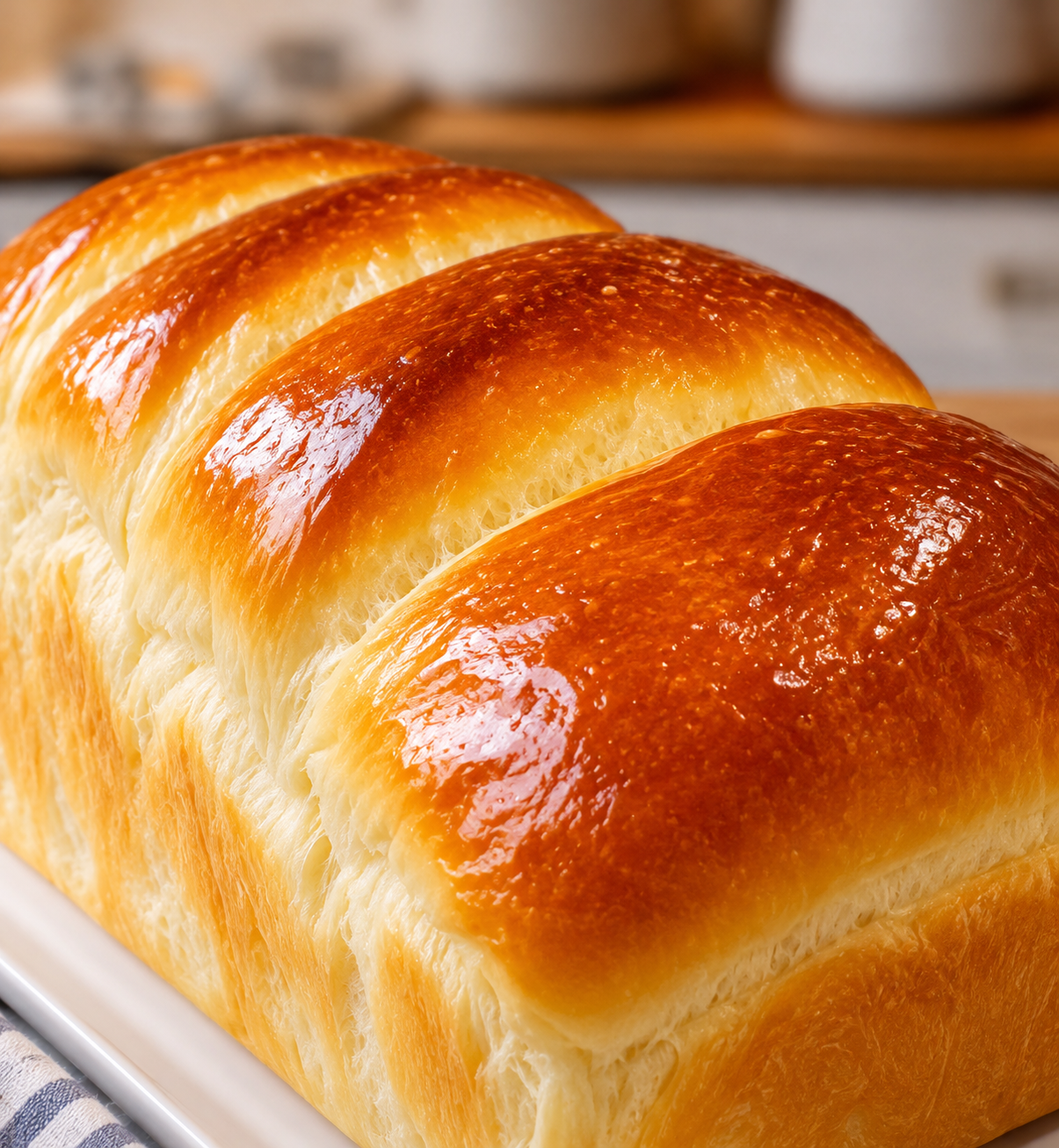
Japanese Milk Bread, also known as Shokupan, is an incredibly soft, fluffy, and slightly sweet homemade bread with a beautiful golden crust and a delicate, cotton-like interior. Its buttery flavor and pillowy texture make it perfect for breakfast, sandwiches, afternoon snacks, and simply enjoying a fresh piece with butter.
What makes this bread particularly special is the tangzhong method, which involves cooking a small portion of flour and milk into a thick paste before incorporating it into the dough. This simple technique helps the bread retain moisture and develop its wonderfully tender texture.
Imagine pulling apart a freshly baked loaf and revealing delicate strands of fluffy white bread beneath its glossy golden crust. It is the kind of homemade bread that makes an ordinary breakfast feel a little more special.
Although Japanese milk bread looks like something from a professional bakery, it can be made at home using familiar ingredients and straightforward bread-making techniques.
Japanese Milk Bread (Shokupan)
Ingredients
Equipment
Method
- Whisk 3 tablespoons bread flour and 1/2 cup whole milk in a small saucepan until completely smooth.
- Cook over medium-low heat for 2 to 3 minutes, stirring continuously until a thick, smooth paste forms and leaves visible lines on the bottom of the pan.
- Transfer the tangzhong to a small bowl, cover its surface directly with plastic wrap, and cool to room temperature for approximately 15 minutes.
- Combine the remaining bread flour, granulated sugar, instant yeast, and salt in the bowl of a stand mixer fitted with a dough hook. Add the warm milk, egg, and cooled tangzhong.
- Knead on low to medium speed for 5 to 6 minutes until a shaggy dough forms.
- Gradually add the softened butter one cube at a time, allowing each piece to incorporate before adding the next.
- Continue kneading for 8 to 10 minutes with a stand mixer or 12 to 15 minutes by hand, until the dough is smooth, elastic, and passes the windowpane test.
- Shape the dough into a smooth ball, place in a lightly greased bowl, cover, and let rise in a warm spot for 1 to 1.5 hours until doubled in size.
- Gently deflate the risen dough and divide it into 4 equal portions.
- Roll each portion into an oval approximately 8 inches long. Fold the left and right sides inward toward the center, then roll tightly from the bottom into a neat log.
- Grease a 9×5-inch or 8.5×4.5-inch loaf pan. Arrange the dough logs side by side, seam-side down.
- Cover loosely and let rise for 45 to 60 minutes, until puffy and approximately 1 inch above the rim of the pan.
- Preheat the oven to 350°F (175°C). If using egg wash, whisk the egg yolk with 1 tablespoon milk and gently brush over the risen dough.
- Bake for 28 to 32 minutes until deeply golden brown. Tent loosely with aluminum foil after 20 minutes if the top browns too quickly.
- Remove from the oven and brush with melted butter if desired. Rest in the pan for 5 minutes, then transfer to a wire rack to cool completely before slicing or pulling apart.
Notes
Why You Will Love Japanese Milk Bread
An Incredibly Soft and Fluffy Texture
The most distinctive feature of Japanese milk bread is its exceptionally tender crumb.
Unlike rustic bread with a thick, crunchy crust and chewy interior, milk bread has a soft structure that almost feels like cotton when pulled apart.
The combination of bread flour, milk, butter, and eggs creates an enriched dough with a delicate flavor and satisfying texture.
The tangzhong method makes this bread even more special.
By cooking a portion of the flour with milk before adding it to the dough, the flour absorbs and retains additional moisture.
This helps create a loaf that remains soft for longer than many conventional homemade breads.
The finished loaf has a beautiful golden-brown exterior and a light, airy interior.
When shaped into four individual sections, the bread can easily be pulled apart, revealing its delicate layers and fluffy strands.
It is particularly delicious when served with a little softened butter, although the bread is flavorful enough to enjoy on its own.
A Versatile Bread for Every Occasion
Japanese milk bread is an excellent everyday bread because its mild sweetness pairs beautifully with both sweet and savory ingredients.
For breakfast, serve thick slices with butter, strawberry jam, honey, or your favorite chocolate spread.
Its soft texture also makes it an excellent choice for sandwiches.
Use it for chicken sandwiches, egg salad, grilled cheese, or simple vegetable sandwiches.
The slightly sweet flavor complements savory fillings without overpowering them.
Milk bread also makes delicious French toast because its tender interior absorbs custard while maintaining a pleasant structure.
You can even use leftover slices to prepare bread pudding or toasted cinnamon bread.
The four-section pull-apart shape makes this loaf particularly attractive when serving it at a family meal.
Instead of slicing the entire loaf, everyone can pull away a soft portion and enjoy it with their favorite topping.
Understanding the Ingredients and Tangzhong Method
What Is Tangzhong?
Tangzhong is a cooked flour-and-liquid mixture used to improve the softness and moisture retention of bread.
For this recipe, the tangzhong is made by combining three tablespoons of bread flour with half a cup of whole milk.
The mixture is cooked gently until it thickens into a smooth, pudding-like paste.
During heating, the starches in the flour absorb liquid and gelatinize. This allows the dough to retain more moisture than it might otherwise hold.
When the cooled tangzhong is incorporated into the main dough, it contributes to a softer and more tender finished loaf.
Preparing tangzhong takes only a few minutes, but it is an important step in this recipe.
Whisk the flour and milk together before heating to prevent lumps.
Cook over medium-low heat while stirring continuously.
Once the mixture becomes thick enough to leave visible lines along the bottom of the saucepan, remove it from the heat.
Transfer the paste to a small bowl and cover its surface directly with plastic wrap.
Allow it to cool to room temperature before adding it to the dough.
Avoid adding very hot tangzhong directly to the yeast mixture, as excessive heat can damage the yeast.
Choosing the Best Ingredients for Milk Bread
Bread flour is recommended because its higher protein content helps develop the gluten structure needed for a soft yet elastic loaf.
This structure allows the dough to trap the gases produced by yeast during fermentation.
Whole milk adds moisture, richness, and a delicate dairy flavor.
Granulated sugar provides mild sweetness and contributes to the attractive golden color of the baked crust.
Instant yeast helps the dough rise and can be mixed directly with the dry ingredients.
Fine sea salt balances the sweetness and enhances the overall flavor.
Eggs contribute richness, color, and structure to the dough.
Unsalted butter creates a tender crumb and adds a delicious buttery flavor.
For best results, allow the butter to soften at room temperature before incorporating it into the dough.
Adding the butter gradually after the initial kneading stage helps the dough develop its gluten structure before becoming fully enriched.
The optional egg-and-milk glaze creates the glossy golden finish associated with bakery-style milk bread.
Brushing the freshly baked loaf with melted butter provides additional softness and shine.
You can use the egg wash, the butter finish, or both if you want a particularly glossy and tender crust.
How to Make Perfect Japanese Milk Bread
Mixing, Kneading, and the First Rise
Once the tangzhong has cooled, begin preparing the main dough.
Combine the bread flour, granulated sugar, instant yeast, and salt in the bowl of a stand mixer fitted with a dough hook.
Add the warm milk, room-temperature egg, and cooled tangzhong.
The milk should be approximately 105°F to 110°F. It should feel comfortably warm rather than hot.
Mix the ingredients on low to medium speed for five to six minutes, until a shaggy dough begins to form.
At this stage, the dough may feel slightly sticky. Avoid adding excessive flour, as this can make the finished bread dry and dense.
Gradually incorporate the softened butter, adding one cube at a time.
Allow each addition to blend into the dough before adding the next piece.
Continue kneading for approximately eight to ten minutes using a stand mixer.
If kneading by hand, the process may take approximately twelve to fifteen minutes after adding the butter.
The finished dough should feel smooth, elastic, and slightly tacky.
One useful way to check whether the dough has been kneaded sufficiently is the windowpane test.
Take a small piece of dough and gently stretch it between your fingers.
If it stretches into a thin, almost translucent membrane without tearing immediately, the gluten structure is sufficiently developed.
Shape the dough into a smooth ball and transfer it to a lightly greased bowl.
Cover the bowl and place it in a comfortably warm location.
Allow the dough to rise for approximately one to one and a half hours, or until doubled in size.
Keep in mind that rising times can vary depending on the temperature of your kitchen.
Use the appearance of the dough rather than the clock alone to determine when it is ready.
Shaping, Proofing, and Baking the Loaf
After the first rise, gently deflate the dough to release excess air.
Transfer it to a clean work surface and divide it into four equal portions.
Using four pieces creates the attractive rounded sections seen in a traditional pull-apart milk bread loaf.
You can use a kitchen scale to divide the dough evenly if you want the finished loaf to have a more uniform appearance.
Roll each portion into an oval approximately eight inches long.
Fold the left and right sides inward toward the center, creating a narrower rectangle.
Starting from the bottom, roll the dough into a neat, compact log.
Repeat the process with the remaining portions.
Lightly grease a nine-by-five-inch or eight-and-a-half-by-four-and-a-half-inch loaf pan.
Arrange the four rolled dough portions side by side, with their seams facing downward.
Cover the pan loosely and allow the dough to rise for another forty-five to sixty minutes.
The dough should become visibly puffy and rise approximately one inch above the rim of the pan, although the exact height can vary with pan size.
Preheat the oven to 350°F.
For a beautiful glossy finish, whisk an egg yolk with one tablespoon of milk.
Gently brush the mixture over the risen dough, taking care not to press down or deflate the delicate surface.
Bake for approximately twenty-eight to thirty-two minutes.
The top should become a deep, glossy golden brown.
If the crust begins browning too quickly, loosely cover the loaf with aluminum foil after approximately twenty minutes of baking.
Once baked, remove the loaf from the oven and brush it with melted butter if desired.
Allow it to rest in the pan for five minutes before carefully transferring it to a wire rack.
Let the bread cool completely before slicing or pulling it apart. This allows the interior structure to set properly.
Serving Suggestions, Storage, and Variations
Delicious Ways to Enjoy Japanese Milk Bread
Fresh Japanese milk bread is delicious with simple toppings because its naturally buttery flavor does not require much additional preparation.
For a classic breakfast, slice the bread and spread it with softened butter or fruit preserves.
Honey, maple syrup, peanut butter, and hazelnut spread are also wonderful choices.
For a bakery-style breakfast, toast a thick slice until lightly golden and top it with butter and a small drizzle of honey.
The toasted surface creates a satisfying contrast to the fluffy interior.
Japanese milk bread is also ideal for sandwiches.
Its mild sweetness works particularly well with creamy egg salad, chicken salad, sliced turkey, or melted cheese.
For a more indulgent breakfast, use thick slices to prepare French toast.
Dip the bread into a mixture of eggs, milk, and a little vanilla before cooking it in a buttered skillet.
The soft crumb absorbs the custard beautifully, creating a rich and tender breakfast.
You can also serve this bread alongside soups and hearty stews.
Its pull-apart sections are convenient for dipping into flavorful sauces.
For an afternoon snack, serve pieces of milk bread with coffee, tea, hot chocolate, or a glass of cold milk.
The versatility of this bread makes it a useful recipe to keep in your regular baking collection.
Keeping Milk Bread Soft and Fresh
One advantage of the tangzhong method is that it helps homemade bread retain moisture.
However, proper storage remains important for preserving its soft texture.
Allow the loaf to cool completely before storing it.
Wrapping warm bread too early can trap condensation and make the crust excessively damp.
Store the cooled loaf in an airtight container or a tightly sealed bread bag at room temperature.
For the best quality, enjoy the bread within two to three days.
Avoid refrigerating it unless necessary, as refrigeration can cause bread to become stale more quickly.
For longer storage, Japanese milk bread freezes well.
You can freeze the entire loaf, individual pull-apart sections, or pre-cut slices.
Wrap the bread securely and place it in a freezer-safe bag or container.
For the best quality, enjoy frozen bread within two to three months.
Thaw it at room temperature before serving.
Individual slices can also be toasted directly from frozen.
If you want to experiment with different flavors, there are several optional variations.
Add a small amount of honey to create a gently sweet honey milk bread.
For a chocolate version, incorporate cocoa powder using a suitably adjusted dough recipe.
You can also roll cinnamon sugar into the individual dough portions before shaping them into logs.
For savory variations, add grated cheese or herbs during shaping.
The same basic dough can also be divided into smaller portions to make soft dinner rolls.
These variations allow you to explore different flavors while enjoying the characteristic fluffy texture of milk bread.
Ingredients
Tangzhong
- 3 tablespoons (23 g) bread flour
- ½ cup (120 ml) whole milk
Alternatively, use ¼ cup water and ¼ cup whole milk for the liquid in the tangzhong.
Main Dough
- 2½ cups (315 g) bread flour, plus extra for dusting
- ¼ cup (50 g) granulated sugar
- 2¼ teaspoons (7 g) instant yeast
- 1 teaspoon fine sea salt
- ½ cup (120 ml) warm whole milk, approximately 105°F to 110°F
- 1 large egg, room temperature
- 4 tablespoons (57 g) unsalted butter, softened and cut into cubes
Glaze and Finish
- 1 large egg yolk
- 1 tablespoon milk
- 1 tablespoon melted butter, optional
The egg yolk and milk mixture can be used before baking. Melted butter can be used after baking as an alternative finish or for additional softness and shine.
Instructions
Prepare the Tangzhong
- Combine the three tablespoons of bread flour and half a cup of whole milk in a small saucepan.
- Whisk until completely smooth and free of lumps.
- Place the saucepan over medium-low heat.
- Cook for two to three minutes, stirring continuously, until the mixture thickens into a smooth paste that leaves visible lines along the bottom of the pan.
- Transfer the tangzhong to a small bowl.
- Cover its surface directly with plastic wrap and allow it to cool to room temperature, approximately fifteen minutes.
Prepare the Main Dough
- Combine the bread flour, granulated sugar, instant yeast, and salt in the bowl of a stand mixer fitted with a dough hook.
- Add the warm whole milk, egg, and cooled tangzhong.
- Knead on low to medium speed for five to six minutes, until a shaggy dough forms.
- Gradually add the softened butter, one cube at a time, allowing each piece to incorporate before adding the next.
- Continue kneading for eight to ten minutes with a stand mixer, or approximately twelve to fifteen minutes by hand.
- Check that the dough is smooth, elastic, and able to pass the windowpane test.
- Shape the dough into a smooth ball and place it in a lightly greased bowl.
- Cover and allow it to rise in a warm location for one to one and a half hours, until doubled in size.
Shape and Bake the Milk Bread
- Gently deflate the risen dough and transfer it to a clean work surface.
- Divide the dough into four equal portions.
- Roll each portion into an oval approximately eight inches long.
- Fold the left and right sides inward toward the center.
- Starting from the bottom, roll the dough tightly into a neat log.
- Grease a nine-by-five-inch or eight-and-a-half-by-four-and-a-half-inch loaf pan.
- Arrange the four dough logs side by side in the pan, seam-side down.
- Cover loosely and let rise for forty-five to sixty minutes, until visibly puffy and approximately one inch above the rim of the pan.
- Preheat the oven to 350°F (175°C).
- Whisk the egg yolk and one tablespoon of milk together.
- Gently brush the egg wash over the risen dough.
- Bake for twenty-eight to thirty-two minutes, until deeply golden brown.
- If the loaf browns too quickly, loosely cover it with aluminum foil after twenty minutes.
- Remove the bread from the oven and brush with melted butter if desired.
- Allow the loaf to rest in the pan for five minutes.
- Transfer to a wire rack and allow it to cool completely before slicing or pulling apart.
Frequently Asked Questions
What Makes Japanese Milk Bread So Fluffy?
The combination of tangzhong, enriched dough, and well-developed gluten creates the characteristic fluffy texture of Japanese milk bread.
The cooked flour-and-milk paste helps the dough retain moisture, while eggs, butter, and milk contribute richness and tenderness.
Proper kneading and sufficient rising time are also important for creating a light and airy loaf.
Can I Make Japanese Milk Bread Without a Stand Mixer?
Yes. You can mix and knead the dough entirely by hand.
The dough may feel sticky at first, especially when incorporating the softened butter.
Continue kneading until it becomes smooth and elastic.
Avoid adding too much extra flour, as this can reduce the softness of the finished bread.
Use the windowpane test to determine when the dough has been kneaded sufficiently.
Why Did My Milk Bread Turn Out Dense?
Dense bread can result from insufficient kneading, inactive yeast, inadequate rising time, or excessive flour.
Make sure the yeast is fresh and the milk is warm rather than hot.
Knead the dough until it develops a smooth and elastic texture.
Allow both rises to finish properly before baking.
If your kitchen is cool, the dough may need additional time to rise.
Can I Use All-Purpose Flour Instead of Bread Flour?
All-purpose flour can be used if bread flour is unavailable.
However, the finished loaf may have a slightly different structure because all-purpose flour generally contains less protein.
Bread flour is preferred for achieving the elastic dough and delicate, stretchy crumb associated with Japanese milk bread.
Can I Freeze Japanese Milk Bread?
Absolutely. Japanese milk bread freezes well when properly wrapped.
Allow the loaf to cool completely, then freeze it whole, in individual portions, or in slices.
Store it in an airtight freezer-safe container or bag.
Thaw at room temperature or toast individual slices directly from frozen.
Conclusion
Japanese Milk Bread is a beautiful homemade loaf that combines a glossy golden crust with an incredibly soft, fluffy, and buttery interior.
The tangzhong method makes this bread particularly special by helping the dough retain moisture and develop its signature tender texture.
Although the recipe requires kneading and two rising periods, each step is straightforward and achievable in a home kitchen.
Whether you enjoy it with butter and jam, use it for sandwiches, or simply pull apart a fluffy piece, this homemade milk bread is a delicious addition to any meal.
Once you experience its delicate texture and rich flavor, Japanese milk bread may become one of your favorite homemade bread recipes.