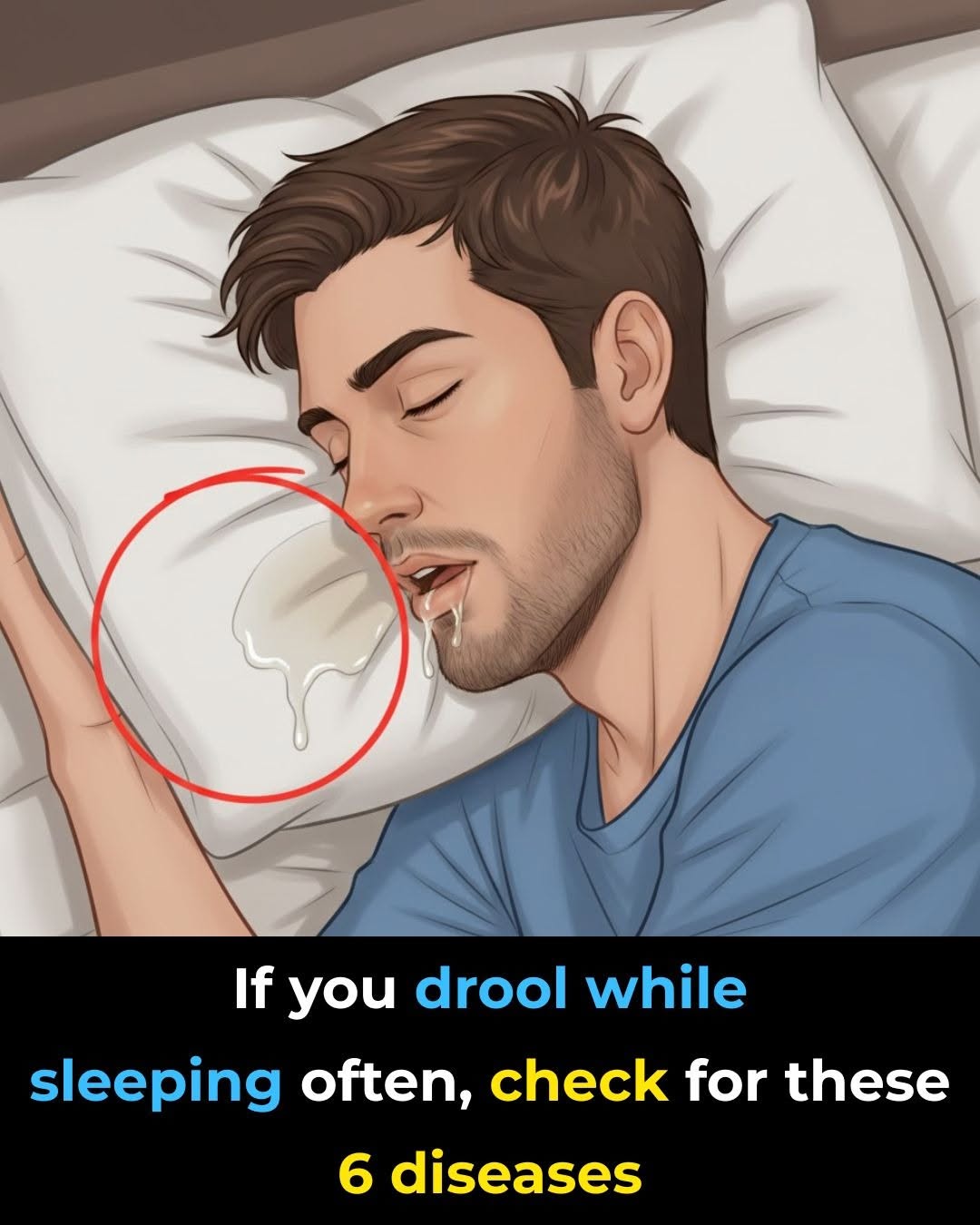
If You Drool While Sleeping Often, Check for These 6 Serious Conditions sounds alarming, but nighttime drooling does not automatically mean something serious is wrong. Many healthy adults occasionally wake with saliva on their pillow, especially when sleeping on their side or stomach. In fact, sleep position alone can make saliva more likely to escape from the mouth. (Cleveland Clinic)
However, new or excessive drooling can sometimes accompany conditions that affect swallowing, facial muscle control, breathing, or saliva production. Therefore, a sudden change deserves more attention than a lifelong tendency to occasionally drool during sleep.
The surrounding symptoms matter most. Drooling combined with sudden facial weakness, arm weakness, balance problems, or speech difficulty requires emergency attention because those symptoms can indicate a stroke. (www.stroke.org)
Meanwhile, persistent drooling alongside tremor, stiffness, swallowing difficulty, severe reflux, or ongoing nasal obstruction deserves a routine medical evaluation.
I once heard someone describe waking with a wet pillow as proof that circulation to the brain had become blocked. The claim sounded frightening, especially because it came with a dramatic story about a young person supposedly discovering an impending stroke. However, I could not find reliable evidence supporting that specific viral anecdote. More importantly, drooling alone cannot diagnose a blocked brain artery. Learning that distinction changed how I viewed symptoms shared online. A common symptom can occasionally appear alongside a serious condition, but context matters. Instead of panicking over the pillow, it makes more sense to look for new symptoms and meaningful changes.
Why Adults Drool During Sleep
Sometimes the Explanation Is Surprisingly Ordinary
Before exploring If You Drool While Sleeping Often, Check for These 6 Serious Conditions, it helps to understand why drooling happens in the first place.
Your salivary glands continually produce saliva. Normally, you swallow it without thinking about the process.
During sleep, however, swallowing happens less frequently. Your facial and jaw muscles also relax. Consequently, saliva can sometimes collect in the mouth and escape between the lips.
Sleep position matters considerably.
When you sleep on your back, gravity tends to keep saliva farther back inside the mouth. When you sleep on your side or stomach, gravity can make saliva more likely to reach the lips and pillow. Cleveland Clinic specifically identifies side and stomach sleeping as factors that can increase nighttime drooling. (Cleveland Clinic)
Nasal congestion can contribute as well.
When allergies, a cold, sinus problems, or another obstruction makes nasal breathing difficult, you may breathe through your mouth while sleeping. An open mouth naturally makes it easier for saliva to escape.
Therefore, occasional drooling does not justify assuming that you have a neurological disorder.
Look at your normal pattern.
If you have drooled occasionally for years, sleep on your side, and otherwise feel well, the explanation may remain simple.
However, a sudden change deserves a different approach.
For example, someone who has never drooled before but abruptly develops significant one-sided facial weakness needs medical attention.
Likewise, persistent drooling that appears alongside swallowing problems, new movement changes, or significant daytime symptoms warrants evaluation.
The symptom becomes useful only when you examine it in context.
When a New Pattern Deserves More Attention
If You Drool While Sleeping Often, Check for These 6 Serious Conditions should not encourage you to diagnose yourself from a pillowcase.
Instead, use a new pattern as a reason to notice what else has changed.
Ask yourself whether the drooling began suddenly or gradually.
Does it happen only while sleeping?
Have you developed trouble swallowing?
Do you cough or choke while eating?
Does one side of your face look weaker?
Have you noticed a tremor, stiffness, or slower movement?
Do you wake gasping or feel extremely sleepy during the day?
Have you developed persistent heartburn or sour-tasting fluid in your mouth?
These details can help a healthcare professional identify the underlying issue.
Drooling generally occurs because the body produces excess saliva, cannot keep saliva inside the mouth effectively, or has difficulty swallowing it normally. Neurological conditions, infections, reflux, allergies, and some medications can all contribute. (Cleveland Clinic)
Therefore, the symptom does not point toward one disease.
That fact also explains why viral claims about one-sided drooling predicting “blocked blood vessels” oversimplify the issue.
Stroke can cause facial weakness and swallowing problems that may contribute to drooling. However, ordinary sleep drooling by itself does not establish that someone has a stroke or impending stroke.
The difference lies in sudden neurological changes.
If face drooping, arm weakness, speech difficulty, vision changes, or sudden balance loss appears, treat those symptoms as an emergency. (www.stroke.org)
Six Conditions That Can Sometimes Cause Excessive Drooling
1. Oral Problems and 2. Facial Nerve Palsy
The first possibility behind If You Drool While Sleeping Often, Check for These 6 Serious Conditions involves problems in or around the mouth.
Inflammation and infections can increase salivation or make swallowing uncomfortable. Cleveland Clinic lists conditions such as tonsillitis, strep throat, sinus infections, and peritonsillar abscess among possible causes of excessive drooling. (Cleveland Clinic)
Dental and structural problems can also affect how effectively the lips close.
Therefore, persistent drooling accompanied by tooth pain, swollen gums, mouth sores, throat pain, fever, or other oral symptoms deserves appropriate dental or medical evaluation.
The second condition involves facial nerve weakness.
Bell’s palsy can cause sudden weakness or paralysis on one side of the face. A person may notice an uneven smile or difficulty fully closing one eye. Weakness around the mouth can also make saliva harder to control.
However, never assume that sudden facial drooping represents Bell’s palsy.
Stroke can also cause facial drooping, and stroke requires immediate emergency treatment.
If facial weakness appears alongside arm weakness, speech difficulty, balance loss, or vision changes, call emergency services immediately. The American Stroke Association recommends the B.E. F.A.S.T. approach: Balance, Eyes, Face, Arm, Speech, and Time to call emergency services. (www.stroke.org)
Even isolated new facial paralysis deserves prompt assessment so a clinician can distinguish possible causes.
When Bell’s palsy is diagnosed, corticosteroid treatment started within 72 hours can improve the likelihood of full recovery. Eye protection also becomes important if weakness prevents the eyelid from closing properly. (Right Decisions)
Therefore, new facial weakness deserves medical care rather than home diagnosis.
3. GERD and 4. Parkinson’s Disease
Gastroesophageal reflux disease, or GERD, represents the third possibility in If You Drool While Sleeping Often, Check for These 6 Serious Conditions.
GERD occurs when stomach contents repeatedly move upward into the esophagus.
Some people experience heartburn, while others notice a sour taste, throat irritation, coughing, or increased saliva.
A phenomenon sometimes called water brash involves increased saliva associated with reflux. Cleveland Clinic includes GERD among medical conditions that can contribute to excessive drooling. (Cleveland Clinic)
Therefore, someone who experiences nighttime drooling alongside frequent heartburn or regurgitation may want to discuss reflux with a healthcare professional.
The fourth condition is Parkinson’s disease.
Parkinson’s affects the nervous system and movement. Common movement symptoms include tremor, stiffness, and slowed movement. However, the condition can also cause non-movement symptoms, and drooling can occur. (Cleveland Clinic)
Importantly, people with Parkinson’s do not necessarily produce extraordinary amounts of saliva.
Problems with automatic swallowing and control of saliva can contribute to drooling.
Still, waking with saliva on your pillow does not mean you have Parkinson’s disease.
Doctors diagnose Parkinson’s by considering a broader pattern of neurological symptoms and examination findings.
Therefore, drooling becomes more relevant when it accompanies symptoms such as persistent tremor, stiffness, slower movement, changes in walking, or other neurological changes.
A healthcare professional can determine whether those symptoms require neurological evaluation.
Avoid using a single symptom to diagnose a progressive neurological disorder.
Nighttime drooling remains common enough that doing so would create unnecessary fear for many healthy people.
Conditions Involving Breathing, Swallowing, and the Brain
5. Sleep-Related Breathing Problems
The fifth possibility behind If You Drool While Sleeping Often, Check for These 6 Serious Conditions involves disrupted breathing during sleep.
People who cannot breathe comfortably through their nose may sleep with their mouth open.
Allergies, sinus inflammation, nasal obstruction, or enlarged tissues in the airway can contribute to mouth breathing. Cleveland Clinic lists allergies and swollen adenoids among conditions associated with drooling. (Cleveland Clinic)
Sleep apnea also deserves attention when drooling appears alongside other characteristic symptoms.
Obstructive sleep apnea causes repeated narrowing or blockage of the upper airway during sleep. Common clues can include loud snoring, witnessed breathing pauses, gasping during sleep, morning headaches, and significant daytime sleepiness.
Drooling alone cannot diagnose sleep apnea.
However, frequent mouth breathing combined with loud snoring and breathing interruptions should prompt a conversation with a healthcare professional.
Sleep apnea matters because untreated disease can affect sleep quality and broader health.
A clinician may recommend a sleep study when symptoms suggest the condition.
Treatment depends on the cause and severity.
Options can include positive airway pressure therapy, oral appliances, lifestyle changes, or other interventions.
The important point remains that treating the breathing problem makes more sense than simply trying to stop the saliva.
Likewise, chronic nasal congestion deserves attention.
If you cannot breathe comfortably through your nose for weeks or months, a clinician can investigate allergies, structural obstruction, chronic sinus problems, or other causes.
Improved nasal breathing may also reduce nighttime mouth opening for some people.
Therefore, think beyond the pillow.
The goal involves identifying what makes the mouth remain open or interferes with normal breathing during sleep.
6. Stroke or Other Neurological Swallowing Problems
The sixth and most urgent category in If You Drool While Sleeping Often, Check for These 6 Serious Conditions involves neurological problems that interfere with facial control or swallowing.
Stroke belongs in this category.
A stroke occurs when blood flow to part of the brain becomes blocked or when a blood vessel ruptures. Symptoms can include sudden facial drooping, arm weakness, speech difficulty, vision changes, or loss of balance. (www.stroke.org)
Stroke can also cause dysphagia, the medical term for swallowing difficulty.
People with dysphagia may drool, cough or choke while eating, feel food stuck in the throat, or retain food or liquid in the mouth after trying to swallow. (Cleveland Clinic)
However, this does not mean that isolated nighttime drooling predicts a stroke.
That distinction deserves emphasis.
If you wake with a wet pillow but have no sudden neurological symptoms, do not assume that a cerebral blood vessel has become blocked.
On the other hand, if drooling begins suddenly alongside an uneven smile, one-sided weakness, unusual speech, vision changes, or severe balance problems, seek emergency help immediately.
Do not go back to sleep to see whether the symptoms improve.
Do not wait for a routine appointment.
The American Stroke Association stresses that stroke is an emergency and that every minute matters. (www.stroke.org)
Even symptoms that disappear can represent a transient ischemic attack, or TIA, and still require emergency assessment. (www.stroke.org)
In this situation, the other neurological signs create the emergency—not the saliva stain itself.
What to Do About Frequent Nighttime Drooling
Start With Simple, Low-Risk Changes
If You Drool While Sleeping Often, Check for These 6 Serious Conditions may sound frightening, but most people should start by considering ordinary explanations.
First, look at your sleeping position.
If you sleep almost exclusively on your side or stomach, gravity may contribute. (Cleveland Clinic)
Next, consider nasal congestion.
If allergies or a temporary cold have forced you to breathe through your mouth, drooling may improve when the congestion resolves.
Pay attention to medications as well.
Certain medications can increase saliva production, so mention new prescriptions or dose changes when discussing persistent drooling with a healthcare professional. (Cleveland Clinic)
Good oral care also matters.
Brush and floss regularly, and schedule dental care when you experience gum inflammation, tooth problems, poorly fitting dental appliances, or other mouth concerns.
If reflux symptoms occur, avoid assuming that simply sleeping higher will solve everything. Instead, discuss frequent or persistent reflux with a healthcare professional, especially when swallowing becomes difficult or symptoms remain uncontrolled.
You can also keep a short symptom record.
Note when the drooling started.
Record whether it happens every night or only occasionally.
Mention snoring, choking, reflux, tremor, facial changes, swallowing difficulty, medications, and nasal congestion.
That information can make a medical appointment much more productive.
Most importantly, avoid trying to “dry up” saliva with random medications.
Saliva protects the mouth and helps with swallowing.
Treatment should address the reason for excessive drooling rather than simply suppressing normal saliva production without medical guidance.
Know When You Should Seek Medical Care
Persistent drooling deserves a routine medical appointment when it represents a new pattern, interferes with sleep, causes skin irritation, or accompanies other unexplained symptoms.
Seek evaluation sooner when swallowing becomes difficult.
Repeated coughing or choking during meals can indicate dysphagia. Because swallowing problems can allow food or liquid to enter the airway, untreated dysphagia can contribute to aspiration and pneumonia. (Cleveland Clinic)
New facial weakness also deserves prompt assessment.
Bell’s palsy can cause facial paralysis, but clinicians first need to consider other causes. When Bell’s palsy is confirmed, early corticosteroid treatment can improve recovery. (Right Decisions)
Finally, recognize the emergency signs of stroke.
Sudden balance loss, sudden vision changes, facial drooping, arm weakness, or speech difficulty require immediate emergency help. (www.stroke.org)
Do not wait for all symptoms to appear.
One warning sign can be enough to justify emergency action.
This distinction provides the most useful way to think about If You Drool While Sleeping Often, Check for These 6 Serious Conditions.
Ordinary drooling alone usually does not create an emergency.
A sudden neurological change does.
Understanding that difference helps you avoid two opposite mistakes: panicking over a harmless sleep habit or ignoring genuinely urgent warning signs.
Frequently Asked Questions
Is drooling while sleeping normal for adults?
Occasional sleep drooling can occur in healthy adults, particularly among people who sleep on their side or stomach. However, newly developed or excessive drooling may deserve evaluation when it accompanies other symptoms. (Cleveland Clinic)
Does drooling from one side of the mouth mean I am having a stroke?
Not by itself. Your sleeping position can determine which side saliva escapes from. However, sudden one-sided facial drooping or numbness, especially with arm weakness, speech difficulty, vision changes, or balance loss, can indicate stroke and requires emergency care. (www.stroke.org)
Can Parkinson’s disease cause drooling?
Yes. Drooling can occur in Parkinson’s disease, alongside symptoms such as tremor, stiffness, slowed movement, and other movement or non-movement changes. However, drooling alone does not diagnose Parkinson’s. (Cleveland Clinic)
Can acid reflux make me drool at night?
GERD can contribute to increased saliva and drooling in some people. If nighttime drooling accompanies frequent heartburn, regurgitation, or other reflux symptoms, discuss the pattern with a healthcare professional. (Cleveland Clinic)
When is nighttime drooling an emergency?
Drooling becomes particularly concerning when it begins with sudden neurological symptoms such as facial drooping, arm weakness, speech difficulty, vision changes, or balance loss. These can indicate stroke, which requires immediate emergency care. (www.stroke.org)
Conclusion
If You Drool While Sleeping Often, Check for These 6 Serious Conditions should serve as a reminder to notice changes, not as a reason to panic every time you find a wet spot on your pillow.
Occasional nighttime drooling remains common.
Your sleeping position, an open mouth, nasal congestion, and other everyday factors can explain many cases. (Cleveland Clinic)
However, persistent or newly developed drooling can sometimes accompany oral infections, facial nerve problems, GERD, Parkinson’s disease, sleep-related breathing problems, stroke, or other conditions that interfere with swallowing and muscle control.
The surrounding symptoms provide the most important clues.
If drooling develops gradually without emergency symptoms, schedule an appropriate medical or dental evaluation when it persists.
If you cough or choke while eating, have difficulty swallowing, or repeatedly feel food going down the wrong way, mention those symptoms promptly because swallowing disorders can increase aspiration risk. (Cleveland Clinic)
Most importantly, remember the stroke warning signs.
Sudden balance problems, vision changes, facial drooping, arm weakness, or speech difficulty require emergency action. (www.stroke.org)
Do not rely on viral anecdotes claiming that ordinary one-sided sleep drooling proves a cerebral blood vessel is blocked. Drooling alone cannot make that diagnosis.
Instead, pay attention to patterns.
Notice what changed.
Look for additional symptoms.
Then, choose the level of care that fits the complete picture.
That approach replaces unnecessary fear with something far more useful: knowing when an ordinary sleep habit can wait and when a sudden change means you should act quickly.