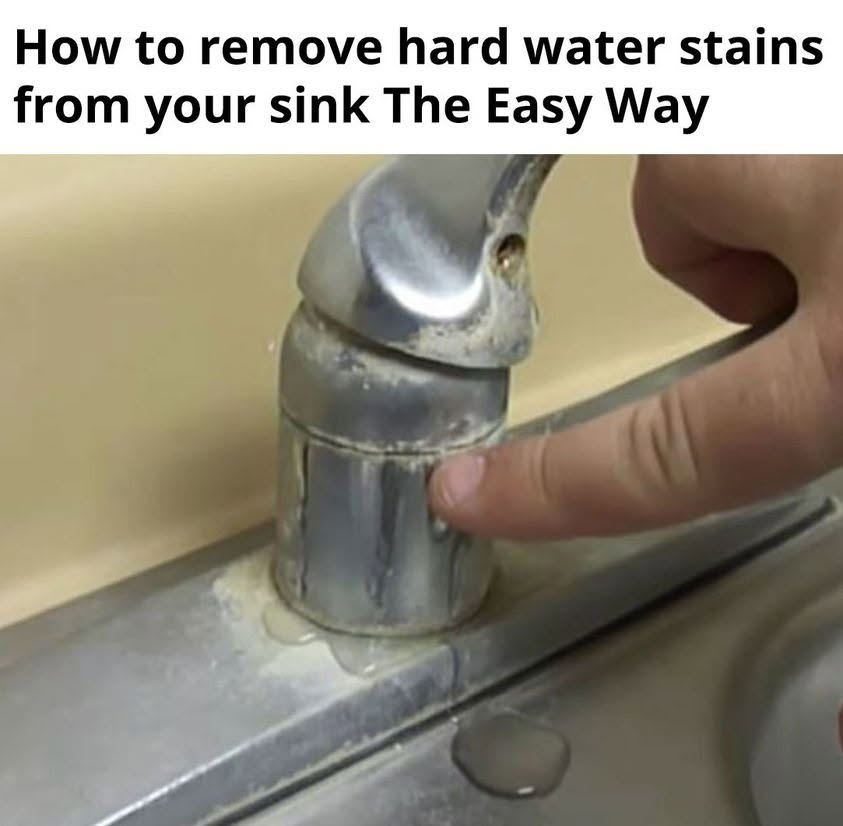
How to Clean Hard Water Stains From a Sink or Faucet becomes much easier once you understand that those cloudy white marks are usually mineral deposits, not ordinary dirt. Hard water leaves behind calcium, magnesium, and other dissolved minerals every time droplets dry on the surface. Over time, those deposits build into a dull film around faucets, handles, sink edges, and drain areas.
Regular soap often struggles with this type of residue because mineral scale needs a different approach. Distilled white vinegar can help because its mild acidity loosens many common hard water deposits. With enough contact time, a soft cloth, and gentle scrubbing, you can often restore shine without relying on strong commercial cleaners.
However, vinegar does not suit every surface. Natural stone, some specialty coatings, certain plated finishes, and damaged fixtures may react poorly to acids. Therefore, always check the manufacturer’s care instructions before applying vinegar widely.
The first time I tackled a heavily spotted faucet, I scrubbed it repeatedly with dish soap and wondered why the white haze barely changed. Eventually, I soaked a cloth in diluted white vinegar, wrapped it around the faucet, and left it in place for a short period. When I removed the cloth, the mineral film wiped away far more easily than before. The biggest lesson was simple: hard water stains need time, not aggressive scrubbing. Since then, I focus on loosening the deposits first and polishing second, which saves effort and helps protect the finish from unnecessary scratches.
Why How to Clean Hard Water Stains From a Sink or Faucet Works With Vinegar
Hard Water Stains Are Mineral Deposits
How to Clean Hard Water Stains From a Sink or Faucet starts with understanding what you are actually cleaning.
Hard water contains dissolved minerals, especially calcium and magnesium. When water evaporates from a sink or faucet, those minerals remain behind.
At first, the deposits may look like faint spots.
However, repeated splashing and drying creates thicker buildup. Eventually, the surface can look cloudy, chalky, or even crusted around seams and faucet bases.
That explains why ordinary wiping often disappoints.
Soap removes grease, food residue, and many everyday soils, but mineral scale behaves differently.
Vinegar helps because it contains acetic acid. The mild acid can react with and loosen certain mineral deposits, making them easier to wipe away.
Still, the process works best with patience.
If you spray vinegar onto heavy limescale and immediately wipe it off, the liquid may not have enough time to soften the deposits.
Instead, keeping the surface damp for several minutes allows better contact.
A soaked cloth works especially well because it holds the vinegar against vertical areas.
For example, you can wrap a vinegar-dampened microfiber cloth around the base of a chrome faucet where mineral rings often form.
Then, allow it to sit briefly.
Afterward, wipe gently and inspect the surface.
If some residue remains, repeat the process rather than scrubbing aggressively.
How to Clean Hard Water Stains From a Sink or Faucet becomes much easier when you let chemistry do most of the work before applying pressure.
Vinegar Is Useful, but Surface Compatibility Matters
Distilled white vinegar is inexpensive and convenient, but it is still acidic.
Therefore, How to Clean Hard Water Stains From a Sink or Faucet should always begin with the surface itself.
Chrome, many stainless steel finishes, glazed ceramic, and some porcelain surfaces often tolerate short contact with diluted white vinegar when used correctly.
However, natural stone can react badly.
Marble, limestone, travertine, and other calcium-based stone materials may etch when exposed to acid.
That damage can look like dullness or permanent marks.
Likewise, some decorative finishes, unlacquered metals, plated fixtures, and specialty coatings may discolor or degrade if you leave vinegar sitting too long.
Therefore, check the manufacturer’s instructions whenever possible.
If you cannot identify the finish, test a small hidden area first.
Apply a small amount of diluted vinegar.
Wait briefly.
Then, rinse and dry the area.
If the surface changes color, loses shine, or feels rougher, stop.
You can also begin with a milder solution rather than full-strength vinegar.
A mixture of equal parts white vinegar and water often provides enough acidity for light deposits.
For heavier scale on a compatible surface, full-strength distilled white vinegar may work better.
However, longer soaking does not always mean safer cleaning.
Once the deposit softens, remove the vinegar and rinse thoroughly.
That approach protects the fixture while still giving the acid enough time to work.
Step-by-Step: How to Clean Hard Water Stains From a Sink or Faucet
Soak the Mineral Buildup Before Scrubbing
How to Clean Hard Water Stains From a Sink or Faucet starts with a simple soaking step.
First, remove loose dirt from the area.
Wipe away crumbs, soap residue, hair, or surface debris with a damp cloth.
Then, prepare your vinegar.
For moderate buildup, use equal parts distilled white vinegar and water.
For stubborn deposits on a vinegar-safe surface, you can use undiluted distilled white vinegar.
Soak a microfiber cloth or soft cotton rag in the solution.
Wring it slightly so it remains wet without dripping everywhere.
Next, press or wrap the cloth directly against the mineral stains.
Around a faucet base, tuck the cloth tightly into the affected area.
For faucet handles, wrap small strips of cloth around each one.
For a sink edge, lay the damp fabric flat over the cloudy deposit.
Leave the cloth in place for about 10 to 20 minutes.
Check the surface periodically.
You do not need to leave vinegar sitting for hours on most fixtures.
Once the deposit looks softer, remove the cloth.
Then, wipe gently.
You may notice that the white crust comes away with surprisingly little effort.
If stubborn spots remain, apply another short soak.
How to Clean Hard Water Stains From a Sink or Faucet works better through repeated gentle treatments than one aggressive attack.
This approach reduces the risk of scratching polished finishes.
It also saves your arms from unnecessary scrubbing.
Finally, never heat vinegar until it becomes dangerously hot.
Warm liquid may act slightly faster, but room-temperature vinegar usually works well enough.
Scrub Gently, Rinse Well, and Dry Completely
After soaking, How to Clean Hard Water Stains From a Sink or Faucet moves into the scrubbing stage.
Use a soft sponge, microfiber cloth, or non-scratch pad.
Avoid steel wool.
Also, avoid the rough green side of a traditional kitchen scrub sponge on polished or plated fixtures unless the manufacturer specifically confirms that the surface can tolerate it.
That abrasive layer can scratch chrome, stainless steel, and decorative finishes.
Instead, begin with the softest tool that works.
Rub the softened mineral deposit using small circular motions.
Apply light pressure.
If the residue refuses to move, soak it again rather than pressing harder.
For narrow seams, use a soft toothbrush.
A toothbrush can reach around faucet bases, aerator edges, and tight corners without requiring a sharp tool.
Once the scale disappears, rinse the area thoroughly with clean water.
This step removes both loosened minerals and leftover vinegar.
Then, dry the entire surface with a clean microfiber cloth.
Drying matters more than many people realize.
If you rinse the faucet and let droplets evaporate naturally, fresh mineral spots may immediately start forming again.
Therefore, polishing the fixture dry helps preserve the result.
You should see a cleaner, brighter finish.
However, if permanent etching, corrosion, or finish damage already exists, cleaning cannot restore the missing coating.
How to Clean Hard Water Stains From a Sink or Faucet removes deposits.
It does not repair damaged metal or etched stone.
Knowing that difference helps you decide when cleaning is enough and when a fixture needs refinishing or replacement.
Cleaning Different Sink and Faucet Surfaces Safely
Chrome, Stainless Steel, and Porcelain
How to Clean Hard Water Stains From a Sink or Faucet depends partly on the material you are cleaning.
Chrome faucets often respond well to short vinegar treatments.
However, chrome plating can scratch easily.
Therefore, use a microfiber cloth and avoid abrasive powders.
Do not scrape with metal tools.
Stainless steel also requires gentle handling.
Always wipe with the grain when you can see a directional finish.
A vinegar solution can help with mineral spotting, but rinse thoroughly afterward.
Then, dry the stainless steel completely.
Water left behind creates more spotting.
Porcelain and glazed ceramic sinks often tolerate vinegar well, especially when the glaze remains intact.
However, avoid aggressive abrasive pads that can dull the surface.
For stubborn mineral rings around drains, place a vinegar-soaked cloth over the deposit and allow it to soften.
Then, wipe and rinse.
How to Clean Hard Water Stains From a Sink or Faucet becomes especially effective when you adapt the method rather than using one tool everywhere.
Chrome needs scratch protection.
Stainless steel benefits from grain-aware wiping.
Porcelain responds well to soaking.
In every case, avoid mixing vinegar with other cleaners.
Never combine vinegar with chlorine bleach.
That mixture can release dangerous chlorine gas.
Likewise, do not combine vinegar with random commercial products unless the label specifically states that the combination is safe.
Use one cleaner at a time.
Rinse thoroughly before switching methods.
That simple rule protects both you and the surface.
Stone, Specialty Finishes, and Coated Fixtures Need Extra Care
Not every sink or faucet should meet vinegar.
How to Clean Hard Water Stains From a Sink or Faucet becomes more cautious when natural stone enters the picture.
Marble, limestone, travertine, and similar stone contain minerals that react with acid.
Vinegar can etch the surface.
Once etching occurs, the area may look dull even after the mineral deposit disappears.
Therefore, skip vinegar on acid-sensitive stone.
Instead, use a stone-safe cleaner recommended for the exact material.
The same caution applies to specialty faucet finishes.
Brushed gold, oil-rubbed bronze, black matte coatings, unlacquered brass, and other decorative finishes may have specific cleaning requirements.
Some tolerate mild soap and water only.
Others can discolor after prolonged acid exposure.
Therefore, check the fixture manufacturer’s instructions first.
If you have no instructions, start with warm water and a soft cloth.
Then, test any stronger method on an inconspicuous spot.
How to Clean Hard Water Stains From a Sink or Faucet should never sacrifice the finish simply to remove temporary buildup.
Sometimes the safest solution involves repeated gentle cleaning with a manufacturer-approved product.
You may also discover that what looks like hard water is actually finish damage.
For example, pitting, corrosion, and permanent discoloration will not dissolve like mineral scale.
If you wipe the area after soaking and the roughness remains unchanged, stop scrubbing.
Excess pressure can make the problem worse.
At that point, a plumber, manufacturer, or surface-care professional may help identify the material and recommend an appropriate treatment.
Prevent Hard Water Stains From Coming Back
Dry Fixtures After Use
How to Clean Hard Water Stains From a Sink or Faucet becomes far easier when you prevent deposits from building in the first place.
The simplest habit involves drying the surface.
After using the sink, wipe the faucet and surrounding area with a small microfiber cloth.
This takes less than a minute.
However, it removes water before evaporation leaves minerals behind.
Pay special attention to the faucet base.
Water frequently pools there.
Likewise, wipe around handles and the drain edge.
Those areas collect repeated splashes throughout the day.
If you live in an area with very hard water, daily drying can dramatically slow visible buildup.
You can keep a dedicated cloth nearby.
Use it only for the sink.
Then, wash it regularly.
How to Clean Hard Water Stains From a Sink or Faucet also gets easier when you clean lightly and often.
Do not wait until white crust becomes thick enough to scrape.
A weekly wipe with a compatible mild cleaner can remove early mineral deposits before they harden.
For vinegar-safe surfaces, a light vinegar-and-water solution can work well.
Spray it onto the cloth rather than directly into seams or openings.
Then, wipe, rinse, and dry.
This routine limits the amount of acid sitting on the fixture.
It also prevents over-spraying nearby surfaces that may not tolerate vinegar.
Regular maintenance usually requires less product and less pressure than occasional deep cleaning.
As a result, the fixture stays shinier with less effort.
Check Aerators and Consider Your Water Hardness
Hard water does more than leave spots on visible surfaces.
Minerals can also accumulate inside faucet aerators.
The aerator is the small screened fitting at the end of many faucets.
Over time, mineral deposits can reduce flow or make the stream uneven.
If your faucet manual allows removal, unscrew the aerator carefully.
Keep track of the small parts inside.
Then, inspect the screen for mineral scale.
For vinegar-safe components, a brief soak may help loosen buildup.
Afterward, rinse thoroughly and reassemble the aerator exactly as it was.
Do not force parts together.
How to Clean Hard Water Stains From a Sink or Faucet can also lead to a larger question: how hard is your household water?
If nearly every fixture develops heavy scale quickly, your home may have high mineral content.
A basic water hardness test can provide useful information.
Hard water is not necessarily unsafe to drink.
However, it can contribute to scale inside plumbing fixtures, kettles, showerheads, and appliances.
Some homeowners choose a water-softening or conditioning system when buildup becomes severe.
That decision depends on water chemistry, household needs, plumbing, maintenance costs, and local conditions.
You do not need a water softener simply because you see a few spots.
However, understanding your water can explain why mineral deposits return quickly despite regular cleaning.
In the meantime, prevention still helps.
Dry surfaces.
Clean early.
Use compatible products.
And avoid aggressive abrasives.
These habits preserve the finish while keeping mineral buildup manageable.
Frequently Asked Questions
Can I use straight vinegar on a faucet?
You can use full-strength distilled white vinegar on many vinegar-safe fixtures for stubborn mineral deposits. However, check the manufacturer’s care instructions first. Avoid vinegar on acid-sensitive stone and finishes that specifically prohibit acidic cleaners.
How long should vinegar sit on hard water stains?
For many fixtures, 10 to 20 minutes provides enough contact time to soften mineral buildup. Check the surface during soaking and avoid unnecessarily long exposure, especially on plated or specialty finishes.
Will vinegar damage chrome?
Short contact with diluted or full-strength distilled white vinegar is often used on chrome, but prolonged exposure or abrasive scrubbing can damage some finishes. Test a hidden area first and rinse thoroughly after cleaning.
Can I use a green scrub sponge on hard water stains?
Avoid aggressive scrub pads on polished, chrome, plated, or decorative surfaces because they can scratch the finish. Start with microfiber, a soft sponge, or a non-scratch pad.
Why do the white stains keep coming back?
Hard water stains return when mineral-rich water repeatedly dries on the surface. Drying the faucet after use and cleaning light deposits regularly can slow buildup considerably.
Conclusion
How to Clean Hard Water Stains From a Sink or Faucet becomes much less frustrating when you stop treating mineral deposits like ordinary dirt.
Hard water leaves calcium, magnesium, and other minerals behind when droplets evaporate.
Those deposits gradually build into cloudy spots, white crust, and dull rings around faucets and sink edges.
Distilled white vinegar can help loosen that mineral scale on compatible surfaces.
Start by soaking a soft cloth in vinegar or a vinegar-and-water mixture.
Place it directly over the deposit.
Then, allow the vinegar to sit for a short period.
Once the buildup softens, wipe gently.
Use a soft toothbrush for seams and corners.
Rinse thoroughly.
Finally, dry the surface completely.
How to Clean Hard Water Stains From a Sink or Faucet works best when you avoid force.
If a stain does not disappear after one treatment, repeat the soak.
Do not immediately reach for steel wool, harsh scrapers, or aggressive abrasive pads.
Protecting the finish matters as much as removing the deposit.
Also, remember that vinegar does not belong on every surface.
Natural stone and certain decorative finishes can react badly to acid.
Therefore, always check care instructions before cleaning unfamiliar materials.
Once your sink or faucet looks clean again, prevention makes the biggest difference.
Wipe away water after use.
Clean small spots before they become heavy scale.
Check faucet aerators when flow becomes uneven.
And pay attention to how quickly mineral deposits return.
With a gentle routine, you can keep your fixtures looking brighter without spending hours scrubbing.
The best part is that most of the work comes from giving the mineral deposit enough time to loosen.
A little vinegar, a soft cloth, and a few minutes of patience can often do far more than hard scrubbing ever could.