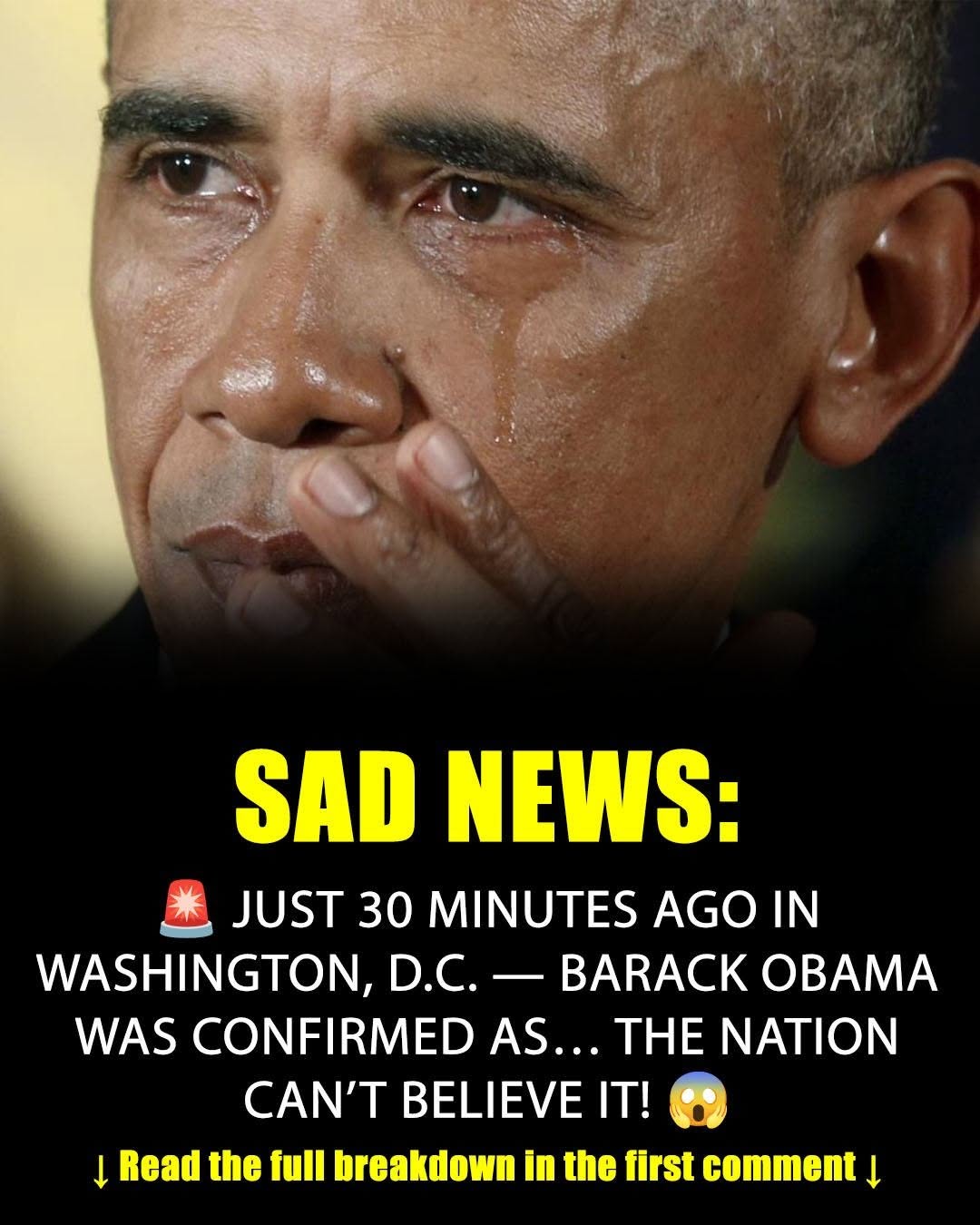
A Moment of Humanity can sometimes tell us more about political leadership than a perfectly polished speech. Barack Obama spent eight years speaking from podiums during wars, economic struggles, natural disasters, mass shootings, and moments of social upheaval. Yet some of his most remembered appearances were not defined only by policy. They were moments when grief visibly entered the room.
Obama’s public reactions after the Sandy Hook Elementary School shooting in 2012, the massacre at Emanuel African Methodist Episcopal Church in Charleston in 2015, and other acts of mass violence became part of his presidential legacy. Official White House records show him speaking about grief, faith, responsibility, and the human lives behind national tragedies. (whitehouse.gov)
However, some details that circulate online have become exaggerated with repetition. Obama did show visible emotion after Sandy Hook, and he later sang part of “Amazing Grace” during his eulogy for Reverend Clementa Pinckney. Yet there is not good evidence for every viral claim about him openly weeping at every tragedy he addressed. Accuracy matters because authentic moments do not need embellishment to remain powerful.
A Moment of Humanity is therefore worth examining carefully. The subject is not whether tears prove that one president was morally superior to another. Instead, it asks what happens when a political leader allows visible emotion to become part of a public response to collective grief.
I remember watching one of Obama’s speeches after a mass shooting and noticing the silence between his sentences more than the political language. The pauses made the event feel less distant. Instead of another headline scrolling across a screen, there were suddenly parents, children, congregations, and families behind the numbers. That memory stayed with me because it changed how I thought about public leadership. A president cannot personally remove a family’s grief, and no speech can undo violence. Still, the way a leader acknowledges suffering can influence whether people feel that their loss has been seen rather than reduced to another statistic.
A Moment of Humanity During America’s Darkest Days
Sandy Hook Revealed a President Struggling With Grief
A Moment of Humanity became unmistakable on December 14, 2012, after a gunman killed 20 children and six educators at Sandy Hook Elementary School in Newtown, Connecticut.
Obama addressed the nation from the White House that afternoon. Official photographs and video documented his visible emotion as he spoke about the victims and families. The White House also ordered flags lowered to half-staff. (whitehouse.gov)
Two days later, Obama traveled to Newtown for an interfaith prayer vigil.
His remarks focused on the 20 children and six adults who had died. Rather than treating the shooting only as a political problem, he spoke directly to a grieving community and acknowledged that words could not repair what families had lost. (whitehouse.gov)
That distinction matters.
Presidents regularly deliver official statements after disasters and attacks. However, the Sandy Hook response became particularly memorable because Obama appeared personally affected by the deaths of children.
Years later, he described December 14, 2012, as the darkest day of his presidency. That retrospective description reinforces how deeply the event remained associated with his time in office. (Barack Obama)
A Moment of Humanity does not mean ignoring the political debates that followed.
Obama advocated stronger gun restrictions, while opponents argued over constitutional rights, effectiveness, federal power, and the proper response to mass violence. Those debates remained deeply contested.
Nevertheless, people across political lines could recognize the human tragedy itself.
The emotional response did not settle policy disagreements.
Instead, it demonstrated another responsibility of presidential leadership: acknowledging national suffering when policy language alone feels inadequate.
That is part of why those images endured.
His Tears Became Visible Again During the Gun Debate
A Moment of Humanity appeared again in January 2016 when Obama announced executive actions intended to address gun violence.
During his White House remarks, he recalled the children killed at Sandy Hook. Official White House material documented him wiping away tears while discussing the victims. (whitehouse.gov)
The moment attracted enormous attention.
Supporters viewed the emotion as evidence that the human consequences of gun violence remained personally meaningful to him.
Critics of Obama’s policies, meanwhile, continued to question the substance and scope of his proposed measures. Some political opponents also reacted skeptically to the emotional presentation.
Both facts can exist together.
People can disagree sharply about a president’s policies while still acknowledging that a visible emotional reaction occurred.
That approach provides a more useful way to understand A Moment of Humanity.
Emotion should not replace scrutiny.
A tear does not prove that a policy works.
Likewise, a calm expression does not prove that a leader lacks compassion.
Political decisions should ultimately face evaluation through evidence, law, consequences, and democratic debate.
However, presidential communication serves another purpose too.
When tragedy affects a community, citizens often expect a president to recognize their suffering. That expectation does not require a leader to perform grief. Instead, it asks the leader to communicate that the people who died mattered beyond the statistics attached to the event.
Obama’s 2016 tears became memorable because they appeared connected to a tragedy that had already shaped his presidency for several years.
Therefore, A Moment of Humanity worked not as a substitute for policy but as part of the emotional context surrounding it.
Whether viewers supported his political response or opposed it, the scene showed how personal memory can enter even the most formal setting.
A Moment of Humanity in Charleston and Orlando
“Amazing Grace” Became an Unforgettable Charleston Moment
A Moment of Humanity took a different form after the June 2015 murders at Emanuel African Methodist Episcopal Church in Charleston, South Carolina.
Nine Black worshippers were killed during a Bible study in a racially motivated attack.
On June 26, Obama delivered the eulogy for Reverend Clementa Pinckney, a South Carolina state senator and pastor who died in the attack. The official White House transcript records a speech centered heavily on grace, racial history, faith, forgiveness, and justice. (whitehouse.gov)
Near the conclusion, Obama paused and began singing “Amazing Grace.”
The congregation joined him.
That moment became one of the defining images of his presidency.
Its impact came partly from context. Obama was not delivering remarks from the controlled environment of the White House. He stood in a church before mourners celebrating the life of a pastor murdered alongside members of his congregation.
A Moment of Humanity therefore became communal rather than solitary.
Obama started the hymn, but the room carried it.
The White House later continued to reference the Charleston community’s response through the language of grace and resilience. (whitehouse.gov)
However, the eulogy also contained political substance.
Obama discussed racism, gun violence, and persistent inequality. Consequently, reactions to the speech varied according to political and personal perspectives.
Some viewers considered it one of his strongest presidential addresses.
Others disagreed with the way he connected the tragedy to broader political issues.
Those disagreements form part of the historical record.
Still, the image of a president singing inside a grieving church endured because political speeches rarely become spontaneous communal hymns.
A Moment of Humanity does not erase controversy.
Instead, it explains why certain pieces of presidential communication survive long after the immediate policy argument moves elsewhere.
The Orlando Response Shows Why Details Must Stay Accurate
A Moment of Humanity also shaped Obama’s response to the Pulse nightclub shooting in Orlando in June 2016, when a gunman killed 49 people.
However, this example demonstrates why emotionally powerful stories still need careful fact-checking.
Some retellings say Obama openly wept while consoling victims’ families.
The official White House record confirms that Obama and Vice President Joe Biden traveled to Orlando and met privately with families. In his public remarks afterward, Obama described listening as relatives spoke through their own pain and tears about the people they had lost. (whitehouse.gov)
That source does not establish the stronger claim that Obama himself openly wept during those meetings.
Therefore, it is more accurate to say that he met grieving relatives, heard their stories, and spoke publicly about their loss.
That correction does not diminish the moment.
In fact, factual restraint makes accounts of A Moment of Humanity more credible.
A political figure does not need to cry publicly for an encounter to show empathy.
Sometimes listening provides the more important act.
Obama’s Orlando remarks recognized the victims as individuals with families, ambitions, relationships, and futures. He also addressed the attack’s impact on the LGBTQ community and the broader city.
Meanwhile, political disagreements followed immediately, particularly around gun laws, terrorism, national security, and the interpretation of the attack.
Again, empathy did not eliminate politics.
Presidents cannot step outside political conflict simply because tragedy occurs.
However, they can choose whether to begin with abstraction or with people.
A Moment of Humanity often emerges when leaders place the lives affected by an event before the arguments that inevitably follow it.
What A Moment of Humanity Reveals About Leadership
Emotional Leadership Can Build Connection Without Proving Policy
A Moment of Humanity raises an important question: should leaders display emotion?
There is no universal answer.
Some people find visible emotion reassuring because it demonstrates that a leader appears affected by the same events affecting the public.
Others prefer leaders who project control and emotional restraint, particularly during emergencies.
Neither preference automatically produces better leadership.
A president who cries can still make poor decisions.
A president who remains composed can still care deeply.
Therefore, emotional expression should never become a shortcut for judging competence or character.
Nevertheless, emotion plays a real role in public communication.
National leaders serve symbolic as well as administrative functions. They sign laws, appoint officials, direct executive agencies, conduct diplomacy, and make consequential decisions. Yet they also speak for the country during funerals, memorials, attacks, disasters, and historic celebrations.
Those symbolic moments help communities interpret events.
A Moment of Humanity can communicate that grief belongs in public life rather than remaining invisible behind statistics.
Obama frequently used family language when responding to tragedy.
After Sandy Hook, for example, he spoke not merely about victims but about children and parents. The official account of his Newtown vigil records his attempt to place himself alongside families in their grief rather than claiming that presidential words could heal them. (whitehouse.gov)
That communication style had political supporters and detractors.
Still, it illustrated a broader leadership principle: people often need recognition before they are ready for argument.
Acknowledging suffering does not settle what government should do next.
However, it can establish a human starting point for the conversation.
Vulnerability and Strength Are Not Opposites
A Moment of Humanity also challenges the idea that strong leaders must appear emotionally untouched.
For generations, political culture often rewarded a narrow version of strength: controlled expression, unwavering certainty, and visible toughness.
Yet leadership frequently requires something more complicated.
A leader may need to remain calm during an emergency while still communicating compassion.
They may need to comfort survivors while making decisions under pressure.
They may need to acknowledge uncertainty without creating panic.
Therefore, vulnerability and steadiness can coexist.
Obama’s most memorable emotional appearances often contained both.
During the Sandy Hook response, his voice and expression showed grief, yet he continued delivering the address.
During the Charleston eulogy, he discussed loss while also presenting an argument about grace and national responsibility. (whitehouse.gov)
A Moment of Humanity emerged precisely because emotion did not prevent him from performing the presidential role.
At the same time, political audiences should remain careful about romanticizing vulnerability.
Modern campaigns understand imagery.
Politicians know cameras are present.
Communications teams plan appearances.
Consequently, citizens should neither assume every visible emotion represents cynical theater nor treat every emotional moment as unquestionable proof of authenticity.
Both extremes oversimplify human behavior.
Sometimes public emotion may be spontaneous.
Sometimes speakers prepare deeply personal remarks in advance.
Frequently, both preparation and genuine feeling coexist.
A useful standard focuses less on guessing what existed inside someone’s mind and more on examining what we can actually observe.
What did the leader say?
What happened?
Did the description accurately reflect the victims?
Did subsequent actions match the values expressed?
Those questions make A Moment of Humanity a starting point for evaluating leadership rather than the final verdict.
A Moment of Humanity and Obama’s Continuing Public Legacy
His Current Role Is That of a Former President, Not a New Washington Officeholder
A Moment of Humanity remains relevant because images from Obama’s presidency continue circulating years after he left office in January 2017.
However, old photographs sometimes return online with misleading new captions.
As of August 17, 2026, Obama remains a former president rather than the holder of a newly confirmed federal role in Washington. Recent reporting instead describes his work through the Obama Presidential Center, leadership initiatives, media projects, public speaking, and other post-presidential activities. (The New Yorker)
The Obama Presidential Center officially opened in Chicago in June 2026. At the opening ceremony, Obama spoke about citizenship, democratic participation, and resisting political cynicism and division. (Reuters)
The event itself included another emotional moment.
Reuters reported that Michelle Obama’s tribute to her husband visibly brought him to tears. She praised aspects of his leadership while discussing the legacy represented by the new center. (Reuters)
That scene differs greatly from the tragedy-related moments of his presidency.
No national catastrophe surrounded it.
Instead, the emotion came during a milestone tied to family, public service, personal history, and legacy.
It nevertheless fits the broader theme of A Moment of Humanity.
Public figures spend years surrounded by ceremonies, cameras, criticism, praise, and carefully managed schedules.
Yet milestones can still become personal.
Obama has also expanded his media work. In August 2026, a six-episode podcast centered on books that shaped his thinking was announced for a September 24 debut through Audible and Higher Ground. (People.com)
His public role continues to evolve, but it remains a post-presidential one.
Why These Moments Continue to Resonate
A Moment of Humanity lasts because people remember emotion differently from statistics.
Most people cannot recite every policy proposal Obama offered after Sandy Hook.
Many cannot recall every sentence from his Charleston eulogy.
However, they may remember him wiping his eyes.
They may remember the opening words of a hymn.
They may remember the silence before he continued speaking.
Human memory often holds onto images and feelings after detailed information fades.
That reality gives political imagery enormous power.
It also creates responsibility.
Old photographs can acquire inaccurate captions.
Video can lose its original context.
A moment from 2012 can appear beside a headline written in 2026, making readers believe something new happened.
Therefore, A Moment of Humanity deserves both emotional openness and factual discipline.
Appreciating a moving scene does not require exaggerating it.
Nor does acknowledging Obama’s capacity for public empathy require agreement with his policies.
Political leadership remains multidimensional.
Supporters can recognize strengths while discussing failures.
Critics can oppose policies while acknowledging meaningful gestures.
That approach provides more room for thoughtful historical judgment.
Obama himself now occupies the unusual position shared by former presidents: his years in office have become history, while he remains active enough to influence contemporary culture and political conversation.
Consequently, interpretations of his legacy will continue changing.
Still, moments of presidential grief offer a specific lens through which to examine that legacy.
They remind us that institutions are occupied by human beings.
A Moment of Humanity becomes memorable when the title briefly falls away and the person carrying it appears.
Frequently Asked Questions
Did Barack Obama cry after the Sandy Hook shooting?
Yes. Obama showed visible emotion while responding to the December 14, 2012, Sandy Hook Elementary School shooting, and official White House imagery documented the moment. He later described that day as the darkest of his presidency. (whitehouse.gov)
Did Barack Obama really sing “Amazing Grace” in Charleston?
Yes. During his June 26, 2015, eulogy for Reverend Clementa Pinckney in Charleston, Obama began singing “Amazing Grace,” and the congregation joined him. The event appears in the official White House record of the eulogy. (whitehouse.gov)
Did Obama openly weep while meeting Pulse shooting families?
Available official records confirm that Obama met victims’ families in Orlando and described hearing them speak through pain and tears. However, those records do not substantiate the stronger viral claim that he openly wept during the meetings. (whitehouse.gov)
Does Barack Obama hold a new government position in Washington in 2026?
No verified current information shows Obama taking a new federal office in Washington as of August 17, 2026. His current public work includes the Obama Presidential Center, leadership initiatives, public appearances, and media projects. (Reuters)
Does showing emotion make someone a better political leader?
Not necessarily. Emotion can help a leader communicate empathy, but it does not prove good judgment, effective policy, or ethical leadership. Those qualities require separate evaluation based on actions, decisions, results, and democratic accountability.
Conclusion
A Moment of Humanity can appear unexpectedly in political life.
For Barack Obama, several such moments became lasting parts of his presidential image.
After Sandy Hook, the country saw a president visibly struggling with the deaths of children and educators. At the Newtown vigil, he spoke directly to families whose loss no presidential words could repair. (whitehouse.gov)
In Charleston, A Moment of Humanity took the form of a hymn.
Obama’s decision to begin singing “Amazing Grace” during Reverend Clementa Pinckney’s eulogy transformed a presidential address into a communal moment of mourning, faith, and reflection. (whitehouse.gov)
After the Pulse nightclub shooting, the public record shows another form of emotional leadership: listening to bereaved families and then describing the people they had lost. (whitehouse.gov)
These moments deserve accuracy.
Obama did not need to have cried at every tragedy for his responses to carry emotional meaning.
Likewise, appreciating his empathy does not require adopting his politics.
Presidential leadership should always face scrutiny beyond appearances. Policies matter. Results matter. Constitutional limits matter. Accountability matters.
Yet words and gestures matter too.
During national tragedy, citizens often look toward leaders not only for decisions but also for recognition that something terrible has happened to real human beings.
A Moment of Humanity does not solve grief.
It cannot bring back a child, repair a shattered family, or settle a national political argument.
However, it can acknowledge that public tragedy remains personal tragedy multiplied across many lives.
Years after Obama’s presidency ended, those moments continue circulating because they captured something politics sometimes hides behind podiums and titles.
Leaders are human.
So are the people whose names enter history because tragedy found them.
Remembering both truths may be one of the most valuable lessons these moments leave behind.