Human beings communicate in countless ways beyond spoken language. A smile can express warmth. A glance can reveal curiosity. A hug can provide comfort without a single word being spoken. Among the many subtle forms of nonverbal communication, one gesture has sparked curiosity, debate, and even mystery for generations: scratching or tracing another person’s palm.
You may have heard stories suggesting this gesture is a secret romantic signal. Others claim it represents comfort, affection, or even good luck. Social media videos and viral articles often portray palm-scratching as a hidden code known only to a select few.
But what does it really mean?
The truth is both simpler and more fascinating. The meaning of scratching someone’s palm depends heavily on context, relationship, culture, and intention. Understanding these factors can help us better appreciate the incredible complexity of human interaction.
Why Human Touch Matters
Before exploring the specific gesture, it helps to understand why touch itself is so powerful.
Humans are wired for connection. From infancy onward, touch plays a critical role in emotional development, bonding, communication, and trust.
Research has shown that healthy physical touch can:
- Reduce stress levels
- Lower blood pressure
- Increase feelings of safety
- Promote emotional bonding
- Release beneficial hormones such as oxytocin
- Improve overall well-being
A simple touch can communicate reassurance, affection, support, attraction, or empathy more effectively than words.
Because touch carries such emotional significance, even a small gesture like scratching a palm can feel meaningful.
Understanding the Palm’s Unique Sensitivity
The palms of our hands contain an extraordinary concentration of nerve endings.
These nerve receptors help us:
- Detect pressure
- Feel temperature changes
- Sense textures
- Perform delicate movements
- Communicate through touch
Because the palms are highly sensitive, even a gentle touch can create a strong sensory response.
This sensitivity is one reason why palm-related gestures often feel more intimate than touching less sensitive areas of the body.
A brief scratch or trace across the palm may seem insignificant to an observer, yet it can carry considerable emotional weight for the people involved.
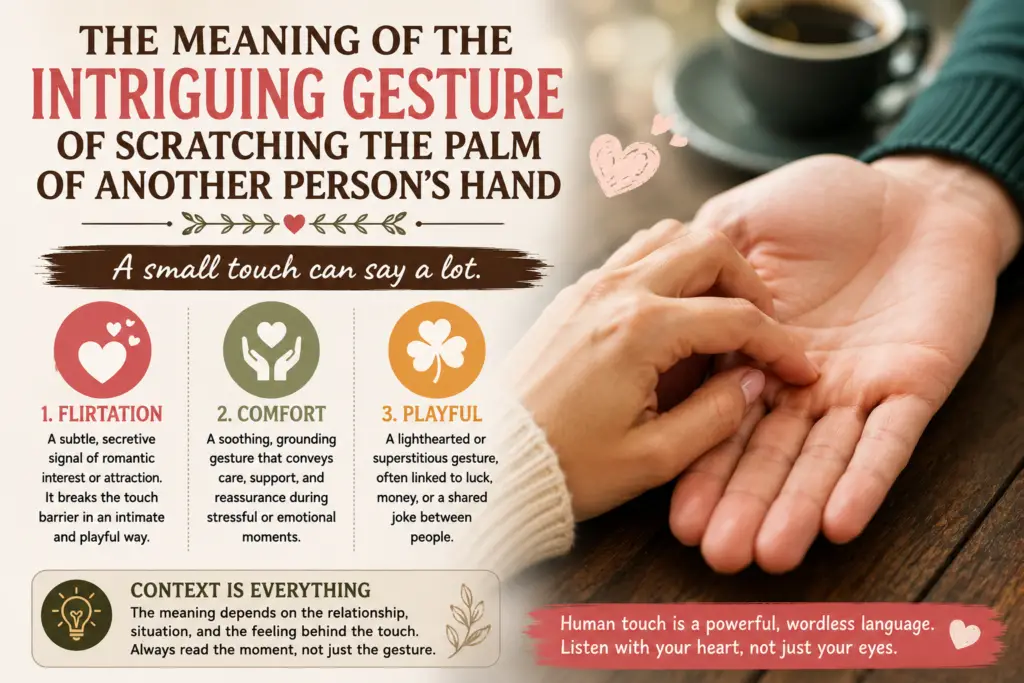
Meaning #1: A Sign of Romantic Interest
Perhaps the most commonly discussed interpretation involves flirtation.
In dating and relationship contexts, scratching or tracing someone’s palm is often viewed as a subtle romantic signal.
Why It Feels Intimate
Holding hands already creates a physical connection.
When one person deliberately traces, rubs, or scratches the other person’s palm, they move beyond casual touch into a more focused and personal interaction.
Because the gesture is discreet, it can feel like a private message shared between two people.
Many individuals interpret it as:
- Attraction
- Romantic interest
- Desire for deeper connection
- Playful teasing
- Invitation for closer intimacy
Common Situations
This interpretation is most likely when:
- The individuals are on a date
- Eye contact accompanies the gesture
- The interaction occurs in a private setting
- Other flirtatious behaviors are present
- The touch feels intentional rather than accidental
In these situations, the palm scratch may function as a silent expression of interest.
Meaning #2: Comfort and Reassurance
Not every palm scratch carries romantic meaning.
Sometimes it is simply an act of comfort.
The Psychology of Soothing Touch
When people experience anxiety, sadness, fear, or emotional distress, physical touch can provide reassurance.
A loved one may unconsciously:
- Rub a hand
- Stroke a palm
- Hold fingers gently
- Trace circles on the skin
These actions often occur naturally without conscious thought.
The gesture communicates:
“I am here.”
“You are not alone.”
“Everything will be okay.”
Biological Benefits
Comforting touch triggers physiological changes in the body.
Studies suggest that gentle physical contact may:
- Reduce cortisol levels
- Increase oxytocin production
- Slow heart rate
- Promote feelings of calm
- Reduce anxiety
This explains why a parent may stroke a child’s hand during a difficult moment or why partners instinctively hold hands during stressful situations.
The palm becomes a powerful channel for emotional support.
Meaning #3: Affection Between Loved Ones
Many gestures become meaningful simply because they develop within a relationship.
Couples, family members, and close friends often create their own forms of nonverbal communication.
A palm scratch may become:
- A personal signal of affection
- A habit developed over time
- A private joke
- A reminder of emotional connection
In these cases, the gesture carries meaning because of shared history rather than universal symbolism.
What appears insignificant to outsiders may represent years of emotional closeness between two people.
Meaning #4: Playfulness and Humor
Sometimes a palm scratch means absolutely nothing serious at all.
Many cultures have traditions and superstitions involving itchy palms.
One common belief suggests:
- An itchy right palm means money is coming.
- An itchy left palm means money is leaving.
Friends and family members occasionally scratch someone’s palm jokingly as a playful reference to these beliefs.
The gesture becomes:
- Lighthearted
- Humorous
- Cultural
- Social
No deep psychological message is intended.
It’s simply part of shared folklore and tradition.
Cultural Interpretations Around the World
Gestures do not carry identical meanings everywhere.
Cultural norms influence how people interpret touch.
In some societies:
- Touch between strangers is uncommon.
- Physical contact is reserved for family.
- Certain gestures have specific symbolic meanings.
In other cultures:
- Frequent touching is normal.
- Friends regularly hold hands.
- Physical affection is openly expressed.
Because cultural differences exist, the meaning of palm scratching can vary significantly from one region to another.
This is why context always matters more than any universal rule.
The Medical Perspective
There is another interpretation that has nothing to do with emotions at all.
Healthcare professionals sometimes scratch or touch the palm during neurological examinations.
Why Doctors Do This
The palm contains nerves that help physicians assess sensory function.
Testing may evaluate:
- Nerve damage
- Sensory deficits
- Peripheral neuropathy
- Carpal tunnel syndrome
- Neurological disorders
During these examinations, scratching the palm serves a purely clinical purpose.
No symbolic meaning should be attached to the gesture in a medical setting.
Why People Search for Hidden Meanings
Humans naturally seek patterns.
We constantly attempt to interpret:
- Facial expressions
- Tone of voice
- Body language
- Social behaviors
This tendency helps us navigate relationships and understand others.
However, it can also lead us to assign meaning where none exists.
A palm scratch may sometimes be:
- Intentional
- Accidental
- Habitual
- Unconscious
Not every gesture is a secret code.
The challenge lies in considering the broader context rather than focusing solely on a single action.
How to Tell the Difference
If someone scratches your palm, ask yourself:
What Is Your Relationship?
A romantic partner, friend, family member, coworker, or stranger may all have different intentions.
What Else Is Happening?
Body language works in clusters.
Look for:
- Eye contact
- Facial expressions
- Tone of voice
- Physical proximity
- Overall behavior
Does It Feel Deliberate?
Intentional gestures often feel different from accidental contact.
Is It Consistent?
Repeated behavior usually carries more meaning than a one-time occurrence.
The answers often reveal more than the gesture itself.
The Role of Consent and Boundaries
While touch can communicate affection and care, personal boundaries remain important.
Everyone experiences touch differently.
What feels comforting to one person may feel uncomfortable to another.
Healthy relationships respect:
- Personal space
- Physical boundaries
- Emotional comfort
- Clear communication
If a gesture makes you uncomfortable, it is perfectly acceptable to:
- Move away
- Withdraw your hand
- Communicate your feelings
- Set clear boundaries
Respect always matters more than interpretation.
What Science Says About Touch and Connection
Researchers continue to explore how touch influences relationships.
Evidence suggests that healthy touch can:
- Strengthen romantic bonds
- Improve emotional resilience
- Increase relationship satisfaction
- Promote trust
- Enhance feelings of belonging
Touch serves as one of humanity’s oldest communication systems.
Long before language developed, physical contact helped people express safety, protection, and connection.
Palm scratching, when affectionate or supportive, may simply be another variation of this ancient form of communication.
Final Thoughts
The gesture of scratching another person’s palm may seem mysterious, but its meaning usually comes down to context.
In some situations, it can signal romantic interest.
In others, it represents comfort, affection, reassurance, or playful humor.
Sometimes it means nothing at all.
The true beauty of the gesture is not that it functions as a secret code. It is that it reminds us how deeply humans communicate beyond words.
A touch can express attraction.
A touch can offer comfort.
A touch can create connection.
And sometimes, a simple scratch across the palm can remind us that even the smallest gestures have the power to make us feel seen, understood, and cared for.
The next time you notice this intriguing gesture, pay attention not only to the movement itself but also to the relationship, setting, and emotion surrounding it.
Because the most meaningful messages are often not spoken aloud—they are felt.