Imagine arriving at your hotel after a long day of travel. You’ve finally reached your destination, checked in, picked up your room key, and made your way down a quiet hallway. You unlock the door, set down your luggage, and begin settling in.
Then you notice something strange.
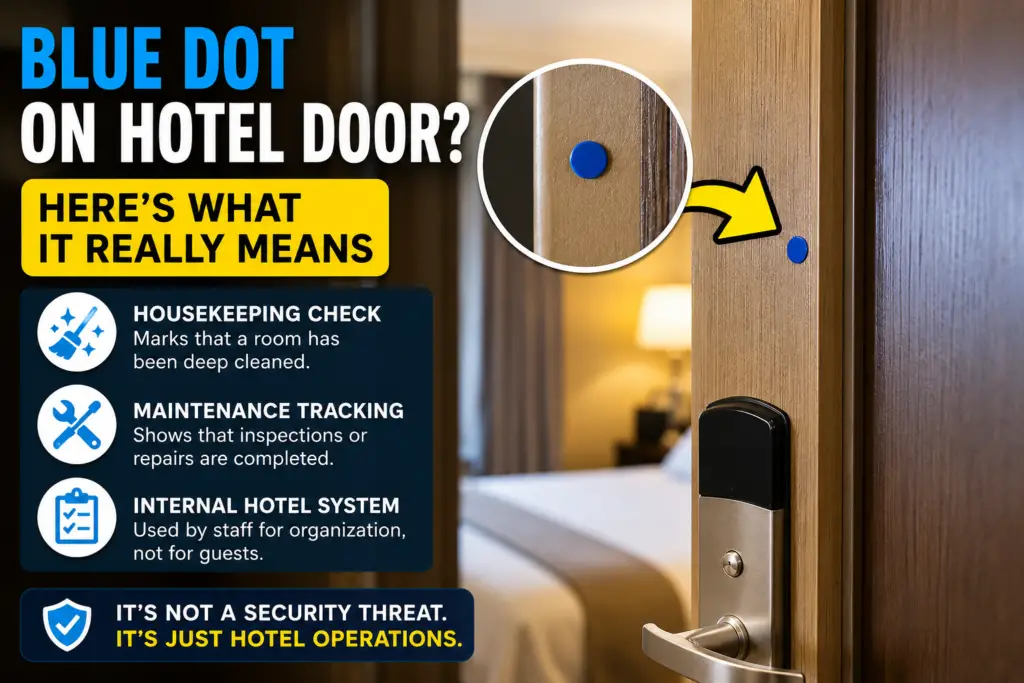
A tiny blue dot sticker attached to the door frame.
At first glance, it seems harmless. However, after spending a few minutes scrolling through social media, you suddenly discover dozens of alarming posts claiming that colored stickers on hotel doors are secret criminal codes, trafficking markers, or signs that someone is watching specific guests.
Panic starts to set in.
This exact scenario has become increasingly common in recent years as viral social media posts spread fear about seemingly innocent markings found in hotels, parking lots, shopping centers, and public spaces.
But what does a blue dot actually mean?
Should travelers be concerned?
Let’s separate fact from fiction and uncover the truth behind one of the internet’s most persistent hotel mysteries.
How the Blue Dot Hotel Rumor Started
The story usually begins the same way.
A traveler notices a small colored sticker somewhere near a hotel room door. They post a picture online asking if anyone knows what it means.
Within minutes, the comments section fills with speculation.
Some people claim it is a signal used by criminals.
Others insist it is a human trafficking marker.
A few commenters suggest it indicates an easy target for theft.
Before long, thousands of shares spread the story across social media platforms.
The problem is that most of these claims are based on rumors rather than evidence.
Law enforcement agencies across multiple countries have repeatedly stated that there is no verified evidence connecting colored hotel door stickers to organized criminal targeting systems.
Yet the rumor continues to circulate because it taps into a very human emotion: fear of the unknown.
When people encounter something unusual that lacks an immediate explanation, the mind naturally begins searching for possibilities.
Unfortunately, social media often fills that gap with the most dramatic explanation rather than the most likely one.
The Real Explanation: Hotel Operations
The truth is much less exciting.
In most cases, blue stickers, colored dots, labels, or small markings are simply tools used by hotel staff.
Hotels are complex operations.
Large properties may contain hundreds or even thousands of rooms that require constant maintenance, cleaning, inspections, repairs, and quality control checks.
Colored stickers provide a quick visual system for employees to communicate information.
Instead of carrying lengthy paperwork from room to room, staff members can use simple color codes to identify completed tasks.
Deep Cleaning Programs
One of the most common uses for colored dots is housekeeping verification.
Many hotels conduct periodic deep-cleaning procedures beyond daily housekeeping.
These may include:
- Carpet shampooing
- Mattress rotation
- Curtain cleaning
- Air filter replacement
- Furniture inspection
- Upholstery treatment
- Steam sanitation
A blue dot may simply indicate that a room has completed a specific cleaning cycle.
Maintenance Tracking
Hotel maintenance teams regularly inspect:
- Door locks
- Air conditioning systems
- Plumbing fixtures
- Smoke detectors
- Electrical outlets
- Emergency lighting
- Fire safety equipment
A sticker may indicate that an inspection has been completed successfully.
Renovation Projects
Hotels frequently undergo upgrades while remaining open to guests.
Colored stickers help contractors identify rooms that have already received:
- Fresh paint
- New carpeting
- Updated furniture
- Plumbing upgrades
- Technology installations
Sometimes these stickers remain in place long after the work is finished.
Inventory Management
Large hotel chains routinely perform inventory audits.
Employees may use colored labels to track:
- Room inspections
- Furniture counts
- Appliance replacements
- Equipment verification
In many cases, a sticker simply gets overlooked and remains attached long after its original purpose has ended.
Why Criminal Marker Theories Don’t Make Much Sense
When examining viral claims, it’s useful to apply basic logic.
Suppose criminals truly wanted to identify a specific hotel room.
Would they use a bright, visible sticker that:
- Hotel staff can immediately notice
- Security cameras can record
- Guests can easily remove
- Management can quickly investigate
Probably not.
Visible markers attract attention.
Criminals generally avoid actions that increase the likelihood of detection.
Security experts frequently point out that highly visible stickers would be an ineffective method for secretly tracking targets.
In fact, if a suspicious person wanted to identify a room discreetly, there would be far less noticeable methods available than placing a colorful sticker directly on the door.
This is one reason law enforcement agencies consistently dismiss these theories.
Why Social Media Loves These Stories
The blue dot mystery survives because it perfectly exploits several psychological tendencies.
Curiosity
Humans are naturally curious.
When we encounter something unexplained, we want answers.
A mysterious sticker creates an unanswered question that people feel compelled to solve.
Fear
Fear spreads faster than reassurance.
A post claiming “This sticker means housekeeping completed maintenance” receives little attention.
A post claiming “This sticker means criminals are watching you” receives thousands of shares.
Pattern Recognition
The human brain evolved to recognize patterns.
This ability helped our ancestors survive.
However, it also causes us to connect unrelated events.
Sometimes we see meaningful patterns where none actually exist.
The Viral Formula
The typical viral hotel sticker post contains all the ingredients necessary for widespread sharing:
- Mystery
- Fear
- Uncertainty
- Personal safety concerns
- Emotional reactions
Together, these elements create highly shareable content.
Hotel Safety Tips That Actually Matter
Rather than worrying about blue stickers, travelers should focus on proven safety practices.
These habits provide real protection regardless of where you’re staying.
Check the Door Lock Immediately
After entering your room:
- Test the deadbolt
- Check the security latch
- Verify the lock functions properly
- Ensure the door closes securely
A functioning lock is far more important than any sticker.
Locate Emergency Exits
Take a moment to identify:
- Nearest stairwells
- Emergency exits
- Fire escape routes
- Evacuation maps
Knowing your exit path can save valuable time during emergencies.
Verify Unexpected Visitors
If someone knocks claiming to be hotel staff:
- Keep the door closed
- Use the peephole
- Call the front desk
- Confirm their identity
Never rely solely on uniforms or verbal claims.
Use Additional Security Devices
Many travelers carry:
- Portable door locks
- Door wedges
- Travel alarms
- Security bars
These inexpensive tools add another layer of protection.
Keep Valuables Secure
Whenever possible:
- Use the room safe
- Lock electronics when leaving
- Avoid displaying expensive items
- Keep important documents secured
Stay Aware
Situational awareness remains one of the most effective safety tools available.
Pay attention to:
- Unusual activity
- Suspicious behavior
- Poorly lit areas
- Security concerns
Trust your instincts if something genuinely feels wrong.
When Should You Be Concerned?
Most blue dots are harmless.
However, if you ever encounter something that genuinely makes you uncomfortable, take action.
Examples include:
- Signs of forced entry
- Damaged locks
- Hidden cameras
- Unusual devices attached to doors
- Evidence of tampering
In these situations:
- Document the issue.
- Notify hotel management.
- Request a room change if necessary.
- Contact local authorities if appropriate.
There is nothing wrong with being cautious.
The key is responding to verified concerns rather than internet rumors.
What Hotel Employees Say
Many hospitality workers have commented online about these viral blue-dot stories.
Their explanations are remarkably consistent.
Most report that colored stickers are commonly used for:
- Housekeeping schedules
- Maintenance inspections
- Renovation tracking
- Internal quality-control systems
Some employees admit they are often surprised by how much attention these tiny stickers receive online.
To staff members, they’re simply part of everyday hotel operations.
To guests, they sometimes become internet mysteries.
Travel Anxiety in the Digital Age
One reason these stories resonate so strongly is that modern travel already creates anxiety for many people.
Travelers worry about:
- Lost luggage
- Flight delays
- Identity theft
- Hotel safety
- Unfamiliar environments
When social media introduces a mysterious blue sticker into the equation, those existing anxieties can quickly escalate.
Unfortunately, constant exposure to alarming online content can create the impression that danger is everywhere.
In reality, most hotel stays occur without incident.
Millions of people safely check into hotels every day around the world.
What To Do If You Find a Blue Sticker
If you notice a blue dot on your hotel room door:
Stay Calm
The overwhelming likelihood is that the sticker is harmless.
Take a Photo
If you’re curious, snap a picture.
Ask the Front Desk
Hotel employees can usually explain the sticker immediately.
Remove It If Allowed
If it bothers you, staff will often remove it.
Focus on Real Safety Measures
Check your lock, secure your valuables, and enjoy your trip.
Those actions will do far more for your safety than worrying about a small sticker.
The Bottom Line
The internet has transformed tiny mysteries into viral sensations.
A small blue sticker on a hotel door may seem suspicious at first, especially after reading dramatic social media posts.
However, the evidence overwhelmingly points toward ordinary hotel operations rather than criminal activity.
Most blue dots serve practical housekeeping, maintenance, inspection, or inventory purposes.
They are not secret warnings.
They are not trafficking markers.
They are not coded criminal messages.
They’re simply part of how many hotels manage hundreds of rooms efficiently.
The next time you check into a hotel and notice a tiny blue sticker, there’s no need to panic.
Take a deep breath, verify your room’s security features, and enjoy your stay.
Sometimes the most mysterious things have the simplest explanations.
And in the case of the famous hotel blue dot, the truth is far less frightening than the internet would have you believe.