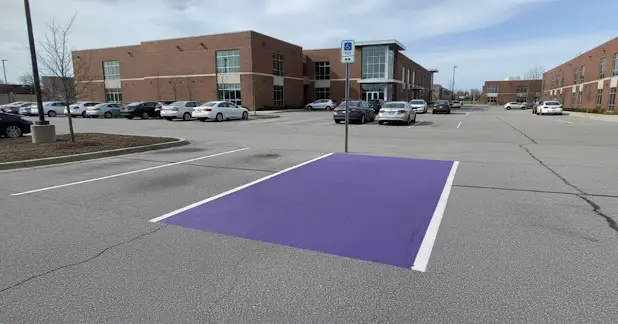
Most drivers are familiar with the colors and symbols that mark parking spaces. Blue spaces indicate accessible parking, red zones often signal fire lanes, and yellow markings may designate loading areas. But every now and then, people encounter something unexpected: a bright purple parking space located near the entrance of a store, hospital, university, government building, or community center.
At first glance, the meaning isn’t always obvious.
There may be no wheelchair symbol. No loading zone notice. No reserved employee sign. Just a striking purple rectangle painted on the pavement and a sign that seems different from anything most people have seen before.
Yet behind that simple color lies a powerful story of courage, sacrifice, service, and gratitude.
Purple parking spaces are reserved for recipients of the Purple Heart, one of the most respected military decorations awarded by the United States. While the space itself may seem small, the meaning behind it is enormous.
Understanding these spaces helps us better appreciate the men and women who have sacrificed in service to their country and reminds us that honoring veterans can happen through everyday acts of respect.
What Is a Purple Parking Space?
A purple parking space is a designated parking spot reserved for military veterans who have received the Purple Heart Medal.
These spaces are usually marked with:
- Bright purple paint
- White border markings
- Signs displaying the Purple Heart Medal
- Wording such as “Purple Heart Recipient Parking”
- Military appreciation messages
They are commonly located close to building entrances, making them convenient and accessible for eligible veterans.
Many businesses, government agencies, hospitals, colleges, and civic organizations voluntarily establish these spaces as a visible way to honor those who have been wounded or killed in military service.
Unlike standard parking spaces, these spots serve both a practical purpose and a symbolic one.
They provide convenience while also serving as a public acknowledgment of sacrifice.
The History Behind the Purple Heart
To understand the significance of these parking spaces, it’s important to understand the history of the Purple Heart itself.
The roots of the award stretch back more than two centuries.
George Washington’s Original Vision
In 1782, during the American Revolutionary War, General George Washington created an award known as the “Badge of Military Merit.”
This recognition was unique because it honored ordinary soldiers rather than officers.
At the time, military awards were generally reserved for high-ranking leaders.
Washington believed bravery and sacrifice deserved recognition regardless of rank.
The original badge featured a purple cloth heart, establishing a tradition that continues today.
Revival of the Award
On February 22, 1932, the 200th anniversary of George Washington’s birth, the United States officially revived the decoration under a new name:
The Purple Heart.
Since then, it has become one of the nation’s most recognizable military honors.
Who Receives the Purple Heart?
The Purple Heart is awarded to military personnel who are:
- Wounded during combat
- Injured by enemy action
- Killed in action
- Killed as a result of combat-related injuries
Recipients may come from:
- U.S. Army
- U.S. Navy
- U.S. Marine Corps
- U.S. Air Force
- U.S. Coast Guard
- U.S. Space Force
Because the medal recognizes wounds received in combat, it represents an extraordinary level of sacrifice.
Why Purple?
The color purple was not chosen randomly.
Throughout history, purple has carried deep symbolic meaning.
Historical Importance
Purple was one of the rarest and most expensive colors in ancient civilizations.
It often represented:
- Nobility
- Honor
- Courage
- Prestige
- Leadership
Military Tradition
The original Badge of Military Merit used purple fabric, creating a direct connection between Washington’s award and the modern Purple Heart.
Visual Recognition
Purple is highly visible and distinctive.
When painted on a parking space, it immediately draws attention and encourages people to learn its meaning.
The color itself has become a powerful symbol of military sacrifice.
Why Purple Parking Spaces Matter
Some people may wonder why a parking space is important.
After all, it is only a small area of pavement.
Yet symbols matter.
Communities use symbols every day to communicate values and priorities.
Purple parking spaces accomplish several important goals.
Public Recognition
Many combat veterans live quiet lives after returning home.
Some never speak openly about their experiences.
A designated parking space provides public recognition without requiring veterans to tell their stories.
Practical Assistance
Combat injuries often have lifelong consequences.
Some Purple Heart recipients live with:
- Mobility challenges
- Chronic pain
- Prosthetic limbs
- Neurological injuries
- Respiratory conditions
Convenient parking can make everyday activities easier.
Community Education
Purple spaces spark curiosity.
People notice them.
Questions lead to conversations.
Those conversations help younger generations learn about military service and sacrifice.
Visible Gratitude
Many people want to support veterans but aren’t sure how.
Purple parking spaces offer a tangible expression of appreciation.
Are Purple Parking Spaces Required by Law?
One of the most common questions involves legality.
The answer depends on location.
There is currently no federal law requiring Purple Heart parking spaces nationwide.
Instead, implementation varies across states and municipalities.
State Legislation
Many states have enacted laws encouraging or requiring Purple Heart parking spaces at:
- Government buildings
- State facilities
- Public universities
- Veteran service centers
Local Programs
Cities and counties often create their own policies.
Some communities actively promote Purple Heart parking through local ordinances and veteran initiatives.
Private Property Participation
Businesses frequently establish purple spaces voluntarily.
Common locations include:
- Grocery stores
- Shopping centers
- Hospitals
- Pharmacies
- Restaurants
- Banks
These organizations often view the spaces as part of their commitment to supporting veterans.
Can Anyone Park There?
This question depends on local regulations.
In some jurisdictions, misuse may result in fines or penalties.
In others, enforcement relies primarily on community respect.
Regardless of legal requirements, the intent is clear:
These spaces exist for Purple Heart recipients.
Using them without eligibility may be legal in some locations, but many view it as disrespectful.
The purpose of the space is to honor individuals who have sacrificed in military service.
Choosing another parking spot is a simple gesture of appreciation.
How Communities Create Purple Parking Programs
Many purple parking initiatives begin with local citizens.
Veterans organizations often work with:
- City councils
- Business owners
- Community groups
- Schools
- Chambers of commerce
The process generally involves:
Research
Learning about local laws and existing programs.
Community Support
Gathering support from residents, veterans, and civic organizations.
Planning
Developing standards for:
- Paint colors
- Signage
- Location placement
- Maintenance
Installation
Painting spaces and installing signs.
Education
Helping the public understand the significance of the designation.
Many successful programs began with only a handful of dedicated volunteers.
The Impact on Veterans
For many recipients, the meaning extends far beyond convenience.
A Purple Heart recipient may spend years adapting to life after military service.
Visible recognition communicates a powerful message:
“We remember.”
Veterans frequently describe feeling:
- Appreciated
- Recognized
- Respected
- Valued
These feelings can strengthen connections between veterans and their communities.
Sometimes the smallest gestures have the greatest emotional impact.
Respecting Purple Parking Spaces
Showing respect for these spaces is simple.
Read the Signs
Always pay attention to posted information.
Leave the Space Available
If you are not a Purple Heart recipient, choose another parking spot when possible.
Educate Others
Many people simply don’t know what purple spaces mean.
Sharing information helps spread awareness.
Support Veteran Programs
Veterans organizations often sponsor community initiatives that benefit service members and their families.
Express Gratitude
A sincere thank-you can mean more than many people realize.
Frequently Asked Questions
Are Purple Heart recipients always disabled?
No.
Some recipients have visible injuries, while others have invisible wounds.
The award recognizes combat injuries, not disability status.
Do Purple Heart recipients need special license plates?
Requirements vary by state.
Some jurisdictions issue Purple Heart license plates or permits.
Others rely on documentation.
Can businesses create purple spaces on their own?
Yes.
Many private businesses voluntarily establish these spaces as a gesture of appreciation.
Why are the spaces usually near entrances?
Convenient access helps veterans who may experience mobility challenges or lingering effects from combat injuries.
Are Purple Heart parking spaces common?
They are becoming increasingly common as awareness grows across the United States.
A Small Space With a Powerful Meaning
Purple parking spaces occupy only a few square feet of pavement, but they represent something much larger.
They represent courage under fire.
They represent wounds endured in service to others.
They represent families who have sacrificed alongside service members.
Most importantly, they represent a promise that sacrifice will not be forgotten.
Every time someone notices a purple parking space and learns its meaning, that promise is strengthened.
Every time a community paints one, installs a sign, or chooses to respect the designation, it sends a message of gratitude.
The next time you see a purple parking space near the entrance of a store, hospital, school, or public building, take a moment to consider what it represents.
Behind that simple patch of purple paint is a story of service, resilience, and sacrifice.
And sometimes, honoring that story is as simple as choosing another parking spot.