
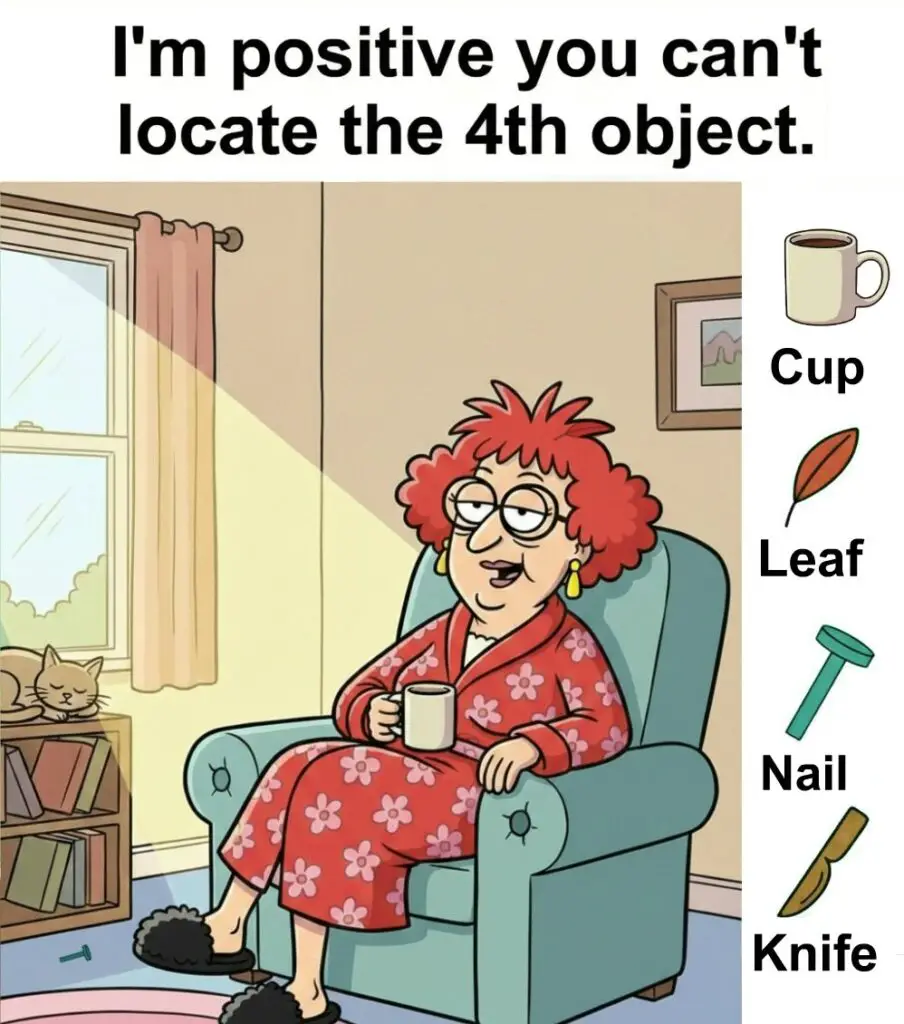
Have you ever stared at a visual puzzle for several minutes, convinced that one hidden object must be there, only to discover later that your brain was playing tricks on you the entire time?
If so, you’re not alone.
Many popular visual puzzles aren’t actually designed to test your eyesight. Instead, they reveal something far more fascinating: how your brain processes information, forms expectations, and interprets the world around you.
What makes these puzzles so engaging isn’t the hidden object itself—it’s the psychology behind the search. In fact, some of the most viral puzzles on the internet become popular precisely because they expose the surprising ways our minds can mislead us.
Let’s take a closer look at the science behind these brain teasers and discover why they are so difficult to resist.
Why Your Brain Automatically Searches for the Missing Object
Imagine a puzzle that asks you to find four items hidden in a picture:
- A cup
- A leaf
- A nail
- A knife
You quickly spot the cup, leaf, and nail. The knife, however, seems impossible to find.
At this point, something interesting happens.
Your brain assumes the knife must exist because the puzzle told you it does.
Rather than questioning the premise, your mind begins scanning every corner of the image looking for anything that remotely resembles a knife. Shadows, folds in fabric, edges of furniture, and random shapes suddenly start looking suspicious.
This is a classic example of expectation bias.
When people expect something to be present, they become far more likely to interpret ambiguous information as evidence supporting that expectation.
In other words, the puzzle isn’t challenging your vision—it’s challenging your assumptions.
The Power of Expectation Bias
Expectation bias occurs whenever prior information influences perception.
Your brain constantly makes predictions about what it expects to see, hear, or experience. Most of the time, these predictions help you navigate the world efficiently.
However, they can also cause mistakes.
In visual puzzles, expectation bias encourages you to continue searching long after you should have questioned whether the object exists at all.
This same phenomenon appears in everyday life:
- Assuming someone is angry because you expect conflict
- Interpreting neutral comments as criticism
- Seeing patterns where none actually exist
- Misremembering details that fit your expectations
Our brains are prediction machines, and puzzles take advantage of that tendency.
Pattern Recognition: Your Brain’s Superpower
Humans are exceptionally skilled at recognizing patterns.
This ability helped our ancestors survive by quickly identifying:
- Predators
- Food sources
- Familiar faces
- Environmental threats
Today, that same skill allows us to:
- Read handwriting
- Recognize friends in crowds
- Drive safely
- Understand complex visual information
The downside?
Sometimes we find patterns that aren’t really there.
When searching for a hidden object, your brain becomes eager to transform random shapes into recognizable items.
A wrinkle in a curtain suddenly resembles a knife blade.
A shadow begins to look like a handle.
A bookshelf edge starts appearing suspiciously object-like.
Your pattern-recognition system works so hard that it occasionally creates convincing illusions.
Confirmation Bias in Action
Another psychological factor at work is confirmation bias.
Confirmation bias occurs when people focus on information that supports what they already believe while ignoring contradictory evidence.
Imagine you think you’ve found the hidden knife.
Immediately, your brain starts gathering reasons why your guess is correct.
You may notice:
- A shape resembling a blade
- A line that looks like a handle
- Nearby details that strengthen the illusion
Meanwhile, evidence suggesting you’re mistaken receives much less attention.
This tendency affects far more than visual puzzles.
It influences:
- Political beliefs
- Consumer choices
- Social interactions
- Financial decisions
The same mental shortcut that makes puzzles difficult can sometimes make real-world decision-making challenging as well.
Pareidolia: Seeing Meaning in Random Shapes
Have you ever seen a face in the clouds?
A smiling expression on the front of a car?
An animal shape in a rock formation?
If so, you’ve experienced pareidolia.
Pareidolia is the brain’s tendency to perceive meaningful images in random patterns.
This explains why people often see:
- Faces in toast
- Animals in clouds
- Figures in tree bark
- Hidden objects in abstract images
Visual puzzles frequently rely on this tendency.
When told to search for a specific object, the brain begins transforming ordinary shapes into potential matches.
The object feels real because the perception feels real.
But perception and reality are not always the same thing.
Why These Puzzles Become So Popular
Visual puzzles spread rapidly online because they tap into several powerful psychological triggers.
Curiosity
Humans dislike uncertainty.
When a puzzle suggests a hidden answer exists, curiosity pushes us to keep searching.
Competition
People naturally compare themselves to others.
When friends claim they found the hidden object instantly, many feel compelled to try as well.
Challenge
Solving a puzzle creates a sense of accomplishment.
Even a small victory can feel rewarding.
Surprise
Many puzzles include unexpected twists that generate memorable “aha!” moments.
These moments encourage sharing and discussion.
Together, these factors create the perfect recipe for viral content.
The Hidden Cat Challenge and Time Pressure
Many puzzles add another layer of difficulty by introducing a countdown.
“Can you find the hidden cat in five seconds?”
This tactic changes how your brain processes information.
Under time pressure:
- Observation becomes less methodical
- Stress increases
- Pattern recognition speeds up
- Mistakes become more common
Instead of carefully analyzing the image, people rely on quick mental shortcuts.
Sometimes these shortcuts help.
Other times they lead directly to the wrong answer.
What These Puzzles Teach Us About Life
The most valuable lesson from visual puzzles has little to do with hidden objects.
These challenges remind us that perception is not always reality.
Our brains constantly:
- Filter information
- Fill in missing details
- Make assumptions
- Draw conclusions
Most of the time, these shortcuts help us function efficiently.
Occasionally, however, they cause us to overlook important information or believe things that aren’t true.
Learning to question assumptions can improve:
- Critical thinking
- Problem-solving
- Decision-making
- Communication
The next time a puzzle frustrates you, remember that the real challenge may not be finding the hidden object.
It may be recognizing how your own expectations influence what you see.
Final Thoughts
Visual puzzles are far more than simple games. They offer a fascinating glimpse into the remarkable—and sometimes misleading—ways the human mind works.
Expectation bias, confirmation bias, pattern recognition, and pareidolia all shape how we interpret the world around us. These mental processes help us navigate daily life, but they can also lead us astray when assumptions take control.
That is what makes these puzzles so compelling.
They remind us that seeing isn’t always believing.
Sometimes the greatest illusion isn’t hidden in the picture at all.
It’s hidden in the way our brains convince us that something must be there.